TrackMania DS
Can the DS handle it all?

On the journey to Glasgow to visit TrackMania DS's development team, Firebrand, I couldn't see how it was going to work. TrackMania - until now an exclusively PC game - is reliant on a couple of key features: speed and immediacy. The DS just didn't seem like it could be a natural home for this.
TrackMania is simple: racing physics-defying cars around the sort of courses an 11-year-old would build with an infinite supply of Hot Wheels tracks. But what makes it great is the instant restart. It's all about beating set times (or in the Platform levels, completing courses with limited restarts), and messing up on a single corner will likely lose you the Gold. So you hit a button, and with almost psychic speed you're back at the start, or most recent checkpoint. Were there to be even a second's pause, it would quickly become a frustrating exercise. That your car is reset before your finger is off the button means you'll never escape the just-one-more-go factor. But surely the DS can't do that, either?
Well, stand on your chairs and wave your arms, it can. It really flipping can. Unless Firebrand does something spectacularly stupid in the last couple of months of development, it's nailed this. My scepticism fell away like an oversized pair of trousers, leaving me feeling particularly embarrassed in my metaphorical boxer-shorts. First, it's fast. Second, despite being 3D on the DS, it doesn't look rubbish. And third, that instant restart is every bit as instant as the PC's.
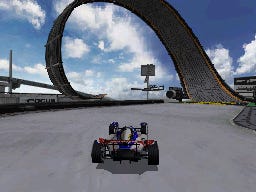
Firebrand is making a name for itself in the DS driving market (okay, partly thanks to no hint of competition so far), with the well-received Race Driver: Create & Race, and the very recently released (and even better-received) Race Driver: GRID. TrackMania DS uses the same engine - something Firebrand has honed and refined for this latest outing - but it very definitely feels part of TrackMania's family, rather than Race Driver's.
The approach taken for the visit to the Glaswegian offices was a smart one. On arrival, we were each given a DS with a cart of the game, and sat down to play it. Producers, coders and designers came in and out of the room, we asked them questions, chatted with them, but mostly played the game. Back from lunch, with no real agenda for the afternoon, everyone sat down, picked up their DS, and carried on playing. Occasionally we'd look up and acknowledge whoever was talking, but mostly we played the game. It's a strong indication it's a game that will work.
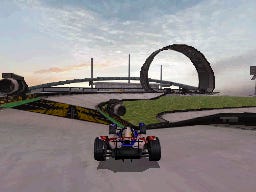
Why might it work? You'll be surprised how much is squeezed in there. There's three zones - Stadium, Desert and Rally - and each feels very similar to the PC's version. The only immediate difference was Rally's wonky old cars feeling slightly more forgiving through corners, but this is more than made up for by TMDS's much more treacherous tracks. There's five difficulty levels, and five completely original tracks in each, for all three zones (75 tracks, maths fans).
Then there's fifteen Platform tracks (where you have to complete the ludicrous course in as few restarts as possible), and fifteen Puzzles (which use the track creator and limited tiles to find a route from start to finish). And so, yes, there's a track creator, which uses the stylus to let you drag and drop, or 'paint' tracks on a 20x20 grid (the PC had 32x32, which proves too much for the DS), with room for creating 59 tracks of your own (but they intend to make it 60, because "59 is a stupid number"). There's a shop, for buying locked tracks, more building pieces and new skins for cars, bought with money won from play. And on top of this there's local Wi-Fi play for up to four players - more on that below.