Tony Hawk: RIDE Review

Thin ice.

Version tested: Xbox 360

And so the Battle for All the Money in the World rages on for games publishers. With Sony out of the running following a disastrously bold opening salvo (599 US dollars), Nintendo having let the nice mood cool and Microsoft still trying to convince us it's worth paying 15 quid a month for posh Freeview, here comes Activision Blizzard.

Once again the company appears to be pursuing a policy of exploiting established franchises every year across every platform. But that's just one strategy - others include hiking prices and bundling games with expensive plastic accessories.

Tony Hawk: RIDE must be Activision's idea of a weapon of mass destruction. It's an ancient franchise, it's available for every platform, it costs a hundred quid and it comes with a plastic skateboard. There's just one problem: it's rubbish.

This is not immediately apparent on opening the box. The skateboard is full-size, feels hefty and has a realistic rough surface which provides a firm grip. There are controller buttons along one edge and infrared sensors on each side. The bottom of the board is moulded so it stands flat on the floor but the sloping undersides allow you to tilt the board in different directions. Standing on it and wobbling about feels surprisingly natural, instinctive and realistic.

On booting up the game you're presented with a cut-scene starring Tony Hawk, who attempts to appear excited as he bangs on about "serious electronic wizardry". Calibrating the board is a straightforward process and the settings are stored so you only need to go through it the first time you boot up the game.
1

Fact: Tony Hawk appeared in Police Academy 4: Citizens on Patrol.

There are two single-player modes - Road Trip and Exhibition. The first of these is a basic career mode where you can play as Tony or one of his pro skater mates. Alternatively you can create your own character, choosing from a frightening array of preset avatars and trying to make them look less like paedophiles and strippers by selecting from a range of hideous clothes, faces and haircuts.

Then there are three difficulty modes to choose from. Pick Casual and all you have to worry about is pulling off tricks - the game will automatically steer your character around the courses. It's Tony Hawk on-rails, essentially. You can even see the rails illustrated as big yellow lines running through the environments. Every so often paths fork, as denoted by big yellow arrows, and you can select a direction by tilting the board. But for the most part you can just enjoy pulling off grinds, ollies and other tricks.

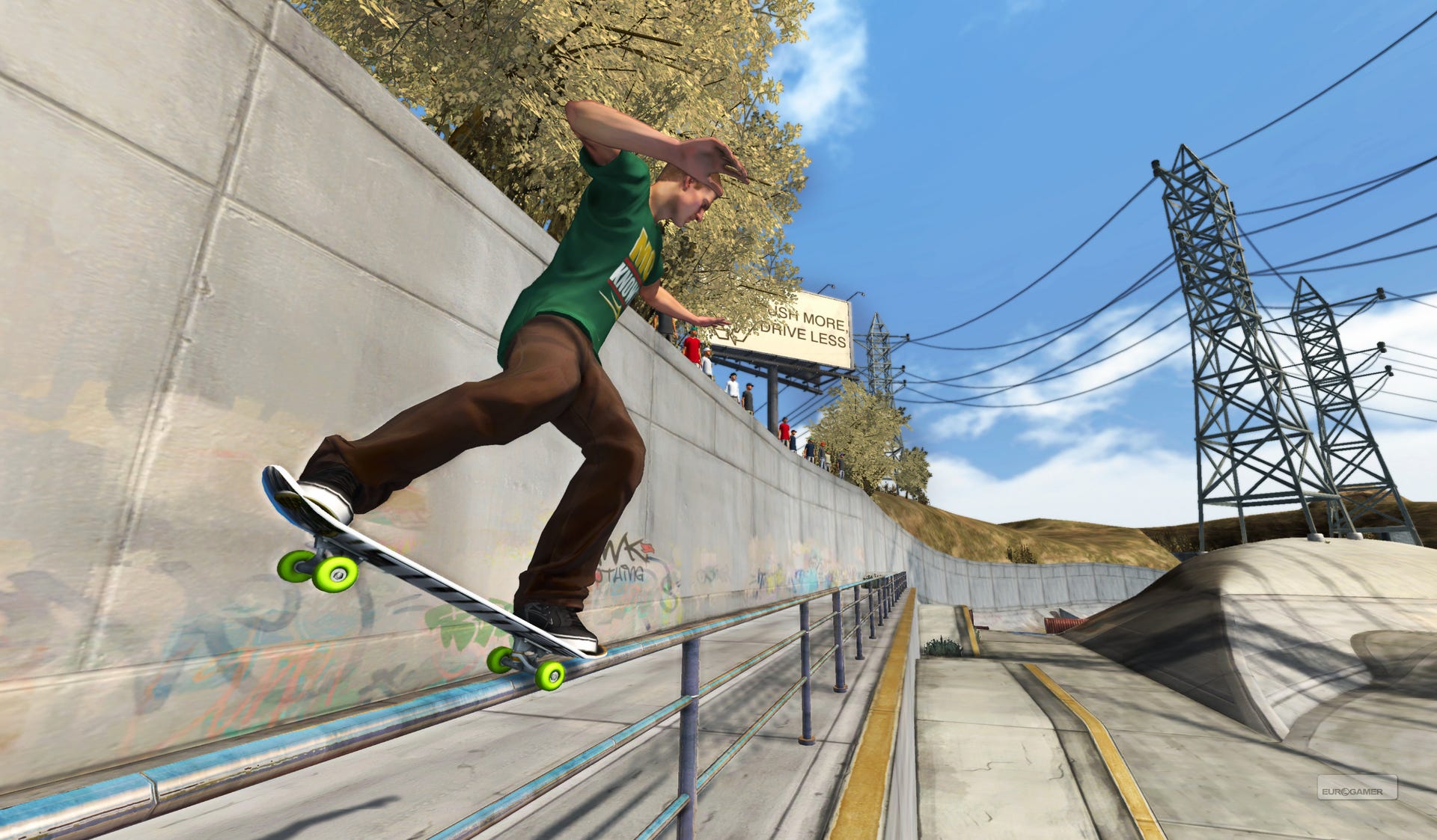
And enjoy it you will, for the first half-hour or so. It's fun to see what you can do as you cruise around the courses and it's easy to pull off tricks which look complicated and impressive. Indeed, it's so much fun you could almost ignore the horrendously dated graphics and dreadful presentation.

Almost, but not quite, because it's hard to ignore environments this sparse, ugly and poorly textured. You can't pretend your character's legs haven't just fallen through the scenery, leaving his head to poke through the concrete, the third time it happens. It's impossible not to laugh at the crash animations, which should be publicly exposed on a Channel 5 programme titled When Ragdoll Physics Attack. Characters flail, fall down and collapse pathetically, or go sailing into the air as if stuffed with feathers before crumpling against obstacles like soggy origami.

Plus, you can't help wondering why there are one or two pointless NPCs meandering round every level. They're not carrying skateboards or anything. They're just random characters - a woman in a bikini, a man wearing a rucksack - who enjoy strolling around skate parks and getting annoyed when they are nearly run over by skaters. They wait till the very last moment to jump out of your way, then look inexplicably surprised and shake their fists at you. Why don't they just go for a walk in a normal park? Still, it's good to know the characters from Crazy Taxi are still getting work.

It might have been possible to overlook all this if the gameplay was good enough to hook you into RIDE. And if it was 1999. But it isn't. The fundamental problem is that the skateboard peripheral, for all its sturdiness, doesn't work properly.

You'll realise this once the novelty of riding around on a plastic skateboard wears off and you start trying to do specific tricks. The game is incapable of registering your moves on the board consistently. Ollies and nollies are easy to pull off, once you get used to the slight lag, but that's about it. Tilt tricks are constantly registered as flick tricks and vice versa.

To perform more complex moves you'll need to watch the tedious, unhelpful instructional videos as there's no in-game help. The manual isn't any use at all - it doesn't even contain a list of the tricks you can do, let alone details of how to perform them.

Then there are those infrared sensors. They're supposed to register hand movements so you can perform grabs and finger flips. They actually do this once every twentieth attempt. If you're lucky. Even when the little indicator on the screen shows the sensor has registered your movement, nothing seems to happen in-game. In short, the sensors are pointless. Activision might as well have stuck on a set of old bottlecaps or some nice shiny beads.

2

Fact: That film is better than this game.

Despite the skateboard's failings it's easy to race through the first batch of Speed challenges on the Casual setting. You're on-rails anyway, so it's just a matter of performing ollies to pick up time bonuses and avoid penalties. It's also possible to win the initial Trick missions without any trouble - simply waggle away on the board with wild abandon to perform random tricks and rack up massive high scores.

The Challenge levels are more difficult as they require you to pull off specific moves, and those who aren't veteran skateboarders will have to go through the tutorial videos to find out what many of these are. The videos are of little use though, being so vague and limited you still often end up with no idea what the game wants you to do.

Even if you're familiar with skateboarding terminology you might struggle to work out the exact moves required. And regardless of your real-life skills, as you unlock new areas, and missions of all types get harder, the constant battle to make the game understand what you're trying to do becomes a serious problem.

All of the above applies in Casual mode - the easiest difficulty setting. Switch to Confident, where you also have to steer the board, and RIDE becomes almost unplayable. Once again the skateboard struggles to recognise commands, constantly confusing gentle and sharp turns. Simultaneously pulling off tricks and jumps while trying not to swerve wildly all over the place is a tall order. It does get easier with practice but it doesn't get any more fun.

There's also a Hardcore setting but it's difficult to tell what's different about this. "No nudges to help you and bails are more likely to happen," says the flimsy manual. There were nudges? More likely?

It's possible to ignore the speed, trick and challenge objectives and just cruise around in Free Skate mode. However, the levels are so confined and unimaginatively designed, and the control system so poor, that this is no fun at all. In this respect, RIDE takes a significant step back from the expansive playgrounds featured in some of the previous Tony Hawk games.

The other single-player mode, Exhibition, isn't worth looking twice at. You get to ride around all the same courses featured in Road Trip, except you don't have to meet point objectives and you don't get to unlock new gear. Why, then, would you bother?

Thank goodness the game features a fantastic array of engaging multiplayer modes hahaha of course not. There is one multiplayer mode. It is called Party Mode. You and up to seven other players take it in turns to have a go on the skateboard. "Battle for the highest score, the coolest combo and bragging rights!" says the manual. "Laugh at the graphics, the gameplay and other players' desperate attempts to make on-screen actions correspond with their movements!" says reality.

Once all your friends have gone home, half an hour after you boot up the game, you could try battling some other players online. Assuming there are any - RIDE has been out in the US for a couple of weeks now and yet it's a struggle to find anyone to play against. Besides, "Play against" is a bit strong. You'll see your opponents at the start of events, displayed as brightly coloured silhouettes (not actual character models, goodness no). But then either you or they will race off and you're unlikely to see them again for the rest of the course. There's no tension, you just wait for the scores to be posted up at the end. Again, why bother?

3

Red sky at night, shepherd would be better off throwing a hundred pounds in a bin.

Perhaps because you're a score whore who only cares about the numbers anyway. In which case, you should be aware it's awfully easy to cheat at RIDE. I discovered I could rack up huge points by sitting on the carpet and wiggling the board around with my hands. I beat one player by 10,000 points doing this. Sorry, IKILL4FUN.

The leaderboards suggest I'm not the only hustler on Live. The person currently in first place has more than twice the score of whoever's in second. He must have found a more innovative way of cheating - bouncing the board on a trampoline, maybe, or tying it to a monkey's back then making it dance by dangling a banana on a piece of string. Or perhaps he's actually Tony Hawk, which surely demands an instant ban.

But it's not just the limited online and multiplayer options which render RIDE worth approximately one-hundredth of the asking price. Nor is it the terrible visuals. Nor the dozens of irritating little things about the presentation, like the pathetically, hilariously, excruciatingly long load times. Or the fact you have to play through all the same old levels again to unlock them for different difficulty settings. Or the way you have to get off the board, pick up the controller and press "Start" every time you get a high score, just to move on to the next screen. There is a "Start" button on the skateboard, but it doesn't work on this particular screen. Obviously.

Or that in multiplayer you're referred to as "Player 1", "Player 2" and so on most of the time, even though you bothered to create a character and input your name. Or that there are only six locations "around the world" to unlock, three of which are in America. Or that Tony Hawk only appears in a couple of the videos, and most of the time you're greeted by 20-something Dilberts with interesting facial hair who say things like, "When it comes to street skating, it doesn't get much more realer than this."

It's also the fact that, having taken a hundred quid off you for this shuddering old mess, Activison attempts to cash in even further by smothering it in adverts. Menus aren't just menus, but mobile phone screens with giant T-Mobile icons. The backgrounds are collages of more brand logos than you thought could actually exist in the world. Environments are littered with branded posters, billboards and shopfronts. The Achievements have names like The T-Mobile Sidegrab 5.

Then there are the "Bonus Videos", which aren't really "Bonus Videos" at all but are mostly "Adverts" for brands like Quiksilver, Billabong, Vans etc. One video is labelled "Tony Hawk trick tip". It begins with Tony in a skateboard park. "The question I get asked most often is, 'How do you learn to skate? What are the basics?'" says Tony. "Well, I'm here to take you through them."

"Aha!" you think. The man himself is going to give us some real tips on real-life skating! Except the lesson ends there. The next shot is a still of the Tony Hawk Trick Tips Collectors' Edition DVD, accompanied by a link to the website where you can buy it.

4

It's no Jambo! Safari, that's for sure.

The endless advertising doesn't quite fit with the image of skateboarding as an edgy, underground urban sport, although you could argue that fell by the wayside years ago. Besides, companies have a right to make money from advertising. Eurogamer wouldn't exist without it. Activision is a business, not a charity.

And perhaps we're too cynical about the price. Maybe the board really did cost loads to develop and is jolly expensive to manufacture. It's just that's difficult to believe with regard to a company run by a man who has publicly stated he wants to "take all the fun out of making videogames", and who has established an employee incentive programme which "really rewards profit and nothing else". It's hard to imagine the next LittleBigPlanet, Fable or Professor Layton coming out of a company with that kind of philosophy.

Of course, not all games have to be fabulously whimsical or original. Nor should they be. Sometimes you just want to shoot a monster in the face, even if it's the same monster you shot in the face last year. And sometimes you want to muck about with a stupid peripheral, as evidenced by the success of Guitar Hero, SingStar and Wii Fit.

The difference is the peripherals which come with those games work, and the skateboard Activision wants a hundred quid for doesn't. It's fun for half an hour, but that's an awfully expensive 30 minutes. Don't buy RIDE unless you want to be taken for one.

4 / 10

Read the Eurogamer.net scoring policy

Comments (122)

Comments for this article are now closed, but please feel free to continue chatting on the forum!

  • Loading...hold tight!