E3: Tony Hawk: Ride Preview

Skater toy.

Activision has seen the future, and it's plastic. Ride, this year's Tony Hawk reboot, ditches traditional controller inputs in favour of a full-size mock skateboard, and if it sells, in the next few years you can probably expect the piles of fake guitars and drum-kits in your living room to be joined with fake sporting goods, the odd bit of fake weaponry, and possibly even fake kitchen equipment, if the publisher ever decides to follow Taito into Cooking Mama territory.

For every game, then, a bundle; for every franchise, a peripheral - when the time comes, you'll likely be able to store all this new clutter in a bespoke Activision wardrobe, which will double as a fake New York skyscraper for you to run up the side of when playing any future Prototype sequels.

In the case of Hawk, the skateboard's more than simply a cash-in on the company's surprisingly potent ability to ship bulky add-ons around the world in massive quantities. It's also a reaction to the success of EA's Skate, which emerged in 2007 to revitalise a genre that had gone slightly stale on Activision's watch. Tony Hawk games were never bad, but the yearly grind - accidental pun - was starting to show, and when EA Black Box came along with the devilishly effective Flickit system, which made brilliant use of analogue control sticks to simulate moving the skateboard around, it was time for Team Hawk to rethink a few of its assumptions about how to make a convincing skateboard game.
1

It's game number 10, by my wonky counting, and Hawk himself is ageing with grace, a slight greying of the temples giving him the air of a youthful senator.

The answer, then, is with a convincing skateboard. The peripheral's pretty decent, too, from the distant glimpse we've got of it so far. Made of sturdy plastic, it's full-size, more or less, with the absence of wheels making it look a little like a hoverboard (pro tip: don't try and use it near water). You manipulate the game much as expected, by placing the board flat on the ground, tilting to steer, spinning to turn, and flipping it up on one end for jumps. Far more than a flattened version of the Wii Remote (which nonetheless apparently formed the basis for the first prototypes) a range of infrared sensors mounted around the edge of the board can register hand placement, meaning you can pull off all kinds of grabs and tucks - or is that snowboarding? I forget - and even push yourself forward by skimming your foot along the floor.

Granted, from the brief display we witnessed, it didn't seem that the board was tremendously accurate at registering the inputs correctly at the moment, but that may be down to a slight delay in the image being projected on the screen behind the person demoing the game, early code, or even a glitchy prototype.

By this point, the one thing you can say about Activision with a certain degree of confidence is that the company knows its peripherals, so it's probably wise to give it the benefit of the doubt that its latest chunk of sexy plastic will do what you need it to when it finally arrives later this year. It's also probably wise to give it the benefit of the doubt because Activision's so staggeringly rich by this point, it could easily dispatch a team of killer robots to finish you off with gold-plated rocket grenades if it doesn't like your attitude.

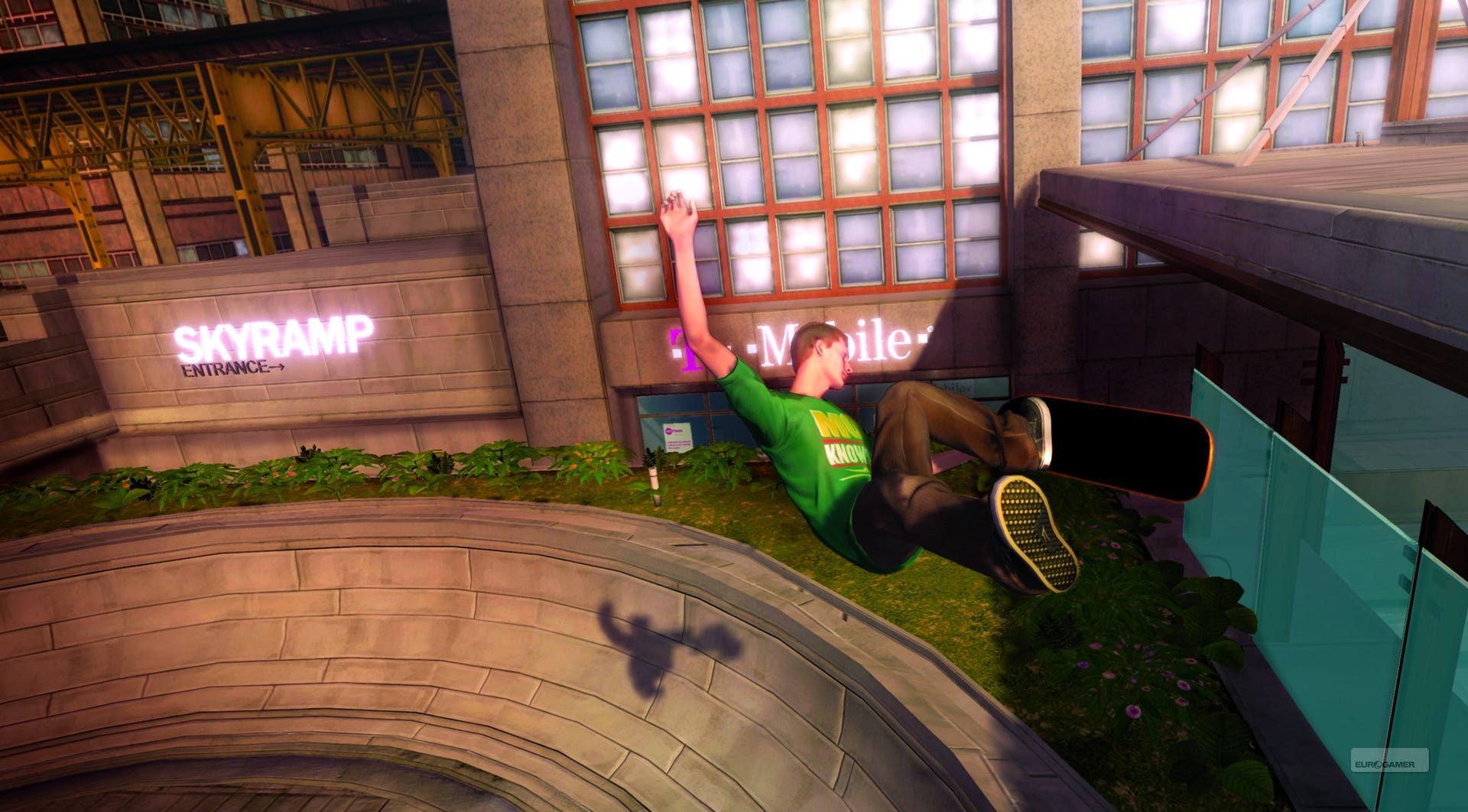
Understandably then, it was the peripheral that hogged most of the limelight at Ride's unveiling, while the game itself took something of a backseat. From what we've seen, however, Ride is visually a move towards slightly more cartoonish ground, employing - if not cel-shading - bolder, flatter textures, and chunky, stylised in-game models. Glowing trails erupt from arms and legs when skaters pull off something slick, and the HUD sprays a lot of highlighter pen neon over its furniture. Some will doubtless prefer the rumpled slacker realism of Skate, but, trundling over the sunny concrete of the LA Riverbed level, the latest Tony Hawk looks pleasantly summery.

Controls aside, it seems the new developer Robomodo isn't adding a great deal of new ideas to the core gameplay on this outing, however, its main focus lying in splitting the key elements up for the sake of accessibility, offering three types of event across every setting, with separate trick, speed, and challenge sessions available.

2

Flashy visual effects suggest that someone at Robomodo's been watching those iPod advertss.

All of them seem to make the most of some likeably freeform environments, and dialling the overall complexity back somewhat is probably a good idea, as, checking out footage of the board in action, even Hawk himself looks ever so slightly wobbly at times, suggesting that you're going to want to move your Henry Moore sculptures away from the TV for safety's sake, even before you start trying to chain tricks together.

Until we've stepped on the board ourselves, and seen a bit more of the actual game, it's hard to judge how many people lured away to EA's upstart will be tempted back to Tony Hawk this time. One thing's for certain, however: Ride's peripheral implies that sports videogames primarily aspire to the closest possible mimicry of the real-world activity. That may be largely correct, but in the process, such an assumption possibly shuts out those who were drawn to previous skating games predominantly because of the ability to master a clever and satisfying controller layout.

To put it another way, what if you like skating games more than you like the idea of actual skating? What if you just like pressing buttons and lounging on the sofa within easy reach of your next Dr Pepper? Regardless of where you stand on the matter, that question's enough to suggest that Ride may prove to be a skilful implementation of a divisive idea.

Tony Hawk: Ride is due out for PS3, Wii and Xbox 360 later this year.

Comments (8)

Comments for this article are now closed, but please feel free to continue chatting on the forum!

  • Loading...hold tight!