Much has changed since Sam Fisher retreated into the shadows under cover of nervous write-ups at Ubidays 2007. He's had a haircut, for a start, and he's bought some clothes that fit, including Jason Bourne's sweater. He's also, to judge by the opening sequence of the first playable press demo - a mash-up of the opening two levels of the game proper - relocated to the flashback bathroom where Craig, Daniel Craig popped his double-oh cherry in Casino Royale. But the most important thing for fans will be that he's found his old feet. Conviction is unmistakeably Splinter Cell. The goggles have gone, but Sam is still there, sneaking around and doing unbelievable things under cover of darkness.
Freed from the niceties of Third Echelon - a government agency so polite that you fail missions for being seen or heard or not picking up after yourself - Fisher is happy to make a bit of noise as he sets out to discover who murdered his daughter, and we join with him as he does just that in said gloriously detailed bathroom. Rising from cracked floor tiles, the camera collects Sam's latest contact as he's hurled bodily into a urinal amidst grime-slick walls, foggy mirrors and unkempt porcelain before you take control, dragging Sam's unfortunate balding confidant around and slamming his head against the door slats of a cubicle, or just slapping him about in search of information.
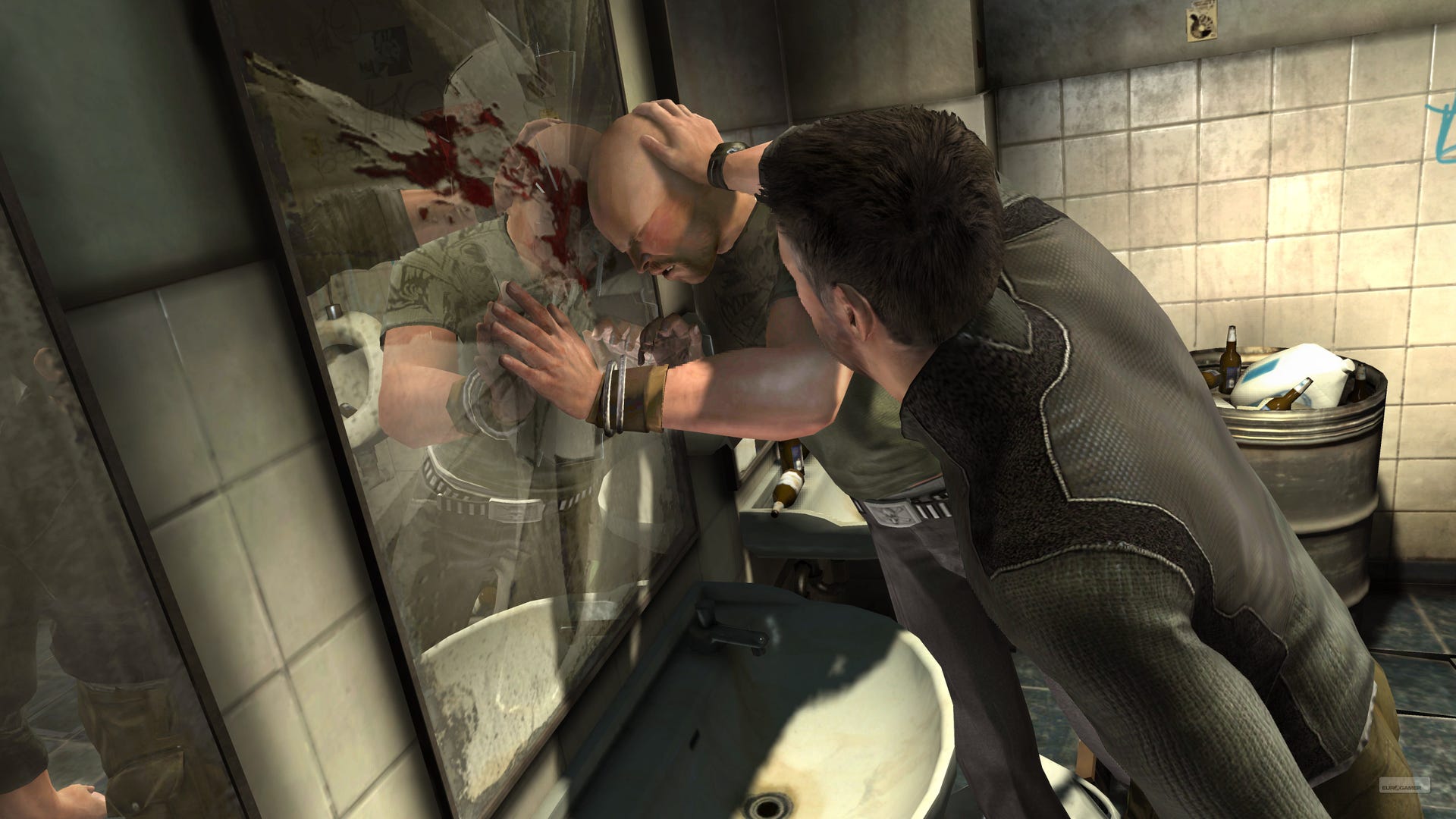
The controls should be complex, but with a smart spread of contextual actions and projected prompts, this is the most approachable Splinter Cell to date.
As he spills his guts, you're transported to a flyby of what he's describing - the mansion home of Andriy Semyon Kobin, the man he says killed Sam's daughter, complete with guard positions and access routes. Back in the lavs, you complete the interview by crashing your poor contact's head into a mirror, which cracks, and as he sinks out of view the Splinter Cell: Conviction logo appears in the reflection.
Then it's off to Malta, where Sam quits a 4x4 and cracks the glass out of the left wing-mirror and sticks it in his pocket, before you assume control again. You're on the riverfront at night, stalking through market stalls, past lovers staring out over the railing across the water, and wandering along towards Kobin's base, which looks a bit like the Houses of Parliament. "Infiltrate the Mansion" is projected on the side in huge, Gail Porter-sized letters. Like the idents scattered across the bathroom tiles and mirrors, Ubisoft's projecting information and even video onto objects in-game to avoid taking you out of it. And probably also because it looks wicked.
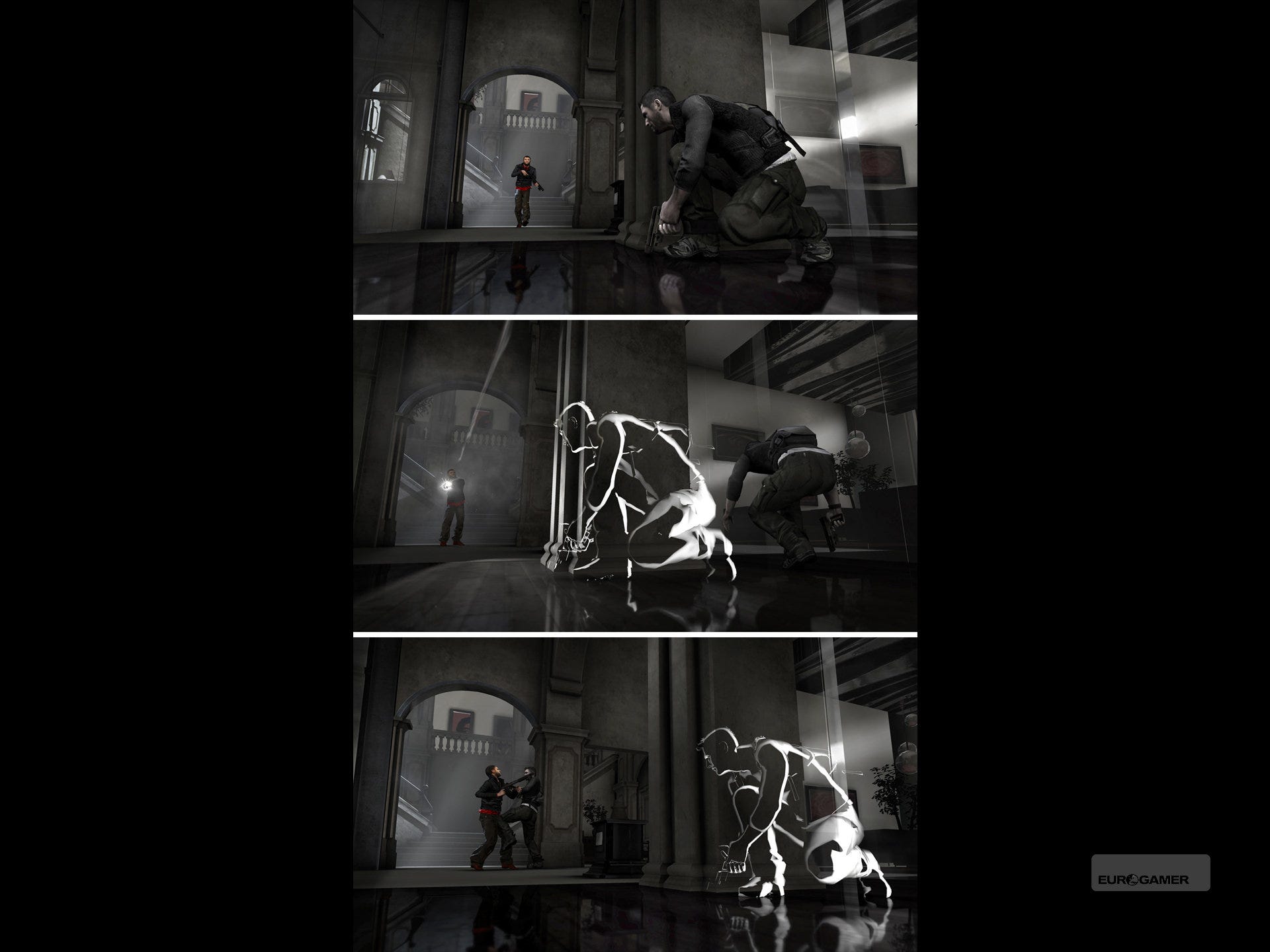
As you walk, you move in and out of shadow, and rather than have a light meter to reflect this, Ubisoft highlights it by switching to a black-and-white image filter to indicate cover. There are two guards at each of the two obvious mansion entrances - the main one is larger, but at the smaller side gate the second guard heads inside after informing his mate that Sam Fisher's in town. There are presumably multiple ways to overcome them, but I managed a couple - by hopping over the riverfront wall and shimmying at Prince of Persia speed in the direction of the side gate, you draw right alongside to the unwitting guard, and pressing X when prompted hauls him over your shoulder, where he falls conveniently into a wheelie bin that snaps shut. Alternatively, you can cross the street and set off a car alarm to distract the sentries.
There's no sign of Sam's previously trademark goggles, except on the Third Echelon spies who grab him up at the end of the demo.
Coming in through the side is neater, however, because it gives you the opportunity to test the new "mark and execute" feature, which you just charged up by performing a melee kill. This provides a certain number of marks to use on your enemies - you creep around tagging them with the right bumper, and as long as they are within your line of sight when you pop out and press Y, you'll down them all with shots to the head quicker than you can say Bourne Ultimatum. In this case, using left-stick click you could simply open the gate as a projected prompt suggests, but when angling the camera down you're given the option to use the wing mirror Sam broke off earlier to observe enemy positions beyond. In this view, you tag the men with RB, then spring the door and down them both in an instant.
Then it's up the trellis at POP speed again to the first floor window, where you gain entrance neatly through the window. Heading across the dark room within, you have the opportunity to stealth-kill a pair of guards, and sneaking up behind them and pressing X evokes a typically brutal Sam takedown, refilling the execute marks. If you like, you can also pick up their weapons. Guns and guns alone can be used for mark-and-execute, but different models allow for more marks.
Looking down from the landing, you discover some men having a discussion in the vast mansion entrance hall under a perilously positioned chandelier, which is quickly delivered onto their heads. This provokes some of their friends to come after Sam, but he's already clinging to a pipe and doing death-from-above drops on them. The relatively open-plan main hall of the mansion, with its grand staircase and surrounding landing, affords the torch-wielding guards decent views, but as you take out individual lights it becomes easy to take them out instead. You move quickly - far quicker than the Sam of old - and they're no match for your contextual repertoire.
You also have other tools to use against them. The B button fires off items from your d-pad-navigated inventory, in which there's an EMP grenade for neutralising light sources and the rather excellent sticky camera - throw one at a wall, and you get a picture-in-picture view of whatever it sees for a limited time, and you can full-screen it at the touch of a button. The guards' AI is based on your last known position, too, and Ubisoft helpfully keeps you abreast of their situational awareness with a ghostly apparition of Sam in his last known position, so you can take further advantage of their likely orientation. With belief firmly suspended, it's easy to file this as the sort of note that Fisher would make to himself, now gift-wrapped for your reference.
Multiplayer is being handled in-house, and should be revealed this summer - our money's on gamescom next week.
After toying with the guards in the foyer, it's time for the demo finale. Through we go to Kobin's quarters, relieving another enemy of a shotgun along the way. There are bodyguards kicking over tables for cover inside the room, behind thick wooden doors, but as long as you don't hang about you can pull the wing mirror trick again to mark three of them, then take the door and shotgun them before they can react. Rather than barrel through the room, though, it's out the window and along, avoiding a scripted explosion, to flank Kobin at the other end and interrogate him. As you do so, however, Third Echelon agents breach nearby and line you up in their eerie red sights, and Kobin whispers to Sam that if he wants to find out more about his daughter's death, he should go with them. Sam surrenders.
Although Ubisoft is quiet on exactly what happens next, production manager Andréane Meunier says the action switches to Washington for the "majority" of the game thereafter. While it's never an open-world stealth title like Assassin's Creed, individual levels will be vast and non-linear, and Meunier says to expect new gadgets at intervals, but fewer and better than before.
That's a reaction to past criticism, and in many respects Conviction is as a whole - whether it was criticism from without, as at Ubidays, or from within. Sam's new life away from civil service may follow familiar themes, but it's a personal journey designed to breathe life into the character, as he dices with the slick new Third Echelon director Tom Reed (not Kristan Bramwell?), and typically for a Ubisoft Montreal game, Meunier's presentation focuses on how the studio retreated to first principles and re-evaluated the genre before committing to gameplay concepts.
Sam's abilities are based on Mossad's Krav-Maga self-defence techniques, which were motion-captured for the game.
That's been true of games like Assassin's Creed and Prince of Persia, too, but while those were criticised in some quarters for falling into repetitive cycles, Meunier believes Conviction will evade the trap. "If I compare to Assassin's," she says, "you would talk to that person, assassinate that guy, and do that, which are very mechanical ways of doing things. Our gameplay is more philosophical. Analyse the situation, do your thing, and then vanish. Even if I do that 100 times, I think there are 100 ways to do it." Meunier talks about the "prepare, execute and vanish" gameplay loop, but planning alone may involve L-trigger stalking, marking enemies, clambering over pipes for vantage points, distracting guards to reach sub-objectives, or many other approaches. Pace has also been a key consideration - not just in doing away with standing for minutes in the darkness, but in quickly evading enemies once detected. It's much easier to control the situation when it starts going against you.
Sam may be older, then, but Conviction is younger, steeped in the modern Hollywood fascination with super-speed takedowns, brutal hand-to-hand combat and gritty verisimilitude - and for all the game's difficulties since its announcement, it's no surprise to be playing a characteristically adroit first demo from Ubisoft Montreal in 2009. Since I originally wrote this hands-on, Ubisoft has delayed the game in order to ensure that the rest of the game lives up to the E3 snapshot, so my original concluding line still seems apt: As long as it keeps this up across the campaign, Sam Fisher's coming out of the shadows and back into the limelight.
Tom Clancy's Splinter Cell: Conviction is due out for PC and Xbox 360 next year. Check out the Editor's blog for more from Andréane Meunier on the decision to rebuild Conviction in 2007.
