The Super Mario Bros. Story

A series retrospective.

"If he finds a warp, he can jump worlds!"

In the climactic scene of the 1989 film The Wizard, a withdrawn kid called Jimmy who's a preternaturally gifted videogame player is competing at a tournament. In the final, he has to play a game he's never played before: Super Mario Bros. 3, then unreleased in the US. For over five minutes of screen time, footage of the game looms large over a screaming audience while Jimmy's brother - suddenly possessed by the spirit of the back of the box - shouts tips and game features from the sidelines.

It's a silly scene in a bad, exploitative movie. It's full of implausibilities, it's badly acted and it's an embarrassingly naked advertisement for Nintendo. But it's also humbling. 20 years ago, the money shot in a major feature film was footage of a game. The game was presented accurately and honestly, discussed in gamers' terms, and the sight of it caused waves of excitement in the audience.

It may have been kids' stuff, but the launch of Super Mario Bros. 3 was also a major cultural event attended by none of the posturing, misunderstanding and self-conscious debate that has recently swirled around the releases of Grand Theft Auto IV or Modern Warfare 2. That's real acceptance. It was what it was, and of course you loved it, how couldn't you? It was Mario.

All this happened just four years after Nintendo had re-invented the home videogame with Super Mario Bros. How on earth did we get there so fast? And where's the warp that gets us back?

Minus World
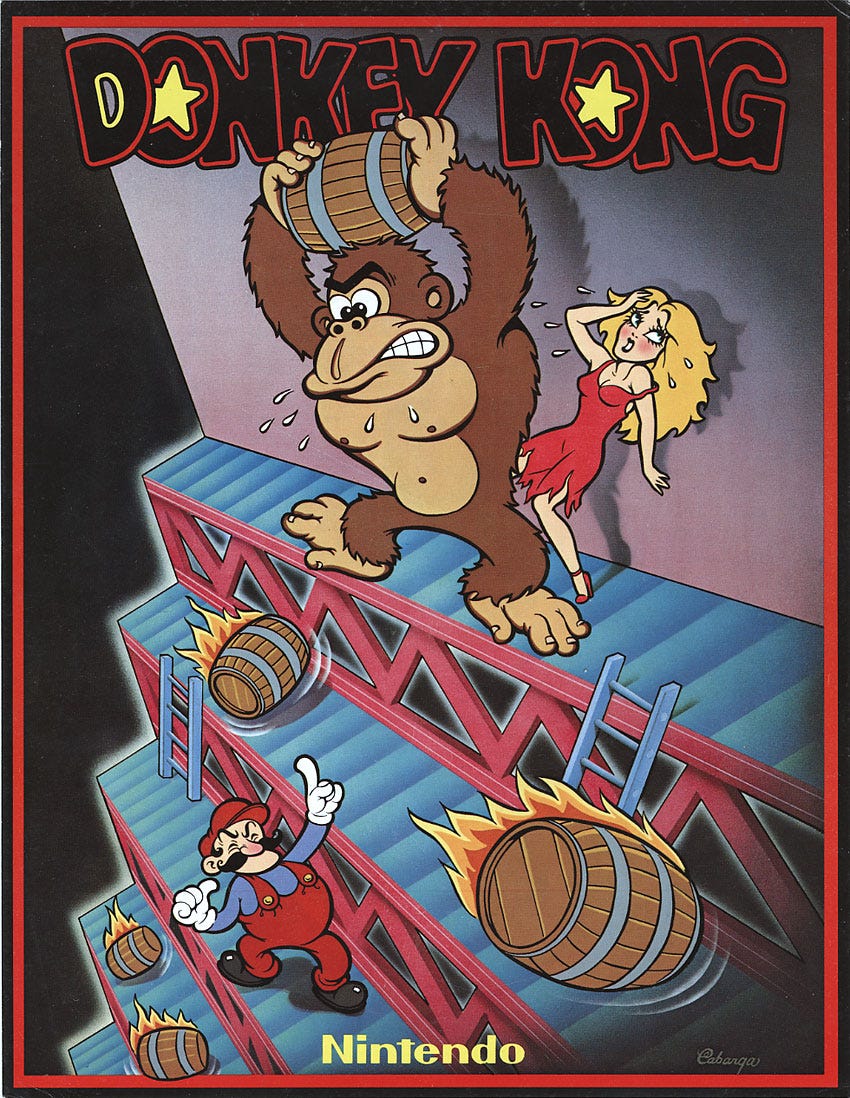
You know the prehistory: in the beginning was the jump, and the jump was the man.

Jumpman was the fat, comical carpenter in the Nintendo arcade game Donkey Kong. He was called Jumpman because he jumped, and he jumped because that was all there was to do. He wore dungarees so you could see his arms move, a hat because hair was hard to draw in pixels, a moustache to emphasise his large nose. "Noses say a great deal," said his creator, Shigeru Miyamoto.

In his next arcade game, Jumpman acquired a proper name (Mario), a new profession (plumbing), and a brother to enable two-player gaming (Luigi). He didn't acquire any new accessories or abilities, though; he still just jumped. In Mario Bros., he battled a strange menagerie of creatures in the sewers of New York. Barring Donkey Kong retreads, it was the last time Mario would be seen in a setting that was remotely appropriate to him. But that was the point.

World 1-1

1

Super Mario Bros. (1985)

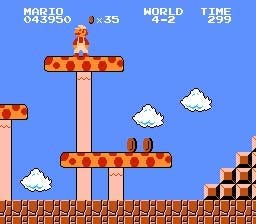
When Mario came up out of the sewers, it was into a strange new world. You could tell it was mysterious because it was plastered with question marks. The question marks were on boxes, and you never knew quite what would come out of those boxes when you hit them.

There were mushrooms in this world that made Mario grow in size, not to be confused with the mushrooms which were people, all called Toad. There were turtles with wings. There were conventional fantasies too, castles and a princess to be saved. Only the clouds looked like they were from the real world (and that wouldn't last). It was like a dream.

This was Super Mario Bros., released in 1985 for Nintendo's first home console, the Nintendo Entertainment System. Miyamoto's dumpy, goofy everyman was still jumping, but now he was running, too, really going for it, courtesy of a dash button. He could achieve amazing speeds and jump to ridiculous heights, and the player was given an exquisite level of control over him, varying the height and length of the jump, guiding his course in mid-air, feeling his giddy momentum. It was beautiful and exhilarating. In the dreamworld, out of place, the ordinary little man became a graceful superbeing.

And the dreamworld was so much bigger. Not only were there dozens of levels, but the levels scrolled along for screen after screen. (Always from left to right, though; in Super Mario Bros., you could never go back. Is that because it wasn't possible with the technology, or just because it hadn't occurred to Nintendo that you would want to?) This was amazing, but it wasn't the half of it.

Halfway through the first level, Mario could descend through a pipe - it wasn't marked, you had to find out through trial and error which one - to find a secret cave filled with coins. The second level was all cave, and there Mario could smash through the ceiling and run off the top of the screen. No sooner had he landed in a vast new world than the plucky plumber was finding out what was underneath it, what was behind the scenes. Secrets were everywhere, and everything was more than it seemed.

"What if you walk along and everything that you see is more than what you see - the person in the T-shirt and slacks is a warrior, the space that appears empty is a secret door to an alternate world?" Miyamoto said to David Sheff, author of the seminal book Game Over. "Perhaps it really is a doorway to another place. If you go inside you might find many unexpected things."

It was surreal, it was impossible, but the Mushroom Kingdom was also more real than other videogame worlds, because you could interact with all of it. There were physical laws, consequences, complex relationships of action and reaction. Mario could bop the turtles (Koopas) out of their shells and kick the shells at other creatures. He could bounce a mushroom by hitting the block underneath it. If he was Super Mario, he could smash up walls. How many games still sell themselves on destructible scenery? Super Mario Bros. had it.

You could transform Mario still further with the fire flower item, which allowed him to shoot (although, typically, not in a straight line - because that would be obvious). But Mario learned never to rely totally on his tools. Like the hammer in Donkey Kong, the items in Super Mario could always be taken away, and he'd be left with only one thing - his jump. Only now, his jump was a weapon.

World 1-2

2

Super Mario Bros.: The Lost Levels a.k.a. Super Mario Bros. 2 (1986)

Defeating enemies by jumping on their heads was a defining feature of Super Mario Bros.; it encouraged you to keep Mario airborne and keep the momentum going. In fact, Mario's iconic move didn't reach its full-fledged form until Super Mario Bros. 2 - the first one, the "true" one, the Japan-only one, known as The Lost Levels in the West.

It was in The Lost Levels that Mario learned to bounce. He could now spring off creatures' heads to reach otherwise inaccessible places, or to keep a chain going. It was an apparently small change, but a crucial one. From the first sequel, the denizens of the Mushroom Kingdom became tools as well as hazards, platforms in their own right; a brilliant reversal of traditional thinking that amped up both risk and reward.

This is classic Super Mario Bros. The series doesn't set puzzles so much as rules to be broken; it doesn't set goals so much as dares. Every level is a series of temptations to make things more difficult for yourself than they need to be, because it's fun, because you want to see what will happen, because it's there.

In this case, however, it was a bit too difficult to start with - or at least, Nintendo's American arm thought so. It rejected the Japanese Super Mario Bros. 2 on the grounds that it was too hard and too similar to the first. Playing it today, it's hard to disagree. Warps that take you backwards are pure cruelty, and requiring you to complete the game eight times in succession to unlock the last four worlds isn't a secret, it's just grind. There were scarcely any new graphics or features (although the mushrooms now had eyes, and the clouds had started smiling).

3

Super Mario Bros. 2 (1988)

The Lost Levels didn't take Super Mario Bros. forward, but Nintendo of America's replacement wasn't Super Mario Bros. at all. It was a reskinned version of another game made by Miyamoto and Nintendo's EAD team, a TV spin-off called Yume Kojo: Doki Doki Panic. It involved plucking and chucking smiling vegetables at enemies. Jumping on them didn't even kill them. Mario rode the hapless creatures' backs until he picked them up and hurled them like anything else. Sacrilege.

Super Mario Bros. 2 may have been a bastard, but it was a fine game, and still is. The sub-space zone, a dark mirror world you could enter by conjuring a door which turned vegetables into money, was like something out of a future Zelda. The levels allowed free roaming - yes, even backwards! - and gained a vertical dimension, scrolling up and down clumsily but freeing Mario Bros. of that forced, constricted drive from left to right. Picking up and throwing things was fun.

But... it had a life-meter you could extend, and by default you started a level powered-up, not tiny and vulnerable. It had four playable characters (Mario and Luigi were joined by Toad and the Princess) who were crudely defined to differ from each other. Mario needed items to succeed, his jump neutered again. Super Mario Bros. 2 was polished and interesting, but it was how everybody else did things.

World 1-3

Third time lucky. Both sequels succeeded on their own terms, but Super Mario Bros. had been so radical, so brilliant that they had failed to succeed it. Miyamoto's men hadn't yet learned how to follow their own act. They did so with Super Mario Bros. 3. Those kids in The Wizard weren't screaming for nothing.

The previous games had always implied a world beyond the linear charge through levels. Super Mario Bros. 3 showed it to you, on a map screen strewn with alternative routes, bonus stages and wandering hazards. Boss battles aboard flying ships picked themselves up and wandered off, and Mario had to chase after them, back through places he'd already been. He could gamble for extra power-ups in Toad houses and take them with him. It was almost tactical, like a board game in which every square was a miniature, animated world.

Diversification and multiplication were everywhere: more enemy types, more moves, more items, more interactions, more outrageous possibilities, all bouncing off each other. Miyamoto, now accompanied by right-hand man Takashi Tezuka, had learned that you couldn't repeat or replace such a rule-breaking game as Super Mario Bros. The only option was to add to it; to invent more rules to break.

4

Super Mario Bros. 3 (1988) - world map

Mario exceeded himself for boundless joie-de-vivre. He slid down slopes like a tobogganing child; gained a mad, pirouetting spin jump; dressed as a frog to swim underwater; leapt into the air and simply refused to come down. When he found a Super Leaf and donned his raccoon suit, Mario could fly. A platform game in which you gained the ability to fly made no sense, which is why Nintendo made it. What value does a super-power have if you still have to play by the rules? And besides, when did Mario's world ever make sense in the first place?

But the rule-breaking only went so far. If Mario games have one immutable rule, it's that what goes up must come down. Even raccoon Mario succumbed to gravity in the end; even the invincible hammer suit could be taken away with a touch. No matter how absurd the power, under the costume there was still just a man, and what he did was jump.

Toad House

5

Super Mario Bros. 3 (1988)

The four NES Super Mario Bros. games are all available in their original form on the Wii's Virtual Console, but the truth is that anyone but purists and nostalgists might want to avoid playing them that way. It's not that they're crude - they're far too perfect and intricate in their construction for that - but they're tough, austere, glitchy, and the lack of a save is punishing.

Save points, 16-bit graphics and a few welcome tweaks were added to all four in the excellent SNES remake collection, Super Mario All-Stars. Alternatively, you could hunt down the handheld versions: Super Mario Bros. Deluxe for the Game Boy Color conjoins the original and the Japanese sequel; Super Mario Advance for the GBA is a superb version of that underrated oddity, the Western Super Mario Bros. 2; and Super Mario Advance 4 remakes Super Mario Bros. 3, although that game is the least in need of it, and by far the most playable today.

World 2-1

6

Super Mario World (1990) - composite world map

As revolutions go, it was a pretty unassuming one. Super Mario World, the launch game for the Super Nintendo Entertainment System, may have had a new title, but it was pretty close in concept and features to Super Mario Bros. 3. The levels were accessed via points on a world map, and Mario gained the ability to fly, a little more sensibly this time, via a feather, not a leaf; a cape rather than a raccoon suit. The graphics were vibrant and smooth, but still simple, unmistakeable.

The clue was in that title, however. Super Mario World did what no Super Mario Bros. game before or since has managed: it took the themed and disjointed dreamscapes of the Mario universe and made them into a place.

The exposed systems of Super Mario Bros. 3's world map were stripped out or disguised, replaced by an organically winding road through the riotous cartoon landscape of Dinosaur Land, punctuated with mysterious byways and unexpected events. The blunt shorthand of the world numbering system gave way to evocative nonsense poetry: Donut Plains, Vanilla Dome, Cheese Bridge Area.

There were still shortcuts and surprises, but now the secrets led to more secrets. In a more relaxed game with a save option, the prize for inquisitiveness wasn't skipping levels but finding new ones, and few were the levels without multiple secret exits. Warps became a sub-system of levels of their own, the Star Road. Nintendo's designers were now so confident with the games' complex lexicon that they started playing impossible mind-games with it.

The Forest of Illusion tuned an already topsy-turvy world on its head by making the secret exit the normal one, and vice versa. The incredible Ghost Houses were dimensional riddles, repeating nightmares for which you had to make up the rules as you went along. Some levels forced the pace, others restricted it, others ripped the ground away completely and hung vast, abstract complexes of moving and crumbling platforms in the sky, where Mario couldn't stand still for a fraction of a second. The gambling mini-games of Toad Houses were replaced with Switch Palaces that altered levels Mario had been to already, or hadn't seen yet. Why satisfy yourself with winning an item when you could change the world?

And why make do with an item when you could have another character? In place of Super Mario Bros. 3's array of suits, the power-ups were stripped back to the old fire flower and the new cape, armed with which Mario could soar across (or on one memorable occasion, under) entire levels in a strangely noble, permanent bellyflop. But they were joined by a power-up with a life of its own: Yoshi.

Mario's dinosaur steed wasn't just a powerful item, with his straining flutter-jump - he was a portable ecosystem, a factory for turning one thing into something else. He could eat enemies and spit them out as weapons, recollecting the mechanics of Doki Doki Panic, but also gain weight, breathe fire, grow wings, turn fruit into mushrooms. In later levels he came in different colours with different abilities and had to be fed up from a hatchling. There was nothing about the game that Yoshi didn't change.

7

Super Mario World (1990)

The spirit of Super Mario Bros. was defined in the very first game. Its possibilities were fully explored in Super Mario Bros. 3. But revisit the entire series today - laying rose-tinted specs to one side - and there can be no doubt that Super Mario World is its pinnacle. Where the NES games are bearable to play, Super Mario World is still a pure joy, as confounding, irresistable and free-spirited as it ever was. It's the best platform game ever made.

Star Road

Then, having reached its height in 1990 - five short years after its birth - the Super Mario Bros. series promptly vanished. Mario disappeared at the top of his jump.

On paper, that's not true. For one thing, Super Mario World had a sequel, and not just any sequel but a game almost as great: the gorgeous and hilarious Yoshi's Island, gaming's finest slapstick comedy. You could argue (and you'd have a point) that its DNA is purer than Super Mario Bros. 2's. But you don't play Mario, it doesn't feature question blocks or Koopa Troopas, and in Yoshi's basic state he can do more than just jump. Yoshi's Island is so good it's heart-breaking, but it's not a Mario game.

As for the plumber himself, just one year later Mario appeared in 3D for the first time. Super Mario 64 changed the game so completely it can't be considered in the same genre, never mind the same series. It laid the groundwork for a new era with all the vision and conviction of the first NES game, but the path ahead of Mario was a much slower and rockier one now - and it didn't lead from left to right.

It was over 15 years before Super Mario Bros. came back.

World 3-1

The smartest, but also the saddest thing about the DS' New Super Mario Bros. is that Super Mario World might as well not have happened. It was all too long ago. It would never have been easy to follow that masterpiece; in the early nineties, Nintendo balked at the challenge and went off at a tangent instead. In 2006, a continuation was impossible. What we got instead was a revival.

8

New Super Mario Bros. (2006)

You can't even call it a greatest hits - without Yoshi or the power of flight, how could you? The new power-ups were mere novelties (with the exception of mini-Mario, a classic in the making). Structurally, the clock was wound back to Super Mario Bros. 3. The map concealed more tricks and secrets, but you still played it like a game rather than discovered it like a world, and some of its rules concerning lives and save points seemed anachronistic and arcane. On the other hand, the introduction of the ground-pound and wall-kick from the 3D games was a stroke of genius. It added tactile flexibility and acrobatic fun to make up for the retreat from sheer freedom.

From some angles, New Super Mario Bros. looked cynical, a little too slick for its own good. From others, it looked like a better game than either version of Super Mario Bros. 2 - maybe even than the first one. But the truth is, none of this matters in the slightest.

The spirit of Super Mario Bros. refuses to be squashed, and every game in the series - including the DS game - surprises and delights in ways that no other 2D platform game has managed to do. In the end, it doesn't matter what you give to Mario, or what you take away. You can't take away his jump.

The Super Mario Bros. series continues this week with New Super Mario Bros. Wii, released on 20th November. Watch out for our review very soon.

Comments (91)

Comments for this article are now closed, but please feel free to continue chatting on the forum!

  • Loading...hold tight!