The Shareware Age
A brief history of the PC's first reinvention.
The history of PC gaming can be neatly split into two eras. Everything from 1993 onwards we can class as the Modern Age, in which the PC is established as a games platform in its own right. (We can pinpoint 1993 based on the fact that before that year the number of PC games that have survived into posterity drops off precipitously.)
Everything before 1993 could be termed the Dark Age, a period shrouded in mystery, when there was no internet nor any dedicated PC gaming magazines, and when the "IBM compatible" was seen as just another home computer format among many (and as far as the UK was concerned, one that was both technically inferior to and several times more expensive than the riotously popular Commodore Amiga and Atari ST).
Thanks to this combination of factors most modern gamers are unfamiliar with the PC's formative years, having only joined the party in the mid-1990s after sound cards and CD-ROM drives had become standard features and the likes of LucasArts, Origin, Bullfrog and Westwood had started churning out big-budget blockbusters. While these big-name studios played a role in the PC's reinvention, most of the credit for realising the PC's true potential as a games platform came from a very different scene.
The Beginning
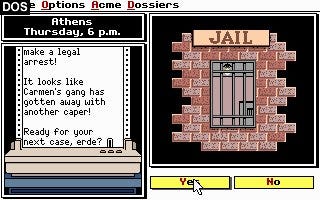
Carmen get her.
Our story begins in America in the mid-1980s, where the PC enjoyed rather more favourable conditions during its early life than in Europe. The Amiga and ST never really caught on in the States, and IBM PCs or fully-compatible clones (no shabby Amstrad 'word processors' over there) were cheap enough to make them a viable option as a home computer, although most were still situated in schools and offices.
The major publishers knew that there was an audience for PC games, but the process of manufacturing and distributing a game was so prohibitively expensive, and PC gamers so risk-averse (what with lacking access to the game demos and wealth of online information that we take for granted today) that they rarely ventured outside of a few tried and tested genres. (Yes, even more so than today, clever-clogs.)
PCs were the tools of Serious Business, and so it followed that PC games should be executive toys (World Class Leaderboard), teaching aids (Where in the World is Carmen Sandiego?) or dorky IT department humour (Space Quest, Leisure Suit Larry). Minimum specs were dictated by the machines that players had access to in their downtime, with the idea of buying or upgrading a PC explicitly for the purpose of playing new games being the stuff of fantasy.
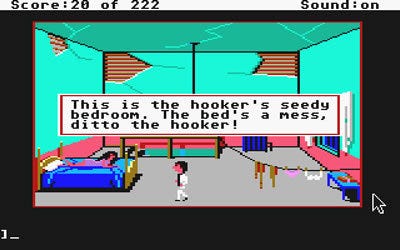
Larry, a man of leisure.
So what happened to transform the PC from the buttoned-down home of golf, chess and flight sims to the hotbed of creativity and innovation pumping out classic after classic from 1993 onward? Was it the inevitable result of technological progress? Only partially. Publishers seemed content at first to use the PC's expanding capabilities to simply make prettier golf, chess and flight sims.
How could the complacent PC games industry be shaken out of its torpor? Such a task called for nothing less than a revolutionary movement - an underground development scene, answerable to no marketing departments and dismissive of hidebound conventions about what PC users would consider 'worthy' uses of their sacred beige monoliths. Their success would hinge on the creation of fast, fluid, immersive games that would thrust the PC into the limelight and make Amiga owners involuntarily hiss with envy. Games, in a nutshell, like Doom.
That movement was known as Shareware.
Sharing is caring
You've probably heard the term bandied about in relation to Doom and Wolfenstein 3D, but shareware's roots go back far earlier. The concept originally emerged (accounts vary, but probably no earlier than 1984) as a response to the high price of commercial business software, as well as a tacit acknowledgement of the tendency of computer enthusiasts to happily copy, swap and pass around software they liked regardless of limitations imposed by the license.
Shareware authors would release complete versions of their programs for free, uploading them to popular Bulletin Board Systems (from where they would be picked up by mail order companies - being sent parcels of floppies was still the preferred option for the majority of users who weren't sold on slow, expensive WarGames-style modems). If you obtained the program, tried it out and found it agreeable, you were encouraged to send a donation to the developer. In return you might receive product support and updates, additional programs, source code, or perhaps just the warm fuzzy glow of having supported the underdog.
While this infrastructure may not have been far removed from the catalogues used by 19th Century homesteaders to order feed, furniture and wives, the appetite for affordable PC software was so great that users embraced the concept immediately and shareware authors found a steady trickle of cheques coming in. A few programs became very successful and sparked a gold-rush among bedroom coders much like the current brouhaha surrounding the iPhone.

Castle Adventure: made by a 14 year-old.
At first shareware vendors viewed games as a sideshow to the main event - an added bonus for people shopping for desktop publishing and book-keeping applications rather than a money-spinner in their own right. The games disks they offered (given evocative names like "Arcade Games 1?) collected together tiny, unofficial versions of golden age coin-ops (Space Invaders, Centipede, Pac-Man, Donkey Kong, Pengo) or mainframe games (ADVENT, SpaceWar, Nethack, Star Trek). Most of these were developed by hobbyists (or in a few cases as promotional items for tech companies) and few made anything more than half-hearted solicitations for payment.
Among the waves of clones were a few intriguing original efforts. Flightmare involved piloting a light aircraft around a post-apocalyptic desert, shooting down gangs of planes and bikers before they could reach your factories. Dracula in London presented Bram Stoker's story as a turn-based adventure styled after an after-dinner board game (going as far as to suggest that the different characters in the party be controlled by different players). Slightly less pretty (in fact, possibly one of the most visually spartan games ever made) was Castle Adventure, a surprisingly competent mash-up of Zork and Atari's Adventure, with only the quirky spelling hinting that the author was only 14 years old.
All of the games mentioned thus far either used "text mode" (ANSI) graphics (a technique introduced to a new generation by Dwarf Fortress) or four-colour CGA, and as such are compatible with virtually every PC ever made.
Going professional

Kroz: made by Sott Miller of Duke Nukem Forever, er, infamy?
These early shareware games were a pleasant enough diversion, but they weren't exactly buying their authors lunch. The standard shareware model may have been successful for 'serious' software and utilities, but game developers quickly found that while gamers were happy to oblige with the sharing part, they were less inclined to pay up for games that they'd played for a while before casting aside. Devs needed to create an incentive to pay, but artificially removing features from shareware applications was frowned upon.
The solution to this dilemma arrived in 1987 with the release of Kroz. This was a vaguely Rogue-like maze game written by Scott Miller and published by his company Apogee Software (who would later become 3D Realms, best known today for spending 12 years working on Duke Nukem Forever). The game was divided into 'episodes', the first being offered as a freebie, with additional bundles of levels available on registration. Unlike modern game demos, the free episodes offered under this model were effectively fully-fledged games in their own right, typically offering several hours of gameplay, most of the game's features (weapons, enemies, powerups and so forth) and a climactic (albeit usually cliffhanger) ending.
The episodic model quickly caught on. The steady income that it provided would allow for investment in more ambitious projects (and in some cases, garagefuls of sports cars). Over the next few years Apogee would go on to become the leading brand in shareware with a string of hits which successfully kept pace with rapidly-evolving PC technology.
By the end of the 1980s PC gamers were starting to feel strange instinctive urges telling them that they should spend more money to get better graphics. At the earliest opportunity, shareware developers started to make use of the Extended Graphics Array (EGA), introducing the concept of the 'minimum spec' to PC gaming in the process.

It's Duke Nukem I! We haven't seen this Forever.
EGA allowed 16-colour graphics, but was notorious for having a fixed palette which lacked even a vaguely acceptable approximation of a skin tone, resulting in a proliferation of games with unfortunate puce- or orange-faced protagonists. The move to EGA coincided with a trend for mascot-driven platform games. Initially these were flick-screen, platform-puzzle affairs similar to earlier games on the Apple II (such as Crystal Caves, Secret Agent and Pharaoh's Tomb).
Conventional wisdom held that smooth, full-screen, console-style scrolling was beyond the reach of the PC's weedy graphics chips. Conventional wisdom didn't know it was about to run afoul of John Carmack, and was going to have to get used to it happening a regularly over the next few years. Commander Keen, developed by id Software and released through Apogee in 1990, elegantly solved the scrolling problem and provided an engine which was used for six main episodes as well as other Apogee games.
For the first time PC gamers were being offered console-style action in a recognisable (if not particularly pretty) form. These games were progressively easier to market (being perfect fodder for magazine cover disks, for example) and provided good fuel for Apogee's episodic model. They would continue cranking out 16-colour action games for the next few years, including titles such as Major Stryker, Bio Menace, Monster Bash and Duke Nukem I and II.
Mein Lieben!
While EGA was widely supported and easy to develop for, many shareware programmers harboured ambitions to one day make games that didn't look like sick. As before id Software led the charge with the 1992 release of Wolfenstein 3D (again distributed through Apogee), which used the high end VGA 256-colour mode. (Remarkably, the VGA standard had been introduced way back in 1987, but with games not yet being seen as a legitimate reason to upgrade it had remained expensive and poorly supported.)
In spite of relatively high hardware requirements, Wolfenstein-3D became a huge hit, netting millions of dollars for both id and Apogee (who worked on a 50/50 split and had minimal overheads) - but leading id to realise that they'd outgrown the need for Apogee. They promptly severed their relationship and took their publishing activities in-house.
1992 also marked the arrival of the other main challenger to Apogee's dominance: Epic Megagames. Epic used VGA graphics and sampled sounds across nearly all of their games, explicitly aiming to match the production values found on other formats. They also tapped the talent of the European demoscene with games like Epic Pinball and Solar Winds featuring incredibly slick 2D graphics engines written in assembly language.

Epic Pinball: not an overused phrase.
(Although Epic have since gone on to become one of the world's most successful developers, their name was originally ironically chosen to make them sound bigger than a couple of guys in a basement. It's hard to imagine Epic, whose output now focuses exclusively on gruff musclemen with huge weapons, ever harbouring feelings of inadequacy.)
It had only taken a few years for shareware games to progress from punctuation marks running around mazes to (what was then) the bleeding edge of 3D graphics. Even the 'Big Three' publishers (Apogee, id and Epic) were struggling with the rising expectations in production values. While some interesting games were released in 1993 (such as Apogee's Halloween Harry, Epic's Xargon and Ken's Labyrinth), development cycles were getting longer and budgets getting bigger. This didn't seem to be an immediate cause for concern, as hits like Wolfenstein-3D, Duke Nukem and Epic Pinball were still raking in cash, and were being introduced to many new PC owners through the proliferation of cheap shareware compilation CDs.
In the final weeks of 1993 shareware reached its apotheosis when id released perhaps the single most important PC game of all time: Doom.
Doom...

Speak of the devil.
It was as if all the ground work that had been done over the past decade had been preparation for this moment. Mainstream hype over "multimedia" and "virtual reality" had started to put high-spec PCs in people's homes. Apogee had provided a spectacularly effective business model. Wolfenstein 3D had given id the reputation, experience and resources to be able to take their time over Doom. And finally the fledgling "Web 0.2? internet provided a community that would put the game at the heart of a thriving ecosystem of user-generated content that persists to this day.
Into this perfect storm id released a game that was not just technically and artistically in a different league to any other shareware game, but was a credible contender for best game ever made. Doom wasn't an incremental upgrade of Wolfenstein. It had palpable atmosphere - a skilled level designer could build tension, excitement and dread (and id's level designers were extremely skilled). Puzzles could actually challenge the player in more imaginative ways than merely having them grope around for fake walls. Doom had immediate appeal to almost anyone with a PC capable of running it and along with its sequel (essentially an expansion pack sold through retail) it shifted millions of copies worldwide. (For more on the cultural impact of Doom and the rest of id's games, I urge you to read David Kushner's Masters of Doom.)

Rise of The Triad. Looks familiar.
In the wake of Doom's success, the first person shooter (or "Doom clone") became a top priority for many (shareware and commercial) PC developers. Apogee were able to cash in quickly with Rise of The Triad (1994), a project which started life as a sequel to Wolfenstein 3D and was directed by ex-id and future-Ion Storm designer Tom Hall. ROTT was weak beer compared to Doom but introduced a few innovations (such as voice taunts and a wide variety of multiplayer modes). It would be another two years before Apogee convincingly advanced the genre with Duke Nukem 3D (in time for id to shift the goalposts again with Quake).
Epic would eventually join the fray with Unreal (1997), but in the immediate wake of Doom their flagship game was Jazz Jackrabbit, a cartoony platformer heavily influenced by Sonic 2, and which is perhaps most notable today for being a collaboration between Cliff Bleszinski (Lead Designer, Gears of War) and Arjan Brussee (Development Director, Killzone 2). Funny how these things turn out.
...and bust
While Doom's success had been a great validation of the mail order shareware model, the PC was changing in ways that made that model an increasingly poor fit. The traditional publishers started to commit heavily to the PC, creating CD-ROM games with production values, scope and complexity far beyond anything that bedroom programmers (at least, ones whose last names didn't rhyme with 'Tarmac') could deliver.
The major shareware developers had become established enough to enter into lucrative deals with traditional publishers, so they did. It's likely that the growing size and falling age of the PC user base also meant that piracy became a significant issue. Shareware games didn't feature any kind of copy protection, and it's likely that pirate copies of Doom alone ran into the millions.
The end of the road came in 1996 - Quake and Duke Nukem 3D were both released in episodic shareware form, but not before launching as boxed products via retail. Later games from 3D Realms, Epic and id eventually dropped the shareware option entirely, removing the need for an episodic structure.

Quake in the days before Quake III became a free-to-play, browser-based game.
The term "shareware" has since fallen out of use, and games are typically promoted with strictly time- and/or content-limited demos rather than giving anything substantial and self-contained away for free. (I suppose an exception to this would be games such as Telltale's Sam & Max and American McGee's GRIMM which have applied the 'episodic' metaphor in the sense of a television series.)
The pioneers of the 1990s shareware games scene may have long since become part of the establishment, but the lessons from that era are still relevant. When the conditions exist for anyone with enough time and motivation to make games, it's possible (and perhaps even inevitable) for small developers to redraw the boundaries of what's possible in the medium. Today, with platforms as diverse as Flash, the iPhone, and the digital distribution channels on each of the consoles, the potential once more exists for games as disruptive as Doom. And just think, you won't even have to send away for a bunch of floppy disks to be able to play them. Huzzah for living in the future!
Addendum
If your curiosity has been piqued by this nostalgic ramble, nearly all of the games that were released as part of the shareware scene via BBSes are now archived online, and many have since been reclassified as freeware by their authors. Sites like DOS Games Archive and cd.textfiles.com (and Apogee's own site, assuming it's still there by the time you read this) are good places to start.
You can use DOSBox to get these games running on modern computers. As they mostly feature keyboard controls, modest hardware requirements and gameplay that can be dipped into with the minimum of fuss, they're ideal netbook fodder.
You may also like...
-
Grand Slam Tennis 2 Review
-
App of the Day: Superman
-
Next Xbox has tablet-like touch-screen controller - rumour
-
Ultimate Marvel vs. Capcom 3 Vita Review
-
Gotham City Impostors Review
-
Skyrim patch 1.4 performance tip: make a new manual save
-
Who Killed Rare?
-
Cheapest places to buy Kingdoms of Amalur: Reckoning
-
Double Fine Adventure raises $1m in less than 24 hours
-
Five new Mass Effect 3 gameplay trailers
-
Diablo 3 release date narrowed
-
Sony confirms LittleBigPlanet Karting development
-
Blizzard legally opposes Valve's Dota trademark application
-
King Arthur 2 Review
-
David Braben discusses consumer Raspberry Pi release
-
Kingdoms of Amalur: Reckoning Review
-
Cheapest places to buy The Darkness 2
-
The Witcher 2 Xbox 360 version cinematic trailer
-
Skyrim patch 1.4 now live for Xbox 360
-
AIAS 2011 Awards winners revealed
-
The Darkness 2 Review
-
Activision promises "meaningful innovation" in next Call of Duty
-
Jaffe: Developers should focus on gameplay, not story
-
Itagaki: Tecmo tricked me into releasing unfinished Dead or Alive 2
-
Minecraft fan series gets cinematic trailer


Comments (47) Latest comment 3 years ago
Comments threads automatically close after 30 days, but please feel free to continue chatting on the forum!
Comment below viewing threshold Show
And of course the amount of pron you could fit on a floppy was never very much, so it was win win for spending Ł400 on a 2x reader.
Insert floppy/pron jokes at will..
Comment below viewing threshold Show
Nowadays some of the business models resemble those Shareware days. Sometimes I feel like buying an incomplete (unfinished) product, where one has to wait for patches to make the game perform flawlessly. Then, one can buy (episodic) content as DLC to add functionality. I'd love to see developers giving away tools and possibilities to customers to make their own DLC and maybe even selling it online through the developers platform (like the iPhone). A very interesting title I found days ago is called "Auditorium".
Play the game, and if you like it, buy it, get the complete game. Shareware, isn't it? And it's addictive, too.
<a href="http://www.playauditor ium.com
">http://www.playauditor ium.com
</a>
Edit: @ Goffee: Some people still wonder today
Comment below viewing threshold Show
I really must get around to read Masters of Doom...
I wonder if something based on the shareware model is something worth looking at today to help combat piracy. Release several levels and good few hours worth of play and once the end of the "demo" is reached you can immediately purchase an download the rest of the game. Might gain quite a few impulse buys. Further to this completely skip retail release and have online only distribution via this shareware like method, means there is no physical copy of the full game to pirate from.
This would also help avoid leaks of the game, can't released a pirated version of the game early if it can't be activated.
You will never stop piracy, it's been rife since the advent of video games, but I think there are plenty of options for developers and publishers to look at to help reduce the impact it has on their profits.
Comment below viewing threshold Show
Err..no. The rest of the article is pretty decent though. Still remember all those games fondly. It's a shame though, up till '96/'97 there was a air of magic around it all (I still remember cycling home with a brand new copy of quake 1 and everything that pursued). Every time a new game would be released, it wouldn't be a new game but a new experience. Now it's just a new release of entertainment.
Comment below viewing threshold Show
Also I have fond memories of Jazz Jackrabbit and Commander Keen, used to play them for hours after I got my computer.
Thanks for this article, it was nice to remember all these things again
Comment below viewing threshold Show
Err..no
Why no? 1993 is absolutely spot on. It was the year PC gaming really took off, the 486 became reasonably affordble, people mothballed their Amiga's and Atari STs, and magazines dedicated exclusively to PC gaming started to pop up.
Comment below viewing threshold Show
Luckily by the time I finished CoW1, I checked the devs site and he'd made part 2 free
Comment below viewing threshold Show
.....Great times
Comment below viewing threshold Show
/ Hugs PC and apologises for forgetting it's gaming side this gen and promises it some RAM, and a new Graphics card.
Comment below viewing threshold Show
Because the PC was already a well established games platform before that. Maybe not in the UK but over here it most certainly was. Probably due to differences in government funding & the lack of alternatives that the UK had. 93 was indeed the year that it all went up a gear, that games became better looking than the rest and that competition started to wither and die but it was an established game platform before that.
Still, '93 till '97 where without a doubt the most magical gaming years I've encountered. You couldn't go around the block without bumping into something new. I'm still enjoying games today and know that 90% of the games from back then are utter shite now but the sensation is just gone. Perhaps the lack of proper paper magazines these days have something to do with it - going into town every week to pick up the latest copy, full with all kinds of juicy stuff.
Comment below viewing threshold Show
Seems odd that there's no mention of Defcon as modern Shareware. Releasing your own game as a torrent and then bugging people to buy it seems a lot like Shareware to me even if it wasn't called that.
I'm really not sure about the dismissal of everything PC before 1993 either. I remember playing a lot of good games on my PC back then, admittedly I think they were almost all ports like Starglider but some found fame on the PC first before moving to other systems, like Tetris for instance. Anyway, an interesting article from a time when I played games but was too young to know what the heck was going on.
Comment below viewing threshold Show
It most certainy wasn't in Germany, either, before 1993. Of course, I can't speak for the Netherlands, but I'd be very surprised. Might depend on how you define "well established". It certainly was all but meaningless next to the Amiga and ST here before that. I knew exactly one guy in the early 90s whose parents had a PC powerful enough to play games, because the father was working for Honeywell Bull. They weren't really affordable for most people, and noone I knew owned one himself (while everybody had a C64, and an Amiga or ST in their rooms).
The first two PC gaming magazines in Germany were launched in 1993, and if you look at multiplatform magazines of the late 80s and early 90s (I still have them in the basement), the PC leads a shadowy existence at best.
Comment below viewing threshold Show
reminds me how lucky people of my age were to have lived through probably the most exciting period of gaming development...
Comment below viewing threshold Show
I remember so clearly that day when I went round to a friend's house for lunch break, saw Doom for the first time, and the accompanying sense that everything was about to change. At that point, the games scene in my school was almost exclusively based around the SNES and Amiga. But after Doom broke, suddenly everyone was getting a 486 for Christmas, and from then on the Amiga scene really died away - Amiga Power became Amiga Pamphet, and its dying breaths were awful Doom clones like Gloom that the poor thing just couldn't pull off due to its hardware architecture(?)
I seem to remember the next game that blew me away after I finally got my Pentium 90 being Magic Carpet..
Comment below viewing threshold Show
I guess we're living in the second Dark Age of PC gaming now then. Crappy ports from consoles, annoying and intrusive DRM, unfinished products and horrible sales. Building a good PC for gaming has never been cheaper, they should get their sh't together.
Sorry for the rant, this is a great article btw. It brings back many fond memories.
Comment below viewing threshold Show
Pc Review and PC Format existed at least since 1991. And multi format magazines like Zero or Ace were already paying good attention to pc with notable games like Ultima VI, VII and Underworkd, Monkey Island 1 and 2, Kyrandia and quite a few others already looking and playing better in pc vga than in Amiga or ST.
Also, I think this article greatly overstates the importance of shareware before Doom, specially it's "technical achievements". Platformers like keen, duke nukem, jill of the jungle or helloween harry looked very primitive (and weren't as smooth) compared to many other commercial pc games of the era like Rick Dangerous 2, Gods, Bart Simpson vs Space Mutants, Rolling Ronny, Prophecy: The Viking Child, Magic Pockets, Wrath of the Demon, etc
Comment below viewing threshold Show
There were scores of AD&D games like Pool of Radiance, Curse of the Azure Bonds, Secret of the Silver Blades. Then later Eye of the Beholder. Sierra had great puzzle games with mini games like Manhunter 1 & 2, Space Quest 3. Exploring planets was fun in Megatraveller. I feel privileged to have played so many great games before and after 93.
Comment below viewing threshold Show
Fair enough - looks like the establishment of the PC as a serious gaming platform might have differed a bit then from country to country - I guess the launch of specific PC gaming magazines is indeed a good indicator. Like I said, I am not aware of any here /in Germany) before 1993.
Comment below viewing threshold Show
There were plenty of PC gaming magazines before 1993. In the UK alone, PC Leisure was dedicated to gaming and launched in 1991, and IIRC the first issue of PC Format was in 1991 too. THere were others pre-1993 too but I can't remember their names, and other countries had their own equivalents.
As for the idea that no one remembers PC games before 1993... how about Lucasfilm (Monkey Island, Maniac Mansion etc), Sierra (King's Quest, Leisure Suit Larry etc), Origin (Ultima, Wing Commander etc)? They released on non-PC formats too, but their target format was the PC and it was the only format that got their continual support.
The PC had lots of pre-1993 hit games like Prince of Persia, SimCity and Lemmings. (They were on other formats too, but so are most major games of any period.)
These weren't obscure games, they sold by the million and were widely known. Lucasfilm's adventure Maniac Mansion had a TV spinoff sitcom in 1990 which ran for three series:
[link url=http://www.imdb. com/title/tt0098851/
]http://www.imdb. com/title/tt0098851/
[/link]
And what about all the game-centric hardware from pre-1993 like the Soundblaster and Ad Lib soundcards?
Sure, 95% of the games released before 1993 are now forgotten, but 95% of PC games released now will be forgotten in 16 years time. That doesn't mean they were flops, and it doesn't mean they didn't have an impact.
Comment below viewing threshold Show
I managed to complete quake with just the keyboard too! I rock! (or was mouse just not supported?)
Comment below viewing threshold Show
Optimizing autoexec.bat and config.sys was an entire game in itself - I actually seem to recall occasionally competing with some of my buddies over who could free up most of those 640 KB on our 386 PCs back in the early 90s
That was back in the days where I still enjoyed messing around with the technical stuff - and that actually continued until 6-8 years ago. Now however it really annoys me to no end when I'm forced to spend half a day every year or two, setting up a new PC with all what that includes in terms of Windows configuration, application installation, data backups that have to be restored etc.
Comment below viewing threshold Show
People will download a torrent of the game, play it, and if they like it buy it. It's common sense for all gamers to do so, and every single one I know does it, if not all the time at least sometimes.
So why not make those torrents available on your site, with 30% of the game fully available, and an option ingame to pay the price of the game and download and install the remaining 60%? Torrents are the epitome of the shareware ethos. Wake up, publishers.
Comment below viewing threshold Show
Xerx3s
24-May-09 12:18:29 is spot on.
Comment below viewing threshold Show
And thus the reason pc gaming is dead.
Comment below viewing threshold Show
well my main income at the time was my weekly pocket money so piracy or not I couldnt have bought many more games than I actually did. but I admit I played a hellova lot more games than I paid for.
bugger, you have made me feel guilty now.
Comment below viewing threshold Show
"Perhaps in 10-15 years time those in their 20’s and 30’s will be reminiscing about the first time they played crysis and what an exciting era Directx.10 was."
Except it wasn't. DX10 has barely been an improvement over DX9. Maybe Dx11 will be a proper update but DX10 has been a bit of a disaster. I would be surprised if anyone sees that as a golden era.
And I wouldnt worry about feeling guilty about pirating when you were young. 99% of kids did/do it and don't really think about weather it's wrong or not. And I'd go as far to say that 90% of people are bullshitting if they say they have never used at least one peice of illegal software.
Comment below viewing threshold Show
Hell yeah. I used to have do multiple boot floppies, for different types of EMS and XMS setup, with enough drivers loaded to run certain games. I was glad when dos4gw caught on, as that largely eliminated the need for it all.
Comment below viewing threshold Show
Plants vs. Zombies "demo" is the full game only limited to 60 minutes of play.
When you buy the game after the time is up and unlock the game you continue at the exact point the game was stopped and nothing additionally is downloaded...
The article is recalling fond memories of playing those Apogee games like "Halloween Harry" etc.
Oh and yes freeing 620+ KB of memory was fun (LH, highmem.sys + setting values for sound cards like IRQs).
In the end it netted me work in IT which I still do today so all is good.
The company I worked for as student hired everyone that could set up networks for games like Duke Nukem 3D or Doom since those people knew a lot about networks already...
Comment below viewing threshold Show
Yeah i bought it after playing the demo.
Amazingly it took me around 70 minutes of play to get bored of it.. so perfect timing on their behalf
Comment below viewing threshold Show