The History of Metroid

Save us, Samus.

After what feels like a wait of ninety million years, this week finally sees Metroid Prime 3: Corruption reach our Euroshelves. To mark this epoch-making event, and to give me an excuse to dust off some really ace old games, here's a potted history of the critically acclaimed franchise so far. If you've always wondered what the fuss was about, hopefully this will entice you to sample some classics. If you're already in love with Nintendo's resourceful lady bounty hunter and her spherical gifts, maybe this will tickle some happy memories up from the sludgy bottom of your mind.

1986 - Meet Metroid

The first Metroid presciently set the tone for the future of the franchise by appearing first on a struggling format and only reaching foreign shores after lengthy delays. Metroid was initially released only for the Famicom Disc System in 1986. The FDS was one of Nintendo's first attempts to monkey around with new storage methods, but its success was limited and it never made it beyond Japan. One year later, Metroid finally appeared on the plain old NES in North America and then, another year later, we pox-ridden Europlebs were deemed worthy of having a copy to call our own. Hmm. Sounds familiar.

Despite this rather awkward staggered release, the rather revolutionary nature of the game was immediately apparent. The story seemed obvious enough - a tough bounty hunter called Samus Aran is given the task of ridding the planet Zebes of malignant lifeforms known as Metroids, before evil space pirates use them to destroy the blah blah blah. And at first glance it seemed like a fairly predictable shooty platform game, albeit one where you could shoot in one direction and run in another. But those who tried playing it like a platform game soon found themselves stumped. Where's the end of the level? Why can't I get through there? What do all these pick-ups do? WHY HAVE I TURNED INTO A BALL?

'The History of Metroid' Screenshot 1

See, Metroid was one of the very first free-roaming games, dumping rigidly defined levels in favour of one expansive gameworld, and the concept of gaining new abilities and then backtracking to use them to access previously blocked areas of the map was pretty much unheard of in this era of left-to-right linear leaping. The innovations didn't stop there. Metroid was also one of the first games to use passwords to allow the player to save their progress (the Nintendo Disk System actually allowed proper saved games) and, as a result, it features some of the most famous cheat codes in gaming history - the identity of JUSTIN BAILEY, whose name unlocks pretty much everything in the game is still hotly debated by hot debating people. His cheat even spoils the sexy twist at the end.

That's right, Metroid confused many young males when, depending on how quickly the game was beaten, cheeky Samus Aran removed her armour to reveal a shapely pixellated female form beneath. If you were really good, you even got to see her undies. And they say there's no place for wimmins in games. Tsk. While it's easy to scoff at such clunky sensationalism now, at the time this revelation was like The Crying Game, The Usual Suspects and The Sixth Sense all rolled into one. And dressed in a leotard. I'll admit, it's coloured my expectations of enigmatic faceless space soldiers ever since, and I was hugely disappointed when I reached the end of Halo and Master Chief stubbornly refused to reveal that he was really a Mistress Chief all along. I mean, I had tissues ready and everything.

1991 to 1994 - The original trilogy

'The History of Metroid' Screenshot 2

Having titillated her audience like a dirty space whore, Samus wouldn't resurface until 1991, when the imaginatively titled Metroid II: Return of Samus debuted on the Game Boy. Metroid II, much like the second Mario and Zelda games, is now viewed as the odd-one-out of the series. Unlike the more adventure-centric exploration of the first game, new areas were now opened up by killing a set number of Metroids - a genocidal goal that still rubs many fans the wrong way. On the plus side, the game did introduce a slew of new weapons and abilities, many of which became series staples, most notably the ability to jump and stick to walls in your morph ball form.

For all its flaws, Metroid II ends on a high note as Samus is confronted by the last Metroid left alive by her savage killing spree. This baby alien thinks Samus is its mummy and, unable to pop a cap in its ass (not that it has an ass, it's a blobby thing) our maternal heroine scoops up the last of the species and blasts off into space. Not only is this about as thought-provoking as videogame finales got in 1991, it also set the stage for the next game in the series, where all these fine ingredients were finally whipped up into a delicious broth of GENIUS.
'The History of Metroid' Screenshot 6

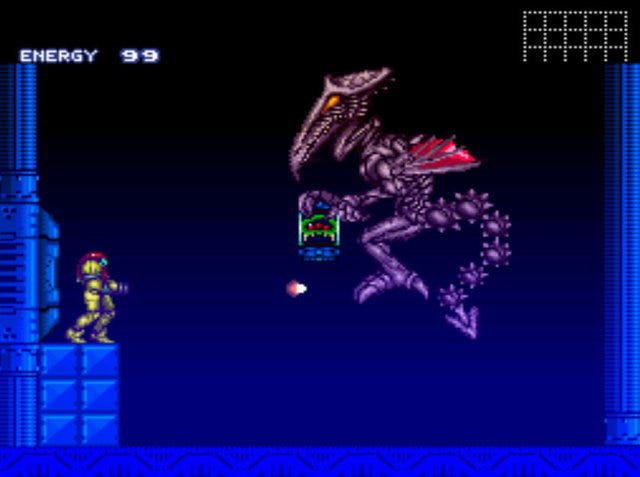
Super Metroid arrived in 1994, and I already gushed embarrassingly all over its face a few weeks ago when it popped up on the Wii's Virtual Console. Everything that needs to be said can be found through that blue text portal, but for those who are click-shy it really is this simple: Super Metroid takes all the good, often great, ideas from the first two games and realises them in gorgeous SNES-o-vision. Not only was the gameplay absolutely beautifully pitched, taking the free-roaming concept of the first game and bringing it to life with smart epic design work and a dramatist's sense of pace, but the game took the idea of the last surviving Metroid and actually spun it out into a poignant story that both made sense and required Samus to become a character rather than a mere avatar. Thematically rich and thrilling to play, Super Metroid took the series to new heights and won over a new legion of fans.

So, having released one of the most timeless and beloved games in the history of the medium, what would you do next? If you're Nintendo, the answer is, "Put it on the shelf and leave it there for the best part of a decade."

We apologise for the interruption...

Admittedly, the fact that - Samus's cameo in Super Smash Bros aside - the series skipped the N64 completely could be down to the fact that legendary Metroid producer Gunpei Yokoi left Nintendo under a cloud in 1996. Having started on the production line in 1965, back when Nintendo was churning out playing cards, Yokoi earned his reputation by designing the Game & Watch handheld LCD games and the world-conquering Game Boy, but then promptly pissed on his own chips following the debacle that was the disastrous 3D headache machine, Virtual Boy. Only a few years after leaving Nintendo, while developing the WonderSwan handheld for rival Bandai, Yokoi was killed in a car accident.

Of course, it's doubtful that this sad turn of events directly resulted in Metroid's hiatus during the rest of the 1990s - "We were thinking of ways to produce a new Metroid title," Shigeru Miyamoto has said of those wilderness years. "We couldn't come up with any concrete ideas at that time," - but it certainly didn't help that the rest of the Nintendo stable had successfully made the leap into the bright new 3D N64 world. Samus was left looking a little bit like a relic to the new generation of polygon-loving joykids. A revered and respected relic, sure, but a relic all the same.

Fans would have to wait until 2000 for Nintendo to announce the return of Metroid, with two new games planned - Metroid IV, a direct sequel to Super Metroid for the Game Boy Advance, and Metroid Prime, a new first-person adventure for the GameCube. The two games, it was declared, would also use the GameCube GBA cable to offer unlockable content across the two games, with success in the handheld version opening up an emulated version of the original Metroid and completion of Prime opening up the Fusion costume for repeat play. In the end it took two years for Metroid IV to arrive, by which time it had been redubbed Metroid Fusion.

2002 - Metroid Prime and Metroid Fusion

'The History of Metroid' Screenshot 3

After such a long wait it's hard to blame fans for being a little sniffy about the game's deviation from formula - Samus now took orders from an AI computer containing the brain patterns of her former commanding officer, Adam, and is thus less free to explore at will - but in retrospect it's still a fine game, one of the best on the GBA, and a worthy continuation of the saga. Indeed, with its 2D side-scrolling format the jump from Super Metroid to Metroid Fusion is virtually seamless, despite twelve years between them.

Fusion was also unusual in that it was the first Metroid to be released in the US before Japan, and this continental shift was also evident in Metroid Prime, the first Metroid game to be developed by an American team - in this case, the Texas-based Retro Studios. Shigeru Miyamoto personally oversaw the project from Japan, while Super Metroid composer Kenji Yamamoto provided the soundtrack - the only game element not created entirely in America. Both games were released on the same day in the US but, in a situation that was already becoming sadly predictable, we poor slobs in the PAL territory had to wait another five months to get our hands on it. Indeed, many commentators still maintain that having Prime miss the Christmas period was the final nail in the GameCube's coffin as far as Europe was concerned.

Thankfully, once we finally got our misshapen claws on the damn thing in March 2003, the hype proved worthwhile. Just as the original Metroid had taken the prevailing 2D platform template of its time and bent it into something new, so Prime took the first-person shooter framework and transformed it into something unmistakably Metroid. As before, the game was open and free-roaming but progress was dependent on acquiring the right beams to open doors or suit upgrades to survive hazardous environments. And, again, shrewd players could take advantage of the game's design - and the new addition of realistic physics - to nab items ahead of time, or to bypass certain chunks of game entirely. The story, meanwhile, closed the book on the classic Metroid trilogy and started a fresh storyline which would squeeze into the chronological narrative gap between the original Metroid and Metroid II, revolving around those pesky space pirates and the all-new monster entity known as Metroid Prime. Hence the name, you see.

Despite initial misgivings about the FPS approach, Prime was greeted with great whoops of joy by critics and gamers alike, with our very own Tom serenading it, with the words "a game so mesmerising that it has stirred emotion in even the curmudgeonliest of games writers" and a cake in the shape of a giant 10/10. Kristan was slightly less tumescent with his praise, in a rare double-team review, declaring that the "true mark of its genius is that even when it annoys the hell out of you, the compulsion to keep on playing never wanes". His cake was therefore only shaped like a nine, but it did have those crunchy silver sugary ball things sprinkled on top.

After being lost in limbo for more than a decade, Samus Aran was once again a hot property and this time Nintendo wasn't about to let her gather dust. Metroid: Zero Mission, an enhanced GBA remake of the original game, was swiftly on the shelves, taking the classic gameplay and throwing some new cut-scenes, areas and enemies into the mix. "One of the finest titles in the GBA's already impressive pantheon of platformers" quoth the silky tones of Rob Fahey. Not content to give the old dear a makeover, the untampered 1986 version was also released as a standalone GBA cartridge as part of the notoriously overpriced NES Classics range. Given that the exact same game could be unlocked for free in both Zero Mission and Fusion, this wasn't a particularly great deal. "Truly dire stuff" scowled Kristan, although the review says it was by Tom [bugs in the system - bugs Ed], which made me very confused. Now, of course, we have the Virtual Console where NES games are only moderately overpriced...

Ahem.

2004 - Metroid Prime 2: Echoes

Metroid Prime 2: Echoes arrived with uncharacteristic swiftness in November 2004, just under two years after Prime rolled up in Europe. This time, thankfully, we managed to get the game at the same time as the rest of the planet. While such punctuality is usually the sign of a rushed cash-in, Echoes was far from a quick copy of Prime, and actually managed to introduce several major new features. The story, which centred around the planet Aether and a battle between the Luminoth and the Ing (plus some space pirates, naturally), found Samus voyaging between light and dark dimensions in much the same way that Link hopped between magical planes of existence in A Link To The Past. This schism also introduced the character of Dark Samus, who was like Samus, only dark. And therefore evil. Echoes was also the first Metroid game to feature a multiplayer mode, allowing gamers to tackle each other in four-player deathmatches. This, technically, also makes it the first Metroid game where you can play as characters other than Samus.

But it's simply not Metroid without an unfathomable wait, so your generous Eurogamer made fans hang around for almost a month, pestering in EVERY BLOODY COMMENTS SECTION before Kristan finally spake forth with his verdict. The addition of multiplayer didn't exactly make him swoon - "tacked on for sake of it" he sighed from deep within his mahogany cigar-scented drawing room - but the game itself was once again greeted with rapture and fawning admiration. Yes, dear reader, he really did say it was better than Halo 2. And, deep down, you know he was right.

Such loving reviews didn't do much to prevent the game getting absolutely flattened in the 2004 Christmas rush though. Despite being hailed by critics as the best thing since sexual chocolate, Samus was left bloodied and crushed by the grinding wheels of franchise behemoths like San Andreas, Half-Life 2 and that little Master Chief game I mentioned a moment ago. Clearly, the moribund GameCube was no place for a classy lady - even if that lady was packing missiles and an ice beam.

2005 to 2007 - The DS and Wii years

'The History of Metroid' Screenshot 4

A new generation of hardware was dawning, and this time Metroid wasn't missing out. Metroid Prime Pinball helped to launch the Nintendo DS Rumble Pak and, as the name cryptically suggests, retold the story of Metroid Prime through the medium of pinball. 4/10, then.

This was followed in May 2006 by Metroid Prime Hunters, demos for which had been frothing the fanbase since the release of Echoes. One of the first FPS games on the DS, Hunters pitted Samus against rival bounty hunters and also marked the first online multiplayer mode in the Metroid series, but such additions weren't enough to compensate for what many found to be rather lacklustre design compared to our high expectations for things bearing the Metroid name. It crept its way up to an 8/10 under the Eurogamer microscope, but even then the praise consisted of words like "competent" and mutterings about "flimsy" online play.

Which brings us to Metroid Prime 3: Corruption, now finally in the shops following an interminable wait - it was supposed to be a Wii launch title, after all. A wise man declared it "one of the best games I've played all year", and that man was Kristan who you'll realise - if you've been following carefully - has been prodding you lot to buy these fine, fine games for many years. Are you going to pay attention this time? Let's bloody hope so. With Nintendo's hand-waggling wonderbox, the all-new Samus finally has a hit console beneath her immaculately groomed cyberfeet rather than the rapidly sinking GameCube, so maybe she'll finally get the audience she deserves.

'The History of Metroid' Screenshot 5

And what of the future? Rumours farting around the infosphere since 2005 have insisted that a new 2D Metroid for the DS, codenamed Metroid Dread, was on the way. Metroid Prime 3 cheekily stokes the fires with a computer screen mentioning that "Project Dread is nearing completion" but, sadly, such talk is naught but poppycock and bally-hoo. Nintendo announced in September that there are no new 2D Metroid games planned. Though that doesn't rule out another 3D game, does it? Hmm.

Comments (27) Latest comment 4 years ago

Comments threads automatically close after 30 days, but please feel free to continue chatting on the forum!

  • HoriZon #1 4 years ago

    2 days! :)

    Great read, lots of Metroid goodness!

    I never knew Yokoi died in a car crash!
    Edited by 1 at 24/10/07 @ 18:31
  • ProtoformX #2 4 years ago

    Cannot wait for this. I'm a little apprehensive about how the looking/moving around will work out but the only way to find that out is to play it. :-D
  • menage #3 4 years ago

    Another Metroid history article (Edge and Games both had one). Interesting, but I know it by now.
  • Banksy #4 4 years ago

    CVG had a Metroid history, too, didn't they?
  • Charlie_Miso #5 4 years ago

    what! a chick?

    madness
  • Kazzahdrane #6 4 years ago

    I got MP3 yesterday and I can safely say it's the best control experience I've had so far on Wii. This game does for Wii what Phantom Hourglass did last week for DS. This is no fad, no silly kids toy, the Wii is *the* best console for first-person control.

    Apparently Medal of Honour Heroes 2 has even better control on Wii, so I can't fathom how that will work.

    Just make sure you set the control sensitivity to Advanced before you play (or during the game), as this is the mode that feels most like keyboard + mouse and gives you the most freedom of movement when combined with the Free Aim option.
  • Eraser #7 4 years ago

    Great article. Loved to read it.
  • JohnnyWashnGo #8 4 years ago

    Cant wait to get my hands on this. However, I predict that after 5 mintutes of playing around it will be put on my 'to play' shelf and left until I get around to playing and finishing final fantasy 12, valkyrie profile silmeria, super paper mario, ouendan 2, grim grimnoire, portable ops + and phantom hourglass.

    God writing that just depressed me, so many games and so little time :(
  • huxathon #9 4 years ago

    bought mp2 while i was waiting for the new one and got quite far in to it, then lost my GC memory card. great. why can't we save GC stuff to the wii flash?
  • JetSetWilly #10 4 years ago

    Great article, cheers.

    Can't wait for tomorrow.
  • Killerbee #11 4 years ago

    Exellent. More of these sorts of things please.

    /settles down to read
  • reality_cheque #12 4 years ago

    Super Metroid was awesome. I loved that game!

    Not played any of the Cube ones though, might have to dig them out of a bargain bin :)
  • andromeda #13 4 years ago

    "Yes, dear reader, he really did say it was better than Halo 2. And, deep down, you know he was right."

    Biggest understatement ever..they shouldnt even be mentioned in the same sentence.
    If Metroid Prime was Battlestar Galactica then Halo is Star Trek : Nemesis.

    good article anyway thanks!
    Edited by 1 at 25/10/07 @ 10:01
  • Killerbee #14 4 years ago

    The original Metroid Prime ranks as my #1 favourite game of the Cube/PS2/Xbox generation of consoles. Gloriously designed and as near to perfect as any game in the FPS or adventure genres has ever got. Only Civilization and Tetris rank better imho.

    Hopefully my copy of MP3: Corruption will be waiting for me when I get home tonight...
  • riz23 #15 4 years ago

    Well that was fun to read. Cheers!
  • VMerken #16 4 years ago

    The Primes were awesome and personally, I'll take them over a certain other franchise mentioned in the article any day.

    Great, yet bizarre music (I don't know what the composer uses, but I want some =), lots of things/info to discover, free roaming, cool weapons and tools, nice graphics and effects, and all the little quality touches you'd expect from a 1st party Nintendo release.

    Apart from Wars, it's also the only Nintendo franchise I can still stomach.
  • RedPanda #17 4 years ago

    Post deleted at 14:31:59 28-01-2012
  • Raya #18 4 years ago

    I got it on Monday - hypermarket obviously didn't know it's release date!
  • Razz #19 4 years ago

    OMG! Dan Whitehead wrote a competent article! :o :o :o
  • dirigiblebill #20 4 years ago

    'Tumescent'? 'Gushing'? 'Tissues'? This article is a study in innuendo. Not getting any at the moment then, Dan? ;)
  • wellzy4eva #21 4 years ago

    My favourite version of the history of Metroid is the Retrospective done by Game Trailers.

    [link url=http:// www.gametrailers.com/retrospective.php
    ]http://ww w.gametrailers.com/retrospectiv...[/link]
  • Hulle #22 4 years ago

    Great article. Thanks.
  • Raya #23 4 years ago

    Oh forgot to mention to MP3 looks spectacular! My cube games never looked like this ;-) You can see that a ton of work has gone into the look - dunno why there was such a big debate on it being too cubey.

    Yes it plays very well, aiming is very cool - bit more spoon fed though - a couple of hours in and I hadn't used the map!
  • StringBeanJean #24 4 years ago

    Metroid! Metroid! Metroid! Metroid! Metroid! Metroid! Metroid! Metroid! Metroid! Metroid! Metroid! Metroid! Metroid! Metroid! Metroid! Metroid! Metroid! Metroid! Metroid! Metroid! Metroid! Metroid! Metroid! Metroid! Metroid! Metroid! Metroid!
  • The_Inquisitor #25 4 years ago

    I didn't risk buying this online, I'll be down the shops first thing.
    Might have to fit in some Metroid Prime tonight, just spent the last week playing Super Metroid. : )
  • Razorus #26 4 years ago

    "...the praise consisted of words like "competent" and mutterings about "flimsy" online play."
    ENNNEERR!!! The online play was fantastic for a DS game. Bite your tongue right now!

    Anyway yeah. metroid for the win I suppose.
  • smelly #27 4 years ago

    "- bit more spoon fed though - a couple of hours in and I hadn't used the map! "


    Wooohoo!! That comment has actually sold me on buying it.. off to ebay i go.