The Chronicles of Spellborn
Humble origins.


The Chronicles of Spellborn is at its weakest when it lapses into the familiar. Level-up dings replete with swirly animation and several minutes spent contemplating where to spend points. Courier quests. With a shoestring budget and no significant publishing muscle behind it, it's an MMO that can ill-afford comparisons to WOW and WAR. Fortunately, this sort of thing is relatively uncommon. It may be guilty of reaching back into established convention for support, but for the most part Spellborn strides out into unknown territory.
Set in a wholly original fantasy world, the game casts you as a novice militia member in the city of Hawksmouth, a medieval metropolis that sits on one of a large number of floating shards that make up the game-world. Once, this was a single planet, but when the game's races - humans and oddly-jointed Daevi, the differences being purely visual from a gameplay perspective - rebelled against their demon overlords, the world was shattered.
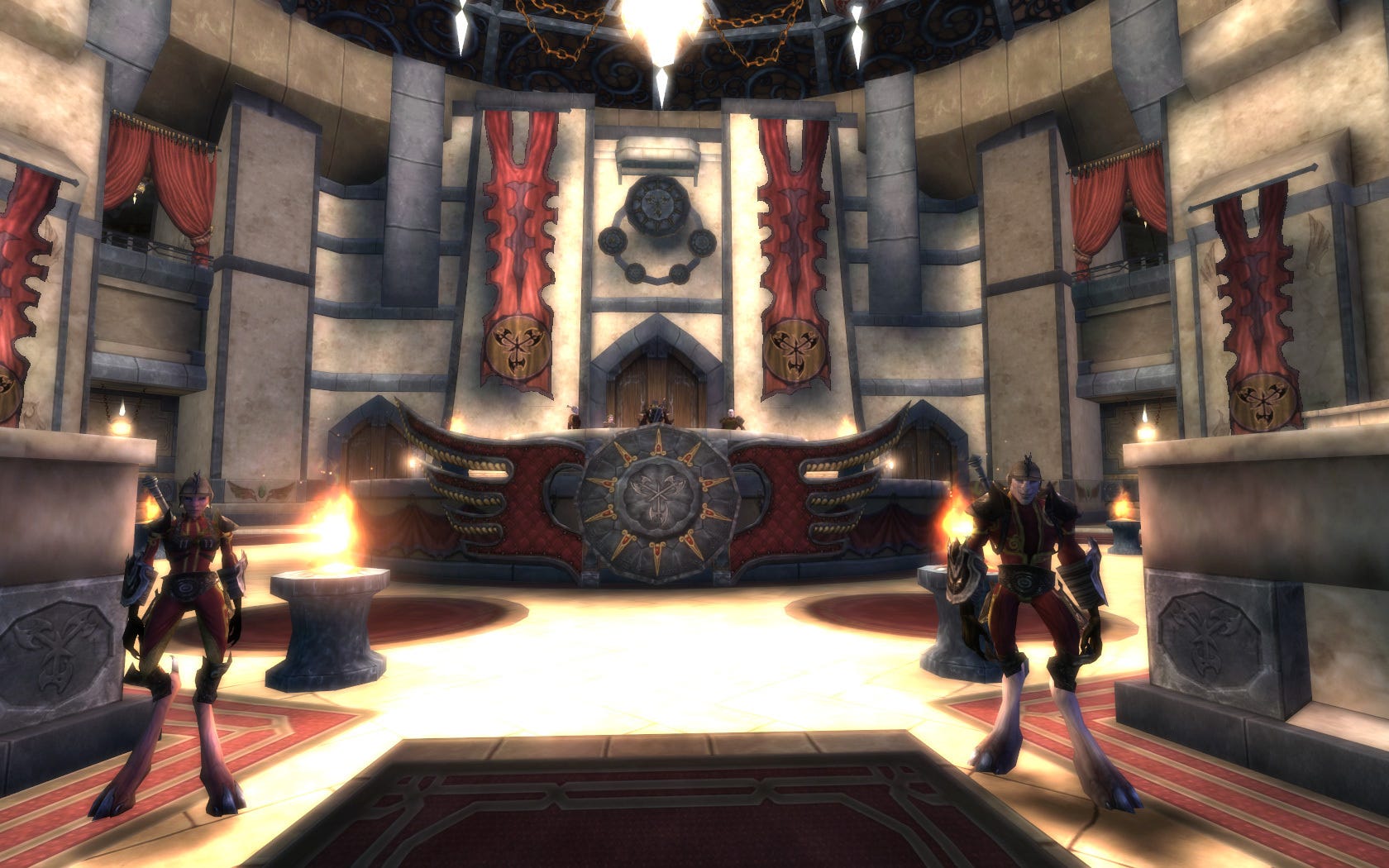
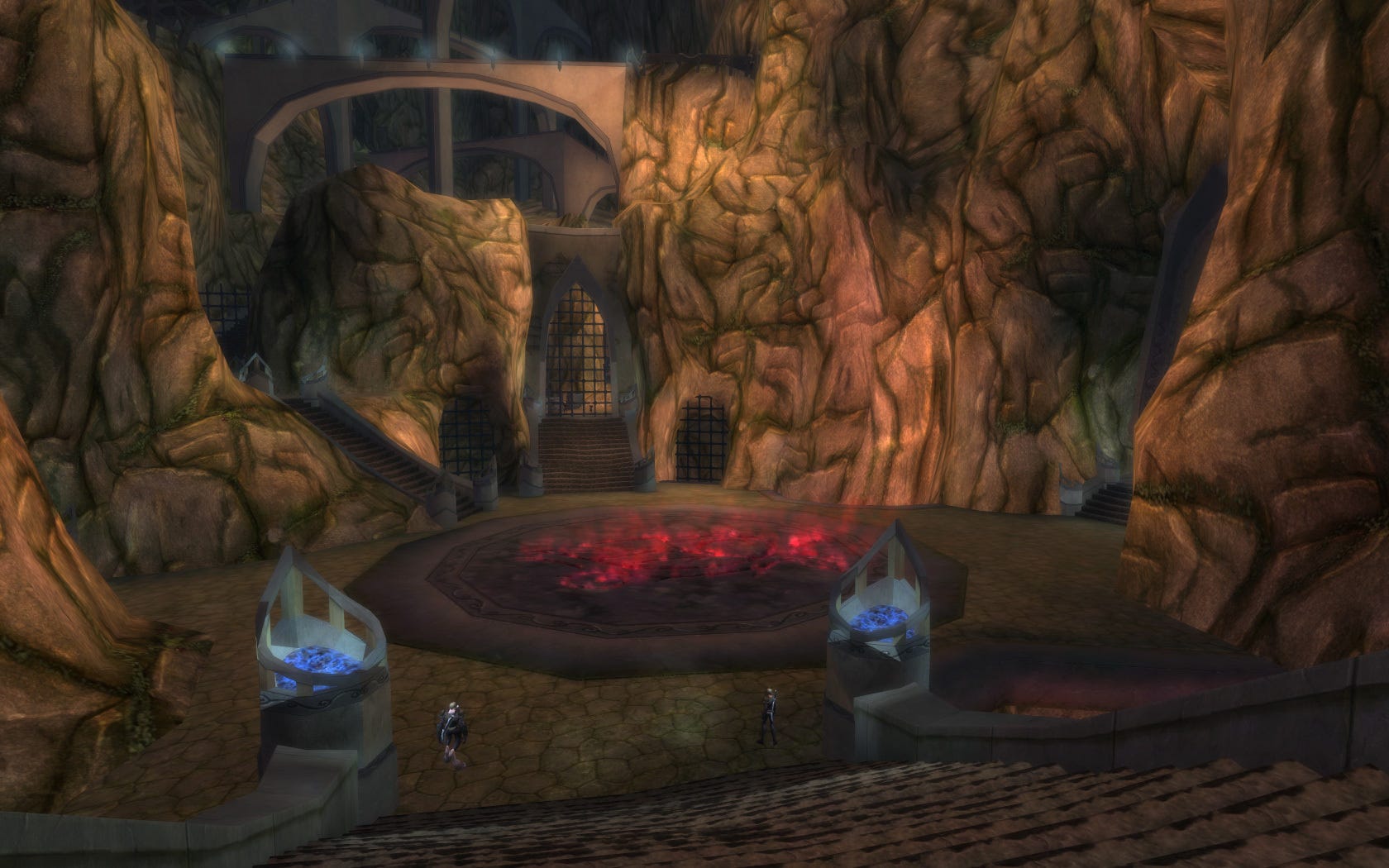
The result is an art style wildly different to other MMOs. The shards are enclosed worlds; when you look up, you see the roof of a stone cavern far overhead, with light streaming through holes in the firmament. Huge slabs of stone, tossed about casually in the Sundering, erupt from the landscape, while shards of glowing crystal provide ghostly illumination for the many forest glades. Combined with the truly lovely environmental art, the unique setting makes for a game that's a joy to explore. Soft edges and diffuse lighting abound, with beautifully composed incidental music and background sound giving the whole game an evocative twilight feel. On occasion, Spellborn tries to wow you with spectacle - the epic home buildings of the High Houses being a perfect example - but it's usually more interested in a delicately woven atmosphere, and it's all the better for it.
If the visual style is unique, however, that's just the start. Within the basic conventions of quest-givers, structure and experience, Spellborn fills in the details with a wholly original hand, relying more heavily on skill and forethought than on gear or statistics. For instance, where other MMOs (most notably Age of Conan) have tried to reduce the prominence of gear by making its stats less important, Spellborn goes one further. During character creation, you select from a wide range of nice-looking armour and weaponry, it's all available to every archetype, and there's more to find as you progress, but it's all completely cosmetic.
Rather than focusing on gear, the game emphasises the importance of skills, bodyslots and sigils. Skills are acquired as you level up, although you'll have to make decisions about which ones you purchase, at least initially. Bodyslots become available at level five, when you make a decision about which character archetype to follow (there are three paths for each, with slightly different abilities and roles). They are essentially umbrella skills, which influence everything you do in combat - reducing damage taken from melee weapons, for instance, at the expense of increasing ranged weapon damage. You equip several of these and then select the most appropriate one with the function keys.
Sigils, meanwhile, are the closest thing that Spellborn has to actual gear, and they're still a long way removed. Sitting in slots on your armour pieces, they don't pop up until you've been playing the game for quite some time, and each can be detached from the armour it's on and stuck elsewhere. It's hard to predict, at this point, whether sigils will be as central to the endgame as gear is in games like WOW, but everything the Spellborn team has said on the subject indicates otherwise.
Instead the developers seem more interested in player skill and strategic planning, and the former's a particular breakaway, as Spellborn completely dispenses with behind-the-scenes dice rolls. No longer do your attacks have a chance to miss, or your defences a chance to dodge, so if you want to hit a creature with an attack you need to be targeting it. To dodge, jump out of the way. Want to land a critical hit, find a way to get behind your enemy and stab them in the back.
In itself, this means that the combat is significantly faster and more action-focused than in other MMOs. It's not, however, a change made without careful consideration. To prevent players from spamming fast attacks, the game introduces penalties for missing with powerful attacks - often, if you fire one off without targeting properly, you'll damage yourself or reduce your stats. Equally, it recognises that movement and turning speed are absolutely crucial to victory. As such, many attacks either provide a boost to your own movement speed or a reduction in your foe's speed - arguably the most powerful and relevant buffs and debuffs in the game.