Tekken 6 Preview

Iron fisting.

"Europe is kind of a big deal for us." Katsuhiro Harada, producer of Tekken 6, is eager to point out that this visit to London is much more than a matter of courtesy. While the latest title in Namco's esteemed 3D fighting lineage dominates Japanese arcades, more than 90 per cent of Tekken's console sales come from the West. Of these, more than half of the series' 33 million sales were made to Europeans, who were responsible for almost two thirds of Tekken 5's global sales. As far as Harada, his team and his game's autumn release on PlayStation 3 and Xbox 360 are concerned, Europe is kind of a big deal.

This importance has been heightened by the fighting game resurgence sparked by Street Fighter IV's overwhelming success on consoles. More gamers than ever are interested in fighting games, willing to take a chance on a genre that may have previously seemed impenetrable and exclusive. And Tekken has always provided a middle ground for those players for whom Virtual Fighter seems too technical, or Street Fighter too frenetic, providing an everyman experience that places just as much focus on over-the-top throws and acrobatics as frame-counting elitism. As such, its release is well-timed to ride the crest of Street Fighter IV's success, even if the two offer very different experiences.

But despite the debt that the current zeitgeist owes Ryu et al, Harada is dismissive of the threat Capcom's latest poses his game. "Street Fighter IV came to arcades six months after we released Tekken 6 and, right from the off, it only achieved around half of the income we were taking in Japanese arcades. Today Tekken 6 remains the most popular fighting game throughout Japan, long after its initial release. I think Capcom's mistake in this regard was leaving such a long gap between releases. With Tekken, we keep a fairly steady flow of new titles coming, something that helps keep the brand in the public consciousness and keeps the more serious players invested."
1

The arcade versions of Tekken 6 are networked in Japan and Korea, allowing the team to extract a great deal of information to help balance this console version.

Some might argue that the regularity of new Tekken titles has resulted in a general ennui towards the brand. Where once upon a time Tekken was a system-seller for Sony, showcasing the cutting edge of graphical achievement on the original PlayStation, today the technological steps are too small and too frequent to make much impact. "I disagree," says Harada. "Tekken 6 is the first game in the series to maintain a constant 60 frames per second during play. This is an extraordinary technical achievement that greatly effects the way the game plays." For Harada, it seems, this is a far more important selling point than effects or flashy camera angles. "Many fighting games run at 30 frames per second but, no matter how impressive their visuals are, the underlying implications of the frame-rate are much greater."

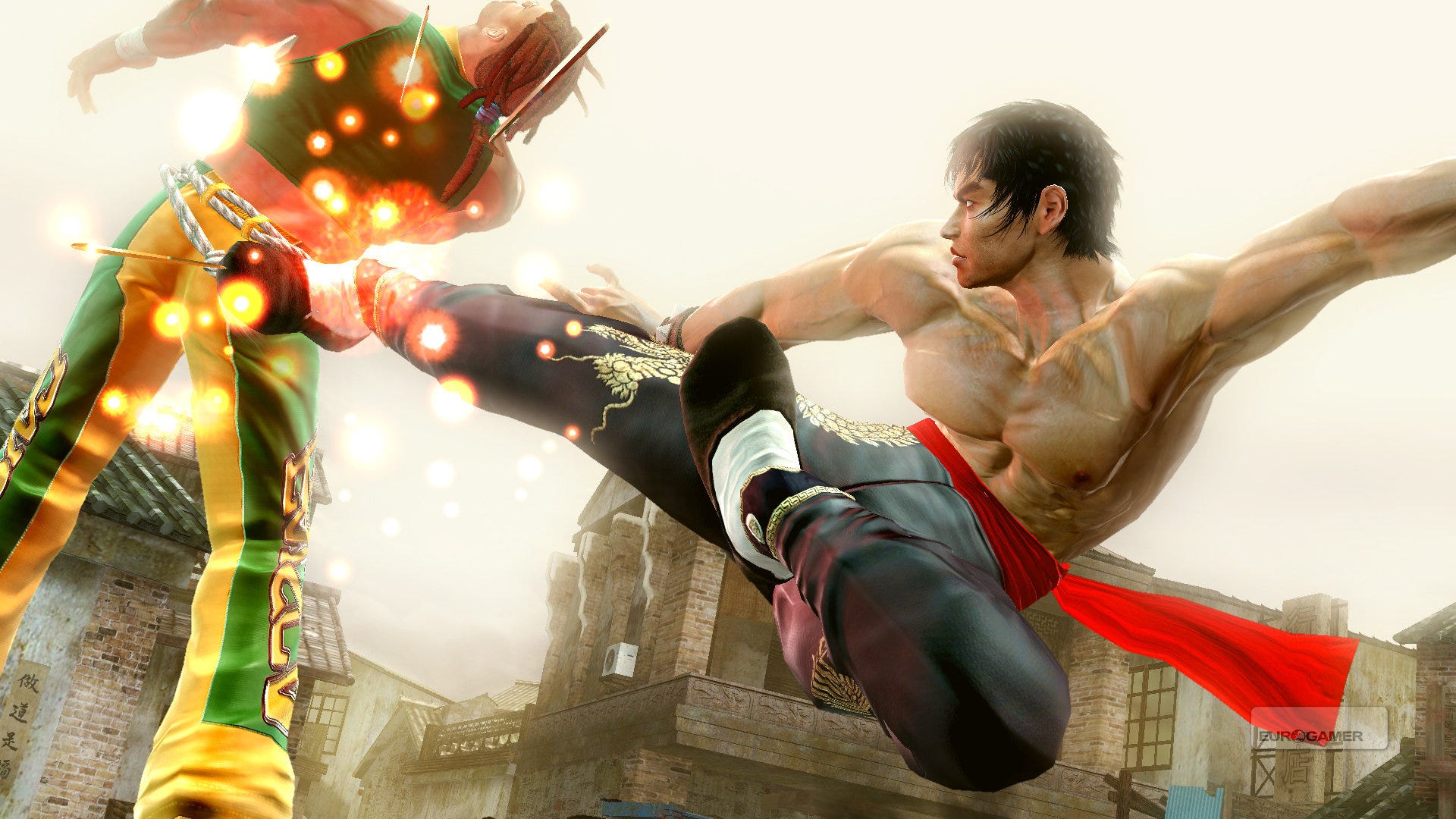
That's not to say Tekken 6 is devoid of effects or visual bombast. The team is clearly very proud of the new 'full-time variable animation' effect it's added to the game, a filter that blurs the transition of character animation between each and every frame, increasing and decreasing the intensity of the effect depending on the speed of a character's limbs and the force of an impact. Now every transition from kick to punch appears natural and fluid in a way that makes its predecessors seem jerky and stuttering. When combined with the other visual upgrades included in Tekken 6's arcade revision, Bloodline Rebellion (upon which this home version is based), the effect is impressive. Here day turns to night during battles, a setting sun casting hazy shadows through the air behind characters, the dramatic lighting emphasising the drama of each bout, the evening air rippling with the force of each counter blow.

Stages too are interactive in a way that's entirely new to the series, if not to fans of rival Tecmo's Dead or Alive. Walls shatter, expanding the play area one moment, while floors disintegrate, throwing both players into a tiny cellar with far more limited floor space the next. These real-time changes in environmental space force tactical adjustments from moment to moment. The environments can also be used to extend combos, players free to bounce their opponents off walls and floors to extend the length of hit strings, ensuring those with good enough timing can chip away at their rival's health with long, impressive chains.

Of course, getting to grips with the hundreds of different combo strings in the game is another matter entirely: Tekken 6's character roster runs to 40, the largest yet seen in the series. We ask Harada what the benefits and drawbacks of including so many distinct characters are for the game. "The benefits are pretty compelling," he reckons. "By providing a broad range of different designs and fighting styles we think it's possible for everyone to find a character they are comfortable with. It also decreases the chance of everyone picking the same few characters. However, there are many drawbacks to this approach to. Balancing the game becomes a nightmare as the set of variables increases exponentially. Also, having to develop storylines, movies and distinct move lists for such a broad range of characters pushes the cost of development sky-high. But on balance I think it's worth it."

No expense has been spared in delivering the definitive version of Tekken 6 to PlayStation 3 and Xbox 360. The number of bonus modes and extras is dizzying. Chief amongst the bonuses is undoubtedly the scenario campaign mode, an overhauled version of the Tekken Force seen in previous titles, that transforms the one-on-one fighter into a Streets of Rage-style scrolling beat-'em-up. Here the control system becomes a hybrid of the conventional move-sets with free movement - each character enjoying their full move list from the main game, yet now able to run around long environments filled with multiple enemies.

2

When a character's life gauge flashes red they enter RAGE mode, something that considerably powers up every attack till the end of the round.

Players can team up with a friend over PSN or Xbox Live and it's by playing through this mode multiple times that the huge array of bespoke clothes and accessories are unlocked to customise characters. Unlocking the full range of customisable options for all 40 characters will likely take hundred of playthroughs, a focus that means the developer has spent a great deal of time smoothing over what has previously been an awkward transition from one genre to another.

It's clear that Namco is hoping players will invest more than just their time into this Tekken release. Timed to coincide with the game's release, the publisher has teamed up with legendary Japanese arcade stick maker HORI to release a GBP 150 wireless 8-button stick that will compete for the affections of the hardcore with Capcom's Street Fighter IV Tournament Edition. Additionally, a UK tournament commencing around Fresher's Week will run in city centres across the country, culminating in a grand UK finale in early November. Clearly Capcom's successes in promoting Street Fighter IV to the nation in similar ways earlier this year have not gone unnoticed.

However, whether Tekken 6 can replicate its rival's success is as much down to the mechanics as the promotions. "I'm certain this is the best Tekken we've made so far," Harada enthuses. "We've tweaked and balanced and carefully considered every decision that's been made along the way. With each new release in a big franchise like this you have to sit down and decide where you're going to go next. Now that we've nearly arrived, I think we've charted the right course."

Tekken 6 is due out for PS3 and Xbox 360 this autumn.

Comments (35)

Comments for this article are now closed, but please feel free to continue chatting on the forum!

  • Loading...hold tight!