Version tested: Wii
I've always been more concerned with improving my Street Fighter skills than keeping up with the latest Marvel or DC adventures, but when X-Men vs. Street Fighter hit the arcades - eventually evolving into the adrenaline-pumping Marvel vs. Capcom 2 - there wasn't a fighter fan in the land who could resist its crossover charms.
Here was an opportunity to dragon punch Spider-Man in the face, or pair-up Wolverine and Strider in a toe-to-toe showdown against Magneto and M. Bison. Needless to say, Capcom had hit upon something big.
The obvious difference with Tatsunoko vs. Capcom is, rather than wondering if Capcom have included Carnage as an unlockable character, you'll probably be saying, "Who the hell is Tekkaman?" This is because most of the included Tatsunoko characters are sourced from vintage seventies anime - the kind your average Shonen Jump fan will be unfamiliar with. What you can expect from the likes of Gatchaman and Neo-Human Casshern is a vibrant abundance of capes and PVC helmets.
However, once you play the game any issue of crossover continuity quickly becomes irrelevant. Ultimate All-Stars is an accomplished coming-together of shotokans and space knights, and for the first time in vs. history, everything is full 3D.
The design is top-notch and uses subtle cel-shading techniques to give each character a rugged Wii interpretation. Even the animation has been handled well with each fighter rapidly chaining their moves in seamless succession. But the 2D departure also means that unlike Marvel's cast of 56, Ultimate All-Stars has a more modest, though still impressive, select screen of 26.
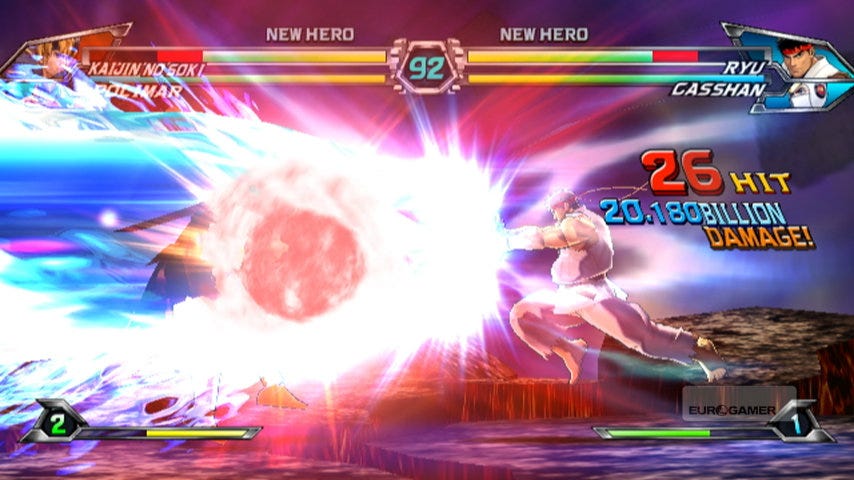
For any chance of pulling off a decent chain combo, invest in a GC pad, classic controller or Madcatz FightStick.
Apart from Daimao, every character from the "Japan-only" Cross Generation of Heroes has made it into Ultimate All-Stars. The street fighting Ryu, Chun-Li and Alex, as well as Batsu from Rivals Schools and Soki from Onimusha, are representing Capcom. We also get the machine gun toting Saki from Quiz Nanairo Dreams - an obscure Capcom dating sim. Still, beats Captain Commando.
Characters returning for Tatsunoko include Ken the Eagle and Jun the Swan - who Western audiences may recognise from Battle of the Planets - as well as the crime-fighting Polimar and the canine-cuddling Casshan. But as the only character created during this century, the demonic swordsman Karas, is the more unique inclusion. His Hiei Zangetsu level-three super is also one of the most brutal.
Capcom has garnished Ultimate All-Stars with five new faces, including Dead Rising's Frank West. His moveset is reminiscent of Jill Valentine from Marvel as he can call upon zombies to attack from each side of the screen, as well as bundling them into shopping trolleys for projectile attacks. Frank also gets his own zombie-infested mall stage, but unfortunately he seems to have forgotten the art of the flash kick.
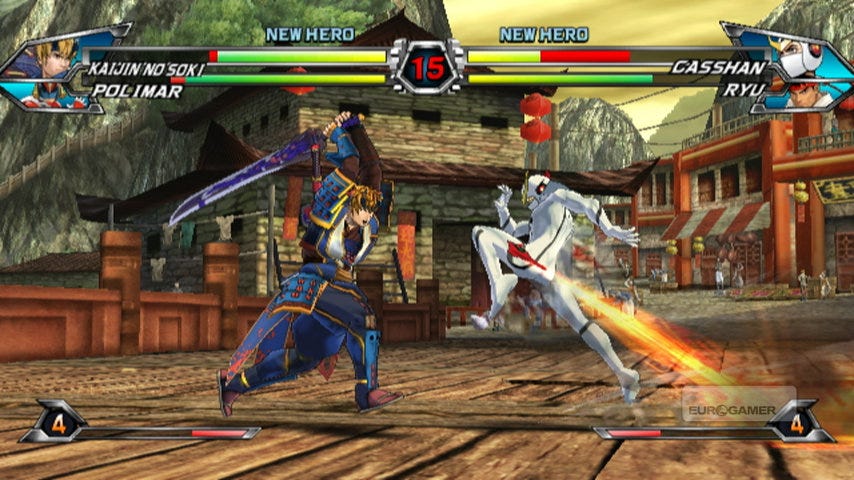
In addition to choosing a tag-team, players can also pick Tatsunoko’s Gold Lightan and a PTX-40A Vital Suit from Lost Planet.
The only other new Capcom character is Zero, who makes it into Ultimate All-Stars with a generic dragon punch and sonic boom. But to spice things up, Capcom have given the Mega Man rival his own custom-combo super.
Moving on to the new Tatsunoko trio we have Tekkaman Blade - who I can only guess is different from Tekkaman in the same way as the white and green Power Rangers. As a regular player of Tekkaman in Cross Generation, I can say that Blade has a few similarities, such as a button-mashing hundred-hand-slap like attack, but overall he feels more rushdown.
The other new bloods are Joe the Condor, another member of the Science Ninja Team with good combo-ability and fast projectiles, and the irritating to unlock Yatterman-2 - essentially Yatterman-1's missus and fairly handy with an electric baton.
For those who've not played Cross Generation the Tatsunoko fighting system can be seen as similar to Marvel, but with some significant changes - chief of which is the four button layout. By doing away with separate buttons for punches and kicks, Capcom has instead streamlined everything down to light, medium and heavy which, regardless of your Street Fighter experience, is fairly intuitive.
Another major difference is that we're back to the classic 2v2 tag-teams, with team tactics accessed via the fourth Partner button. But in a nutshell Tatsunoko is a slightly slower and more user-friendly Marvel, without losing the ability to pull-off crazy 50+ hit combos.
Tech-wise Tatsunoko also shares many of Marvel's more advanced mechanics, with hardcore players using Air Combos, Delayed Hyper Combos and Variable Combinations in-order to send the "billions" damage rating skyward. New systems are also introduced via the Variable Air Raid, Mega Crash and Baroque Cancel, with the Variable Air Raid giving the option to tag-out during an Air Combo, and the Mega Crash allowing you to interrupt the opponent's combo at the cost of one super stock.
Baroque Cancelling meanwhile isn't entirely dissimilar to Street Fighter IV's FAD Cancelling, but in effect works more like the classic Roman Cancelling from Guilty Gear. Overall these new systems add a bit of extra depth but don't change the pace dramatically.
It's a similar situation for the available modes. Capcom has furnished Ultimate All-Stars with all the usual suspects including arcade, versus, survival, time attack, training, shop and gallery. Nothing groundbreaking, but at least they've bested The King of Fighters XII.
Seeing Frank West don a full Mega Man costume for his Real Mega Buster super is a real high point.
The arcade mode also finishes with a fight against Yami, the end boss from Okami. This angry sphere of calligraphy has to be tackled over three stages in a similar style to Marvel's Abyss, but good timing and a solid defence will see most players through quickly.
After completing the arcade mode you're rewarded with a short piece of storyboard narrative. These are character specific and best described as fevered fan fiction. Expect to see Doronjo facing off against Devilotte from Cyberbots, as well as Tekkaman Blade and Hayato teaming up to take down Ghost Bilstein from Plasma Sword. Things get crazier still when Ken and Joe have an argument after Joe uses a Bird Missile to blow up the castle from Haunting Ground. Suffice to say the odd fanboy smiled will be raised.
But what didn't amuse is the online experience, as my hands-on with Ultimate All-Stars has so far been wobbly. All the functions are in place, with ranked and player matches as well as the ability to fight friends and players added as rivals, but the netcode hasn't shown itself to be particularly sturdy.
Developer Eighting has done an excellent job of balancing the two factions for high-level play.
Indeed, so far it's been a bit of a lagfest, although this may be down to the lack of local players at the time of writing. Either way this is cause for concern as initial impressions suggest Ultimate All-Stars isn't as stable as Street Fighter IV. Once the game is released the situation may improve.
In summary Ultimate All-Stars is a highly polished fighter that strikes a good balance between casual accessibility and mechanical depth. Although the Tatsunoko element doesn't have the same western appeal as Marvel, it doesn't tarnish a familiar fighting system that offers new tech and fresh characters.
To say it's a good stopgap for Super Street Fighter IV would be an injustice, as it's a fighter that stands out on its own merit. Those who look beyond the tinted visors will discover not just an excellent Wii game but an all kinds of awesome
2D fighter.
8 / 10
