Tabula Rasa: Getting Started

Tough love for new recruits.

Character Creation

It may have had a rough ride in the press recently, but there's still a lot to love about Tabula Rasa. Of all of 2007's massively multiplayer launches, it's arguably the most interesting and ambitious - the science fiction setting, the emphasis on weapon switching and tactical positioning, and the brilliant "cloning" system which cuts much of the grind out of trying out new character classes are just a few of the ways in which Tabula Rasa sets itself well apart from the competition. In a market full of WOW-alikes (and, frankly, rather full of WOW itself), a bit of solid innovation is a definite short-cut to our hearts.

However, that same innovation can be a bit daunting for new players getting into Tabula Rasa - no matter how seasoned they are at MMOs in general. For newcomers to the genre who are interested in Tabula Rasa's sci-fi style and more action-focused combat, it's even more intimidating.

On that note, we've put together a guide to the fbasics of Tabula Rasa. For new players struggling to get to grips with the game, this should give you a fair idea of how things work - but it's also aimed at those of you sitting on the fence. We hope it gives you a pretty good taster of what it's like to play TR, and whether it's something into which you should invest your precious cash - and even more precious time.

As with most RPGs, your first task in the world of Tabula Rasa is to create your avatar. This isn't something you'll spend especially long doing, though, because the range of options available at the outset is very limited indeed. TR doesn't have any races, as such - although "hybrid" types can be unlocked later on in the game, everyone is human at the outset. An even more surprising simplification is that TR doesn't let you choose a class at this point either. You start out as a raw recruit, the same as everyone else, and won't get to specialise until you've advanced a few levels.

As such, character creation is really just a matter of choosing your look. The one thing to take note of is your choice of surname for your character. In Tabula Rasa, every character has a given name and a surname - and all of your characters will share the same surname, so choose wisely.

Bootcamp Blues
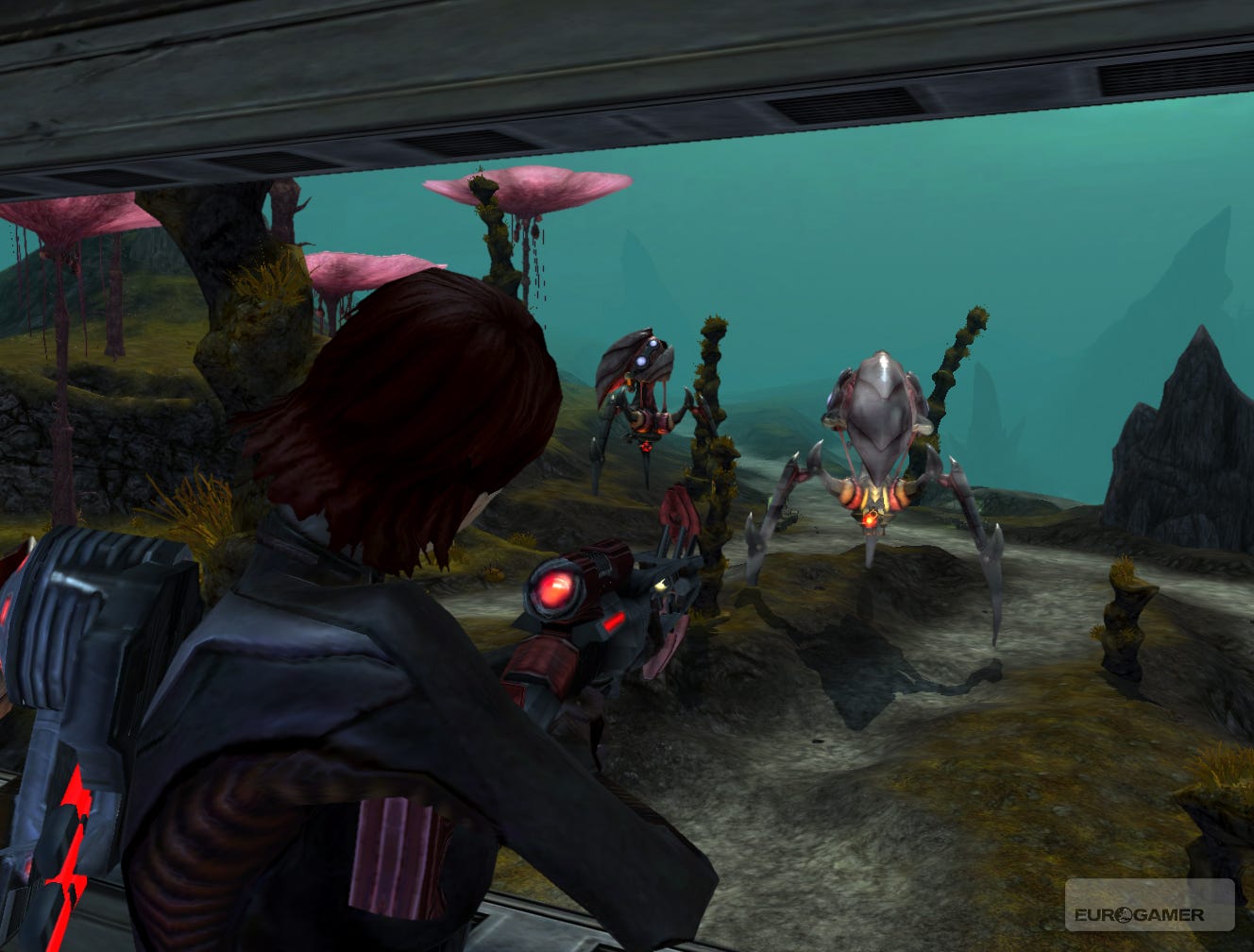
'Tabula Rasa: Getting Started' Screenshot 1

We prefer this over-shoulder view for battle encounters.

Your first port of call is the Bootcamp - a special single-player zone that'll introduce you to TR's main concepts before you're dropped properly into the fray.

In some regards, the Bootcamp zone is one of Tabula Rasa's best features. It means that by the time you're actually doing quests around other players, you aren't at risk of getting utterly confused and looking like a fool. In other regards, though, the Bootcamp is a bit weak. TR is a complex game, and we understand that introducing every aspect of gameplay in the Bootcamp would have been impossible - but there are a few things players definitely need to know - about the weapons system in particular - that the tutorial zone just doesn't tell them.

Two keys worth noting about the user interface are T and Ctrl. The T key is your main method of interacting with the world - be it talking to people, pressing buttons, picking things up or opening chests. In most games, these functions would be on the mouse buttons - but Tabula Rasa saves those for combat, so T is your trusty "talk / interact" button.

Ctrl, meanwhile, is one of the nicer aspects of the game's user interface. It brings up a radial menu around the middle of the screen, with all of the game's main interface windows listed - no matter what you want to do, if you don't know the shortcut key for it you can find it quickly from the Ctrl menu.

A final point on the user interface, though - and one of the biggest bones of contention between fans and critics of the game. Tabula Rasa is heavily focused on combat, and it uses an action game style "mouse-look", where moving the mouse directly controls your crosshairs. This is different to most MMORPGs, where you have to hold a button to look about - and one of the consequences is that when you're using UI windows, with a mouse cursor on screen, you can't move your crosshairs.
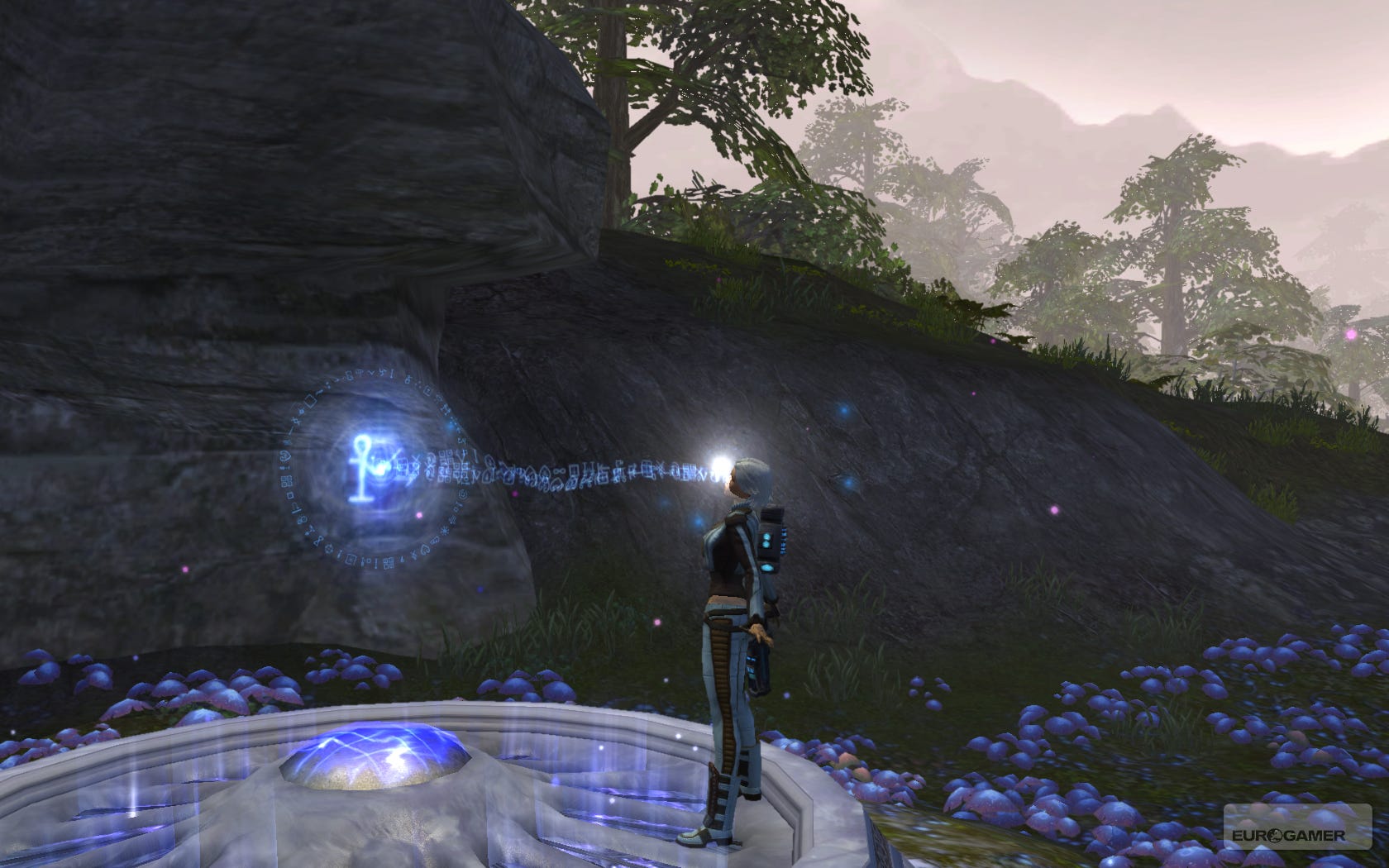
'Tabula Rasa: Getting Started' Screenshot 2

You'll gradually gather Logos as you play - these characters from an alien alphabet unlock magical abilities.

In a game which does a pretty good job of separating micro-management with UI windows from fairly intense combat, this isn't much of a problem for most players. However, if you do get stuck in a situation where you need to look around and can't, just remember to tap ESC a few times to shut your UI windows and bring you back into the action.

Looking Over Your Shoulder

Speaking of the action, that works pretty much as you'd expect an action game to work. Left click fires your gun, and right-click uses a magical or technological ability. You don't actually have to target enemies precisely, as you would in an FPS - the game selects the target nearest to your crosshair and automatically aims at that, and you can even lock on by pressing Tab. The longer you're aiming at a specific target, the more accurate your shots will be - indicated by the lines on the crosshair getting closer to the centre.

Another way of improving your accuracy - and the damage with some weapons - is to crouch down before firing. You do this with the C key, and it's definitely a good idea when you're using a ranged weapon. It's not hugely important early in the game, but it's also worth noting that you can get behind cover to avoid enemy fire (don't just stand there and soak up the damage, like you would in most MMORPGs), and that some enemies even have different armour on different parts of their bodies, so circling around them can work to your advantage.

The game also comes with a choice of two views. The traditional third-person view is the default, and it's probably the best view for adventuring or wandering around in villages and forts. The other view is an over-shoulder viewpoint, similar to the one in games like Gears of War. We're fond of it for combat, simply because it gets you closer in to the action and looks better - it probably doesn't give you any real advantage in battles, but it's definitely more fun. Click the middle mouse button to move between the two views.

So here we are in the Bootcamp. What you need to do is fairly self-explanatory - after talking to the commander, you'll get a few simple tasks and will then be chucked into a battle against a few Thrax enemies. Nothing too strenuous, and as you go along you'll have your hand held for most of the way.

You can, of course, skip out of the Bootcamp level entirely. Near the starting point there's a character called Captain Burba, who can ship you straight to the first zone in the game - but if you're a new player, this really isn't recommended, and bear in mind that there's no way of coming back here to do the training again.

Over the course of the Bootcamp, you'll get to do a base assault mission, venture into a nearby cave to claim a Logos power, and fight a couple of boss enemies - and on your return, you'll have to do a base defence mission, where you take out attacking forces and don't let them breach the base or touch the capture point. All of this is useful, because it's exactly the sort of thing you'll be doing in the main game, for the first couple of dozen hours, at the very least. Getting a chance to learn the ropes solo before you enter the big bad multiplayer world is very handy.

Combat Fatigues

'Tabula Rasa: Getting Started' Screenshot 3

Tap ESC repeatedly to get out of menus if you're attacked while you pick your favourite colour scheme. You nancy.

There are a few more things that you'll notice as you make your way through the Bootcamp missions, and which merit explanation in a bit more depth than the game itself manages. For a start, most enemies have two status bars, because they have a Shield bar as well as a Health bar - and until the Shield bar has been shot to bits, your bullets won't be hurting the soft, fleshy bits underneath at all.

This is one of the pivotal systems in the game, and it's a good introduction to the mainstay of the game's combat - the idea of combined arms. Shields, you see, aren't vulnerable to the same things that soft flesh is vulnerable to. Certainly, you can make a mess of both of them with bullets, and that's exactly what you'll be doing for much of the early part of the game - but as you progress, you'll have the option to be much, much cleverer than that.

Shields, for instance, are vulnerable to EMP - electro-magnetic pulses, which are created by many of the weapons, bombs and abilities you'll acquire. As such, a more efficient way to take down shielded enemies is to hack their shields off with EMP based attacks, then to switch to more conventional attacks in order to slash their health. Early in the game, your Lightning ability is the best EMP based attack at your disposal, but it's far from the only one available.

Other types of enemies have different vulnerabilities, so TR's "weapon tray" - the quick-select box in the bottom left which allows you to cycle through equipped weapons with the Q key - starts to make a lot more sense. You'll be using it (and its companion, the quick-select box for abilities) a lot.

'Tabula Rasa: Getting Started' Screenshot 4

You'll need to kill a handful of these for a quest - but if you like, you can clear out more to complete a Target Of Opportunity.

The combined arms concept goes beyond simple elemental differences, though. One of the things we like most about Tabula Rasa is that different classes of weapons in the game behave in really distinct ways - and swapping between EMP and physical damage weapons is only the tip of the iceberg.

For instance, you'll probably have noticed by the end of Bootcamp that you've been given a number of different weapons - a Shotgun, a Pistol and a Rifle, to be precise. Far from being simply a matter of picking the one with the best stats and sticking with it, each of those weapons is actually useful in different circumstances - and you'll want to switch between them as the tactical situation demands.

The pistol, your first weapon class, is something of an all-rounder. Not terribly powerful, it's got both decent range and a good punch close-up, and it doesn't take long to lock on to an enemy. The rifle and the shotgun, however, are polar opposites. Shotguns are incredibly powerful close-up, so much so that they're actually capable of sending enemies flying backwards on occasion - while the rifle is a long-range weapon, which is at its best when an enemy is far away, and you're crouched down and able to spend some time focusing your aim.

Later in the game, plenty of other weapon types will be added - the first being Chainguns (if you choose to develop your character down the martial Soldier route) and Leech Guns (for characters who go down the more support-focused Specialist career path). The former are a rapid-fire type of weapon, and great in a big scrap; the latter is a continuous beam that doesn't do that much damage, but heals you and your teammates as it goes.

Fantasy Tactics

Learning to use each of these weapon types appropriately is key to enjoying Tabula Rasa. Rather than running around with a favourite weapon, try to cultivate a collection of good weapons from early on - so you can deal with shielded enemies, or take out targets by slapping them from afar with the rifle, switching to the shotgun for close-up combat or to the chaingun for dealing with groups of foes. Keeping abreast of those tactical options is how to stay ahead in the game.

Something else you'll probably notice while playing through Bootcamp is that when you fight a lot of enemies, you occasionally get rewarded with a boost to the XP you're getting - indicated by a multiplier in the bottom of the screen. At low levels, this is normally just in the 125% to 200% range, but it can go plenty higher, which makes levelling up really fast as long as you stay in the thick of combat as much as possible.

That's another way in which TR differs from the competition, then, and it's worth keeping in mind. WOW players will be used to fighting a few enemies, depleting your mana or health, and resting for a bit. Tabula Rasa, on the other hand, encourages you to find ways to stay in the fray for as long as possible - pushing your character hard and taking risks in order to keep that multiplier going, and get the maximum XP out of a situation. It keeps the emphasis on action, rather than caution.

Okay, so you've graduated from Bootcamp, and it's time to ship out. Your next destination is Concordia Wilderness - the game's first real zone, and also your first encounter with TR's unusual server system. Upon boarding the transport dropship, you'll be asked which instance of the zone you want to ship out to - in general, just pick one with a medium or low population in order to ensure that you don't get bad lag as you play.

'Tabula Rasa: Getting Started' Screenshot 5

The mission tracker in the top right is very useful for keeping an eye on your progress.

You may wish to move between them later on to play with friends; don't worry, this is easy thanks to a commonplace system of transport nodes scattered around each zone. Helpfully, those nodes also help you to teleport around the world to waypoints you've discovered elsewhere, so in general there isn't too much running around to be done in Tabula Rasa.

By the time you get to Concordia Wilderness, you should be within spitting distance of Level 4 - and from here on, the game holds your hand fairly effectively right up to level 10, with chains of quests that gradually bring you through the entire zone.

Golden Opportunities

Now, there's really no need for us to give you an in-depth tutorial of how to handle this section of the game - but it's worth pointing out a few things that aren't immediately apparent. The first relates to a chap called Cimoch, who you'll run into as soon as you ship into Concordia Wilderness - he's standing in the middle of the base, just across from Rogers. He'll give you a quest called "Wilderness Targets of Opportunity", which actually turns into one of the game's most unusual quest systems.

Basically, each zone in the game has a Targets of Opportunity quest - which actually comprises a handful of other quests that'll open up as you stumble upon them. So, for example, kill your first Thrax soldier and you'll get a Targets of Opportunity objective - kill 200 Thrax soldiers. Explore a cave, and a new objective will pop up, suggesting that you explore every cave in the zone. And so on.

Thing is, you're not actually meant to go out and try to kill 200 Thrax soldiers. That would be the dullest mission in the history of MMO gaming, which is really saying something. Instead, these are basically just side-objectives - it's assumed that by the time you finish all the "proper" quests in the zone, you'll already be damned near having killed 200 Thrax. So these are just little extra incentives to progress, and if you fulfil them all, you get a clone credit - which allows you to make an exact copy of your character (sans equipment, of course), so you can try out another career path without having to start a new character again from scratch.

'Tabula Rasa: Getting Started' Screenshot 6

For those sword-fetishists who are wondering where the melee weapons are - you only get them if you specialise as a Spy or Guardian, much later in the game.

The other thing we should probably explain is that when you do make your way to the Landing Zone Outpost... Well, you might well find it crawling with Thrax and looking desperately unfriendly. This is the first of the bases you'll encounter which changes hands between the players and the attacking enemies. When it's in human hands, it's frequently besieged by foes - and players need to band together for a concerted push to retake the base if it falls into enemy hands. So if you're hanging around an enemy occupied base, just give it a little while - the allied cavalry will probably come charging over the hill in no time.

Aside from that, there's little we can say about the Wilderness zone other than - go out, explore, and have fun. In general, the game does a great job of making it clear when you're getting out of your depth; the boundaries between areas with monsters you can kill, and areas with monsters who'll hand your backside to you on a plate, are pretty clearly defined. The Wilderness does have a few small areas with higher-level monsters (around level 13) who are designed to be killed by groups, rather than by individuals, but for the most part, you can solo right the way through this part of the game.

And that, in short, is how you get through the first few hours of Tabula Rasa. It's a very different experience to a conventional MMO title, and one that has proven very divisive among players - but hopefully we've managed to give you a taste for how the experience unfolds, if nothing else. Pack your gear, recruit - we've got an alien menace to fight off...

Comments (13) Latest comment 4 years ago

Comments threads automatically close after 30 days, but please feel free to continue chatting on the forum!

  • Fusey #1 4 years ago

    If you like MMO games but fancy something different than the regular WoW style gameplay then give it a go!

  • Gurgeh #2 4 years ago

    "It may have had a rough ride in the press recently, but there's still a lot to love about Tabula Rasa"

    No there isn't.

    I await the article on the end game in Tabula Rasa. I bet it's going to be a lot shorter... because there is no end game. Maybe this can be spun as an attempt at innovative design, but it's really because the game's been such a flop and moneysink they'd be mad to invest any effort in developing one.
  • Nithron #3 4 years ago

    I think this game's losing a lot of potential customers by not having any kind of free trial/demo kind of thing
  • M83J01P97 #4 4 years ago

    They really, really, really should have done the Guild Wars thing and done away with monthly fees.
  • onegoodman #5 4 years ago

    I was really looking forward to this when I heard about it all those years ago. Got in the beta and I did like it, though the killer for me is the system requirements. Sure my machine is considered dated, but I dont fancy paying several hundred quid to upgrade again, or go full out and buy a better system. On the bright side by the time I get a new computer they may have fixed up the game enough to warrant me to revisit.
  • tangerine_monkey #6 4 years ago

  • Darkjinxter #7 4 years ago

    Having played this to lvl 32 before stopping my subby I think it's 'ok' for a quick blast, unfortunately after lvl 30 you're scratching around looking for missions, and when you find some you realise it's the same old all over agian. Most players are grinding the game out solo, but group play can add a lot more to it if you can find a group.
    A bone of contention among most players is the lack of indivuallity in the gear, it all looks the same, just a different colour. The Thrax all look the same, and the local wildlife all look the same, complete with different colours. it all adds up to a boring ol' grindfest.

    Instead of flying out to space ol' Garriott should be knuckling down to getting some variety in there if this one is to survive until the end of the year.

    ^^ 'Latin' best typo ever amended :D
    Edited by 1 at 01/04/08 @ 16:26
  • Kami #8 4 years ago

    110% in the camp of Darkjinxter.

    I gave up at 39. It's just terribly planned out. Yes, the environments are kinda nice and the concept is still I swear blind a great one, but it's like another MMO that came out at more or less the same time - namely, Hellgate London. It's well-paced for a while then is left up shits creek for the remainder of the last 1/3rd of the game. It's not fun, to be fair at 39 I wanted to be ultra-super violent to anyone who came by and stole a quest NPC, or to the devs when I do ANOTHER FUCKING BUGGED QUEST YOU INCOMPETANT BUNCH OF MORONIC CHIMPS!!!

    Nice idea. First 20-30 levels, lovely. After that, just no. The game needs attention or it'll join the list of MMORPG's that simply have failed to cut the mustard...
  • SuperBas #9 4 years ago

    Maybe they shouldn't have marketed as an MMORPG with guns, only to have the guns act as swords, gameplay wise.
  • hahayou #10 4 years ago

    @Darkjinxter

    cententio - best typo ever? Or deliberately speaking latin?
  • crsh #11 4 years ago

    TR is simply a bad game; it's uninspired, it's sluggish, and it looks awful.
  • Dizzy #12 4 years ago

    Played in beta. Hated it.

    Went back at release.... MUCH better, just not my kind of game. At least people should give it a try IMHO...
  • ZuluHero #13 4 years ago

    Are there many ppl playing it then? Or will I be all on my lonesome in the starting zone?

    I might give it a go based on what I’ve read here. I was a beta tester toward the end of its pre-life, but it sounds like it has improved somewhat…

    Edited by 1 at 01/04/08 @ 17:19