Version tested: Wii
When Mario popped from 2D to 3D it was as if we had previously only seen him through a glass darkly, but now could see him in full. Sure, his pixel moustache was at last rendered in polygons, offering us a more vivid portrait of the plumber than we'd yet known. But far more than that, the added dimension gave Miyamoto's venerable mechanics room to flex and unfurl, revealing their full, unrestrained potential for the very first time. Never before had we experienced the platform game in such terms, and never again could it be the same again.
The real-time strategy genre, by contrast, has never enjoyed the sort of epiphany that platformers underwent with the release of Mario 64. Ever since Herzog Zwei, they've always been viewed from a top-down perspective, units moving to and fro over a map in a race to dominate the opposing force. As a result, the transition from sprite to polygon was irrelevant to the genre's underlying systems, which have remained largely constant from hardware generation to generation.
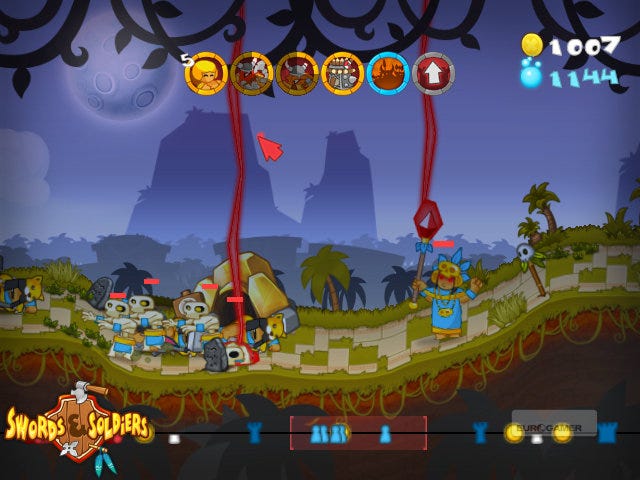
As such, Swords & Soldiers, a side-scrolling RTS game, is a regression back to a formative period that never was, imagining what the genre might have looked like had it started life as Super Mario Bros. Viewed sideways on, its mechanics have been necessarily compressed and flattened to focus only on the core elements of the modern RTS title. That's not to say the game is regressive or overly simplistic. Ronimo Games, the Dutch studio best known for the freeware version of de Blob, press the game's nose hard against the boundaries they've imposed for it, extrapolating on their core ideas in interesting, creative ways over the game's 30 core missions. But it's a focused game, one that trims the fat from the form to present a familiar yet novel experience quite unlike any other.
As with the mini-games in Plants vs. Zombies, Swords & Soldiers' extra-curricular challenges offer some of its finest moments.
That said, at its heart, Swords and Soldiers' core is wholly orthodox: you mine resources in order to fund your army, whose job it is to vanquish whichever foe is set before you. Unusually, however, you don't position your units. Rather units arrive on screen and, depending on their type, automatically toddle off to collect gold, or begin an inexorable march to the right of the screen. They continue with dogged determination until they encounter an enemy foe, at which point they automatically start attacking. If victorious, they continue on their merry way, but if defeated, they crumple dead to be replaced by the next soldier you've already lined up. In this way, the game has more in common with Lemmings than Command & Conquer: units follow preset paths and AI routines, which you can do little to interfere with directly.
There are three factions in the game - Vikings, the Aztecs and the Chinese - each of which offers only a handful of different units to work with. Some units are close-combat warriors, while others throw axes or spears from a distance. As you progress you'll be able to deploy some structures but these can only be constructed in predetermined locations.
These factors remove a lot of the freedom RTS fans will be used to and shift the emphasis away from geographical strategy onto a strategy of process, that of choosing which units to create in what order. As your units all move at different speeds, much of the challenge derives from perceiving the timing of creating, say, a slow-paced Aztec giant and a fast-paced necromancer so that they'll arrive at their target concurrently.
As well as gold, your units also accrue mana that can be used to purchase spells. These spells are used by you, as an esoteric force on the field, rather than given to any particular unit. Purchase the heal spell, for example, and you'll be able to race about applying magical first aid to units in trouble. Likewise, buy the snowstorm spell and you can bury a battalion of advancing enemies in a temporary avalanche, allowing your units to group together around them.
Each faction presents ten missions to play through, the stories that drive the scenarios as bold and silly as the graphics that act them out. While most of the missions require you to overcome a rival force and destroy their base, these are mixed up with challenges where you have, for example, a limited amount of gold to spend or a set amount of time, for which you have to merely survive.
A detailed statistical rundown follows every mission, recording the time taken to completion, the amount of gold mined, the number of warriors deployed, spells used and enemies killed. However, your performance in each area doesn't contribute to an overall rating or score, so there's little incentive to play through the campaign for a second time beyond gunning for missed achievements.
Certain missions restrict you to a limited set of units, while others require you to simply fulfill the level objectives within a strict time limit.
A two-player skirmish mode offers longevity after the core single-player game is finished. Splitting the screen horizontally, each player churns out units in an effort to shunt the frontline ever closer to their opponent's base. As with many RTS titles, two evenly-matched players will find often themselves in a deadlock, repeating the same few interactions over and over again in the hope that their opponent is first to make a mistake. In these protracted two-player matches, the game shows its repetitive core. Indeed, there's no denying that, across both the single-player and multiplayer modes, it's at its best when it's brief. Missions or matches that last for more than fifteen minutes become something of a drag.
But in bite-sized chunks Swords & Soldier is a riotous experience, bursting with the kind of visual character and creativity that typifies Behemoth's Castle Crashers on Xbox Live Arcade, while offering a rare sort of mechanical polish. As with PopCap's best titles, Swords and Soldiers reworks the weary conventions of its tradition to compelling effect. Its deliberately restricted perspective is unlikely to sate the appetites of hardcore RTS fans, but the move to 2D acts as a concentration of the genre's charms, not a dilution, and is perfectly suited to WiiWare. Its vim, accessibility and choice of platform will no doubt do more than almost any other title in recent memory to expand the genre's fanbase.
8 / 10
