I'm cheating - again! The first time we saw Split/Second it was for GDC at the end of March, and we saw it in Brighton. This time - the first hands-on - is the E3 demo. Never mind the fact E3 isn't for another month; I'm still perched on a sofa in a Black Rock demo room flanked by cabinets full of PS2 and Xbox racing games (Dakar 2! GTC Africa!), while design director Paul Glancey talks me through half a dozen attempts to conquer the airport lap playable demo. I conquer it twice, and manage a couple of other respectable placings.
E3 will tell Black Rock a lot about where it's going with Split/Second. A diverse, tens-of-thousands-strong audience of industry folk, it's a cauldron of snapshots, all of which have value, even if some of them will emphasise the dangers of playing five minutes of an unfinished game out of context. "The test will be E3, because obviously you have a very mixed group of players," Glancey acknowledges with some understatement.
He needn't worry too much, however, because six or seven runthroughs of the Split/Second demo may throw up a lot of conflicting accounts, but when it comes together - when you kiss the apex at ferocious speed, and glide clear of opposition cars that have been uprooted by an explosion you set off - the idea of a racing game where you can trigger your own set-pieces really works, and they know that's what they're aiming for already.
So how are they doing? Last time we got to look, this time we get to touch. The sense of speed is the first thing that hits you, and it's something with which I hit myself repeatedly over the first few laps. Like the faster vehicles in Burnout Paradise or PGR, Split/Second's sleek sportscars hurtle down the track precariously, particularly with the discomfiting shake of the camera addling your senses. Cornering is muscular, demanding subtle correction and more braking than you expect. Initially there's a lot of understeer that I struggle to master.
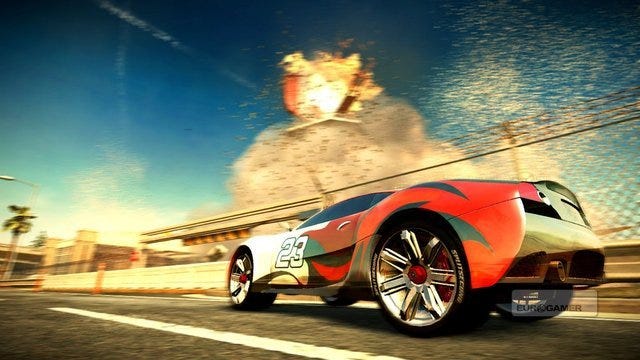
Racing through the smoky aftermath of a powerplay is worrying, but the game already knows not to punish you here.
Drifting plays more of a role than the hands-off demos communicate, too. You have to pump out a lot of speed into sharper turns, and maintaining positive momentum is satisfyingly difficult, even though the airport lap only throws up a few serious corners per lap. After bashing against each of them and gradually learning how far to push the back of the car out on subsequent attempts, I get Glancey to show me, and if anything the confidence with which he grazes the nose past the inside crash barrier is more encouraging than playing the demo. It's because he's not just competent, he's good; but it emphasises that while being good at driving in Split/Second is an art, it also isn't an end. If you can hit every apex in PGR, you can win those platinum medals. If you can hit every apex in Split/Second, you still have to worry about powerplays.
Powerplays, in case you missed the first half, are the set-piece attacks and demolitions that you can activate from behind the wheel. By driving well - with drifts, drafts and whatnot - you build up a three-stage powerplay bar locked to the underside of your car's bumper in a modest heads-up display. Blue icons then appear on items of scenery for regular powerplays, and red icons are highlighted if you have all three stages full.
The timing window for each is narrow - depending on your speed, obviously - but even with your eyes locked to the vanishing point by the intensity of the drive, you can work out most of what's about to happen: there's going to be a big f***ing explosion, and it's going to trash whatever the debris hits. In the case of regular powerplays, that means an explosive barrel launched from a helicopter is going to land on the car in front, or the carcass of a bus is about to be hurled in from the sideline. Super powerplays - the red ones - are going to bring the house down, or at least the entire airport terminal, and they're going to change the route.
As such, saving up reds when you're caught behind can be useful for clawing back a margin on other racers. If the guys in front have just sped through the start/finish line and spun off past Departures, you can drop the freeway ahead of you down a storey in a controlled demolition and bounce through the building, shortcutting them. Or you can use super powerplays for all-out attack, dropping Air Traffic Control onto the last corner as you exit the preceding tunnel. If you're out in front, icons at the bottom of the screen allow you to set off attacks in your wake.
Glancey admits that some of that messaging needs work (in other racing games, icons at the foot of the screen often mean an approaching competitor, and some players see it and swerve to block), and it's fair to say that there's a lot of tuning left to do. You shouldn't, after all, run into the bus you've thrown at an opponent every other time.
But there's nothing I do that breaks the game, and some of the things that evidently get in its way are already on Black Rock's radar. As I crest a hill and sweep graciously into a crash barrier, provoking the Burnout-style "wrecked" message and vehicle reset that accompanies failure, Glancey asks if it was the hill wot dun it. It wasn't actually - I overcorrected - but it's nice to know they're on the alert not just for things that punish you unfairly, but also for things that punish you fairly. You get the sense they won't overcorrect, if not on trust then from Pure.
The elephant in the room is the AI, which is certainly competitive at this stage, and something I worried about last time. After all, it's a potential contradiction: you're racing, but if you're ahead of or behind the other guys, the powerplays are moot, so you can't be too far ahead or behind. "We want to get a really exciting race with lots of powerplays triggered, so keeping guys at a certain distance - so that you feel they're right behind you - is one of the things we try to create," Glancey says. "But at the same time, you don't want really obvious rubberbanding. It has to feel like a proper race. We've got various degrees of pretty intelligent catch-up in there."
"One interesting problem that we have that other racing games don't have is that you have really major events on the track - you can take out almost the whole field with one powerplay - so we need to make sure that that doesn't adversely affect the competitiveness of the race."
Some of the deferred lighting effects and other, subtler visual flourishes are already in place barely a month after we last saw Split/Second.
At the moment, the AI dynamically changes behaviour lap to lap, and there are sensible concessions to fun. "The AI engineers really don't want to make the game cheat at all - they want all the power-earning to be real, so they'll only trigger powerplays when they can - but sometimes you have to go after the best experience," says Glancey. "So we do stage-manage certain things, like the AI will only trigger a powerplay when you can see it on-screen." That way the track layout never catches you off-guard. "You also want the player to get first dibs on powerplays, so the AI won't trigger the route-changing powerplays, but if it gets to the last lap, and you're nearby and haven't triggered it, we want to make sure that you see them, so the AI will trigger them."
E3 demos can be ill-judged - you need to be playable to qualify for an award, which is why there are so many - but at this stage you can still appreciate Split/Second's place there: there's a long way still to go, with so much undecided, and in a racing game founded on an apparent paradox, feedback is vital. Black Rock is certainly still experimenting - one idea on the table at the moment is a time trial where you don't activate powerplays, but an AI director does. (That was my idea for multiplayer, and I want royalties.)
Whatever the reaction in Los Angeles though, you can't fault the Brighton-based studio for ambition, and Disney for backing them: a lot of studios would have fled to the safety of realism or the shield of complete abstraction after Pure's critical acclaim failed to translate into sales. And equally it's telling that between Bizarre Creations and Black Rock, the UK racing game faculty is heading in a clear direction: off the tarmac and into the scenery, chunking it as they go. There's a lot of risk inherent to Split/Second and Blur, but still plenty to separate them.
They both look good, so we'll keep cheating our way in to find out what's happening as often as possible.
Split/Second is due out for PC, PS3 and Xbox 360 early next year.
