"The one iconic action sequence that comes up time and time again is that idea of a big articulated lorry attacking the smaller hero car." Nick Baynes, game director on Split/Second, is about to show us a New Feature!
Waving an Xbox pad around excitedly as Eurogamer munches on a bourbon cream in the Brighton studio's meeting room, he reels off examples from the movies: Bad Boys 2, The Island, Terminator 2. Each one, he says, has its Mega Truck vs. Hero Car moment. Now Black Rock's made its own virtual tribute.
Nemesis mode - the name's a place-holder - is "old-school arcade", a quick-fix change of pace the developer wants as "something that felt different to the rest of the game". Simply, it's survival against the clock. You get a time bonus for overtaking lorries, which are everywhere, with angry AI drivers programmed to reverse their 'How's My Driving?' sign into your face at 100mph.
The trucks also regularly dump payloads of coloured barrels, currently in eighties-arcade blue and red. Hit a blue barrel and a small explosion impedes progress; hit a red one and it's game over. There's the added promise of a strategic dimension through tricking other AI drivers on the road into shielding you from the blasts. Circuits are specifically designed for this mode and, naturally, full online leaderboard support will be built in. "It's a nice break from the rest of the game," adds Baynes.
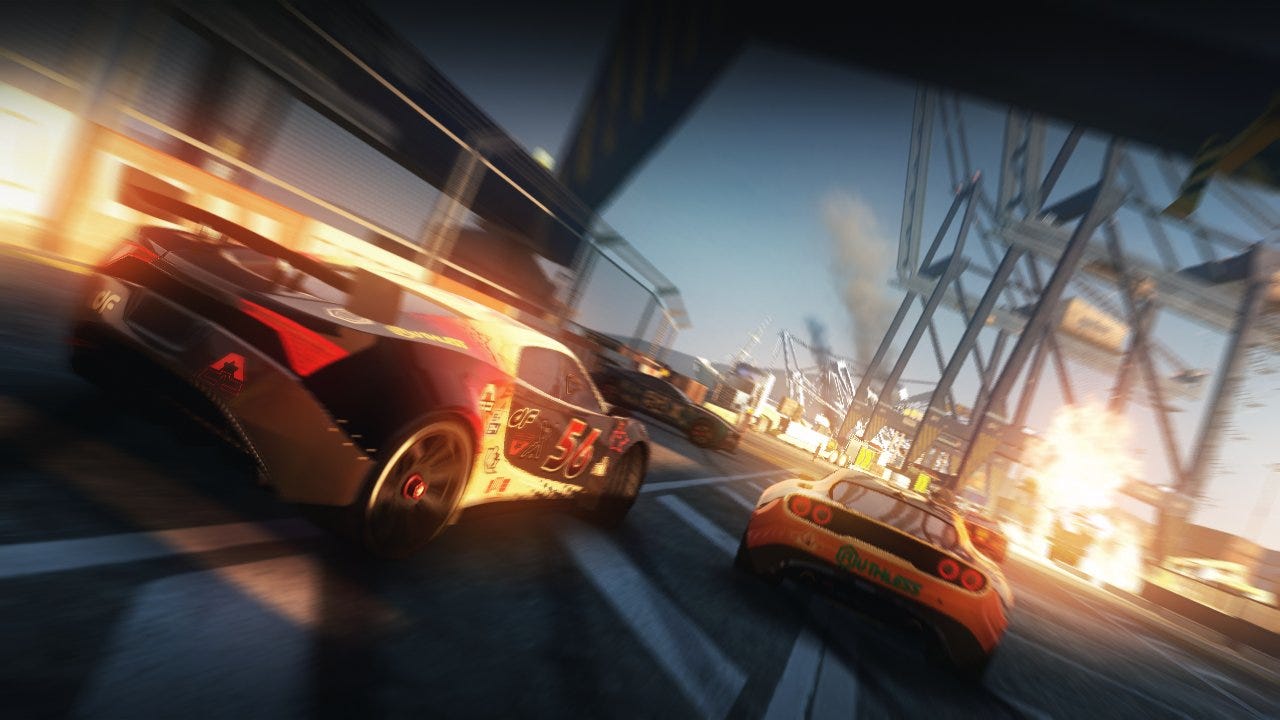
The Docks level starred at Eurogamer Expo.
Very possibly, but we're still a full tank of petrol away from being in need of a break from Split/Second. The game proved one of the highlights of Eurogamer Expo - both in Black Rock's epic big-screen Developer Session demo and on the showfloor. You lot got to go hands-on and, by-and-large, seemed to come away mightily impressed.
"We had great feedback from the show," beams Baynes. "Everyone can see the scale of what we're doing and the visual spectacle. When people play it they realise it's actually really good fun as well and that it's not just a series of pre-canned events."
Our latest visit to the studio (practically a stone's throw from Eurogamer HQ, although we've been asked to stop trying) promises more hands-on time plus a good chunk of new stuff we're not allowed to play yet. Fine by us - that plate of biscuits won't eat itself. And having demoed the Dock and Airport stages to death, Baynes - despite protestations from his team that it's still a bit broken - is itching to show us a new one: Downtown.
Probably wasn't worth polishing it given it's about to get set on fire.
All Split/Second's action takes place in a single location split off into tracks, and Baynes insists the "20km2 footprint" is about the same world size as Burnout Paradise. Our demo of Downtown begins on an elevated roadway. The evening sun hangs low in the sky and long shadows are cast across the tarmac; sparks fly as cars jostle for position across snaking flyovers and deep into the city's narrow veins.
What separates Split/Second from other racing games, of course, are its powerplays - multi-level power-ups which literally collapse everything from cranes to giant cruiseliners onto the raceway, ideally to take out rivals, although sometimes you inevitably take out yourself instead.
The powerplays in Downtown are just as spectacular as we've seen elsewhere. A helicopter plunges from the sky and ruptures into flames; a bridge buckles and cracks as if shaken by a violent earthquake; explosions burst dramatically from either side.
The level of powerplay you can unleash is determined by a meter that is charged as you race. Coloured symbols corresponding to a controller button appear at relevant sections. As well as offering a moment of visual wonder (which can be savoured cinematically in slow-mo with a press of the shoulder button), shortcuts can be opened up as the environment crumbles in order to shave vital seconds off your lap times.
As undeniably spectacular as these signature moments are, the concern to an observer would be that powerplays are little more than scripted gimmicks. Absolutely not, insists Baynes. "Watching different people play it you do genuinely see people having different experiences in terms of what they're triggering and when. You can learn where things are on the track, but you can never predict exactly what's going to happen and when, so you've still got to rely on your reactions."
This is certainly borne out when we eventually get our hands on a pad to take a spin around the Dock circuit. At the first attempt I finish a lamentable seventh of eight. As early as my second attempt I've climbed to a respectable fourth, already beginning to deploy powerplays with a degree of strategy. Timing is everything, as a crane I set swinging utterly destroys my car.
EGTV's James Hills fares no better, turning the air barrel-blue as he first cranes himself in the face then, moments later, takes a bus-sized chunk of masonry on the chin. It's in these moments that Split/Second succeeds in being both terrifically engaging as a spectator sport and thrill ride.
To avoid visual clutter, the HUD is neatly tucked beneath your vehicle.
Even with the strategic elements and the unpredictability, familiarity is bound to lessen the fun over time, so breadth and depth are essential. The driving model itself, as you would expect from a developer with a decade of driving games under its seatbelt, feels responsive, satisfying and subtle based on initial experiences.
What Black Rock refuses to discuss at this point are numbers. Baynes won't be drawn on the number of tracks, saying only that it will be "competitive". However, he claims pre-emptively that each course in the game is equal to one and a half courses in Project Gotham when split routes are taken into account.
And anyway, he's right in as much as breaking down a racing game to a laundry list of numbers of numbers tells you nothing of the experience and can be a distraction at this stage. Furthermore, it's likely the team simply doesn't know what's going to make the cut.
Holding the shoulder button affords a more cinematic view of the carnage you've unleashed.
Two things raise themselves from the latest build of Split/Second: the most polished, complete courses look absolutely stunning and are joyfully carnage-strewn riots of fun to weave around, and meanwhile there's still a great deal of work to be done elsewhere or that's yet to be finalised.
Luckily, with the game not due until next summer, there should be at least another five months for this clearly talented team to fine-tune and finesse a title of considerable and unique potential - and it's the last 10-15 per cent of development that's likely to determine whether it fulfills that potential.
Bizarre Creations' Blur, another power-upped petrolhead coming in 2010, is also following the Hollywood action blueprint, but as a visual spectacle at least, Black Rock's effort feels grander. For a game that looks not just at its peers for inspiration, but to the likes of Half-Life 2 and Call of Duty, we hope the final twists are turns of development are negotiated successfully.
Split/Second is due out for PC, PS3 and Xbox 360 in summer 2010.
