Sin and Punishment: Successor to the Sky Review

Don't go unpunished.

Version tested: Wii

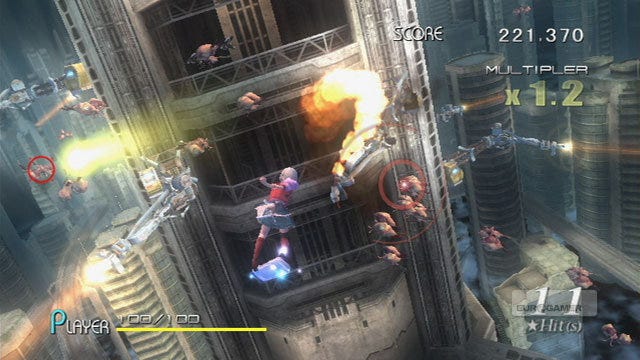
Sin and Punishment 2 looks like what would happen if a music visualiser developed sentience and tried to kill you. It envelops you in sweeping patterns of bullets, elegantly criss-crossing lasers and lens-flare, a deadly visual cacophony that puts you into a comforting trance as you flit defensively around the screen. But hidden behind these familiar graphical patterns is a deceptively innovative and flexible shooter; developer Treasure plays with your expectations and your instincts, and Sin and Punishment 2 comes out feeling at once like a genre greatest hits compilation and completely fresh.

Depending on which mood you catch it in, it can echo Bangai-O, Ikaruga or Space Harrier, but its own personality always shines through. A large part of the appeal is the glorious, inventive insanity of the levels, particularly the boss design. Each of the game's seven stages is wonderfully distinct, only occasionally throwing up a staple environment like a factory or a volcanic landscape or the final extraterrestrial battle with an enormous spaceship. The rest of the time it's completely off the rails. Some illustrative phrases from my notebook, jotted down whenever there was a five-second gap in the bullet assault: "forest of the testicle-mace golem", "magma guinea-pig and the baffling cranes", "four-pronged whale assault", "moonlit battle with the giant stonefrog", "cactus-hatted sand leeches".

Most of the time you're running into the screen on a 2D plane, but the camera angles are creative and the game sometimes turns you on your axis and becomes a side-scrolling shooter for a while, or zooms out to offer a panoramic top-down view. The elven main characters, Kachi and Isa, have been freed from the floor since the original Sin and Punishment, pulling out a hover skateboard or jetpack to float around the entire screen.
1

Thanks to this new freedom of movement, bosses are now screen-filling affairs, and there are at least three of them in every single stage. Their attacks often take up half the screen. You must learn to use your evasive roll, and the tiny window of invulnerability that it provides, to dodge everything from massive claw-swipes to explosive cherry-blossoms to projectile tadpoles. B fires a constant stream of bullets, tapping A locks on to a boss' weak-point or particular enemy - locked-on bullets, though, have less power. Most importantly, tapping B brings out a sword for a melee attack that can deflect missiles and damage nearby enemies.

Each character has their own charge shot, too - Kachi's can target multiple enemies, Isa's is one focused explosion. It's absolutely non-stop madness from start to finish, which is about six hours including frequent deaths (less if, for some reason, you choose to play on Easy). As you would hope and expect, Sin and Punishment 2 is a relentless, non-stop sensory assault from start to finish. Everything that you touch (or try frantically not to touch) explodes. Robots, giant eagles, bulls, birds, vehicles and fish all explode. Even human enemies, once you've shot them, fall over and then explode.

It's all accompanied, of course, by Japanese midi-rock that sounds like it's from about 1999 and makes your ears ache. Playing Sin and Punishment 2 for half an hour is absolutely mentally exhausting; the concentration leaves you drained and happy. In one stage, you're zipping along a desert highway on a futuristic motorbike-thing at F-Zero speeds whilst casually blowing up a giant sand-tiger and then a massive eagle, which afterwards combine to form a deadly desert wildlife Megazord which, once finally defeated, gives you a ride to Mt Fuji. The plot makes absolutely no sense at all, obviously, which contributes to driving you mad after prolonged exposure.

Treasure often inverts your expectations of the genre. Aggression actually pays off more often than not, which turns your cautious bullet-dodging instincts against you. Getting in close to a boss and unleashing sword combos destroys its health bar(s) far faster than staying at the other end of the screen and shooting at it. Deflecting bullets with a melee attack, too, is often more important than avoiding. You can't help but be right in the thick of things, dangerous as it is, but once you develop that special split focus that lets you concentrate on where you're shooting and how you're moving at the same time, you find yourself darting around a screenful of absolute chaos whilst somehow not taking any damage.

Sin and Punishment 2 is undeniably very, very hard, but in the correct and old-fashioned way - not because it's unfair, but because it's hugely demanding. Thankfully infinite continues and checkpointing ease the pain for the faint of heart. But it's here that the game lets itself down; the checkpoints are inconsistent, sometimes forcing you to play extended sections right from the beginning if you die, and the stages themselves are overly long. There are also some massive difficulty spikes, usually due to the odd checkpoint structuring, which upset the flow of the action.

2

Each stage really ought to have been split up into more manageable sections rather than exhausting 20-minute epics with three boss battles each. If you want to replay a particular one, or go for a high score, there's no option but to play the entire stage again. Split up into arcade-style chunks, score-chasing and replaying levels would be a lot easier to get into, and Sin and Punishment 2 would hold the attention for much longer.

The two-player mode, disappointingly, only adds another cursor to the screen rather than allowing you to play the Isa to a friend's Kachi. The second player is limited to a stream of simple bullets - no charge shots, no lock-on. Although two-player running (or floating) and gunning would have been fun, it's easy to see why it wasn't possible. Trying to calculate the effects of Sin and Punishment 2's neverending onslaught on two players at once whilst keeping things running smoothly would make the Wii burst into tears and then explode.

Sin and Punishment is bold and testing and completely mad; like so many Japanese favourites of previous decades, it often seems to have arrived with us from a different planet. Treasure has crammed unbelievable variety into four-to-six hours of blistering action, never giving you more than five seconds to think before throwing the next insane, bullet-spewing child of its bizarre imagination into your path. It's inventive within a quite traditional template and weirdly anachronistic, at once comfortingly familiar and modern. It's greatly comforting that there's still a platform for it in this world.

8 / 10

Read the Eurogamer.net scoring policy

Comments (60)

Comments for this article are now closed, but please feel free to continue chatting on the forum!

  • Loading...hold tight!