Sin and Punishment: Successor of the Skies Review

Heavens above.

Version tested: Wii

It is, perhaps, the most expensive videogame ever made. Not in the financial sense: Treasure, Japan's small yet consistently brilliant boutique developer has nothing like the resources of its high-profile Western counterparts, as the often-rudimentary graphical assets in this Space Harrier-style shoot-'em-up testify. But in creative terms Sin and Punishment: Successor of the Skies is a high-speed conveyor belt of valuable, distinct ideas, scenes and flourishes that dizzy the mind with their density and inventiveness.

An on-rails shooter, you move into the screen at a steady pace, the camera wheeling and diving as patterns of enemies streak across your fixed path. So nothing in the game is procedural or ad-hoc. There are no freeform battles to intersperse the set-pieces, as in a Halo or Modern Warfare, no moments where the developers can let the AI pad out the experience. Rather, every swoop of an enemy and pivot of a camera has been meticulously orchestrated, an assault of precision-laid creativity. This is a four-hour long rollercoaster ride far more expensive in ideas than any 60-hour RPG epic.

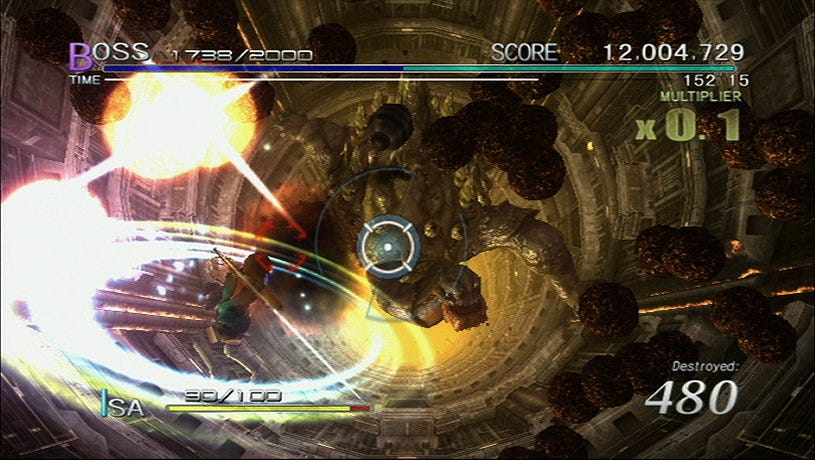
The rules are simple. You fire into 3D landscapes with a steady stream of shots. Lock-on an enemy and the need to keep the reticule manually trained disappears, albeit with a loss of firepower to offset the convenience. Where the first game in the series was locked to the ground, now protagonists Isa and Kachi have jetpacks and hoverboards and can seamlessly take to the skies and descend back into a run with an easing of the analogue stick. While your character exists only on a 2D plane at the foreground of your screen, by tilting and pivoting this angle into the world Treasure creates new, fascinating angles in the game, shifting it from side-scroller to top-down to vertical shoot-'em-up with disorientating yet delightful frequency.
1

Valuable medals can be won by fulfilling hidden conditions in each level by, for example, taking down all of the enemies in a flying formation, or killing a monster by battling back its own missile.

When a foe wanders too close you can strike them away with a close-quarters melee attack, and the move also works to swipe away any rockets, bombs and grenades hurled at you, batting them back at the opposition for a score boost. There is no cover to hide behind, no low walls in whose shelter you can scheme and plot your next move. Instead, you must survive the assault out in the open, bullets and breeze whistling past in a continuous stream of evolving scenes and scenarios. A single multiplier rises with consecutive kills and falls with consecutive hits, a tally readout charting your most recent performance and a modifier that must be carefully capitalised on for leaderboard dominance.

It's in the details that Treasure reveals its flawless pedigree. Your score balloons whenever you manage to set foot on the ground, so running along a derelict motorway will maintain the flow of points into your score tally where tapping up and taking to the air in the jetpack will halt it. The developer plays with convention and genre, including numerous nods to its own back catalogue. A one-on-one boss battle with a flying samurai girl recalls the high-speed freeform face-offs of Bangai-O, while a side-scrolling march through a cyborg factory is every inch Alien Soldier, and an assault on a battleship moored within a sea of lava recalls Radiant Silvergun's most ostentatious set-pieces. One stage has you take the controls of an F-Zero racer, tearing along tarmac and desert in an exhilarating high-speed chase over miles of undulous terrain.

Each stage is filled with set-pieces, boss fights and snapshot views that clamber over one another for attention in the memory. And while the visual ideas in these set-pieces are distinct and inventive, the real delight is the way in which Treasure uses each to twist expectation and play with the basic mechanics.

In one area a hulking boss in the middle distance hurls crates at you as you take pot shots at it from afar. The crates disappear from view on their incoming trajectory, before descending from the top of the screen as Tetris blocks, slowly obscuring the view of your foe. So you are tasked with clearing the foreground space while maintaining an awareness of your target in the background. Occasionally a red crate falls which, when destroyed, will shoot dangerous flames off in the four directions of the compass, Bomberman-style. This adds a third layer of complexity to the moment, as you are forced to consider your character's position on the play field as well. The scene lasts a couple of minutes and the idea isn't repeated again.

This is vintage Treasure: an embarrassment of inventive riches that surprise, delight and challenge in equal measure, painting their rivals and indeed much of the gaming industry as bankrupt of imagination.

A 20-foot skeleton that plays basketball with a cluster of purple, disembodied ghouls' heads; ninja frogs crouch in a tall-grassed field demanding you shoot away the blades of grass to uncover where the shuriken-throwing creatures lurk; you traipse through a dark forest, a torch bolted to your gun, cutting swathes of light and destruction with each sweep of the Wiimote across the screen; a giant chicken squeezes out chicks that try to knock you over. Not spoilers, but hints to the litany of extravagant, memorable moments that barrel towards you.

2

The two-player mode is a slight let-down as, rather than placing both characters on screen, it simply gives the supporting player a cursor with which to add to the stream of bullets on screen.

As with so much of Treasure's output, high scores are where the longevity lies. Die and it's an immediate Game Over, the choice to continue returning you to the most recent checkpoint but resetting your score in the process. Online leaderboards exist for each stage across each difficulty level and are grouped by region, country and continent, so there's plenty of challenge for those who want to squeeze every last point from the experience. If there's any criticism to be made, it's in the length of each level, as it will take practice to make it through each 20 minute-long segment without using a continue on even the easiest difficulty level.

But that is also the game's strength. It is the antithesis to current fashions, where anyone can plough through a game without much need to learn or improve, where external reward systems take the pressure off creative level design, where games are broken into commercial break sized chunks, and slipped down with spoonful-of-sugar achievement points or trophies.

Here the rewards are rich, satisfying and threaded in the design. The compulsion to play through the game has not been found in manipulative shortcuts, but in graft and execution and a plethora of ideas. It is expensive game-making, for sure, but it is game-making at its absolute best. So Sin and Punishment 2 is videogame distilled, a fearsome concentrate to confound and delight, a suckerpunch reminder of what is possible in the medium if you choose not settle upon one brilliant idea, but instead embrace ten thousand.

9 / 10

Read the Eurogamer.net scoring policy

Comments (90)

Comments for this article are now closed, but please feel free to continue chatting on the forum!

  • Loading...hold tight!