Series Retrospective: Colin McRae Rally

Definitely flat out.

Powersliding, while a glorious, evocative word for petrolheads, proved an irritatingly elusive dynamic for driving game developers of the 1970s, eighties and very early nineties. Indeed, it was only the remarkable acceleration the genre benefited from as a result of videogaming's transition to 3D (coupled with the renewed processing power of enhanced hardware) that finally enabled the recreation of drifting a box of polygons sideways through a corner in a manner that felt satisfyingly convincing. Up to then, even the most fervent member of the Sprite Generation knew deep down that adding smoke and screeching effects ā la OutRun just didn't cut it. If you're going to give the illusion of powersliding, you need to do it in three dimensions. Namco's absurdly popular Ridge Racer was an early front-runner in this regard and soon found a rapidly growing number of efforts from other publishers in its slipstream.

Forgive the historical introduction, but it is crucial in understanding why it would be another couple of years before developers felt confident enough to take driving games off-road. Because unlike circuit racing, powersliding is a fundamental component of rallying - get that wrong and it doesn't really matter how good the game's other elements are.

Thankfully, one particular game got it very right.
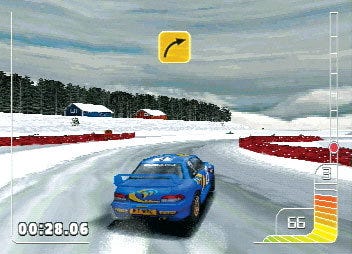
1

The original Colin McRae Rally - still playable after all these years.

Many will remember 1995's SEGA Rally Championship and its subsequent Saturn conversion with great affection. What many often forget is that while we think of rally titles as being well represented in contemporary gaming, the subgenre did slide off the scene soon after SEGA's landmark outing. True, slam your memory into reverse and you will find contenders - Milestone's Screamer Rally or V-Rally from Eden Studios come to mind - it's just that they failed to have the impact that SEGA's defining take on rallying deservedly enjoyed in both its arcade and home form.

Codemasters was one of those affected. Inspired by SEGA AM5's work and sensing another gap in the market (after so brilliantly exploiting the British touring car licence in TOCA Touring Car Championship), the publisher turned its attention to rallying. The Colin McRae series was born.

In retrospect, the choice of Colin McRae on which to base a franchise may seem obvious, but in the second half of the 1990s the WRC was all about Tommi Mäkinen - by the time the first CMR rolled out of Codemasters' development pits, the Finn was eyeing up his third successive world title (he'd go on to add another one before leaving most of the podium appearances to Grönholm, Burns and co).
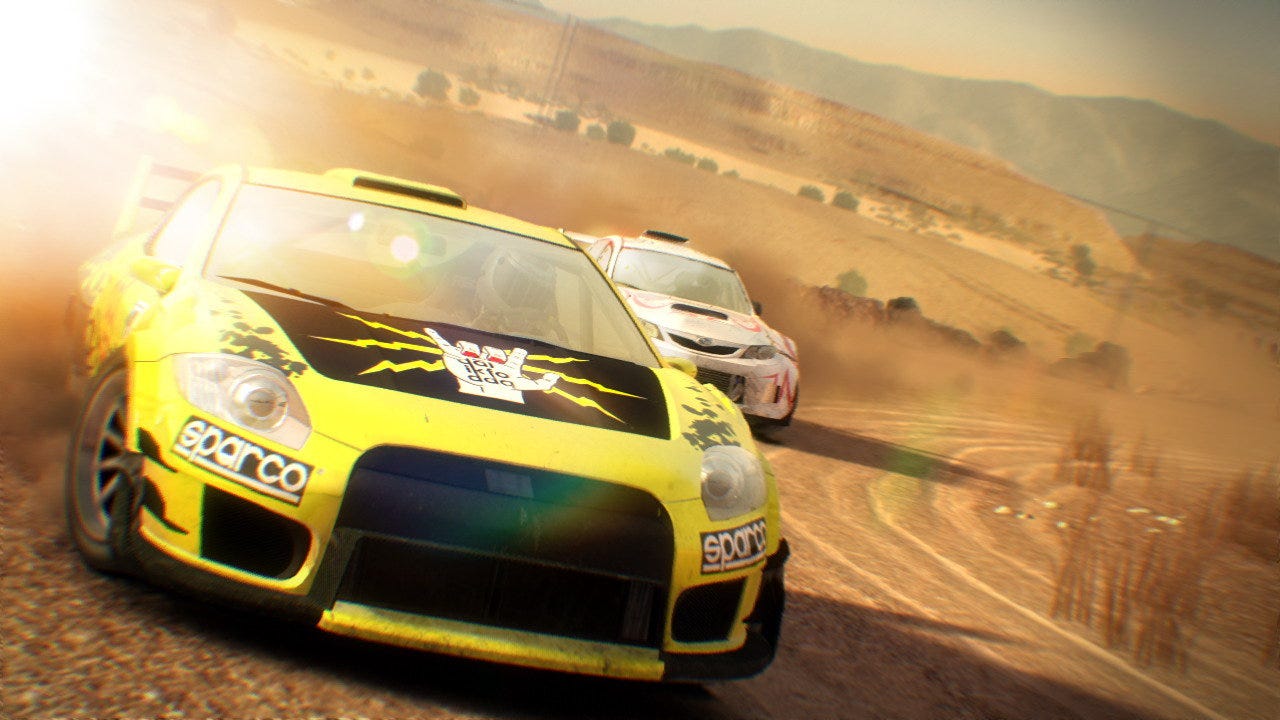
2

11 years later, DiRT 2 in all its hulking HD glory.

Whether the act of Europress obtaining the Mäkinen licence (a mediocre game ensued, alas) influenced matters or not, the reality is that as majestic as the real-life Mäkinen proved at the wheel of his Mitsubishi Lancer Evo, there was arguably no driver/car pairing at the time that could match 1995 champion McRae and the Subaru Impreza 555. Even when sat idling, the distinctive Prodrive-prepared Impreza looked as though it was doing 100mph and in the hands of one of the most flamboyant, brave drivers of his generation - "If in doubt, flat out," goes the famous McRae saying - the combination would come to epitomise everything that made the late-nineties World Championship Rally series one of the most thrilling forms of motorsport in the world.

The McRae/Codemasters partnership turned out equally successful. Sequels came thick and (at times a little too) fast, but the quality and confidence of the driving model so evident in the franchise's first outing never failed to evolve. Ably supported by McRae's genuine involvement and Codemasters' growing technical competence, it resulted in consistent world-class rally driving productions. When McRae ended up without a WRC drive in 2004 it was hardly surprising to see the association remain firmly in place, with the games wisely adapting themselves to the Scot's more widespread motorsport activities.

Just as there can't be many who questioned Codemasters' decision to continue with the franchise following that tragic helicopter crash. So as we approach the second anniversary of McRae's death, and the release of the second DiRT title, it seems a fitting time to power down the gravel track that has led the genre-leading series to this point. Strapped in? Enjoy the ride.

Colin McRae Rally (1998)

PC, PlayStation

The success of the first Colin McRae Rally game can be attributed to a combination of factors not even Max Clifford could have engineered. Aside from the already-mentioned popularity of the McRae/Impreza marriage and the WRC enjoying some of its best years in terms of car manufacturer support, media coverage and audience numbers, 1998 also marked the height of the PlayStation explosion. Crucially, CMR further gained from following in the tracks of TOCA Touring Car Championship. Released the previous year, TOCA had convinced a public too fond of arcade-like racing experiences that not only were sim-based driving titles on console a possibility, they could be thrilling, too.

Not that Colin McRae Rally is as simulation-heavy as its touring car predecessor - the SEGA Rally influence is evident - but its handling, although light by the series' later standards, was clearly a couple of turns on from the arcade crowd of the time. The game's 50-odd stages spread across typical WRC international locations give ample opportunity to sample the then-remarkable subtlety of the handling dynamics.

Where realism played the biggest role, however, was in the structure. While other rally games bastardised the core concept of the sport by transplanting the fundamentals of circuit racing - that's a pack of cars vying to be first to cross the chequered flag - into their creation as a way of spicing things up, CMR was having none of that nonsense. Adopting the 'one car, one stage' nature of rallying could have been costly, not least in the danger of turning the experience into a dull series of time trials, but an inspired decision to divide stages up into eight segments - with each checkpoint revealing a player's position against competitors in real-time - resulted in a hugely intense digital motorsport experience.

Other real-world inclusions such as Super Special Stages, running a specified set-up and any damage incurred through a number of stages in between returns to the service area (where any repairs eat up varying chunks out of the allocated servicing time) may seem obvious now, but they were then unusual and served to cement the game as the definitive rally title of its day.

Colin McRae Rally 2.0 (2000)

Dreamcast, PC, PlayStation

3

Colin McRae Rally 2.0 - uncompromising.

If CMR had taken SEGA Rally as a loose blueprint, its sequel crumpled up the plans, threw them in the bin and then lit a match. Colin McRae Rally 2.0's determination to outperform its predecessor is almost palpable, with a completely overhauled (and still very impressive) handling system benefiting from independent wheel suspension and individual tyre friction values, for instance, as well as considerably more input from McRae himself with regards to how the cars should behave on the different surfaces of the beautifully rendered stages.

The cosmetic improvements had gameplay implications, too. With vehicle polygon counts nearly double those of the first outing (on PlayStation) the damage model effortlessly outclassed that of the closest competition and added hugely to the already tense atmosphere. Additional notable achievements in sound and a stylishly redesigned presentation gave excellent indications of other areas Codemasters' rally series would become renowned for.

But they would also mark the tracks the McRae games would increasingly follow. One obvious criticism of CMR 2.0 is its reluctance to compromise its real-world stance - fine if you're prepared to put the effort in but excessively challenging for many who mourned the original's more fun-flavoured approach (although well-intentioned, the game's Arcade mode is a poor substitute). For the hardcore CMR crowd, though, the heightened focus was a revelation - those that conquered CMR 2.0 were rewarded in a manner few driving games manage.

Colin McRae Rally 3 (2002)

PC (2003), PS2, Xbox

4

You can have any Ford worked on, as long as it's a Focus. CMR3 takes a leaf out of Henry's book.

Aside from the more mainstream offerings of Infogrames' V-Rally series, the first CMR titles had the whole rally game road to themselves. By the time the franchise's third revved up, however, Evolution's World Rally Championship title had been running since 2001. It was a commendable, if ultimately inferior, effort but the official licence combined with publisher Sony's marketing clout ensured the competition faced was fierce - Colin McRae Rally 3's prequels might have sold in excess of 4.5 million units but brand strength alone offered no guarantee of similar success.

Codemasters' response was to concentrate the CMR experience further, enabling players to experience the game as though McRae themselves - one car (Focus RS WRC), a three-year contract with the Ford team, eight countries. Aside from being one of the bravest structural decisions such a popular franchise has undertaken, it afforded the team the ability to pour all efforts into recreating an exceptionally detailed model of the central vehicle (with damage system to match).

It also proved divisive, of course - not everyone liked the idea of being offered no campaign option but to take on the role of McRae, regardless of the improvements in handling (although the central pivot point-based dynamic felt more obvious, partly as a result of general driving game advancements of the time) or how masterful the level of atmosphere this made possible (supported in no small part by standard-setting sound effects).

Colin McRae Rally 04 (2003)

PC (2004), PS2, Xbox

5

Only foolish rally games ignore the Lancia Delta Integrale WRC - CMR 04 is no fool.

An increasingly crowded scene now incorporating two (soon to be three) WRC titles and technically brilliant newcomer RalliSport Challenge saw Codemasters switch to a yearly production cycle as well as a move towards the more mainstream approach favoured by its rivals.

CMR 04 also marked a return to a more traditional structure of multiple championships, play modes and vehicles (Sony's official licence prevented WRC cars from inclusion but Codemasters found 20-odd suitable replacements). The contrast with the straightforward essence of CMR3 was sufficiently great to ignore the worryingly short 11-month gap between the two games, but the acclaim this latest McRae outing received was also justified. CMR 04 offered arguably the finest rally-based handling model seen on console at the time and, as ever, was backed by a leading audio package and damage system.

CMR purists may have resented the tweaked difficulty curve but even the shortest test drive would have ensured they couldn't fail to notice that every aspect of the substantial CMR 04 package, no matter how subtle, appeared honed to an remarkable degree. For some, this remains the definitive pre-DiRT Colin McRae experience.

Colin McRae Rally 2005 (2004)

N-Gage, PC, PS2, PSP, Xbox

It seems impolite to criticise a series that has delivered excellent gaming moments as consistently as Codemasters' McRae titles, but it is entirely possible to have too much of a good thing. CMR 2005, released in the year that McRae found himself out of the WRC and went off to play at the Dakar Rally and 24 Hours of Le Mans, proved one more CMR game too soon.

Although undeniably accomplished, it proved difficult to differentiate from CMR 04. Yes, there was the obvious inclusion of online modes, the content was boosted and there were the usual, expected improvements in visuals, damage model and other such details but in the context of the series too underwhelming to recommend it to owners of the game's predecessor. CMR 2005 would serve as one of the more convincing arguments against a yearly production cycle for driving games - thankfully the industry, not just Codemasters, would take note.

Colin McRae Rally: DiRT (2007)

PC, PS3, Xbox 360

6

DiRT does a remarkable job of convincing everyone WRC is so passé.

After a deserved - and much-needed - sabbatical, the McRae brand burst back into action with DiRT, a gloriously revitalised and fresh new direction for the series. Having clearly thought long and hard about what to do with the franchise, Codemasters wisely realised that McRae's continued disassociation with the WRC, as well as that sport's recent tendency to get weaker by the season, offered a degree of freedom the games hadn't dared enjoy.

The resulting feast of varied off-road activity may differ wildly from, and was evidently constructed to appeal to a wider audience than its predecessors but it retained the essence of McRae's all-or-nothing approach to motorsport competition. A new game engine, no doubt combined with a reinvigorated development team, ensured one of the finest rally driving models ever conceived and a level of graphical prowess finally in line with the Race Driver titles (Codemasters' other brand of racing experiences having previously consistently beaten the McRae games technically).

The expected success of its imminent sequel may yet confine it to history but, like the remarkable talent whose name adorns the series, DiRT's role in setting the standard for others to follow while supercharging a franchise that looked in danger of stalling should not be forgotten.

Colin McRae Rally: DiRT 2 is due out for DS, PS3, PSP, Xbox 360, Wii on 11th September, with a PC version to follow. Check out our review elsewhere.

Comments (46)

Comments for this article are now closed, but please feel free to continue chatting on the forum!

  • Loading...hold tight!