
Rolando 2 Review

In bloom.

Version tested: iPhone

Rolando 2's world is without blemish. Every cloud, tree and roly-poly blob of a character is piped in perfect Pantone, as if someone took away all of Jackson Pollock's flick brushes and instead made him squeeze paint like icing in steady dollops onto the page. It's still pure LocoRoco, of course, but somehow LocoRoco with the contrast turned up: French mustard yellows becoming brilliant suns and petit-pois hills turned deep evergreen.

This near-sterile sort of flawlessness is mirrored too in the game's systems, which, while narrow in scope and ambition, are self-assured. The Rolandos roll smooth and true as you shepherd them toward each level's exit with sometimes-careful and sometimes-exaggerated tilts of the iPhone. The touch-screen controls are economic: tap the screen to advance dialogue, draw boxes over groups or individual Rolandos to select them RTS-style and make jerky upward flicks to jump obstacles. Everything works as it should do, the game excelling in the sort of effortless, intuitive function that comes from a Nintendo-esque attention to interaction.

Of course, it's the game's context that makes you want to applaud these modest triumphs. iTunes may have democratised game publishing but when you open your platform to the world, expectations of what might be possible are soon lowered by a hundred thousand fart apps, Bejeweled clones and two-minute sub-Flash game novelties. The first Rolando was a gemstone in the rubble, a simple, clean game that mightn't have drawn much attention if it appeared on a more traditional handheld, but which, in the context of iPhone's library of mixed amateurism, shone like the greatest game ever made, or, at very least, the most professionally-crafted one.

But in truth it was neither. While Rolando displayed ngmoco and HandCircus's unrivalled appreciation of the iPhone and iPod Touch's unique abilities, it was defined as much by restraint as by ambition. The short, snappy levels were ideal for gaming on the go, but their length made every play session feel like snacking, something exacerbated by the slightly pedestrian level design that prided muted consideration over raw spectacle.
1

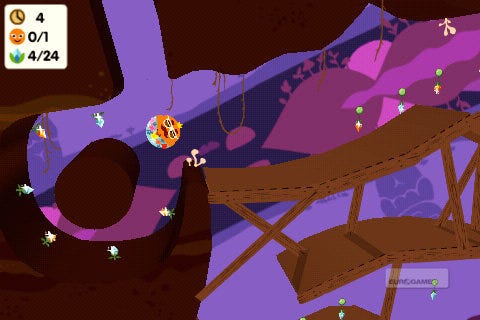
Golden idols are scattered through the world, each one allowing you to skip a level that you're finding too hard.

Rolando 2 is, on almost all of these counts, an improvement. Levels are, if anything, more tightly wound and precise than before, the volley of 45 stages coming fast and frequent towards the determined player. But they are, in general, better thought out and executed than before, the designers more clear on what they wanted to achieve with each and, for that reason, the learning curve is a distinguished one, leading players old and new by the hand into the deep end.

This time around, the game's cushioned into a cute story, a quest to save an island's royal Rolandos from a ravaging sickness. The only cure for the Kilogorean flu, as the islanders know it, is a rare golden orchid, which you roll off in search of through a variety of south-sea hot locations. As well as the stock flick-to-jump move your fingers must be employed to activate numerous contraptions to move them towards each level's exit. The swipe-controlled yellow lifts and springboards from the first game make a more refined return, as does the explosive fruit, which must be tapped from a tree's branches and used to blast through walls and enemies.

Where the first game struggled to maintain momentum over the full set of levels, Rolando 2 introduces a number of new objects and features to bulk out its possibilities. Water is core amongst these conceits, with large Rolandos sinking underwater to roll along the seabed while small Rolandos float along the surface. It's a simple idea but one from which the developer is able to derive numerous puzzles, all of which are generally enjoyable. Once again 'spiky commando' Rolandos can stick to any surface, rolling up walls and ceilings as you tilt and even rotate the iPhone in 360-degree circles, but the new balloon-like Rolandos (who suffer from terrible gas when they eat peppers) allow you to take to the skies for the first time. Likewise, the addition of some basic vehicles adds variety to the experience, even if the novelty only marginally extends its depths.

As before, each stage has three objectives: steer all of the Rolandos to the exit, collect all of the level's gems, and complete the stage within the timelimit. While you only need to complete the first objective to unlock the next stage, the levels are short and sweet enough to ensure most players will try for a complete set of medals before moving on. As you can complete each objective on separate plays, you can tackle the speed-run before the gem-collecting run and so on - a pleasing, Mario-esque approach to the metagame.

Rolando 2 benefits from the inclusion of ngmoco's new Plus+ feature, an online service that allows you to post your times to a global leaderboard and earn Xbox Live-style achievements. With 3000 Plus+ points to earn for passing specific milestones during play, as well as the chance to challenge friends to beat your scores on any particular level, there's a welcome competitive edge to play. Indeed, the meta-challenges will spur on players who might otherwise have walked away at the later, more demanding stages of the game.

2

Bonus stages in which you must roll a Royal Rolando to the exit (who won't take any orders from your taps) make a welcome return.

As with all of ngmoco's titles, the presentation throughout is a delight, menu screens crisp, clear and superfluously interactive (you can make the galleon on the start screen heave to and fro in the waves in a pointless but joyously tactile way), and transitions between levels given depth by some of the most tasteful 3D work we've seen on the platform. The shift from flat 2D to a more 2.5D perspective is almost imperceptible at first, but the difference is stark when you return to the first title. Finally, the soundtrack, by Ninja Tunes' glitch-hop artist Mr Scruff provides perfect complement to the aesthetic and can be enjoyed from a separate music menu 'stage', where each of the game's songs can be bought and downloaded directly to your iPod.

In every way that matters, Rolando 2 is a stronger, more robust game than its forebear, and for that reason we can understand why ngmoco were planning on removing the original from iTunes when this sequel launched (a decision it has since reversed). In lieu of a dedicated first-party studio on the platform, ngmoco continues to lead the way with robust, well-executed games whose ambitions meet the iPhone's capabilities without outstripping them. There may well be gamers for whom this approach is too substantial, preferring instead the quick-fire charms of the iPhone's throwaway, two-minute-blast games. But where those titles often wither under sustained attention, Rolando 2 blossoms, and in doing so maintains the series' position at the very top of the handheld's library.

8 / 10

Rolando 2 is out now on the iTunes App Store and cost GBP 5.99 at the time of review. iPod Touch users should note that the game is currently only compatible with firmware 3.0, you'll need to upgrade to play.

Read the Eurogamer.net scoring policy

Comments (41)

Comments for this article are now closed, but please feel free to continue chatting on the forum!

  • Loading...hold tight!