Rhythm Tengoku Gold Review

Drawn to the rhythm.

Version tested: DS

Possibly the most important thing to tell you about Rhythm Tengoku Gold is that I adore it despite not being brilliant at it. That's a wonderful achievement for any game. Best of all, its being on the DS, and a resolutely one-player, on your own, hidden from embarrassment sort of thing, you don't have to be not-brilliant at it in front of anyone else. You can keep Guitar Hero, Rock Band, and whatever else, because I've got my onion flipping, ghost rock band playing, robot filling, iguana wooing, Easter Island burping, pencil sketch singing festival of gibberish, and I'm delighted with it.

You may remember the original Rhythm Tengoku on the GBA, although don't feel bad if you don't. It was pretty obscure, available only by import from Japan, and defiantly in Japanese. But it was a rare joy. It reached its sliver of Western notoriety thanks to coming from the same team within Nintendo responsible for Wario Ware. And that's a reason to take notice. Like its predecessor, the DS sequel is a collection of mini-games all based around maintaining rhythm in the most absurd circumstances. While the GBA required nothing more than pressing A, the DS version combines tapping on the screen, holding the stylus down, or sweeping the stylus in a quick upward glide. So, still reasonably simple.
1

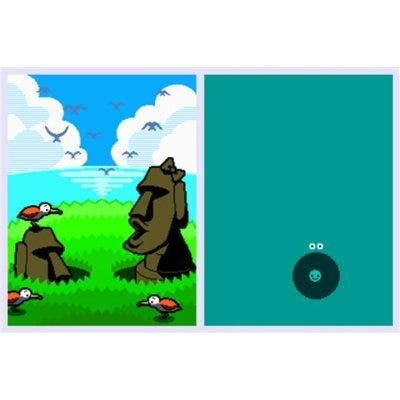
In case anyone was wondering, this is what funny looks like.

Each game consists of two stages: the tutorial, and the challenge. The tutorial teaches you exactly what you're meant to be doing in this game, but of course this is in Japanese, so here we have a period of trial-and-error, attempting to fathom what's needed. There's an English version coming, and part of me wonders if some of the fun will be missing when it's written there for me straight away. And then another, more intelligent part of me slaps the first part and points out how frustrating it is, as you yell bemused at the screen, "I DON'T KNOW WHAT YOU WANT FROM ME!"

Get what it's asking of you correct twice in a row, and you'll move onto the next lesson, until you're ready for the challenge proper. This is all about application, where things are inevitably faster and more involved, and the game throws in new twists based on what you've learned. Do okay, and you'll progress. Do well and you'll feel proud and progress. Do poorly and you'll have to try again.

As you complete a challenge, the next in the ladder appears. Complete all four in a ladder, and you unlock the "Remix", which is a lunatic combination of the previous four set to a new tune. Complete this, and the next ladder opens up. All fairly streamlined and obvious. But that's all that's obvious here.

This time the DS is held in the sideways book form. The logic for this appears to be that you need extra room to swoosh upward. It's arguable, and it certainly works neatly to have what you're mimicking to be alongside the touch screen, rather than above it. But for those with irrational phobia of the rotated DS, well, you've been warned.
2

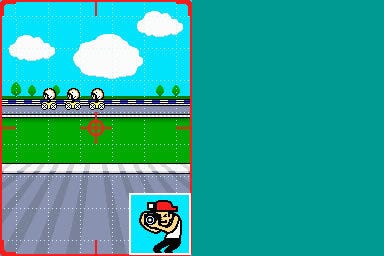
This one's all about photographing the cars as they drive past. Try and do it visually and you'll miss. It's all about rhythm, man.

So about these mini-games... well, they're often magical. They're magical because there's no way in a million years you'd guess what combination of things would appear. You click on a new level with the emblem of a microphone. Maybe something to do with singing? Close. It's clapping a monkey in rhythm with a crowd of other monkeys at a pop concert. A man wearing a gardening hat? It's almost gardening. It's plucking onions from the ground and then lobbing them into your backpack, while flinging gophers out the way. A picture of some storks wearing hats? Clearly they're in the army, under the wrathful glare of a drill sergeant duck.

It'd be worryingly easy to keep doing this. So I will. Easter Island statues, as hinted above, sing along together in a peculiar burping sound, combined with barking like a small dog. Your task is to mirror the sounds made by the, er, male statue (you can tell yours is a girl because she has a stone bow in her hair), with gulls s****ing on your head every time you mess up. Obviously. The animations on their mouths, and their bulging eyes, make it really hard to maintain rhythm for laughing.

Even so, it's not as funny as the hip-bopping frogs. Providing backing dancing for a peculiarly pink frogess, the task is to keep tapping the stylus in time with the tune, such that your frog's hip jiggling doesn't bump the amphibian at his side, all the while keeping up with the twists and flourishes thrown in by audio cues from the singer.

The same sense of smart visual or audio cueing is present once again. During the tutorial you may be taught as many as three or four particular moves, but each will be cued in either by a particular movement or aural clue. It's smart, and it makes sure you're the one who feels stupid when you get it wrong.

Doing well is extremely satisfying, despite the relative simplicity of many of the levels. But of course, while at first it's about unlocking the next one to see what fresh madness lies beyond, it soon becomes about going back and scoring "perfects" on previous levels. While you can pass with a middling performance, the trumpeted wah-wah noise and blue cloud of mediocrity won't sit comfortably with you.

3

A nod to proper arcade games, shooting the aliens in time with the rhythm.

The comparison with Wario Ware is a very helpful one, and it explains something of why, despite its insane joyful fun, Tengoku Gold doesn't win as much of my heart as the GBA's version. Wario Ware Touch never managed to reach the GBA Wario Ware's greatness, seemingly because it was freed from the technical constraints of the simpler machine. When Wario Ware was all about just the one button, the imagination of design was stunning. Given a touch-screen, too much fell into technical thinking rather than pure ingenuity. Something similar seems to have happened here. Just one button to tap forced the game to think damned hard for each of the many levels. Three movement styles dilutes the experience ever so slightly.

However, the descent isn't as sharp as Wario's (Touched dropped to a 7 from Inc.'s 9). While Eurogamer's Keza MacDonald gave the original Tengoku an 8, I would have gone to 9. This game's only a point lower in my mind, and there's a very strong chance it's a point it will make up when the forthcoming English language version appears. Knowing what on earth you're doing, and a simpler route through the very many menus, will be a fantastic experience.

4

Rockstar, you've been beaten. This one's particularly tricky. Oddly, I find it, and many, easier with my eyes closed.

Talking of those menus, as you'd expect from Team Wario Ware, there are many bonus mini-games to unlock, and peculiar extras. A lot are lost in translation, but the bonus mini-games are of course a fresh pleasure. They take the emphasis away from being accurate within a confined time limit, and instead focus on reaching high scores. A particular favourite is the coin-flipping game, which relies on your own timing by gradually removing the metronomic background noise, making it tougher and tougher to know when to catch.

So there it is. Apply that same sense of curiosity and intrigue you had when first hearing about Wario Ware - remember how people said, "I don't get how a collection of three second games can work"? And how wrong that was? The same goes for a collection of minute-long rhythm games based on deeply odd ideas. Synchronised swimmers are of course aided by underwater dolphins. Two scientists throwing and catching conical flasks are of course mixing red and blue hearts for the box of purple hearts on the table. Ghosts? They're in a rock band, dummy.

8 / 10

Read the Eurogamer.net scoring policy

Comments (33)

Comments for this article are now closed, but please feel free to continue chatting on the forum!

  • Loading...hold tight!