Version tested: PC
A few months ago, World of Warcraft's first full expansion pack was finally unleashed upon the game's millions of players. We opted not to review the entire expansion all at once. Instead, we reviewed the parts of the pack which might sway new players for or against a foray into Blizzard's epic moneyspinner - the new races, new professions and new low-level zones. By and large, what we found was good; if you missed our review at the time, you can click here to check out the solid eight-out-of-ten style of that chunk of the expansion.
The reason we chose not to talk about the higher-level content in the game at that time is straightforward enough - we hadn't seen it all. Ten new levels to advance through, a new continent whose size rivals the launch content of entire rival MMOGs, around twenty new instanced dungeons to kick your guild's backside... Not to mention all manner of changes to how the basic game works. New talent trees! Flying mounts! New crafting recipes and ingredients! Equipment with sockets for stat-boosting gems!
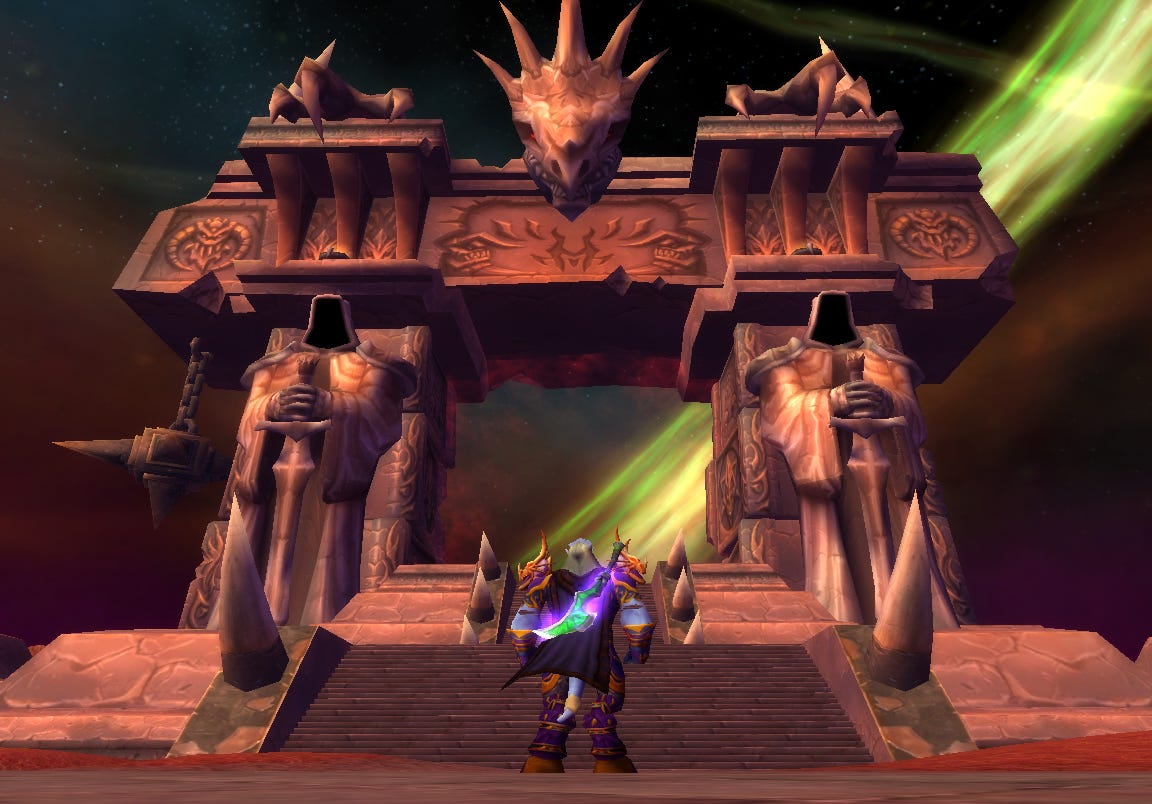
Prepare to travel through the Dork Portal, brave adventurer!
You certainly can't accuse Blizzard of skimping on the content. The Burning Crusade is enormous, varied and ambitious - which is why we've taken three months to get around to tackling the thorny task of critiquing the high-end content. It's not just that it's taken us three months to feel confident that we've experienced enough of the game to comment. It has also taken three months for The Burning Crusade to bed in.
Three months; for the real impact of the exodus en masse to Outland to be felt across Azeroth. For guilds to develop strategies and routines, for players to learn exploits, tips and tricks. And, of course, for bugs or unfinished features - a temporal, amorphous concept in an MMOG, as opposed to a solid bump in the road in a normal game - to be ironed out or polished up.
Justification over. We're confident that now we can talk about the Burning Crusade as it is, rather than as it promised to be at launch. Of course, if you're a hardcore WoW fan, you're probably one of the two-point-something million people who rushed out to buy the expansion in the first few weeks after launch. You're only reading this for affirmation or outrage; delete as applicable, depending on how you feel about that score you scrolled to the bottom to glance at. However, there are plenty of lapsed WoW players still waiting for Doubting Thomas to stick his fingers in the stigmata and let everyone know if the miracle is for real. We doubted as you do, brothers and sisters. Let's explore the Gospel according to Blizzard together.
Just Like You Imagined
You all know the story, presumably. The twin continents of the world of Azeroth, which have been the home to a truly ludicrous number of hopelessly addicted gamers for the last two years, were once invaded by the demonic hordes of the Burning Legion. You may recall them from the previous stunning installments in the Warcraft strategy game franchise (before it went all new-fangled and Massively Multiplayer on us) - large chaps, hooves, horns, leathery bat wings, burning flames of eternal hatred in their eye sockets. Not hard to spot in a crowd, unless you're in Camden Town on a Saturday evening.
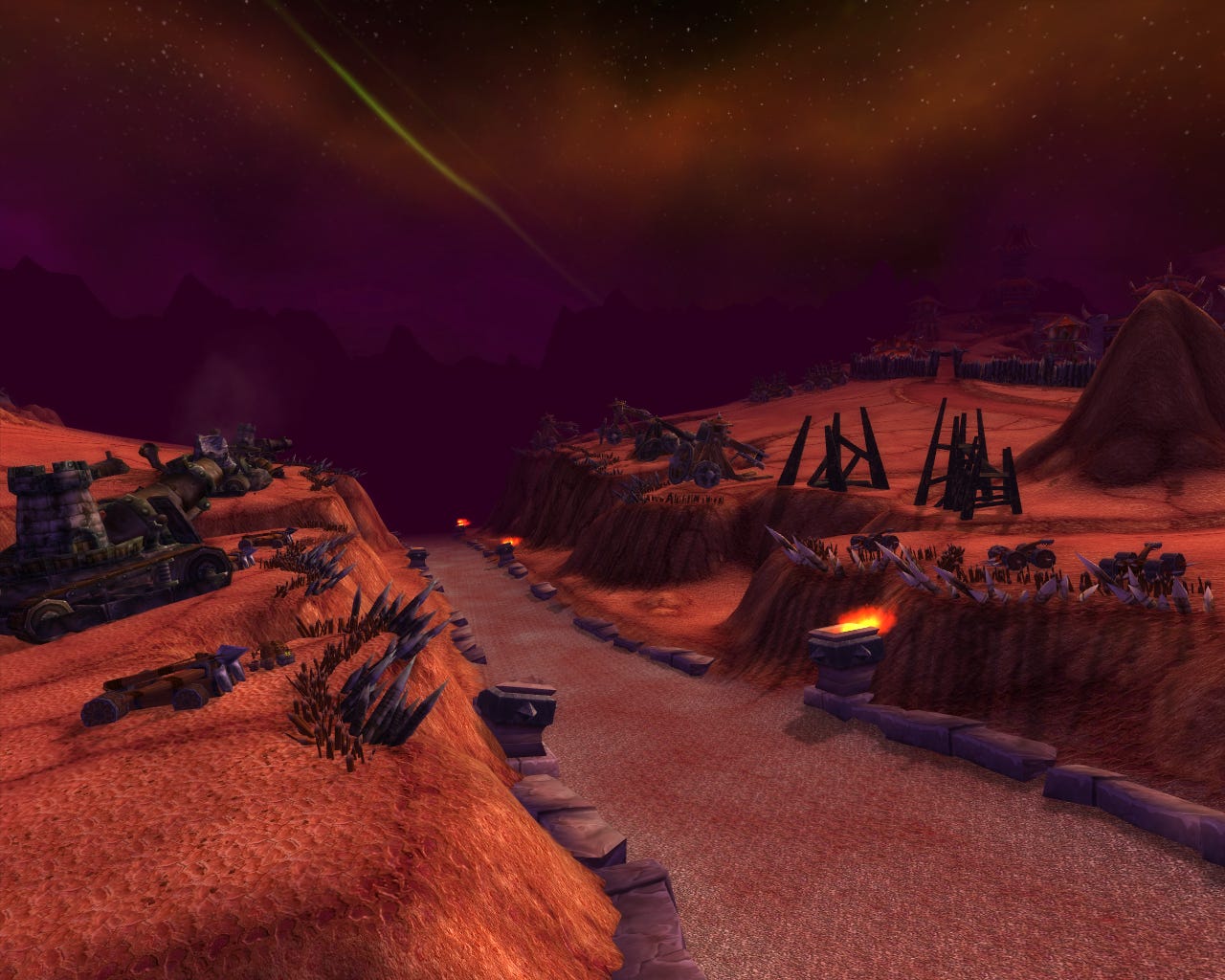
The first place you end up, Hellfire Peninsula, is a scarred wasteland. We believe they're holding the Olympics here in 2012, actually.
The Burning Crusade sees the races of Azeroth, effectively, taking the fight back to them. Upon the launch of the game, the Dark Portal - a giant and rather foreboding dimensional gateway which has loomed over one of WoW's high-level areas since launch - was opened. After a rather impressive battle - a once-off "world event", so either you were there to see it or you weren't, it's too late now - the Alliance and Horde forces pressed through the portal to the shattered world on the other side, Draenor.
If your eyelids are drooping at all this fantasy nonsense, don't worry. As with all of the rest of World of Warcraft, you can enjoy Outland simply as a procession of new things to kill, if that's your thing. However, for those who have followed the lore of the series so far, it's worth noting that The Burning Crusade is probably the best piece of storytelling Blizzard has done yet.
The stories of the various factions and characters in Outland are intricately intertwined, well presented and are daubed in deft strokes across the entire landscape of the game. The rest of the MMOG genre still has a lot of catch-up to play with Blizzard's seemingly effortless ability to craft a fantasy world that is consistent and intriguing without being overstuffed and pompous. Blizzard borrows heavily from Pratchett in many regards; The Burning Crusade is perfectly comfortable with presenting regal, epic or tragic moments one second, and sending you on quests for ale-sozzled dwarves or introducing you to NPCs called Haris Pilton the next.
Rich storytelling contributes heavily to one of the biggest successes of the Burning Crusade in your early experience with the expansion. From the moment you walk through the Dark Portal - which puts you right into the heart of a fresh surge against the portal by demonic forces - you are bombarded with quests, as a wide variety of characters turn to you for assistance. Each zone of Outland has multiple settlements; each settlement has between half a dozen and a dozen quests for you to get your teeth into.
Happiness in Slavery
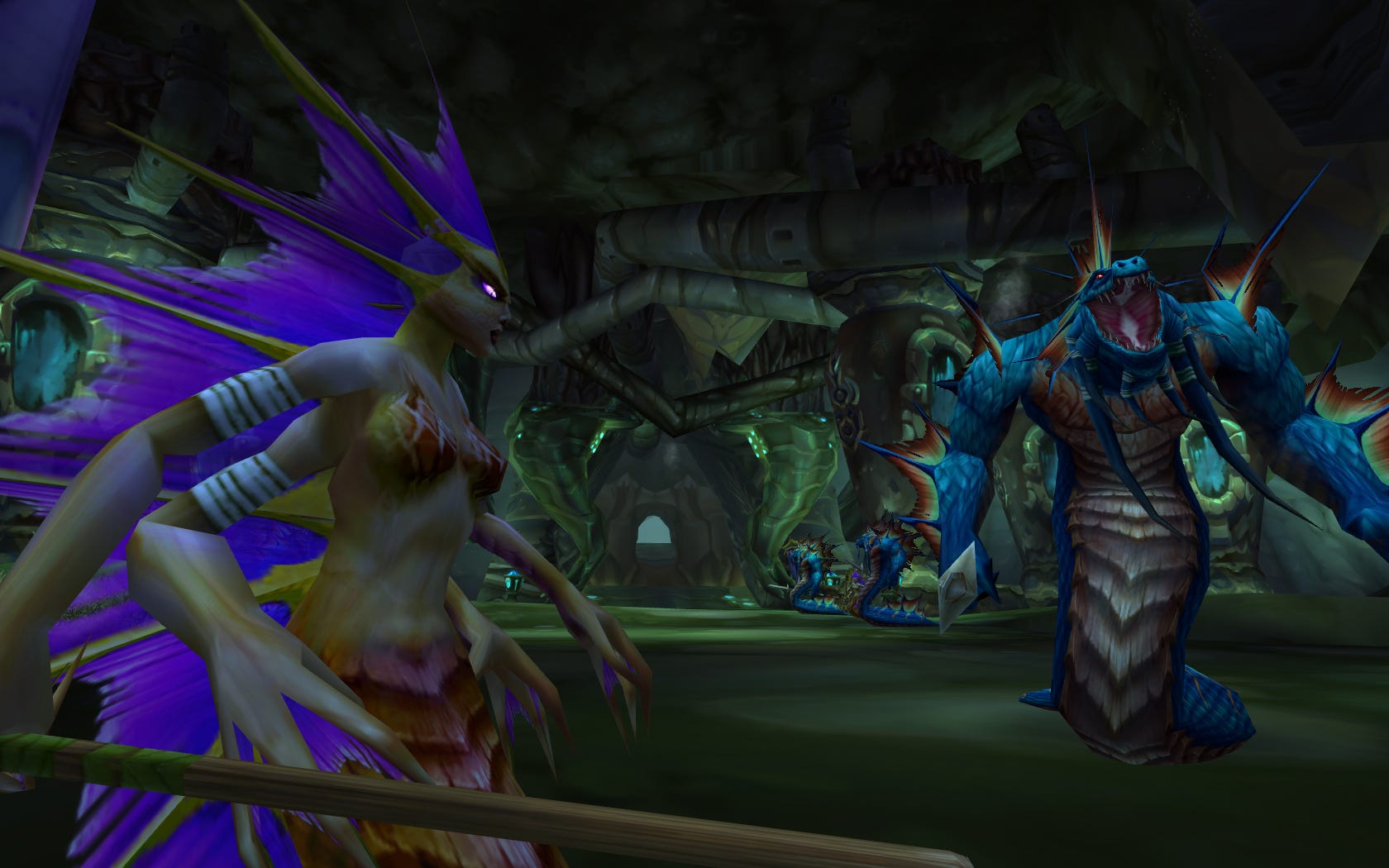
The Naga. You'll be slaying a hell of a lot of these, but they're scaly and hissy so you won't feel too bad about it.
It's just as well, too. One of the first things you'll notice when you pop your head into Outland is that the XP requirements for the levels between 60 and 70 are completely, ridiculously huge. While leveling between 1 and 60 saw small incremental climbs in the XP needed to achieve each level, this slow curve topped off with just over 200,000 XP for level 60.
For level 61, you'll need over 400,000. Level 62 is over half a million XP. By the time you work your way through level 70, you'll be looking at racking up over 800,000 XP - numbers that seem daunting even to the most ardent grinder.
The truth of the matter, however, is that the actual leveling process between 60 and 70 is a breeze. In a game where many players boast of being able to manage the entire 1-60 progression in under a fortnight of intensive play, it's not surprising that the first level 70 characters were strolling around WoW servers within a week of the Burning Crusade being launched. What's perhaps more surprising is that even a fairly casual player can expect to hit 70 within a month, without any significant wailing or gnashing of teeth along the way.
This is a testament to the fantastic job Blizzard has done of building the progression structure in Burning Crusade. You'll never grind for XP in this expansion. As you discover new areas, you are given a vast number of quests to do, which will give you just enough XP and enough new items to allow you to explore the next area, where the cycle begins anew. It's so perfectly, accurately worked out as to be almost breathtaking; this is a game where the allocation of XP, gold, and a million other points and statistics is defined with a precision that would make a physicist weep for joy.
What's more, the Burning Crusade finally gives players a bit more variety than the usual "My leg hurts. Please kill 82 badgers." quests which made up the bulk of the leveling experience in World of Warcraft. Admittedly, you'll still be sent out fairly often to kill a certain number of badgers, or collect a certain number of dropped items - and we'll never quite understand how in the hell it's possible to kill 20 badgers and only have two of them drop any god-damned fur.
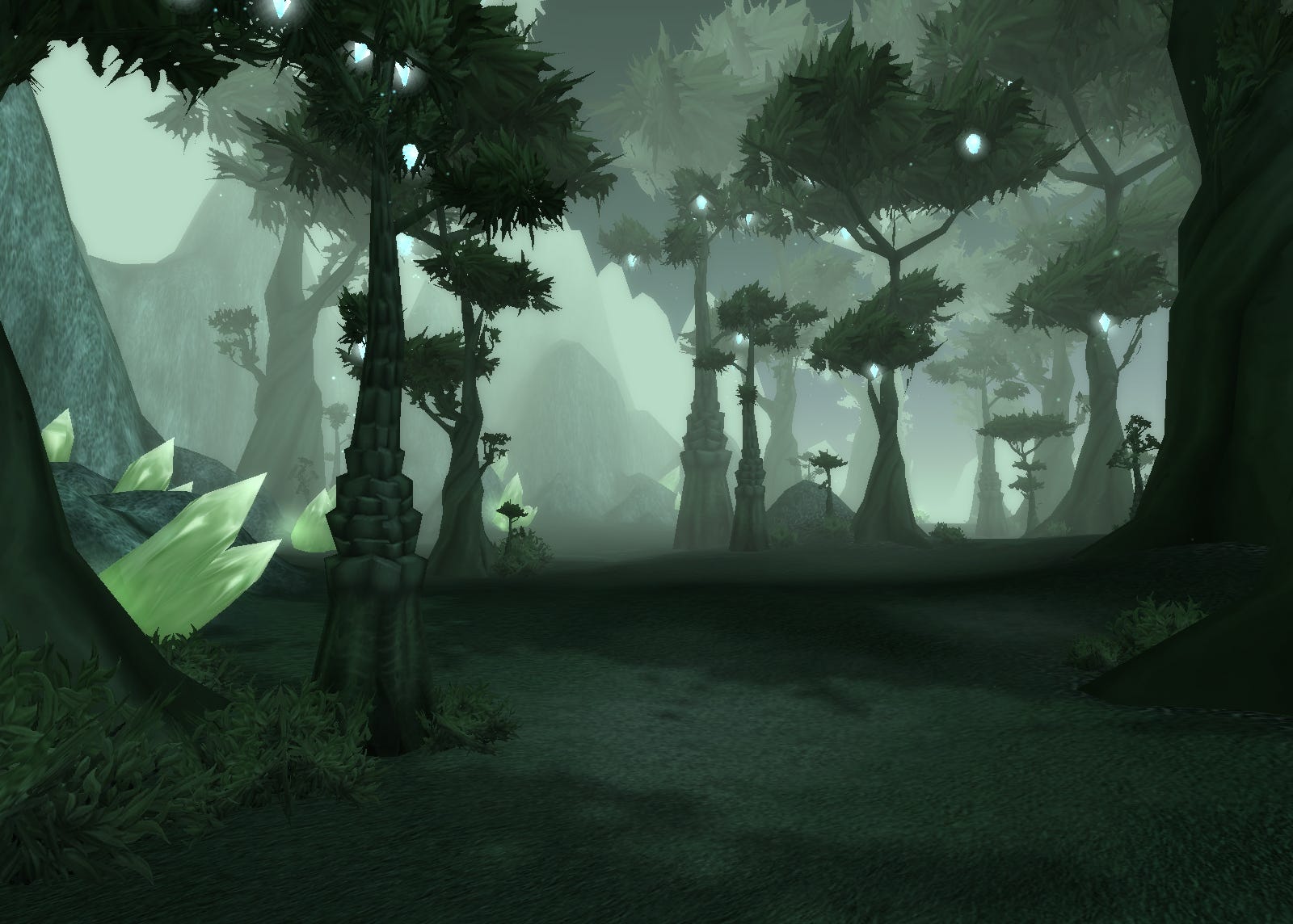
Terrokar Forest is a complete stylistic change from Hellfire. Each zone in Outland is incredibly different from its neighbours, much more so than in the original game.
However, the monotony is broken up nicely by quests which see you bombing enemy positions from the back of giant griffins, or dramatically summoning a vast undead dragon which swoops through the skies. These "special" quests are a far cry from the usual badger-killing antics, and a real step forward for Blizzard's quest design. Outland's zones also feature a host of PvP objectives which give you a perfect excuse to batter your fellow players around the place. Most of these are capture-and-hold exercises, but our personal favourite sees you trying to capture an entire village, an exercise which involves wiping out its defenders with aerial bombing runs.
The Good Soldier
Let's be honest, though. The questing from level 60 to 70 is a side-show, and experienced players will burn through it in a fortnight. Their more casual guild-mates will take a month to stroll through Outland's vast, graphically stunning zones; but this is a game you're expected to play for months. For a year, in fact, paying a subscription for the privilege each month. You won't be completing quests for that time; the real meat of this game, the rich red flesh that keeps people hooked, lies elsewhere.
The key is the game's dungeons. Seven new dungeon complexes were added in the Burning Crusade (with two more to follow in a forthcoming patch), each sporting multiple different "wings" which are essentially dungeons in themselves. You'll hit the first of these dungeon complexes, Hellfire Citadel, within hours of entering Outland, and further dungeons will open up to you as you progress before a vast array of new instances is made available at level 70.
Blizzard is great at designing dungeons; that much has been clear for a long time, and there are few instances in World of Warcraft which don't make for enjoyable play experiences - if you can spare the time, and find a group large enough to do them. It's no surprise, then, that the Burning Crusade sports a selection of extraordinarily well designed and scripted encounters. That's almost a given. Several key changes to Blizzard's approach do stand out, however.
Nagrand is probably the are most similar to previous zones in WoW - but it comes with a few surprises...
In essence, the changes are as follows: dungeons are shorter, they require fewer players, and you can play them either on Normal or Hard mode. These changes were controversial prior to the launch of The Burning Crusade, but the premature fury of the raiding hardcore now lies cold in its grave. Why? Because Blizzard was right all along.
Shorter dungeons don't mean less challenge, they means less filler. Smaller raid teams don't mean less strategy, they mean that it's even more vital that everyone in the team knows exactly what they're doing. Both factors combine to allow guilds to put together a couple of short raids a night, and give people who can't commit hours and hours on end to playing a videogame a chance to take part in the World of Warcraft endgame properly for the first time.
The upper limit on raid sizes has been dropped from 40 people to 25; still a daunting number of players to organise, but certainly a more reasonable goal for a large guild or a couple of medium-sized guilds working together. Most of The Burning Crusade's dungeons, however, feature wings designed for as few as five players, which makes it possible to complete them with just a few friends in tow. By far the most popular dungeons at present seem to be 10-man instances such as Kharazan, which offer a decent raiding challenge to the average guild, without being a logistical nightmare at the same time.
The Greater Good
In other words, The Burning Crusade has struck a balance in its endgame which World of Warcraft never quite found. The original game, for all its success, lost favour with many more casual players who found, after meandering their way to level 60 over the course of as much as six months, that there was nothing for them to do. Everything high-level required a large, active guild and the ability to commit entire evenings, several days a week.
... Like people dropping great bloody bombs off flying dragons and winged lions, to pick a relevant example.
The clever introduction of special Player vs Player battles solved the problem to some extent, but the Burning Crusade has eradicated it entirely. For perhaps the first time ever in an MMOG, the end-game experience is finally open to everyone. There will, inevitably, be complaints that it has been dumbed down, just as WoW has faced complaints in the past that it doesn't offer enough for high-level players; presumably the kind of high-level players who want their MMOGs to come packaged with special bottles for pissing in. So far, though, such complaints have been surprisingly muted. It looks like for now, at least, the balance works for everyone.
This isn't to say, of course, that The Burning Crusade gets everything right. The game is still, after all, a subscription MMOG, and its job is to keep players paying for the game month after month. What it can't do entirely through fun, it does instead by dangling a carrot in front of players anxious to progress and upgrade their characters. And for every evening you'll spend in a fun raid group, you'll spend two mindlessly grinding away at various types of creature. Some things never change.
Admittedly, the grind isn't for XP, which is something. Instead you'll find yourself grinding for gold. The highest level flying mounts, which really open up the game in a variety of ways (especially farming natural resources and PvP combat) cost an astonishing 5000 gold, and there are plenty of other sinks waiting to drain away your resources. You'll find yourself grinding for reputation with various factions. Without having high reputation (earned by completing quests at first, but ultimately only attainable by crawling through dungeons repeatedly) you'll be unable to access Heroic dungeons and a variety of rewards. You'll find yourself grinding for crafting materials, some of which have pathetic drop rates, because otherwise some of the game's best equipment will be denied to you.
Welcome to Kharazan - proud recipient of precisely zero Michelin stars last year, we're sorry to note.
This is a component of every MMOG. We mention it only because it's worth noting that whatever else may be fixed in the Burning Crusade, this is still a core element of the game. The pay-off is that raid groups are incredibly good fun (with the condition that if you play with morons, even the best game will be awful); but if having to spend time grinding for gold, reputation or items in between raids seems like the kind of thing that would turn you off going back into World of Warcraft, well, caveat emptor.
The Day The World Went Away
The other thing which Burning Crusade gets wrong, arguably, is that it breaks a lot of the high-level content which already existed in World of Warcraft. This was inevitable, but it's still potentially frustrating. Former top-end zones like the Eastern Plaguelands and Silithus are all but abandoned, getting a raid together for the old dungeons is practically impossible, and even the PvP environments - which were a hive of activity prior to the launch of TBC - are now largely devoid of life. PvP, admittedly, has been superseded to some extent by Arena combat, which sees teams of 2, 3 or 5 facing off with one another, but this aspect of the game is in its infancy and we actually found it quite tough to actually get a decent number of matches. It's promising, though, and it will be interesting to see how it develops.
The old capital cities, at least, remain full - not just of low-level adventurers, but also of high-level characters who must return there to use facilities like the Auction House. However, the experience of approaching level 60 must now be a very strange one for new WoW players. Entire trails of quests lead into dungeons where nobody goes any more, and at level 58, you just down tools on all the quest chains you were doing and head to Outland instead. It's an abrupt leap, and it makes Blizzard's hard work on the previous content completely pointless, although we fully expect that rebalanced "Heroic" versions of those dungeons will appear at some point in the future.
Kharazan's opera house provides a fun challenge - and a chance for Blizzard to trot out bosses based on famous fictional characters...
Regardless of these complaints, The Burning Crusade has turned out to be a resounding success to an extent which few had expected. Three months into the lifespan of the expansion pack, it's clear that new life has been breathed into a game which was threatening to grow stale for many players. Superb graphics, sound and playability are simply to be expected from Blizzard at this point in time, and it's worth noting that if your machine was being pushed to its limits by WoW, you'll be turning down a few more graphical settings when you get to Outland. However, Blizzard's achievement here is far, far more than simply to offer a pretty, nice-sounding and eminently playable "more of the same" to its players.
In a genuinely striking move, The Burning Crusade simultaneously gives World of Warcraft veterans the swathes of new content they've been crying out for, and makes the end-game experience vastly more open to casual players or new players. Rather than merely catering to its hardcore audience, Blizzard has actually extended the accessibility of WoW to bring even more people into the fold.
There's never been a better time to get into WoW, or to reactivate your account if you're a lapsed adventurer; but be warned. Like the Hotel California, you can check out any time you like; but you can never leave.
10 / 10
Pop over to Eurogamers and see what's happening in the World of Warcraft group.
