Race Driver: GRID

Project go team!

On our visit to Codemasters' HQ to see the reboot of the track racing series formally known as TOCA, one other game keeps coming up in conversation. That game is Project Gotham Racing 4, and it's not just the journos bringing it up. Codies developers are generous enough to praise PGR4's beauty, its structure, its weather effects, its difficulty balancing. Watching an Aston DBR9 tear around sunlit Milan esplanades and neon-lit Shibuya alleyways - and, later, feeling a certain credible but forgiving slide in the handling, when we go hands-on - it seems that the influence of Bizarre's brilliant series runs deep and wide in GRID.

"I think that's fair," says chief game designer Ralph Fulton of the certainly quite flattering comparison. "In terms of the arcade-to-simulation spectrum, I guess we're inhabiting a fairly similar space at the moment. And we're comfortable with that, because that's where we set out to go in the first place."

Seeing Race Driver close in on PGR gives rise to genuinely mixed feelings. Codies' admiration for Gotham is easy to share: its effortless poise, rich variety and note-perfect pitch between stern sim challenge and arcade thrill make it close to the perfect racer, so why not emulate that? But we also had a deep fondness for TOCA's real motorsport setting and tight, aggressive, wheel-to-wheel touring car racing. Sadly, Fulton reveals that Codemasters felt that TOCA was, conceptually, on a hiding to nothing.
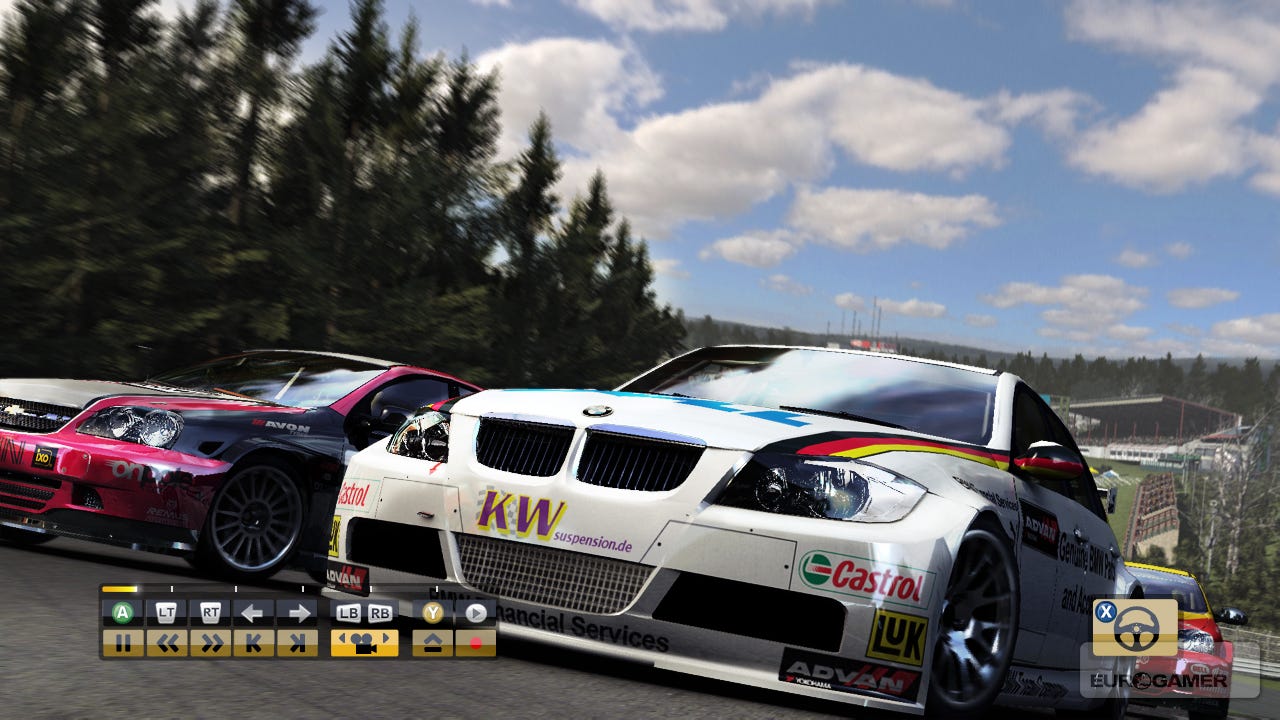
1

Touring cars battle it out on Spa's Eau Rouge, most feared corner in motorsport.

"We reached a stage with the TOCA franchise where we'd hit a ceiling with the number of people to whom we could sell that type of content. It certainly does not appeal broadly in the United States, hence unit sales in single digits for previous TOCA games over there," he confesses. "We make no bones about it, corporately, that we want to make the American market as important as our European market. If that sounds clinical, then I guess that's just the way the games industry is at the moment. But I don't think the people who traditionally love touring cars and open-wheel racing will be disappointed, because you can still do those things in this game as well. And we still use the AI and the physics which have made those games really successful."

The result is an edgy new title and look, a smattering of glamorous city tracks, the complete removal of any setup, modification or tuning from the game, and a move to mostly fictional, unlicensed motorsport series. This is still a game about racing cars, though - with the exception of a hands-on session with a classic Boss Mustang, we don't see a single production model. And it's very much a game about racing. Once you squeeze past the Gotham-sized elephant in the room, you'll discover that GRID is a game with a lot of interesting and unique tricks up its sleeve - especially with regard to its team system.

The career mode is based around racing in three regions - America, Europe and Asia (Japan) - through three tiers of competition, and across a number of different disciplines: stock muscle cars, GTs, touring cars, Le Mans series sports cars, open-wheel racing and, intriguingly, the Japanese drift scene. You begin as a driver for hire, but you'll eventually be spending your winnings on setting up your own team - buying cars, establishing a racing livery (a simple one - no Forza paint editors here), seeking sponsorship from real brands to stick on your car, and, most crucially, hiring an AI team mate. Progress is earned through a combination of money and reputation, with your sponsors setting specific goals for each race.
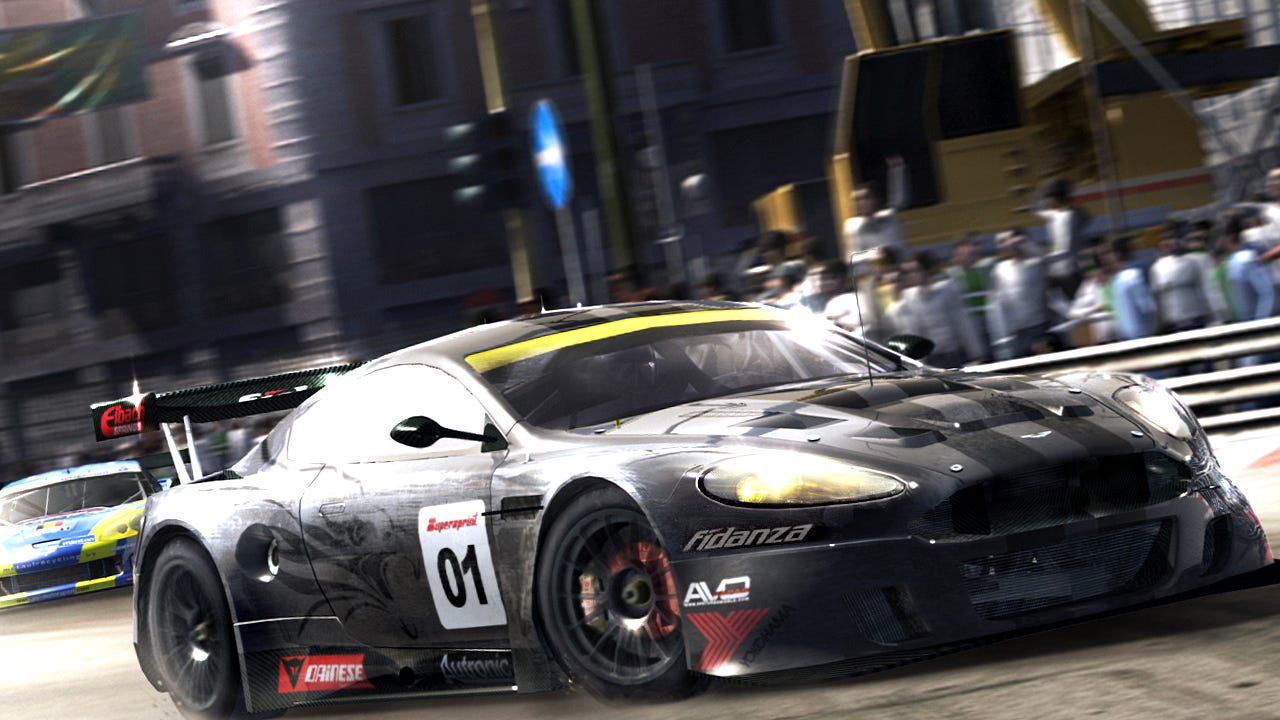
2

The black and grey livery belongs to your bitterest rivals.

It's all about bringing the racing experience to the fore, says Fulton. "The team idea is a way of getting the player to feel involved at a really basic level - by making him buy the cars, by making him hire the team-mate that races with him, by leading him to forge rivalries with other drivers.

"So a crash isn't just a crash, it's a crash that involved his worthless team-mate. I'm not ashamed that there's a little bit of soap opera in that, because there is in real life. For me, last year's Formula One season was the first one for a decade where it had all those things." There's even a pit radio system (although there are no pit stops), and recordings of hundreds of first names and nicknames, so you could quite easily have your own name shouted at you when you take the lead.

Alongside Milan and the stunningly-lit Shibuya - the Neon engine used in Colin McRae DiRT is really flexing its muscles now, and there's no doubt that GRID is a gorgeous game - Washington and San Francisco will appear in the US section. The Asian tracks include a fictional Grand Prix circuit, and a couple of locations that reflect the illegal street-racing scene - a drift track at the deserted Yokohama docks, and the famous Haruna mountain road from the Initial D film (complete with oncoming traffic).

Europe, Milan aside, is all about real race tracks: Castle Donington, the brand-new Istanbul Park, Jarama (a little-known but wonderfully fast and sweeping Spanish circuit), the new F1 track at the Nurburgring (but not the Nordschleife, which is good, because we're almost bored of it now), and Belgium's mighty Spa-Francorchamps, which is the greatest race track in the world - fact. If that weren't enough, the terrifying Le Mans 24-hour race appears under official licence, as a special even at the end of each 'season' of your career. It takes 24 minutes in the game, and is a chance for Codemasters to show off their lovely dynamic time-of-day changes. If you were worried about Race Driver losing its motorsport pedigree with its change of direction, you ought to be feeling a bit better now.

Races sport fields of between twelve and twenty cars - a good sign that the busy tracks we loved in TOCA will return - and a mixture of fictional and real-world racing teams to compete against, including a "boss" team who will be rivals throughout the game. As is Codemasters racing tradition, there's full damage: "I wouldn't like to insinuate that others are too lazy to do it," says Fulton, who feels that licensing issues are too often used as an excuse. "If you're going to do it, you have to do it properly, and I think that's probably a decision that a lot of people don't want to take."

Damage can be deeply frustrating to the player though, as anyone who's crashed on the last lap of a Forza endurance race will know. Hence GRID's most radical and controversial feature: Flashback. It's a one-button rewind (available only in single-player, naturally) that allows you to unspool your crash, similar to the Sands of Time in recent Prince of Persia games. Codemasters is still considering very carefully how to ration use of Flashback (indeed, whether to ration it at all). We hope they get it right, because it will have an enormous impact on the game's balance, and could quite easily make or break it.

3

Ridiculous next-gen detail #89: bunting flutters in the wake of passing cars.

The most striking new racing class is a fairly serious recreation of real-world drifting competition, with a simplified version of the scoring system used by the famous D1 championship series in Japan, that judges you on angle, speed and flair. Specific cars with drifting set-ups are used - including many famous D1 vehicles - and they drift easily without using a different handling engine, which was a point of honour for Fulton.

"I don't think it's all that controversial to say it: drift has not been done well in a videogame," he states. "We're kind of battling against gamers' perceptions, particularly those who aren't that aware of what drift is in real life, of drift in videogames as being generally overwhelmingly poor. Traditionally developers do one of two things - go super-simmy and involve things most gamers don't understand, like clutch kicks... or the absolute opposite end of the spectrum where you almost seem to have a completely different physics engine for your drift. We've done neither of those things."

Drifting will come in two flavours, a straightforward score attack, and a racing game that balances position against score. Drifting around the Yokohama docks is certainly hypnotically compelling, the huge slides and ticking score multipliers making it feel like a simultaneously more extravagant and focused version of PGR4's drift kudos challenges.

4

Drifting at the docks. We thought that was a Sprinter Trueno, but it has a boot. Help!

We also get to try out the DBR9 in Milan, a BMW M5 touring car at Jarama, and a Dodge Challenger in a muscle car race in San Francisco. With all three driving aids (steering, brakes and traction control) turned on, the handling is direct and surprisingly easy-going, with controllable slides. Turning the aids off changes things of course, but not as much as you might think; we weren't expecting Forza's overwhelmingly detailed realism, but the gritty bite of TOCAs of old seems to have been lost in translation somewhere.

There are plenty of compensations, though. The opponent AI is entertaining - aggressive and credibly accident-prone - the physicality that the damage brings to the game is immense, and there's a proper in-car view, too. Surprisingly, GRID finds its best expression in the muscle car class in San Francisco, as the V8 monsters scrape and squabble through wide corners and make camera-wobbling crash landings from jumps. Sitting down with one of the handling engineers later, we spent ten happy laps just chucking the vintage Mustang around, with all driver aids off. The more basic and brutal a car is, the better GRID seems to get. (Which is not to say we aren't looking forward to getting our hands on the just-confirmed Koenigsegg CC GT.)

Concerns about handling depth and the implementation of Flashback aside, Race Driver GRID already looks like a phenomenally well-polished and entertaining game that brings a number of interesting ideas to a crowded genre. Codemasters is one of the best racing developers in the world, and out of all of them it has maybe the clearest sense of what makes for exciting track action. A change in style for the US market doesn't change that, and Codemasters absolutely deserves this shot at playing with the big boys.

Comments (53)

Comments for this article are now closed, but please feel free to continue chatting on the forum!

  • Loading...hold tight!