Version tested: DS
Once upon a time, reviewing handheld versions of popular video and PC games was a bit like inviting your old friends round only to discover they all secretly hate you and are recent burns victims. These days, though, the DS is big business to games publishers, so surely they're trying a bit harder. We tracked down five recent examples of "and on DS" to find out.
The Simpsons Game
Games that make fun of games can't really afford to be bad themselves. That was the problem The Simpsons Game had on telly consoles, and the same's true on the DS. Except this time the game bits are worse. (So, off to a bad start.)
Homer, Marge, Bart and Lisa have worked out that they are in a game and now have special powers. So Bart can use his Bart-man cape to hover, and Lisa can use statues of Buddha to move heavy objects around the screen. Much the same as the others, then, except this one's a 2D rather than 3D platformer, and some of the mechanics have been tweaked: Lisa's telekinesis relies on touch-screen input, for example.
The humour's still there, too - and a surprising amount of the script makes the transition, accompanied by cut-scenes reworked to suit the DS' less amazing graphics hardware.
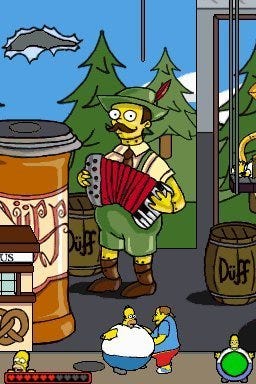
The action's split across two screens, obviously. Haven't you ever played a DS game?
What hasn't changed is the big-brother versions' dull, plodding combat, exacerbated here by stodgy controls and enemies whose attacks and movement patterns make them maddeningly potent, and who also respawn. Great. Nor does the DS game have an answer to its sibling's problem of repetitive, straightforward puzzles that barely qualify to be labelled as such.
One of the better new bits is the Nintendogs-inspired Pet Homer, who sits on the couch while you feed him endless pizza, burgers and snacks, paddling his chest with a defibrillator whenever his heart gives out. This makes you laugh to begin with, but it's rather more throwaway than the developer seems to accept, and being able to unlock new things to do with Pet Homer (essentially two-second sight gags) isn't enough to send you out of your way to round up the game's countless pick-ups, all of which are tiring rather than challenging to collect.
Ultimately it leaves you in the same dilemma as the other versions: if you want a laugh, the show's a much better bet, and if you want to play a decent platformer you might as well dust off NEW Super Mario Bros. You wouldn't slap your Gran if she gave it to you for Christmas, to be fair, but ropey controls and level design will have you reaching for something else come Boxing Day.
5/10
Lego Star Wars: The Complete Saga
We never reviewed the last Lego Star Wars game on DS, but the consensus is that it was so broken it wouldn't even help if you got out and pushed. The Complete Saga is in much better shape, and while it's obviously less pretty and exciting than its counterparts on the front-room consoles, it does a surprisingly effective job of building a similar 3D game without falling foul of the DS' relative constraints.
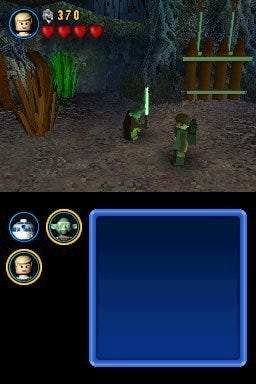
You can switch between characters by tapping the screen. Or the shoulders.
In many ways, it's just as complete a Complete Saga as the others. It's got 160 unlockable characters, dozens of 2D platform levels with 3D graphics encompassing the events of all six films, surprisingly unrubbish top-down vehicle levels, as much of John Williams' iconic soundtrack as Traveller's Tales could fit on the game-card, and controls that do a fair enough job of replicating the console versions' analogue originals.
It was never going to look as shiny and reflective, and animations are rudimentary by comparison, but most of the important bits are handled cleanly: lightsabers cleave droids handsomely in twain, Lego bricks tumble apart and reconstitute themselves into new shapes with the same click-clacking fluency that won our hearts in the first Lego Star Wars game, and sand people always march single file to hide their numbers.
The d-pad isn't a perfect substitute for the analogue stick, of course, and those of you used to the responsiveness of the console versions will take a little while to adapt. Shorn of some of its graphical loveliness and with slightly dumpier controls, collecting studs (the in-game currency) feels more laboured, too, and other elements like the new Force power touch-screen interface are missed opportunities - the latter is soon ditched in favour of simply holding the A button. A bigger shame is the deterioration of some of the game's best bits, the cut-scenes, which are forced to use awkwardly animated sprites instead of polygons, and lose a lot of their comic impact as a result.
Even so, this is a very impressive recreation of the proper console's Complete Saga. Now if they'd just give it out to everyone who picked up the last DS version, it'd be apology accepted, Captain Needa.
7/10
Need For Speed ProStreet
There's something odd about ProStreet on the DS. It's not the horrible Career menu, which spreads your progress colourfully across an asphalt background like partially digested carrot chunks rolling along Western Road at closing time. It's not the music, which while packed in with surprising density roars from the DS' troubled speakers like a smoker's cough auditioning for X Factor. And it's not that you still hate being called Ryan Cooper. It's that apart from that, it's actually not bad.
In racing sections the touch-screen shows an overhead view of the track and damage read-outs, while drag races display your rev-meter and other gauges, and the top-screen shows off developer Exient's surprisingly handsome game engine. The cars are basic, and the combination of jagged pixels and miles of concrete inevitably unite to look a bit like the carpet in a dentist's waiting room, but the cars are also satisfyingly shiny, and at least you can clearly see where you're meant to turn in, which isn't always true on the home console versions.
The handling's noticeably friendlier too, allowing you to tear round the courses at what feels like a decent old speed, even observing the sorts of rules that govern actually driving, like braking before turning into a corner rather than effectively having to pull over and deploy a parachute half a mile before the turn to avoid smashing into an advert for Madden.
This is presumably because the developer's been carving its own technological path away from the PS3 and 360 team, allowing them to borrow or adapt many of the proper game's better features (like the customisation systems and their influence on race outcomes, and online racing for four players), and dodge some of its flaws. Even the drag races, which I found desperately dull on Xbox 360 and PS3, are slightly better here. Slightly.
All in all it's one of the better examples of a DS companion to an established game series - not much threat to Mario Kart in pure playability stakes, but home to surprising depth and fun all the same, providing you can look past the fact it's designed for people to play when they're not the one talking on Jeremy Kyle.
7/10
Call of Duty 4: Modern Warfare
The last time we heard from the chaps at n-Space - or at least the last time I was paying attention - was with oft-delayed Cube FPS Geist, in which you could possess dogs, cats and all sorts of other things and then sneak around and scare people. That obviously wasn't the amazing springboard to success it might have been, though, because here they are applying their talents to the DS version of a graphics-heavy console and PC first-person shooter - a task that sounds like it would be innately, er, dispiriting. Sorry.
If you're a lefty, they push the buttons to the right of the map. How thoughtful!
Not that they've done a terrible job. The controls are the now traditional d-pad or face buttons for movement and strafing (depending on whether you're left or right handed), with the shoulder buttons firing whatever you're holding and the stylus controlling head movement. 3D shoot-'em-up action happens on the top-screen and the touch-screen doubles up as a map, inventory and toggle for peering down the sights.
What with the DS being rather simple in the head, Modern Warfare here even looks a bit like Geist did, full of blocky, angular environments and characters, and explosions that look more like dancing orange spheres than bursts of fire and shrapnel.
It's certainly basic, then, and if you've never enjoyed this handheld control scheme in other FPS games then you won't start doing so here, but there's a fair amount of content for single players, and n-Space is sensible to change the pace occasionally with back-of-the-Humvee on-rails bits. You won't be eulogising set-pieces in end-of-year roundups as you would with the more modern Modern Warfare off in PS3 and Xbox 360 land, but you won't find it too annoying either, although the decision to couple a dodgier control system to a new-found need to shoot everyone four billion times before they fall over is a little confusing.
And while single- and multi-card multiplayer options are always welcome, the absence of online play is keenly felt - not just because Call of Duty is renowned for its internet action, but also because the DS has had that bar set for it once already by the still-arresting Metroid Prime: Hunters, which remains a better option for fans of Friends Codes and other Wi-Fi Connection quirks. Worth a look, then, but probably only if you're in a very exclusive set: FPS-obsessed gamers who only own a Nintendo DS.
6/10
Tony Hawk's Proving Ground
After "doing the wrong things reasonably well" in last year's Downill Jam, Vicarious Visions is back to making companion games for the real Tony Hawk series, and this latest example - based on the PS3, 360, Wii and PS2 based game of the same name - demonstrates the DS' growing aptitude for rendering proper-game graphics despite the obvious drawback of being powered by a 1980s Casio wristwatch.
Some special tricks require simple touch-screen inputs, but nothing particularly exciting. It's still more of a challenge than American Sk8land was though.
Whether this is something to be drawn in big happy red letters all over your deck or ground unhappily beneath the trucks is a fairly subjective matter; players with more Tony Hawk experience will probably tire quickly of its routine marriage of superhero skating and Simon Says tasks, but those of a less jaded hue will probably become rather enamoured with it.
It's got huge play areas, it delivers most of the THPS series' control scheme (bar some of the nattier recent additions) allowing for similar degrees of flexibility and depth in the process, and it's even part of an elaborate network system that allows for global stat-tracking, and four-player online games with voice-chat for people who have swapped Friends Codes beforehand. Even without Internets, questing for each of Proving Ground's single-player "Sick" goals will probably take you as long as Hawk's head has been warmed by 2007's money-hat.
It might have been nice to have a bit more colour to the environments, a bit less soul-crushing music and street-speak from the assembled skaters, and an interface that looked less like an MTV tribute, but you can probably forgive these things in light of just how much content you get and how fit the game is to bear its mother-series' name.
DS ports are often guilty of capturing and even exacerbating the original game's flaws without adding anything, but Proving Ground on the DS is actually slightly simpler and a bit more likable. It won't get you out of your Tony Hawk funk if you're already bored to death, but then you've already got SKATE for that so hurrah.
7/10
