Burnout: Revenge Review

Sweeter than ever.

Version tested: Xbox 360

When it came out last September on the Xbox, we can't deny our initial reaction to Burnout Revenge was one of slightly muted disappointment, and looking back it's easy to see why. This beloved series has become one of our all-time favourites, so to see Criterion shamelessly pandering to the mainstream left us with a feeling of resigned disappointment. It was - in the main - way too easy to blitz through the game, the new traffic checking system felt like one idea too many, and the online implementation was still not quite there.

So, as pointless as porting the game to the 360 appeared, it at least gave Criterion a chance to tweak a few elements of the package, buff up the visuals, and deliver a much better online game where you can now exact revenge on friends and enemies. Whether it's worth paying almost double for what amount to minor improvements is a moot point, but we'll try and leave the pricing squabbles out of this discussion for the sake of argument.

If you haven't played the Xbox version, then effectively what you're in for is some of Criterion's best work to date, alongside ideas that you'll either love, hate, or warm to eventually. As ever, the game lives up to its billing as the fastest and most destructive racing game out there, offering a brilliant mixture of racing challenges, time trials, and crash junctions.

Rival school
1

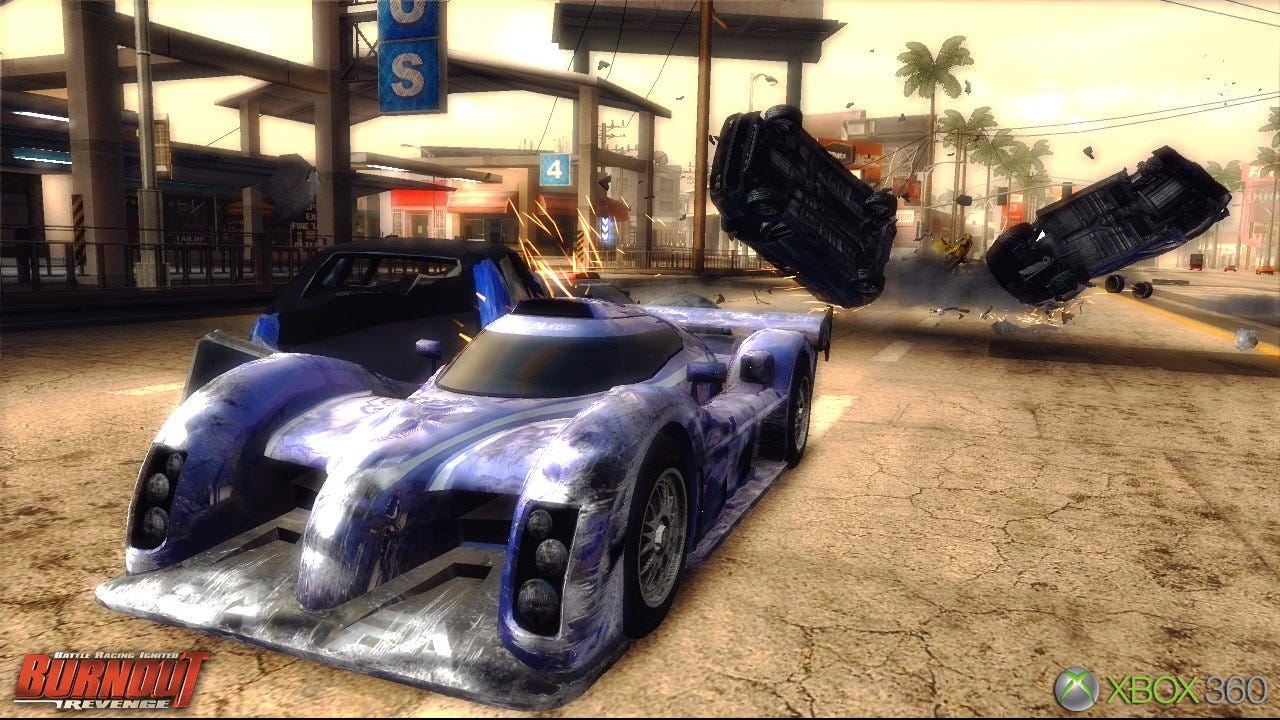
Scratched to hell, but not a dent in sight... what's this car made of?

In the standard-issue camp, Criterion dishes up plenty of regular first-past-the-post racing against five AI opponents, as well as Eliminator races, where the last placed car gets taken out every 30 seconds, and Burning Lap (against the clock) to keep the traditionalists happy. Beyond that, there's the all-new Traffic Attack, where the idea is to shunt same-way traffic out of the way to cause as much damage as possible while topping up your time meter; Road Rage, the bash-your-rivals-to-gain-time-and-medals mode; as well as 50 Crash events - ten more than the original PS2/Xbox version, but still 50 less than Burnout 3 featured, remember.

The big, controversial difference between Burnout 3 and Burnout Revenge was the new ability to gain boost from 'Traffic Checking', or blatting anything from behind smaller than a bus. Not only can you use it to top up your boost bar, but turn the road into a giant moving snooker table where you can casually set up explosive trick shots to potentially take down rivals in new and exciting ways.

At first, Traffic Checking seems like an irksome new addition to the series that makes it nearly impossible not to boost your way around every event. If you're not gaining boost from Checking, you're gaining it from driving into oncoming traffic, gaining air, drifting, takedowns... basically anything that doesn't involve crashing into oncoming traffic or an immovable obstacle. Even then, crashing gives you a chance to use aftertouch to steer your way into rivals after the fact and - you guessed it - gain more boost. Boost boost boost. It seemed like one of those needless features bolted onto a nigh-on perfect game, and one that turns the game into something a lot of us weren't 100 per cent charmed by, because boosting now felt obligatory rather than a special reward, and that in itself felt wrong.

Half and half
2

That'll teach him to fiddle with his iPod at 209mph.

Part of the issue here is just how easy the first half of the game is. Criterion seemed to be under the impression that it needed to make most of the game so ridiculously simple that all you had to do was press one button, vaguely steer in a straight line and win a medal. And with so much of the game unlockable by winning nothing more than the ludicrously straightforward Bronze medals, you have to play for absolutely hours on end to meet anything approaching a true challenge.

In Criterion's defence, it felt the need to make the game more accessible to the masses - and it does - but on the other hand, it singularly manages to alienate the core audience that hold it dear to their hearts. Fortunately for the long-term fans of the series, the real meat of the game is in there - you just have to wait a while for it to appear. Cleverly, Criterion makes the already massively improved World Tour progression structure even better by reserving the Gamerscore Achievement points for those people willing to go all the way and complete each tier on Perfect - no mean feat. With this carrot dangling above you, there's far more incentive to replay each and every event until you've extracted all five stars from each, and with that in mind the true challenge within some of the events really comes to the fore.

The progression structure's a clever sod, too, because it allows fans of specific types of race events (i.e. Crash, in our case) to go through much of the game playing these events exclusively. Eventually, of course, you find yourself lacking enough points to make it to the next tier, but on the whole the game does a great job of allowing you to play things in your own order, rather than prescribing a route.

Burning love

3

Who's going to clear up all this mess. Not me, I tell thee.

When you get through the sixth, seventh rank and beyond, it's more than evident just how good Burnout Revenge really is, and how the Traffic Checking system isn't just the annoying gimmick it appears to be for so long. It's still not quite the Burnout you might love from the past, but eventually it's an idea you start to warm to, and eventually start to admire. Once Criterion starts turning up the heat and you're weaving in and out of lorries and buses, smacking vans into opponents and setting up huge trick shot chains, you can't deny that it's actually very exciting indeed. If only the game wasn't so insultingly easy for so long, you'd probably be more forgiving.

As we always point out, the Crash mode provides huge amounts of fun, and it's no different here, with 50 of the buggers to conquer - some of which are among the most devious and destructive yet. Since Burnout 3, things have changed a notch, with the removal of the dastardly multiplier that took a lot of the skill out of the experimentation, replaced instead by a target car that does effectively the same job but in a slightly less obvious fashion. Better still, it's much quicker to restart failed attempts than before; making it even more compulsive than it was in the original version. Admittedly, it seems a little easy to gain Perfect ratings on many of the junctions, but you'll still have heaps of fun going for the highest scores - particularly now that you can finally compare your offline scores on Xbox Live, which as we all know is good for bragging rights.

As far as technical improvements go, of course, Criterion's reputation for visual excellence was practically untouchable in the last generation, so it hardly needed to do very much to make things irresistible - but at first glance there's not been a massive leap in quality if you're used to playing the game in 480p in the past. Sure, it's wonderful seeing the game in pin-sharp high definition on a big widescreen HD-equipped set, but given how amazing it looked already, you'll not really be blown away by any massive leap in standards or effects.

Heart attack

4

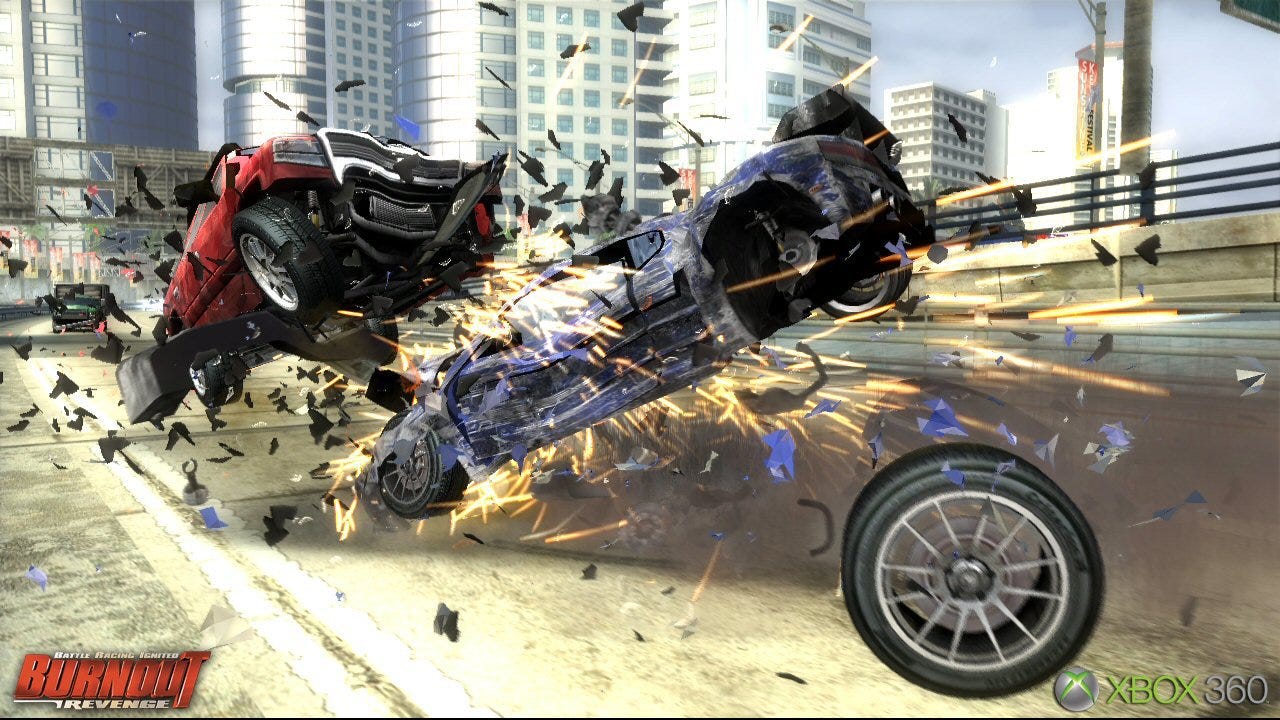
Wheels on fire.

In a game of spot-the-difference, you'll immediately notice how much the cars now scratch progressively over the course of a race, how the cameras seem to show things off more spectacularly, and that there's less slowdown - but you'll still experience the odd chug on very rare occasions, so it's not flawless beyond improvement. But just to be clear, on the 360 it's an incredible looking game, that's possibly the best looking racing title on the platform to date, and one that moves at face-altering speeds that leave your heart beating out of your chest when things really get crazy.

The audio deserves a special mention, too. Not only does the game now sport the legendary theme music from Burnout 2 (a lovely touch), but the in-game audio has to rank as the best we've ever heard in a racing game, with roaring engine noises, booming crash effects and a plethora of other wonderful effects that add immensely to the atmosphere. Even the soundtrack - despite the odd blip - features largely impressive tunes from a whole selection of top notch left-field acts. Thumbs up Criterion, you got this one right for a change.

On the whole, Burnout Revenge simply feels like one of those games you're quite likely to develop quite a short-term obsession with. With so many events to conquer (179 in total), and all those perfect ratings to go for, you'll spend at least 20-odd hours unlocking everything, and probably another 30 or more perfecting each and every event. If anyone tries to claim the game lacks depth, laugh in their disbelieving faces for as long as you've got breath in your lungs. With each multi-level course criss-crossed by devilish short-cuts, some courses take ages to truly master, and even then you'll squeak through certain events by the seat of your pants. It's just such a fast and furious game, there's often a very small margin of error to play with, but one that does admittedly let you off as far as the AI goes. So often race leaders evidently 'hang back', allowing you to pip them at the post, which is a bit rubbish, but certainly eases the frustration at times.

On and on

5

Look! We can do sparks!

The fact that Criterion has also taken big strides in providing a much more rounded online experience is a bonus, too. Although there are still only three main modes (Crash, Race and Road Rage - a chasers versus the chased team-based mode) the ranking system now follows a much more logical leaderboard approach, and all cars are available to everyone. Not only that, the new Revenge system works a charm by extending the premise of the single-player 'takedowns' into the Race and Road Rage face-offs. So, for example, if someone shunts you off the road in a race, the game's very clear who the culprit is. Not only does the game remind you who 'got' you, you can also see who you've taken down, who you've settled scores with and so on. The brilliant thing is, if you ever meet these players in the future it'll keep a permanent log of your rivalry and give you a chance to settle scores way down the line.

Not only that, the Terms and Conditions page only ever shows up the first time you play online, the matches are generally lag-free, with no inexplicable drop-outs and you can also compare off and online scores in series of leaderboards. On that point, though, Criterion needs a thorough ticking off for making it a real counter-intuitive faff to easily compare offline lap times and crash scores without going through hoops. Stupidly, you actually have to log into the Live section of the game to even access this, even though it ought to be transparently visible from the in-game World Tour mode at all times. A small point, but an important one, nevertheless.

6

Now's definitely not the time to bail out.

And on top of that - as a footnote, really - you can now record clips of your finest moments from any of the replays in the game and upload them for others to download. Similarly, people can recommend clips and you can browse the Top 20 most downloaded to see what the truly elite players get up to. While it's not perfect, it's a cool little community feature that's a nice extra, though certainly not something we'd play around with much, if we're honest.

Whether you agree with EA's decision to re-issue this on the 360 is kind of irrelevant. Sure, if you've bought it already, then there's very little reason to get this unless you're an obsessive fan, but if you resisted buying the original, then Burnout Revenge surely ranks as by far the best arcade racing game on the platform right now, and is without doubt as exciting a game as we've played on the system. Traffic Checking might irk you to begin with, but as long as you've got the patience to get over the easy first half and play the game in the right spirit, there's tons of face wobbling fun to be had. Stick with it, go for the Perfect rankings and go online with it - it'll be worth every penny.

8 / 10

Read the Eurogamer.net scoring policy

Comments (60)

Comments for this article are now closed, but please feel free to continue chatting on the forum!

  • Loading...hold tight!