Pro Evolution Soccer 2009
Push and pull.

It's telling that both Activision and EA are now saying much the same thing: Wii games can't just be PS3 and 360 ports with madcap control schemes stretched over downgraded visuals. EA is making greater strides - Boom Blox and Tiger Woods 09 are particular standouts - while Activision boss Bobby Kotick said recently: "I think we can do a better job of creating original content for the Wii, and I think you'll see more of that this year." What must be galling for both is that Konami blithely did it the wrong way with Pro Evolution Soccer last year, constructing an absurdly complicated set of controls that used every button and gesture the Wiimote and nunchuk can conjure, and won almost nothing but plaudits.
The key to its success wasn't the underlying PES framework - increasingly maligned on PS3 and 360 anyway, and rendered virtually moribund by EA's towering FIFA 09 just a few months ago - but the way that the game allowed players to break free of the shackles of direct control. Football is a team sport, and a lot of the most exciting and beautiful things that happen on the pitch are down to players positioning themselves intelligently, anticipating their team-mates' actions, and improvising as a group. In short, all the things that have traditionally been forced to the periphery by the need to focus on the man with the ball. It's possible to play proper team football in PES and FIFA on PS3 and 360, but PES Wii allowed players to control more of the team at once without having to rely on AI team-mates second-guessing your intentions at exactly the right moment.
PES 2009 for Wii is a cautious evolutionary step forward. After demanding so much persistence and concentration in the early stages last year in order to master Pull and Point Dribbling, never mind the various advanced skill techniques and variations, this is a game of refinement. There are new attacking options like one-twos and give-and-gos, which sound horrible on paper (while Point Dribbling, hold Z and press B to pass the ball, then continue your run), but which anybody with a couple of hours of PES Wii under their taped ankles and Vaporubbed chests will absorb relatively ably, while a new option to direct a shot with the pointer and B button is about as simple and intuitive an update as this spin-off series is ever likely to deploy.
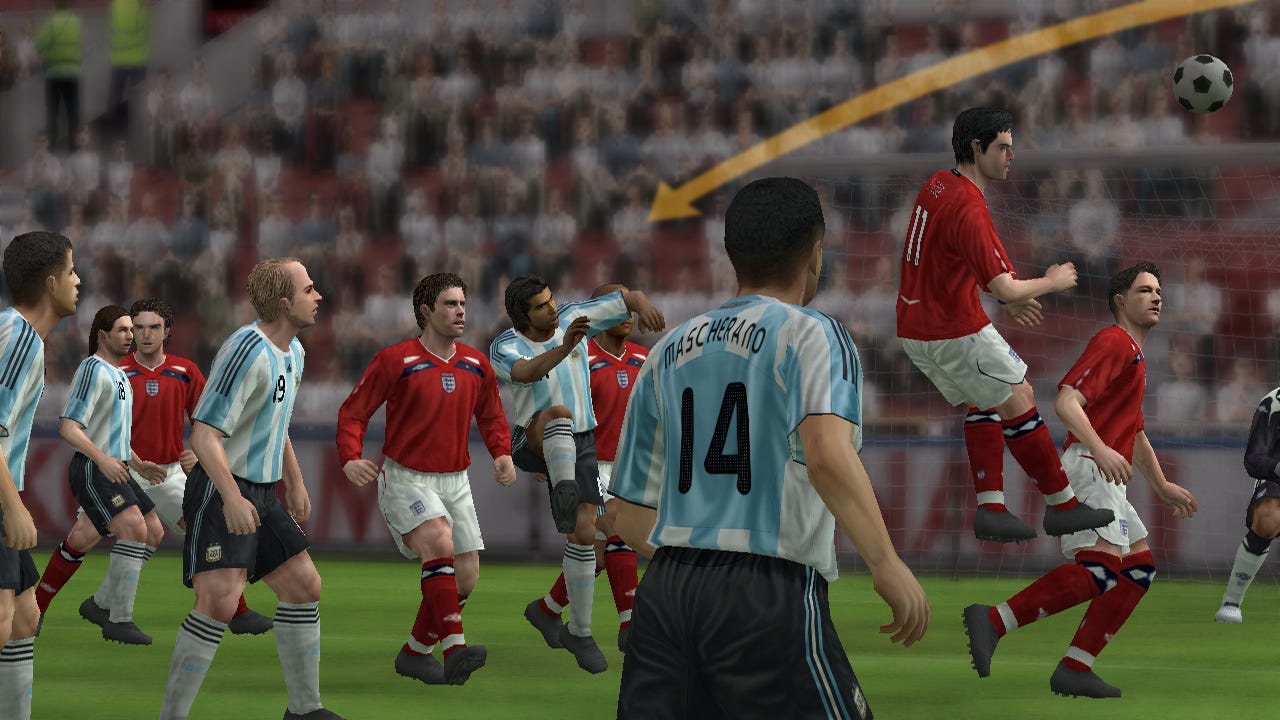
Where PES Wii needed most refinement though was in defence. PES 2009 has a fair crack at this, sending a defender after an opposition player automatically so you can then decide to jostle (Z) or slide in (shake the nunchuk), or bring a second defender into play by pointing at the attacker and pressing A. The result more closely resembles the traditional PES tactic of pressing with two players at once, not least because you can still use the nunchuk analogue stick to fine-tune the first defender's positioning. Combined with the existing option for man-marking, it should give you a better range of options to deal with advancing forwards. That said, the new ability to have a man-marker step out to intercept a pass requires superhuman anticipation - so much so that I rarely used it again after a few dozen cack-footed attempts.
It's still much easier to attack than to defend, with more than enough options to bamboozle the easily-confused opposition AI (especially on the starting difficulty level - beating Bordeaux 9-2 in my first Champions League game was an eye-opener), along with any opposing humans who haven't gone through all the training camps. Human vs. human defence is often about exploiting the difficulties you're familiar with in attack rather than any particular control mastery. Given that productive defence is about tight, positional play and reactions, you almost wonder if Konami should give it over to more traditional, direct analogue-and-buttons input and leave the pointer and indirect input playmaking to the expansive forward game. Whatever - it would be nice to see the developers apply the same inventive approach to defence as they have to attack, which isn't the case yet.