At last, Sony's new motion controller has a name. And it's not Arc or Gem, as you'll know if you read our live text blog or the rumours floating around the internet before the press conference even kicked off. As soon as it was over the audience flocked to the room next door, where Sony had set up 30 demo stations to show off the first batch of PlayStation Move games.
Eurogamer reporters Ellie Gibson and Oli Welsh were first in line. They were pushed out of the way by a lot of excitable Americans, but eventually they got to play all the games on the show floor. Oli had a go at the butcher titles (SOCOM 4, Sports Champions, Motion Fighter, The Shoot) while Ellie, obviously, was in charge of Women's Things (EyePet, Move Party, TV SuperStars and Brunswick Pro Bowling). Here's what they made of it all.
Move Party
No motion controller software line-up would be complete without a mini-game compilation, and Move Party is Sony's offering. This EyeToy-alike title was demonstrated during the GDC press conference by studio communications manager Nancy Carter, who's also presenting the playable demo.
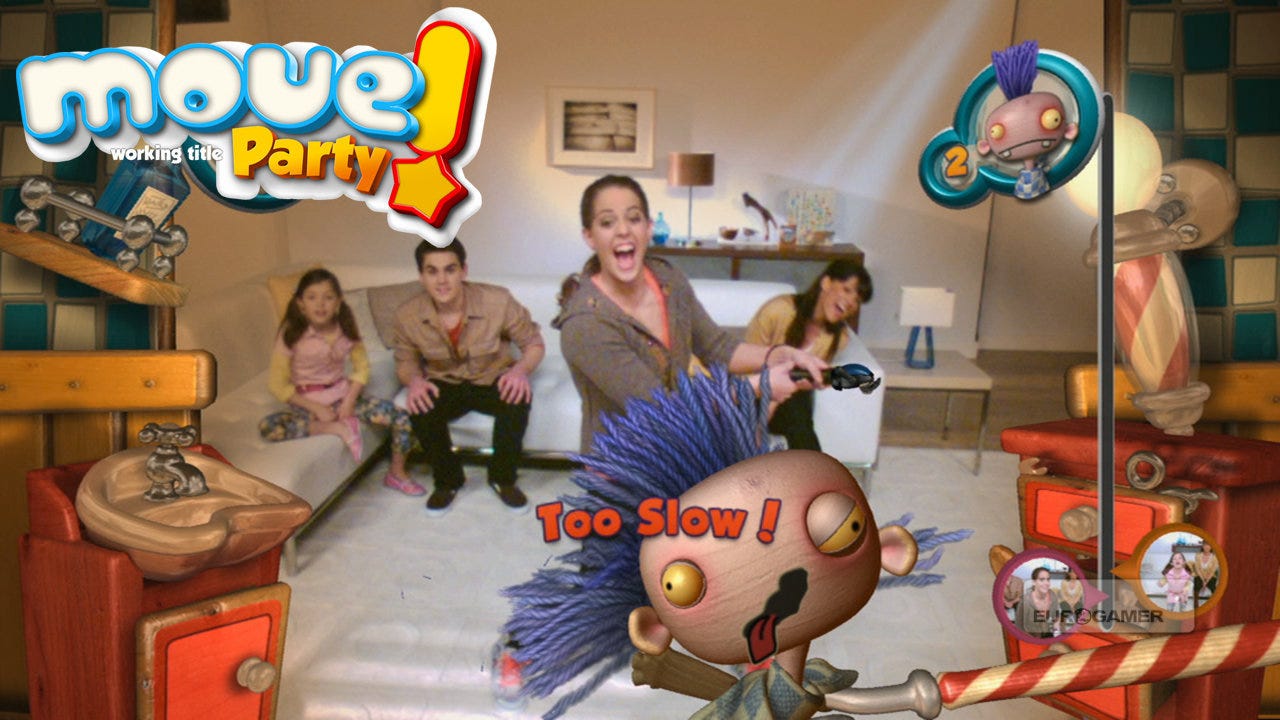
She tells me there are currently five mini-games in Move Party, and that she can't discuss whether more will feature in the finished game. At least I get to play all five of those today, beginning with the butterfly swatting game. I see myself on the screen holding a virtual tennis racket and set about thwacking my fluttery friends to death. There's no noticeable lag between my movements and the on-screen action, and I'm impressed by how realistically I can tilt and twist the racket.
Next up is the painting game, where you use a virtual brush to paint shapes as directed. I'm instructed to draw a boomerang shape, then a circle and a swirly letter E. I manage to paint the lot without too much trouble. The Move controller is indeed pretty precise, though it feels like a Wii remote would do the job just as well here.
The third game I get to play involves using the controller like a pair of clippers to cut hair. When I get too close to the character's scalp the controller vibrates intensely, demonstrating the impressive level of rumble Sony has integrated into the Move wand.
And finally there's a balloon popping game. The screen fills with balloons and my mission is to pop different colours according to the on-screen instructions, using a virtual harpoon. It's quite hard to see what I'm doing and real force required to burst the balloons, but the game is pretty good fun.
As are all of the above, but Sony may need to stick some more mini-games in this compilation to provide long-term value. Some more challenging ones might also be in order if Move Party is to appeal to the post-pub crowd as well as families. And while we're writing a wishlist, all these games are turn-based - how about some you can play simultaneously with other people?
Brunswick Pro Bowling
Not technically a women's game, what with male arms being more suited to lifting and throwing heavy objects. But having reviewed the Wii version of the game (oh dear), I took it upon myself to have a go.
As you'd expect, BPB looks a lot better on PS3. But it's played in the same way - you hold the trigger button while pointing it down to line up your throw, then raise your arm to a vertical position and tilt it to adjust the angle. You make a bowling motion and release the button to chuck the ball.
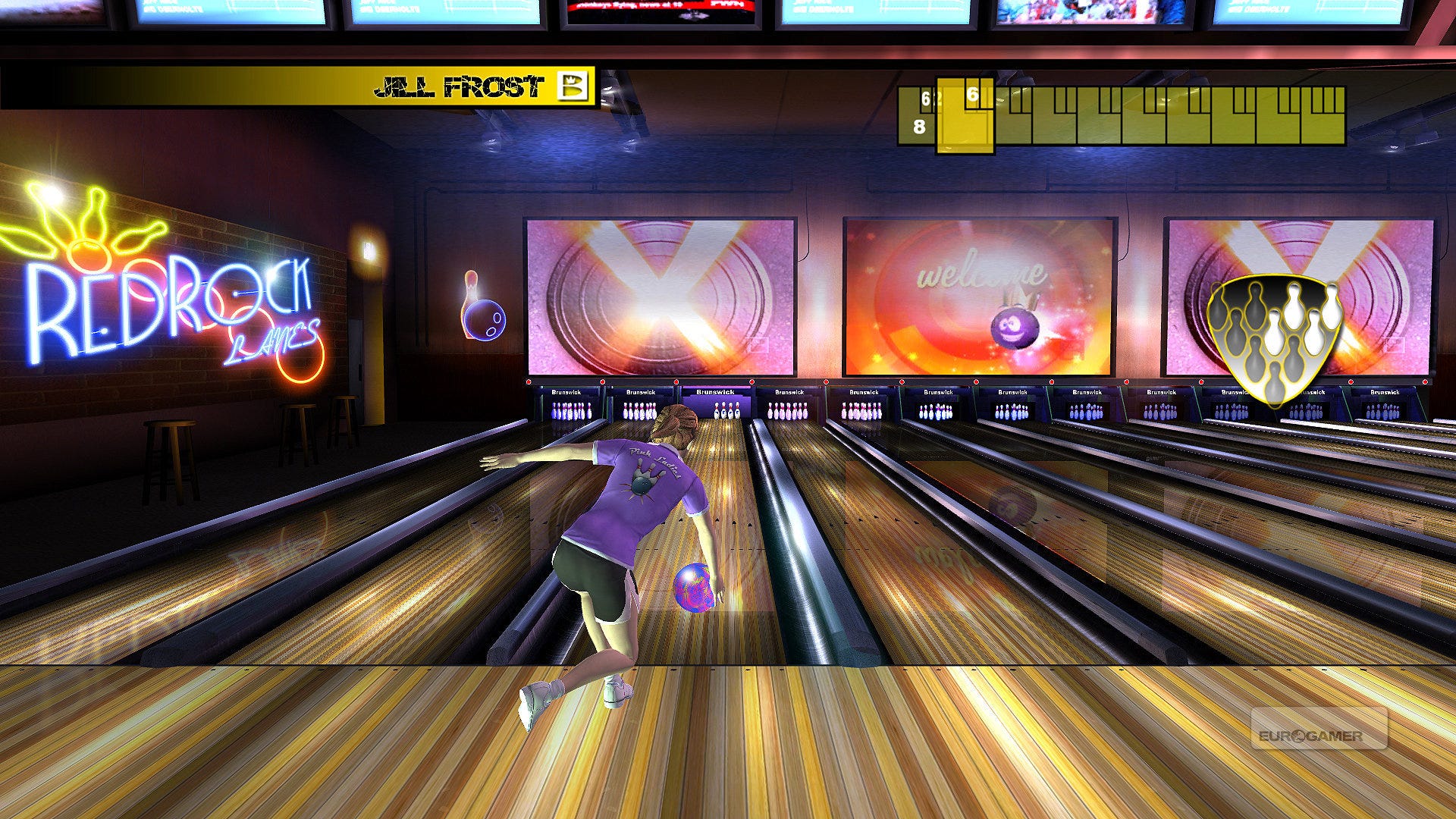
Just like in the Wii game, you have to keep up with the on-screen throwing animation - the character doesn't copy your moves, but you must copy theirs. "If you start the animation at the same time as you release the button, it'll look seamless," says producer Reed Livingstone. I can't and it doesn't. Plus, disappointingly, the ball appears to float rather than roll down the alley, just like in the Wii game. Livingstone points out this is only a pre-alpha build, however.
What's more, he's confident Sony's new technology will make for a much better game than the previous effort. "Besides the graphics, the physics are going to be much improved. There's much more realism in this game as opposed to the one we did in '07," he says.
"Back then we were dealing with the Nintendo Wii, and the abilities of the PlayStation Move controller - I mean, night and day, they're different. We're going to be able to do so much more with this controller as opposed to the Wii remote. Not to put Nintendo down - it's a great controller, and it was a great game back then - but this game is head and shoulders above that one." It's impossible to confirm that at this stage, but here's hoping.
EyePet
Later this year, fans of the original EyePet will be able to throw away that magic card it comes with. Or will they? Technical director Mark Lintott isn't "at liberty to say" whether a patch is planned to make the original playable with the Move controller, or whether an entirely new game is being prepared for release. At least he's letting me have a play with what's on show today, however.
It's extremely similar to the version in the shops now. You get to care for and play with a weird virtual cat-monkey thing, who responds to your movements. "You've still got the same hand interactions. It's just that whenever we used the magic card, we're now using the PlayStation Move," explains Lintott.
So, for example, I can hold the Move controller like a showerhead to wash the EyePet's fur. I can tilt it and twist it in any direction and the on-screen showerhead responds exactly. This new level of dexterity makes the game more suitable for younger kids, according to Lintott.
"If you played the original version, there was a lot of problems with twisting," he admits. "Especially with small children, when they moved their arms to the side of the screen, the card turned away quite often. This is much more usable."
That aside, it's hard to say whether the Move controller greatly enhances the EyePet experience. In one regard, it makes it a little less magical. In the original game, you can draw a real life picture using a pad and pen and the EyePet will copy it with a virtual crayon. In the Move-enabled version, you draw the picture on the screen using the controller. Watching an image come to virtual life just isn't quite as exciting when the image is virtual anyway. Lintott promises that new features we aren't being shown today are in development, however, so once again it's too early to judge.
TV SuperStars
This game is being developed by Sony Cambridge, as lead designer Jon Ingold informs me. It wasn't shown during the press conference, so to begin with, what is TV SuperStars?
"It's a casual game for social and family audiences," Ingold says. "The idea is that you, your friends and family can become celebrities in the world of reality TV. It's a fun, accessible thing where you kind of get to be famous. And we're using the Move controller to make something that anyone can pick up and play, so there's no barrier to entry."
The first step on the road to fame is taking a picture of your face using the PlayStation Eye. This then appears on the head of your in-game avatar, so it looks just like you. You can choose your body type from a range of elements and dress your avatar up in different clothes.
"As you become more famous you'll see yourself appearing in adverts, on billboards, in glossy magazines, attending celebrity parties... So it's about tapping into that kind of celebrity culture in a computer game, which I don't think has ever been done before," Ingold says.
Do you get to see pictures your husband took of himself in his pants on the cover of The Sun? "This is a game for a family audience, so we have to be careful about including any material which won't go down so well if the avatar isn't a kid. We've gone for cheeky British humour rather than Chris Morris-style satire." Shame.
Today Lintott is showing off Frockstar, one of several TV programmes featured in the game. Others, he says, include a cooking show hosted by a gangster rapper chef, and a disastrous DIY show where everything goes horribly wrong. But Frockstar is all about fashion. You can use the Move controller to dress your avatar up in different outfits and apply make-up, for example.
So far, so Wii. But Lintott shows us a dancing mini-game which is a bit different to the likes of Just Dance. Instead of fast, jerky movements, you're instructed to do sweeping movements - moving your arms in slow circles, for instance.
"One thing I found playing dance games a while back was that they hurt to play," says Ingold. "I wanted to make something cooler and more voguey, so the creative director and I sat down and looked at what this device could do." The end result is certainly a game which makes you look more graceful and less silly than Just Dance, which may or may not be a good thing depending on your perspective.
Do well in the mini-games and your photo could appear on a mock Heat cover, as we're shown today. The images of other players are stored on the hard drive and they will appear in a range of media too, so you might find yourself starring in an advert with your Mum as an extra. A bit like the way in which your Miis populate games such as Wii Fit, then. "I suppose so, I hadn't really thought about that, honest," says Ingold. "What I like about this is, it's not a Mii - it is me."
Motion Fighter
Motion Fighter drew crowds with its stylish, sharply lit monochrome visuals, a tight over-the-shoulder camera tracking our tattooed Asian boxer as he trades blows with a bandana-wearing biker thug. This bare-knuckle brawler looks like no motion control game you've seen before - very high definition, very grown up, very cool, very PlayStation.
Strange, then, to pick up the two Move controllers and find myself playing a refinement of Wii Sports Boxing, many people's first experience of motion control over three years ago. Or not so strange: it's natural to pick up a motion controller and want to punch stuff, of course, but even the greater technical capabilities of Sony's set-up can only do so much with boxing, where timing is dictated by gesture recognition and animation routines. My moves aren't always accurately represented by my avatar, but there is much less input lag than in Nintendo's game.
After quick and simple calibration - hold both controllers to your chest and press circle - it's into the bout. Simple, forceful gestures initiate straight punches, hooks and uppercuts; a flick won't do, Move sensing how far and fast you throw the punch to determine its force. The uppercut is particularly satisfying, since you need to twist your fist around to execute the blow properly.
Holding both controllers up to your face blocks, leaning dodges, pressing Move's big action buttons and tilting the controllers walks you around, while pressing the triggers and the action buttons during wild gestures executes dirty fighting manoeuvres. You can grab your opponent in a headlock and elbow him in the face by moving as if you were doing just that, or perform a vicious head butt by lurching towards the screen with both hands and your whole body.
The simple interface presents health and stamina bars for both fighters, the latter being used up by strings of moves, but it's my own stamina that runs out first - like Wii Sports Boxing, Motion Fighter (it's a working title) is a very energetic and exhausting game. It looks great and is only 20 per cent complete, but Motion Fighter doesn't quite feel like a standalone release yet.
The Shoot
The least convincing game on display was The Shoot, a basic, movie-themed shooting gallery that combines pointer aiming with a handful of gesture-triggered special moves. Using Move in this way is exactly like aiming with the Wii remote; anyone who's played one of the Wii's excellent "light gun" games like House of the Dead: Overkill will be instantly at home with the fast and accurate pointer control, guiding the cursor by tilting the wrist rather than aiming down the sights of a gun. The Move controller's curved, comfortable trigger - this is a very ergonomic and well-built peripheral, and very pleasant to hold - is the fire button.
The level available to play has us shooting cartoon robots as they move through a subway station, onto a train and eventually along its roof. 2D cardboard cut-outs of civilians need to be left unmolested, while the robots can be blasted away piece by piece by targeting different parts of their bodies - but the most efficient way to dispatch them is to "headshot" them in their glowing eyes, which makes them explode.
You can also flick the Move controller side to side to dodge (though only in certain sections), slam it down to send out a shockwave, or twirl it once to start a brief period of slow-motion if things get too hectic. It's the same old gesture control we're used to - not quite instant, not quite reliable - although it does seem a smidgeon snappier on Sony's device.
Move isn't the problem with The Shoot, however. That would be the amateurish, low-grade graphics, clumsy scripting, and lack of imagination in the enemy patterns or level design. As a proof of concept it's fine, but if Sony wants to avoid giving the impression that Move will suffer the same flood of cheap and cheesy cash-ins that the Wii has, it shouldn't be showing games like this.
SOCOM 4
You can't say the same of SOCOM 4, the most complete and most traditional game on display and the latest entry in Sony's evergreen tactical shooter series. SOCOM 4 has been in development for three years, although developer Zipper Interactive has only been working on the (optional) motion controls for the last six months. You wouldn't know it - they're a completely natural fit.
This is our only chance to try out the sub-controller, Sony's nunchuck. It's slightly larger and less curvaceous than Nintendo's add-on. Like the nunchuck, it has an analogue stick, a trigger and a bumper; unlike it, it has a couple of face buttons by the stick, and is - joy of joys - wireless. Once more, it's a nicely made piece of kit, and comfortable to use.
This is another pointer-aiming game, which means the control experience is identical to what you'd expect from a Wii FPS or third-person shooter. Using Move as a pointer guides your sights around the screen, while pushing them towards the edges turns your character or moves the view up and down, which works fine in this third-person perspective. Running and strafing is handled by the sub-controller's analogue stick, the Move trigger fires, and the sub-controller trigger tucks you into cover. You can also throw grenades (no gesture required, thankfully), and for the first time in the SOCOM series, call in air strikes.
The pointer feels a little slow at times, but I suspect this is down to the choppy frame rate of this early version of SOCOM 4 rather than the Move hardware. Otherwise, SOCOM is a breeze to control using the new controller duo, and my Zipper guide admits that, although the developer's still tuning, it's been relatively easy getting the basic interactions to feel right. This is an established control scheme, well implemented in a solidly enjoyable shooter. It proves that Move will be a very viable alternative in this mainstream genre, and it will be out this year.
Sports Champions
At the end of the day, it's the unprepossessing mini-game package of Sports Champions that really shows us what Move can do. At first glance, it's easily dismissed as a Wii Sports wannabe, albeit with a rather odd selection of sports (table tennis, gladiator duels, disc golf, archery, bocce and beach volleyball) and bland graphics that are faintly reminiscent of PlayStation Home. But Sports Champions is by far the most impressive demonstration of the capabilities of Sony's device.
I get to try table tennis and the gladiatorial game. The first uses a single controller to mimic a table tennis bat and I'm immediately struck by how amazingly smoothly and accurately Move tracks my movements. It's a step up from Wii MotionPlus, no doubt.
Table tennis plays a fair bit slower than the real-life game, which is probably just as well. It doesn't use the buttons whatsoever; you apply spin by angling the bat and direct shots by angling your body and by your follow-through when you strike the ball, just as you would in real life. Your avatar fades away, just showing your bat floating in mid-air, while useful on-screen guides show you where incoming balls are going to land and give your a target to aim for. The game also helpfully tells you what you're doing wrong when you miss. It's all 100 per cent convincing.
Meanwhile, gladiator duel is a best-of-three bout of sword-and-shield (or in my case, hammer-and-shield) combat where victory is earned by knocking your AI opponent out of the ring or depleting their health bar. It can also be played with a single Move controller, buttons operating the shield, but it's much more fun with two, standing side-on to the screen, holding your "shield" in front of you and batting away the AI opponent's attacks.
Once again, your avatar fades out, leaving just the weapon and shield in view, and giving you an almost first-person perspective on the action. It's fast-paced, satisfying and extremely responsive, especially after Motion Fighter. There are some neat combos, blocking with the shield powers up a super-move, and you can even jump attack by, well, jumping.
But it's all about how instinctive and accurate wielding the weapon and shield feels. With no sensation of lag at all and proper three-dimensional tracking in full song, Sports Champions shows Sony's motion controller at its best. It may be too early to say whether "it only does everything", but in this game at least, it only does exactly what it says.
