Talk about strange bedfellows.
A German publisher of games and children's software, without a major hit to its name and with no experience in online gaming, committing tens of millions of Euros to the development of what it hopes will be a triple-A MMO. An American author of doorstop science-fiction and fantasy novels seeing his work adapted for the first time. A bunch of talented, dispossessed Australian developers, striking out in a new field and a new country, with a truly international team. A wealthy Asian city-state looking to compete with its neighbours and foster an entertainment industry of its own.
If all that doesn't sound out-there enough, wait till you get a load of the game they're making. This is no World of Questhammer: The Rune Crusade. Otherland - from the books by Tad Williams - is a mind-bending concept. For want of a better soundbite, let's call it the first cyberpunk MMO: a virtual world about virtual worlds, in which your avatar is an avatar, the NPCs play NPCs, and you explore a multiverse in which you might be in realistic historical surroundings one minute, and cartoon fantasy ones the next. Everything changes, even your own appearance, and nothing is even pretending to be real.
In a field as formulaic as videogames, you seldom come across anything as unlikely as this. And yet here we are in baking, steamy Singapore, the guests of dtp Entertainment (the publisher) and its new Singaporean outpost, the development studio Real U, formed around a core of ex-Melbourne House talent. You remember them: 8-bit heroes of The Hobbit and The Way of the Exploding Fist, and then cult classic Shadowrun, who in later years struggled valiantly with the tide of licences and conversions heaped on them by Atari, sometimes triumphing against the odds (as in PS2 Transformers).
Even the impossibly garrulous author Tad Williams is here, bulldozing through the jetlag on raw enthusiasm alone, talking enough to fill the thousand pages of one of his books. It's rare enough to get the reluctant presence of a licensor, but Williams seems genuinely delighted to be here promoting this game - and after all, why shouldn't he? It's not just that his work is being faithfully adapted - it's that his predictions are coming true.
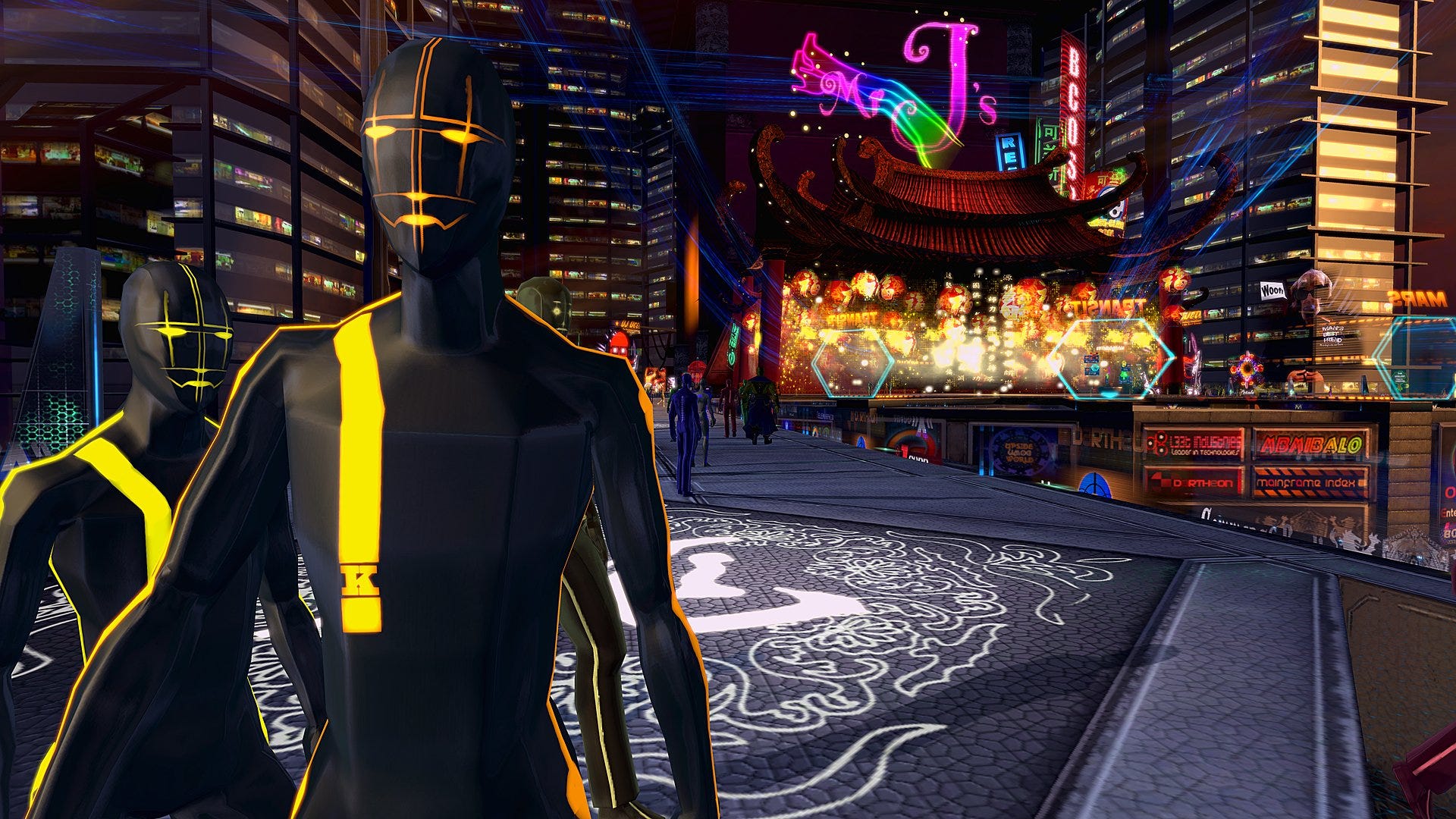
The aesthetic of Lambda Mall is weirdly dated - a very 90s version of VR - but the graphical performance isn't.
Otherland depicts a near-future world where the net rules all, and virtual-reality headsets that turn it into a surround sensory experience are commonplace. Everything from shopping to games has become an all-consuming alternate reality played out by humans ("Citizens", inhabiting their "sim" avatars) and computer-controlled AIs called Puppets.
In this world, the ultimate status symbols and playthings of the super-rich are their own personal virtual realities, tailored to their interests and specifications. But these come at a human cost. Without giving too much of the books' plot away, a sinister secret cabal of net overlords is feeding on the consciousnesses of innocent humans, trapping them in virtual space to make their personal fantasies that little bit more real.
You start the game as one of those consciousnesses in a place called the Land of the Lost, a nightmare scenario which you're trying to escape. You'll run, be killed, and reborn in a "baby" state as a simple, low-rent sim (though we suspect the game won't be using that term, for obvious reasons) - a blank, featureless avatar that can be male, female or even neither.
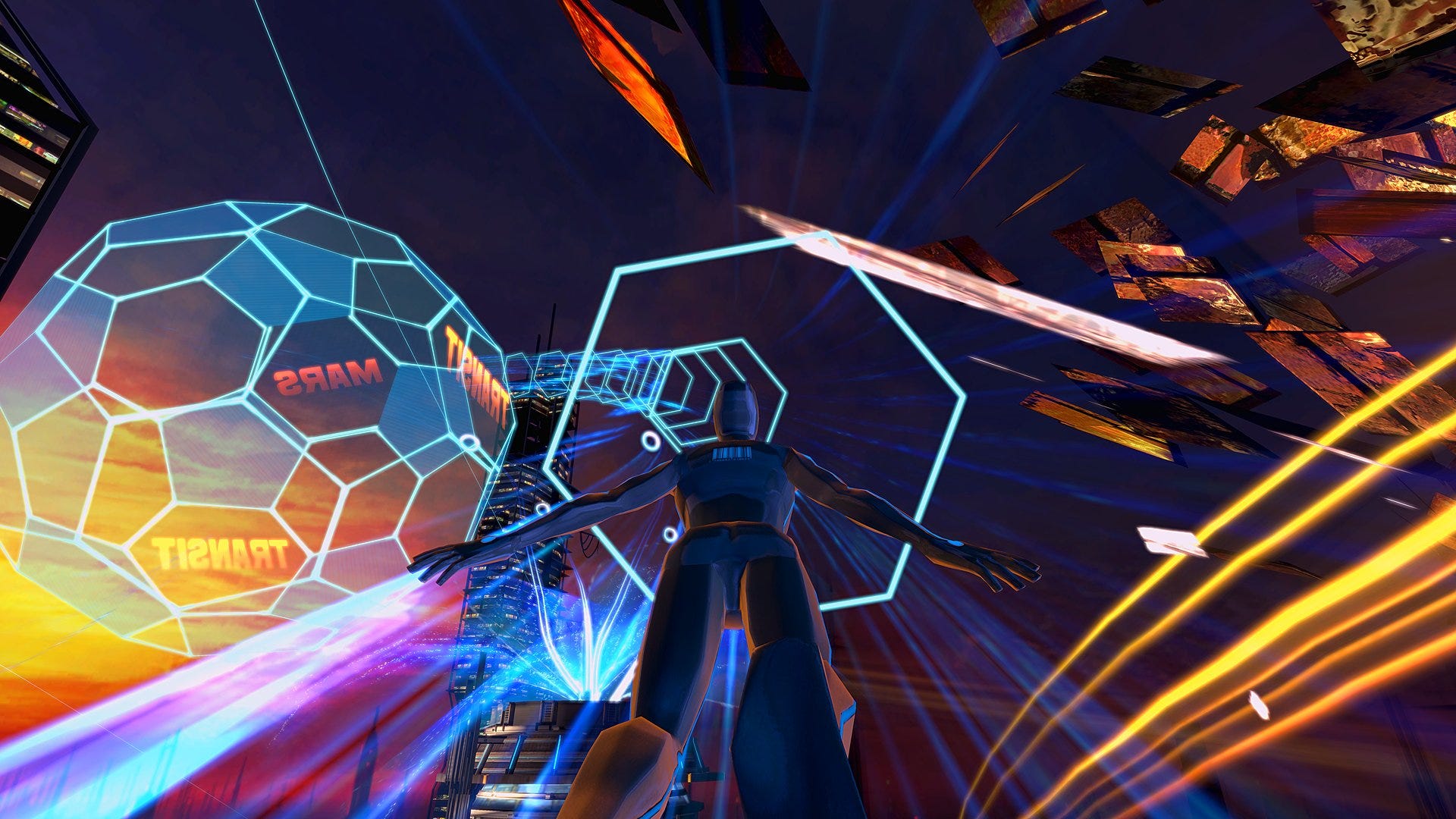
Flight tubes shoot you between sections of the Mall and other virtual realities.
As you increase in power, you learn to manipulate the appearance and properties of yourself and the world around you, and you learn to work with the "code" that underlies and defines everything in the Otherland multiverse (well, it's one hell of a rationale for levelling up). Only then will you be able to take on a more defined appearance, and this could blend you in with your surroundings, or express your wildest imaginings.
On rebirth, you'll arrive in what Real U calls "a chunk of real estate", a virtual space that becomes your own and that you'll return to in order to rebuild yourself - from scratch, but via shortcuts - every time you "die" in Otherland. This is connected to the game's hub, a neon-edged, Bladerunner-style virtual shopping and entertainment complex called Lambda Mall.
Lambda Mall will be the social centrepiece of Otherland, and provide its most scattershot, lightweight and casual gaming. Real U doesn't want the fractured nature of the setting to lead to a fractured game - the largely co-operative massively multiplayer gameplay will be the same across most of its realities - but in Lambda Mall, it is indulging itself in an orgy of minigames. Bars and shops with names like Alien Sex Friend host simple games with online leaderboards - we're shown a rhythm-action dance game in a miniature club where every avatar is shrunk to two inches tall. Real U promises 50 or 60 of these for the finished game.
These social areas also act as a stealth lobby system, where "hosts" will cross-reference players' data, and suggest quests in Otherland's multiple realities to them. Most quests will be set by NPCs, and have risks associated with failure - a reluctance on the NPC's part to offer it again, for example. But there will be player-generated quests too, which you'll be able to charge an in-game fee for access to, in a sort of lottery system.
Moving on to the game's many worlds - by way of "surfing", alarmingly literally, through a twisting network of data-splines and flight tubes - things become somewhat more structured. Real U is determined to introduce some of the production values and storytelling techniques of offline games to the MMO, whilst also avoiding a literal journey through the tale of the books, instead making every player like one of the books' minor characters - or, as Williams puts it, "building story into the experience at a cellular level".
There will be a loose structure that opens the worlds to you in some kind of sequence, but progress in one won't necessarily imply progress in the others, and the intention is to allow players some freedom over which virtual worlds they choose to inhabit. Unlike the static nature of most MMOs, these worlds will change over time and according to your actions, progressing through "phases" that are punctuated by dramatic events, illustrated in two and a half hours of cut-scenes.
The heart of the Mall is a promenade for seeing and being seen in the latest avatar mods.
These phases will work similarly to the use of instancing for storytelling in Lord of the Rings Online, or the progressive world-states used for the Death Knight starting area in next World of Warcraft expansion Wrath of the Lich King. It will be possible to "time travel" forwards through these, but not backwards - so you can bring a lower-level player up to meet you, but you can't go back to disturb the status quo for them.
Real U is only showing one world off at the moment. Mars - or rather, some Otherland characters' fictional, virtual interpretation of the red planet - is an ornate steampunk-cum-sci-fi world with Asian and North African overtones. There's a huge tower containing a labyrinthine Bazaar marketplace, sky-barges sailing around, beautiful aliens reclining in otherworldly gazebos.
It's alluring enough, but we're hoping - and to be fair, expecting - that the full range of worlds in Otherland will provide much more striking stylistic variations from the MMO norm. Some of the teasing hints we get include Egyptian mythology, contemporary settings, cartoons and a "wind tunnel" world, and it's noted that, these being virtual spaces, physics can vary hugely from one world to the next. That's not all - each world's rules are entirely defined by its owner, so in some, combat may not be possible at all. There will also be another space, outside of the worlds, where there will be a reason for player-versus-player conflict - but Real U refuses to be drawn on the details.
Yeah, these Martians remind us of Toad, too.
It's when you try and nail the developers down on the specifics of the game's design and mechanics - combat, crafting, questing, anything - that things get confusing and frustratingly vague. This is mostly because they're anxious to protect their ideas at this very early stage, but also because those ideas are so strange, so abstract.
Everything in Otherland is made of code, and your understanding of code and ability to manipulate it - the power of the link between you and the net, your "telemorphic capacity" - is what dictates your character's advancement, and acts as its health. It replenishes over time, but consistent damage reduces the total you can have, and at zero your own code degrades so much that you experience virtual death - lose your appearance, in other words.
Telemorphic capacity is what will allow you to change your own appearance, modify the stats of your virtual equipment, morph your gun into a sword, and adjust your avatar's abilties as you see fit (though there may be some specialisation later on) in an advancement system that Real U describes as "very organic and deep". It's all about bring able to suck information from the world around you -and that includes other players, who you can "hack into" in order to steal their information, take or copy their items, or plunder their virtual remnants after "death". The lower your telemorphic capacity, the more of the "real you" you expose, and the more vulnerable you are (not just in combat - NPCs or players might decide not to do business with you, for example).
Computer viruses will be a key tool. These can be bought from places like the Bazaar, plundered from enemies, generated through a crafting component of the game, and traded much like traditional MMO equipment. There will be situations where you'll want to infect hostiles with a virus, or even yourself; you can protect yourself from them with colour-coded shields, or by trying to outrun the "data ghost" goes that passes on the infection. Another tool will be the "Zoomer", an avatar mod that acts as a sort of data-capture sniper-rifle, capturing snapshots of the world and mining them for information. It will lock onto targets, but locking on will set off alarm bells for the victim.
Radical new system - or merely elaborate set-dressing for the usual RPG numbers game? At the moment, it's impossible to tell. We didn't see any of these bizarre interactions running, and many concepts remain bafflingly beyond our grasp. Real U stressed that non-combat goals would be common - often set by characters from the books - but couldn't elaborate much on what they'd be.
Either way, it's frankly a fascinating set-up. The sheer, wild stylistic abandon of the game - we see a character gallery of medieval knights, mutants, grotesquely fat Victorian caricatures, walking angelpoise lamps, coarsely pixellated Tron-like simulations - is invigorating enough, and the code system makes a perfectly twisted sense as a way of tying this disparate multiverse together.
Mars' giant tower punctures its atmosphere. Which, in case you've forgotten, isn't real.
The potential for expanding the Otherland universe is, naturally, also limitless. Williams' books contain enough raw material for years of game content, but he's ready and willing to expand the story beyond them. "This is my sequel," the author says. There will be a "post-story" game, after you've completed the phases of the existing worlds, where players could actually amass enough wealth to become the world-running evil in the system. User-generated content, anyone?
The more you think about Otherland, the more questions you have. There's time enough for Real U to answer them. The game is in pre-production only, some 15 per cent complete, and due to be released in 2010. It's running on a modified Unreal Engine 3 and envisaged as a fairly high-end PC game, with 1080p visuals on a quad-core PC the benchmark - something they studio feels won't be too outlandish in two years' time. Quixotically, Real U is also working on 3D mouse support for object manipulation and a social gesture system that, unlike everyday emotes, can be used to influence NPCs.
Looks like somebody left her feeling blue.
Otherland is also, its makers claim, being designed for truly global success - part of the rationale behind Real U's establishment in Singapore, that most Western of Eastern cities. Support for any and every business model, from subscription to micro-transaction, is being built into the game in an effort to make it ready for every market. Real U and dtp's ambition, quite simply, knows no bounds. It doesn't entirely fill you with confidence - the history of MMOs is littered with well-funded studios with grand ideas that never saw the light of day, or did, and failed. But it does fill you with wonder.
The appeal of Otherland's basic premise - an MMO that has the potential to be anything you want it to be - is as easy to grasp as the specifics are hard. It's being realised by a team that's passionate and serious about what it's doing. It must be one of the most original, thought-provoking and intellectually exciting games in development anywhere, and although you might be a fool to bet on its success, you'd be a churl to bet against it. Because, in the all-too-conservative world of MMOs, Otherland is exactly the kind of unlikely story we need.
