Retrospective: Omikron: The Nomad Soul

One for the dreamers.

David Cage is a man of extraordinary vision. Whether you believe his games match his ambition is a very personal thing. I will argue with you that Fahrenheit is one of the most exciting games I've ever played, even though it's broken in about 657 ways. Perhaps this is what's most exciting about Quantic Dream's output. However, I cannot find a similar love for Omikron: The Nomad Soul. And that's not because I can't run it on my PC.

It appears that the more recent ATI cards have seen fit to stop supporting Z-buffering, or something similar. I'm not Richard Leadbetter I'm afraid, so these words sound like buzzing to me, but what I know is it means The Nomad Soul paints the screen in giant black squares with every movement. For a game that's based around a combination of adventuring, first-person combat, third-person fighting and spotting teeny tiny objects on the floor, a mostly black screen isn't ideal (Richard would agree, I'm sure). Which put me in something of a pickle, if it weren't for the nagging certainty that I owned another copy. For Dreamcast.

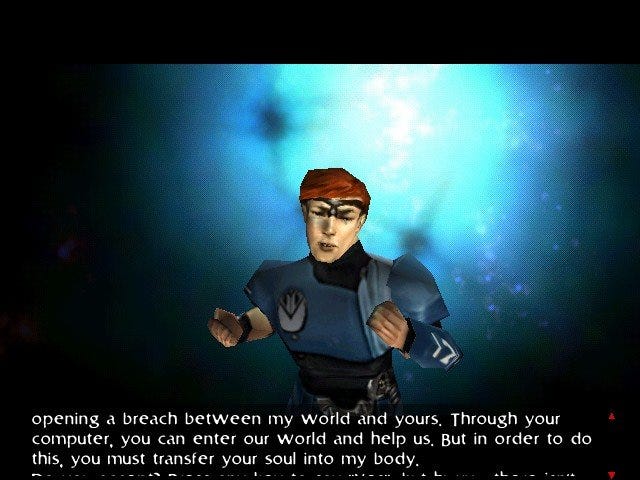
Cancelled on both PlayStation and PS2, The Nomad Soul came out for PC and Dreamcast. Of all systems. It's set in the city of Omikron (we'll get to the game name confusion in a bit) on the planet Phaenon. But you're not playing a citizen of that world - you're playing you, playing a videogame. By beginning the game you've agreed to have your soul transferred into the body of a citizen of Omikron, and thus control him as an avatar. It's an opening moment of Brechtian estrangement that ensures you're aware that this isn't going to follow conventions so much as dissemble them. Your body previously belonged to a police officer who was investigating a series of murders. So it's from there you pick up.
1

Making localisation decisions that render the game less coherent was really quite something.

I'm impressed my Dreamcast still works. It's not been switched on in three years at the very least. An Xbox would surely have turned doorstop by now. A PSX burned through a dozen chips. But the Dreamcast must have been built like a 1950s refrigerator. The gasping and wheezing as it spins the disc is like a soundtrack to 2001 and Virtua Tennis 2.

The Dreamcast version of the game, released six months after the PC version, was criticised in 2000 for falling short of the PC build. Weaker graphics, long load times, weird bubbly voices in places, and most of all, no dialogue changes to reflect the platform, leaving players instructed they were playing on a computer, staring at a monitor. But take that, PC! You can't play it any more. The DC, like the brave tortoise, has won the race.

Except all those things are horribly true. It looks phenomenally awful, a smear of brown and grey filled with polygonal characters that belong in the mid-nineties. Walking through a door takes an extraordinary amount of time, needing to load in two separate chunks each time you want to walk out of a shop entrance, staggering and croaking throughout. And oh dear me, when you're attempting to break the fourth wall it's a good idea to make sure you're referring to the circumstances the player is actually in. I'm holding a controller in front of my TV, Omikron. Not sat in front of my monitor. I think you might have the wrong soul.

But such ideas! This notion of being you trapped in a character's body is a really nice one, somewhat literalising the way we understand our role in gaming. But it's taken a step further. You're not just a character, you're a character in a game. It says so. Talking with one character you're given the conversation option, "What does it matter if I die? It's only a videogame." In fact, you're told, Omikron is a game created by demons in order to capture our souls. Which brings us to the name.

Much as the Dreamcast port fails to recognise the system it's being played on, the European renaming of the game is not reflected within. Which rather begs the question, why was the game renamed for Europe? Called Omikron: The Nomad Soul in the US, this naturally abbreviates to the first word. And indeed this is how the game names itself from within. Which is a little confusing when the Euro version drops that word entirely. So poor Mr Brecht isn't being well reflected here, now I'm playing a game with a different name on a console it doesn't know about.

But those ideas! You begin playing as cop Kay'l 669 (note: "begin"), who is a person in a city, with an apartment, wife, friends. Confused about what's going on, you migrate toward Kay'l's home to regroup. Here you can use the toilet, practise your combat skills, root through kitchen cabinets, and have a Very Special Cuddle with your wife. David Cage likes apartments.

The city itself is open and explorable, a third-person view of your character with the option to switch to first-person to have a better look around. In what's ostensibly an adventure game, such freedom to explore is remarkable. I think this was best highlighted at a point when I needed a certain drink for a certain task, and discovered that I'd accidentally drunk it earlier. Accidentally because the inventory system is so peculiar, but resolvable by visiting a local supermarket to replace it. It was a wow moment - I need this tea, there's a city with shops - I'll likely be able to find some.

2

The improv break-dancing sections would prove formative for the young David Cage.

Oh, and if you die, then you die. Often the next human who touches that corpse becomes your character. Which is a fairly astonishing thing. Should Kay'l fall in one of his early fights with a demon upon a rooftop you'll now be playing the next stage of the game as a female thief. You're the Nomad Soul, remember, playing a game, attempting to thwart the efforts of the demons by uncovering their actions with the help of underground sect The Awakened. The body you use isn't the most important thing about you. Then later in the game changing body becomes key to solving puzzles. Don't get attached.

Before this all falls apart completely, I'm going to celebrate one other detail. Then Bowie - I've not forgotten.

Much of the game involves solving mysteries by finding clues, codes, messages and communications. By really quite elaborate means you can break into places to procure secret documents. (One early puzzle can be solved by either drugging your boss's tea and then stealing her pass, or - and here "or" should be written in 60-foot high letters made of flashing bulbs - hacking into the police force's giant mechanised robots after giving booze to a mechanic so you can steal the necessary hardware and implant it in a robot's eye then stealing a fuse from a machine and convincing a computer engineer to leave to fix it and then controlling the mech on a third- and first-person mission fighting a couple of dozen other mechs, in order to open a door.)

Often these messages are written in a font that I think may actually be magic. At first glance it looks like alien gobbledegook, and then as you stare it slowly swims into a legible form. Creating this lettering alone is a masterpiece.

Bowie. 1999's album Hours (which I've listened to throughout playing the game, alternating with 97's Earthling, and then occasionally disappearing back into the seventies) contains songs written for/alongside the game, including closing track The Dreamers - the name of the band he sings for in Omikron. (In fact, dig out the Digital Deluxe version of Hours and the bonus album comes with the original Omikron mixes of Thursday's Child, New Angels of Promise and The Dreamers.)

As you wander the early stages of the game you'll find flyers for The Dreamers' illegal gig - if you choose to, you can find the right bar and watch a performance of the wonderful Survive. And it's well worth it. Bowie, emerging from his (fantastic) dalliance with drum 'n' bass, had rediscovered a more classic sound, and there's never a bad time to hear it. Although try to avoid noticing that his clunky avatar is wearing nothing below the waist but for the most revolting black thong.

So much ambition. Such poor execution. And while the Dreamcast controller is partly to blame, the PC version was not much better. David Cage's ideas are wonderful, but here the technology cannot allow them to be coherent.

As a third-person 3D adventure game (which makes up most of the time) it's ghastly to control. Your character staggers about like a piston-powered shop mannequin, bumping into scenery and waddling off ledges. This is frustrating enough when trying to walk into a lift, but becomes enraging when the game somehow gets the impression that it's capable of platform action. It really, really is not.

Occasionally it switches to first-person shooter, which the engine is even less capable of achieving. Here you're splurged across a muddle of strafing and turning, aiming and walking. You can hit enemies despite firing about three feet above their heads, and they can hit you despite your hiding behind giant walls of rock. It's farcically bad.

3

Darling... we need to talk.

Thirdly there's the third-person beat-'em-up sections. Street Fighter it is not. Here you do button-mashing battle with various demonic foes, in a fighting system so deranged it has no button for block. Yet you can block. I'm still not sure how, but I would sometimes do it. In fact, to fight you have to train, because this is of course also an RPG. Train up and you'll be more successful in these battles. But mostly just mash the buttons in the hope of stumbling on the special moves, and you should get through.

The RPG exists in the form of improving various skills through either training or the consumption of potions. Later on you get access to magic, which requires mana. This is quite heavily scripted into the game, but of course adds another dimension to how it's played. This is all seen using your SNEAK, a computer implanted in your arm, which also acts as the inventory, quest screen and map. All loading agonisingly slowly, and designed as unhelpfully as could be imagined. Seeing your current health should not be seven button presses away.

I'm absolutely certain that there will be people infuriated by me at this point. Omikron will be many people's favourite game, and it absolutely should be. It's utterly incredible. Not necessary good, but certainly beyond credible. It's so densely packed with ideas, so brilliantly original, so boldly unaware of its own limitations. It's a tremendously exciting game to talk about, think on, remember. But sadly it's not a great deal of fun to be playing at the time. The writing (and this will sound familiar with the discussions of Heavy Rain) is not stunning prose, nor indeed necessarily coherent in any useful fashion, but it's again just bursting with madly (and mad) original thinking.

Give me Fahrenheit and I'll argue with you why the stupid combat, DDR sex, giant green killer insects, and fighting the internet is all absolutely acceptable. It's the one that clicked for me, and I forgive its foibles. I'll even be so ridiculous as to call them only "foibles". But despite the concept, the character death, the remarkable freedom and dammit, even Bowie, I can't get past the mistakes to love Omikron. If you can, you're the winner here.

Comments (61)

Comments for this article are now closed, but please feel free to continue chatting on the forum!

  • Loading...hold tight!