Off the Map

Our tribute to the levels designed to confuse rather than guide.

In these heady, three-dimensional times where players are expected to move not just from left to right but also backwards and diagonally and sometimes in strange new directions they may not be comfortable with, level design takes on an all-new meaning. Levels now need to be both playgrounds and delicately constructed pathways. To stop their players wandering around aimlessly like children lost in a supermarket, developers must build their games so as to lead the player with an invisible hand.

This hand is usually made up of colours and other visual cues hinting at where to go next, or sometimes it's just a bloody hand or some breadcrumbs. Under someone like Valve, however, it becomes an impossibly complex thing involving the same mastery of sound effects and pattern tightness you'd see in a Las Vegas casino. In any case, the job of the modern level designer is clear.

Or is it?

We say: Enough of this crap! We're not children, and if we are for the purposes of an analogy then maybe it's fun to get lost in a supermarket for a little bit. There are good things in the supermarket after all, such as dirty magazines and chocolate and bleach.

The following is an analysis of the levels designed to confuse us, worry us and throw us off our game. These levels are the bumps in the luge, the cardamom seeds in the curry, and whether you love them or hate them it's impossible to deny just how interesting or brave they are.

Thief: The Dark Project - The Sword
1

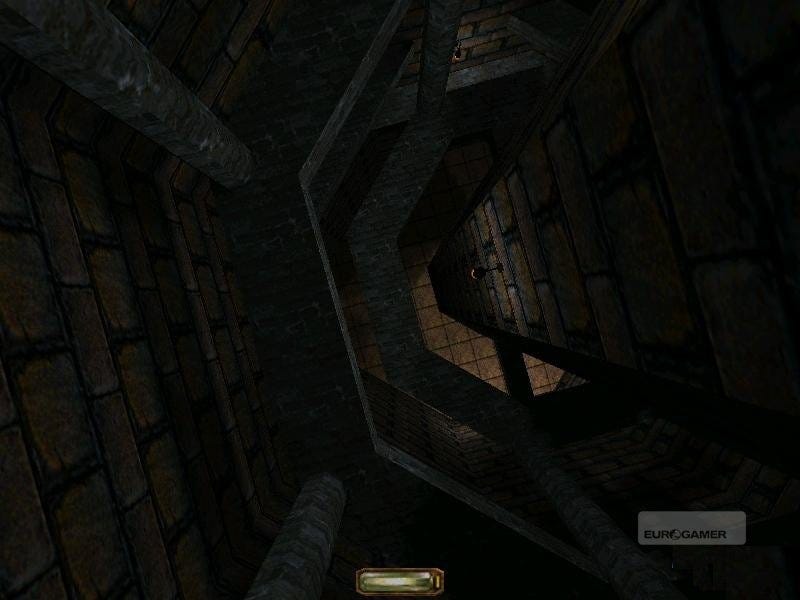
Yes, this is the only image of The Sword on the entire internet. Bask in its glory, and pray you never, ever have a job that involves looking for screenshots of PC games from 1998.

The placing of this one's important. With the player having knocked over their first few levels and escaped with a tolerable amount of puncture-holes and bruises, they'll have started to get comfortable with their role as a thief. What began as nerve-wracking will be becoming... well, only marginally less nerve-wracking. But all those ice-cool cut-scenes and completed objectives followed by clean escapes will have given the player a bit of an ego. They'll be getting comfortable. And Thief, at its heart, is a game about discomfort.

Constantine's mansion is there to put the player back in their place. Unlike the Cradle in Thief 3, which felt from beginning to end like an abrupt and temporary change of tone, Constantine's mansion is designed to make the most of every assumption the player has been goaded into making in order to make them feel as scared and naked as they did on the first level.

It even starts the same way as the first level. You arrive at a vast nobleman's house with a mental shopping list of things to swipe. You infiltrate it, and begin the tense process of mapping out those guard-filled corridors, servant's quarters, lounges and kitchens. Everything's as you'd expect. Then, as you climb higher, you stumble across hints that something's wrong.

By the second floor the architecture's gotten weirder, and you start spotting unknowable vegetation growing up through flagstones. One floor higher and the house becomes a chaotic maze of curving corridors and slopes, with players having to push up and up to steal the sword they came for but always accidentally backtracking. Running from guards was scary enough back when you knew where you were going. All of a sudden you're a rat in a trap.

Constantine's mansion probably peaks with The Door. As you're poking your nose around the labyrinth there's one door most players will pass and open just to see what's on the other side, and the answer is... nothing. As in, literally nothing. A dark, gently spinning void with no visible floor, ceiling or wall and no explanation. All you can do is close the door, try to put the insanity out of your mind and continue down the corridor, lost as a little lamb. Just awesome.

Halo: Combat Evolved - 343 Guilty Spark

Another level very carefully placed to shake up players with some unexpected fear and tension, though Guilty Spark is different. Where Constantine's Mansion exists to trip the player up on their own assumptions and return them to the mental darkness where the game thrives, 343 Guilty Spark is there as an enforced diversion from the action or 'palette cleanser'. I stole that term from Epic, but I reckon they stole it from someone else so it's okay.

343 Guilty Spark also exists to introduce the Flood. As much as people might dislike the Flood, Bungie's reason for including them is fairly obvious. Being enemies with different attacks, weaknesses, appearances and barks they add more variety to the game, and later on when you encounter the three-way Covenant/Flood/Master Chief battles, they add a little more depth too.

This level's purpose then is to maximise the impact of the new enemy by taking what makes them special and amplifying it. In the case of the Flood, that means the fear and panic they cause. Unlike the Covenant, who demonstrate care for their own survival, the Flood are suicidal, angry and hungry and both look and sound like something you'd find in the vegetable drawer of an abandoned fridge.

2

For a good time imagine that Guilty Spark on the right there is actually behind Master Chief and 20 feet tall.

Bungie therefore made Guilty Spark a level about exploring the unknown. Sent into a swamp, at night, to rescue a squad of marines that have dropped off the radar, the player has no idea what they're walking into or why there are no enemies to shoot. Confusion is applied carefully and bearably to the game by making a debut together with a trail of clues that let you know everything will be revealed soon.

As the player continues along with nothing to shoot, the tension increases, and when the Flood are finally revealed the player takes them in with every ounce of attention they can muster. The level is practically a catwalk for the new enemies, except with more stringy, vicious creatures who seek only to further themselves. Oh wait! Zing!

Metal Gear Solid 2: Sons of Liberty - Arsenal Gear

This all contrasts with the MGS2 surrealist madhouse that is your capture and transportation to Arsenal Gear, which exists to. Uh. Well.

3

You'd really think there'd be more screenshots of Naked Raiden floating around online.

Arsenal Gear's purpose is, I suppose, self-contained. Rather than shunning traditional level design as a tool of some sort, Hideo Kojima uses the hallucinatory innards of Arsenal Gear as a surrealist work with its own worth. To this day fans of the series are still trying to work out exactly what the segment means, which parts are canon and why all that strange stuff happens, not picking up on something Snake says to Raiden near the end. Let's give thanks to the OCD children of GameFaqs.com for allowing me to quote this exactly:

"Snake: The memories you have and the role you were assigned are burdens you have to carry. It doesn't matter if they were real or not. That's never the point."

That, right there, is Kojima saying that to try and decipher MGS2's surrealism is to miss the message.

For anyone who didn't play it, Arsenal Gear is when Metal Gear Solid 2's plot of effete terrorism, hostage-taking and bomb-disarmament breaks down. Your operation commanders start spamming you with nonsensical messages, you go from being naked to having both clothes and a bullet-deflecting katana in the space of one cut-scene, the game psyches you out with a fake game-over screen, you suffer a boss fight where you have to fight dozens of 100-foot tall robots and much, much more besides. And there's no solid conclusion to it all - the game ends with Snake giving Raiden (you) some dogtags with the player's real-life name and of birth on in a crowded city street.

The game knows your real-life name, date of birth and blood type because you entered them all when you started the game, though you've long since forgotten that (a.k.a. The Earthbound Magic Trick).

I love Arsenal Gear because it stands as a monument to something games do not do. It gets a lot of hate, but that doesn't seem entirely fair. Every time the original MGS did something gamers didn't expect, like the Psycho Mantis battle or getting Meryl's codec number from the back of the CD case, it was praised. So Kojima goes on to make an entire section of the sequel post-modern on a scale we haven't seen before or since, but it doesn't work. Fans are confused, or at worst outraged. And that's really sad. MGS2 is before its time like no other game, and it's an awful lot easier to enjoy it in retrospect.

The Chronicles of Riddick: Escape From Butcher Bay: These Subheads Are Getting Ridiculous Now - Cryo Facility

Now we're talking.

This game has such a phenomenal structure. Following the tutorial you're led, shackled, into a gargantuan prison on a barren planet. You don't know why you're being locked up and it doesn't matter. As you're led in through the walls you're told We Have You At Last, and Nobody Escapes From Butcher Bay, Not Even You and Don't Even Think About Escaping.

Everyone's so concerned about the whole you-escaping thing that you begin to wonder if you got arrested for possessing illegal quantities of badassitude. As you look upon the sky-puncturing towers, bars and reinforced security doors of the prison your goal is crystal clear. Your enemy is right there. You have to escape Butcher Bay.

4

You're right, this one isn't actually from Cryo Sleep. I quit. I'm done. Stick a fork on me. Or just close your eyes, grunt, and pretend you're a sedated Riddick.

So they put you in maximum security, and over the first third of the game you study your surroundings, escape them, get caught, and get put into double-max. It's deep underground, crueler, darker, dingier and even more restricted. Over the next few hours you search for a way out, escape through it, get caught, and get put into triple-max.

You grip the pad. You turn and tilt your head as far as it'll go to stretch your neck. You are Riddick. Nothing can contain you. What's next?

What's next is instead of being buried somewhere even deeper, danker and more dangerous, you wake up heavily sedated and in a space-age white room with other triple-max inmates wandering around in a daze. You're so dangerous they're keeping you asleep in a locked pod with only two minutes a day for exercise. Monday turns to Tuesday turns to Wednesday. There is no way out.

In the case of triple-max, this twist in level design is there as both a fun surprise and an added challenge. Triple-max is actually an interesting case study as to how developers can employ player deceit and confusion safely. The sedation of the player doesn't feel at all cheap or annoying because the game's taken pains to make you feel like a badass for so long, and has taught you that there are ways out of every stage which are very satisfying to find. Cryo Storage simply makes escaping from Butcher Bay more varied and satisfying experience, as you've proved yourself in a greater breadth of challenges.

There are going to be some people out there who dislike the previous three levels we looked at, but Riddick's triple-max section is inarguably good with the single flaw of being a touch short. It's a shame Assault on Dark Athena couldn't muster up anything similar.

In closing, and because I'm pretty sure it's coming - no, Arkham Asylum's scarecrow levels don't count. Cute as they are, it'd take a very special boy or girl to not realise Batman's been gassed (again!) and besides, the game tugs you through those sections like a child keen to get home. Besides, it's too early to take a trip to that particular district of spoilertown just yet. Let's let all the would-be Batmen out there have their fun first.

Comments (65)

Comments for this article are now closed, but please feel free to continue chatting on the forum!

  • Loading...hold tight!