Retrospective: The Operative: No One Lives Forever

I spy with my freakishly giant eye.

They say money makes the world go round, but this is somewhat inaccurate. Leftover momentum from the solar nebula makes the world go round. Money, in fact, is not responsible for rotation, gravity, nor indeed any number of other phenomena in the galaxy. It does, however, occasionally make games less interesting.

You simply couldn't make No One Lives Forever today. You couldn't because it would be too long, require far too many assets, and most significantly of all, risk all the cost of development on a comedy game - a genre that no longer exists. Its international scale, its enormous volume of content and its emphasis on making you laugh add up to something that feels like it's from another age - an age before an FPS lasted six hours and cost $250 million.

Set in the 1960s, Monolith's spoof of spy fiction starred Agent Cate Archer in the lead role - a female spy in a male-dominated career, fighting not only for her country, but also for some respect from her doubtful superiors. Her story in a game everyone has forgotten was called The Operative (the 'No One Lives Forever' intended to be a James Bond-style episode title) sees her trek around the world in pursuit of H.A.R.M., an evil organisation murdering UNITY operatives.
1

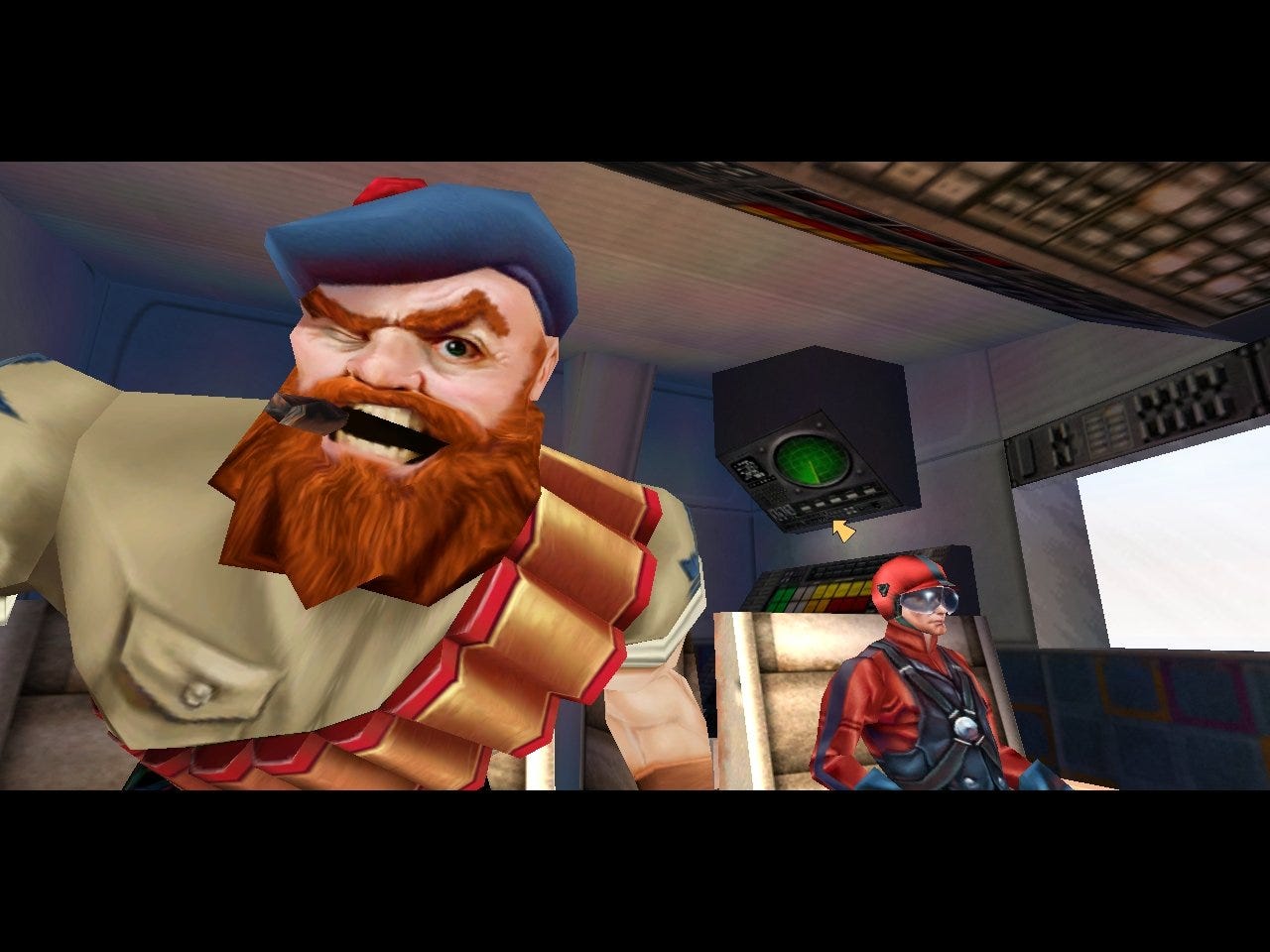
You can't ask for a more Scottish baddie than this.

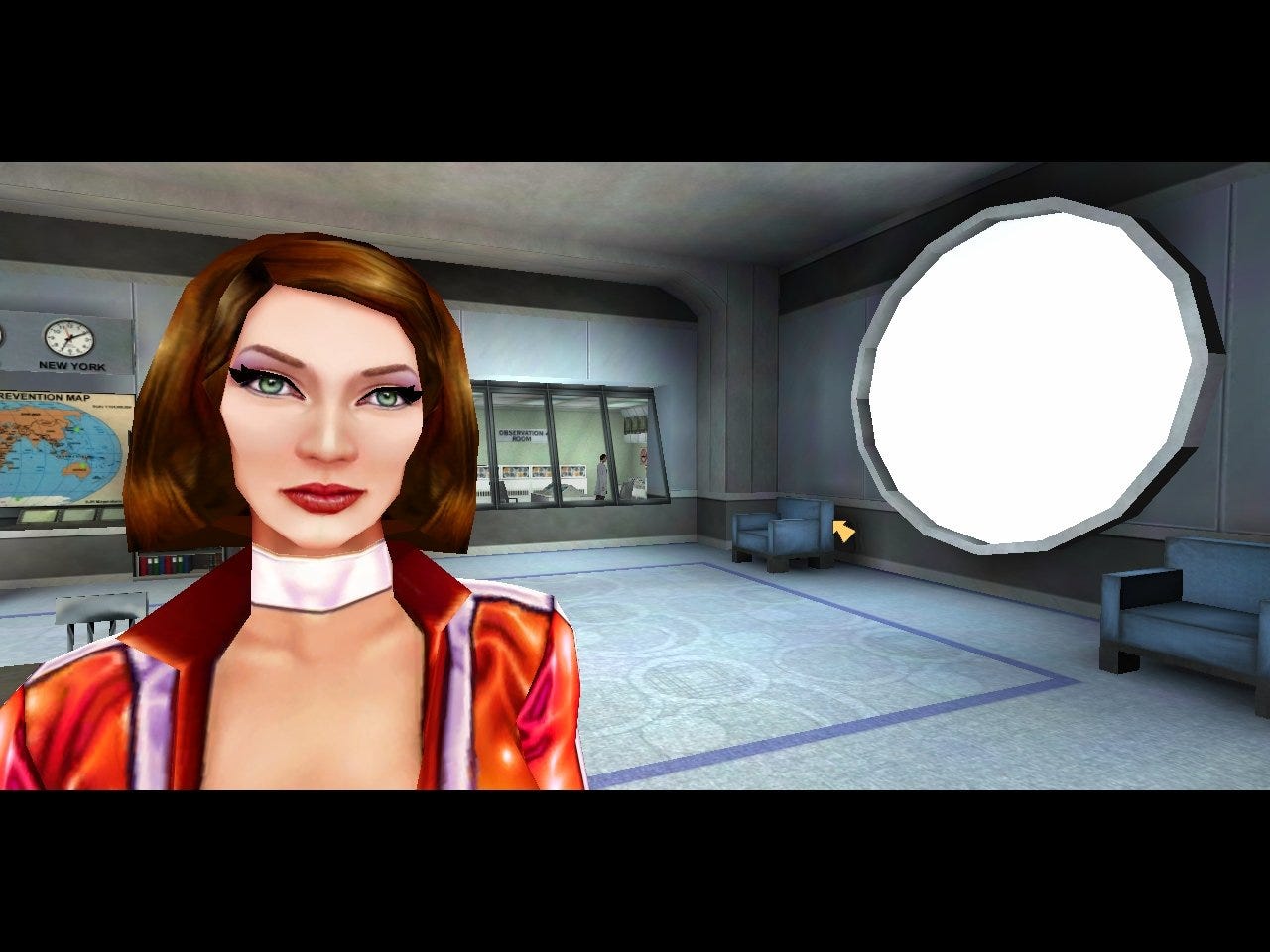
Built using Monolith's own Lithtech engine, it's dated enormously but survives well. If anything, the things that stand out as strange stood out just as much in 2000 when it was first released, including the utterly bizarre faces on all the characters, especially their giant alien eyes. Once you're playing there's not a thing to distract you, possibly thanks to its focus on a cartoon style - a design that always lasts longer.

NOLF learned the lesson that Half-Life had to teach, that almost no other games took notice of. It knew to be quiet at the start. The opening sequences, introducing characters, opening up the plot, and teaching you/Archer a series of spy skills in the training rooms, are laid out in the offices of UNITY. It's a day at the office. You get trained, talk to people, visit the Toy Shop to receive your first batch of gadgets, and settle in. The details here are surprisingly lovely - down one corridor, through a glass wall, you can see a secretary catching a nap, cartoon Zs floating from her head. Bang on the glass and she'll wake up. Completely unnecessary, irrelevant to everything, but there anyway.

Which makes it a pretty giant clanging shame that the first mission begins with a tiresome, slow and boring shooting gallery. Stationed at a window you're asked to protect a deaf, senile foreign consular from a series of potential assassins. Then you move to another location, and, er, do the same thing again. What on Earth Monolith was thinking to do this is beyond me, but fortunately it quickly snaps out of this idiocy and becomes a sneaky, stealthy shooter that remains an enormous amount of fun.
2

Genetic freak, sure, but still sexy.

There's a genuine choice of how to approach the game. While some levels will fix specific completion criteria restricting your options, often you're left to decide if you want to go with all guns blazing or stealth your way through a mission. The weapons and gadgets you bring with you can determine this too - take lock-picks and silenced pistols and you can be a lot more subtle than if you're carrying lipstick bombs and machineguns. Often you're tasked with avoiding the eye of security cameras, which trigger level-wide alarms. But grow tired of this and you can just trigger them, and put up with the noise and attacks from all-comers.

While there are certainly a lot of missions built around sneaking past security, there's also an enormous amount of variation. Levels set on aeroplanes (finishing in freefalling without a parachute), on motorbikes, trains, even a space station. Each location seems to have been treated as a challenge to the developers: how can we make sure it's still interesting in this tiny space?

I'm always tempted to believe that NOLF and the way it pokes fun at the swinging sixties and accompanying spy culture came before Austin Powers. However, it was the other way around, Mike Myers' movie released three years before Archer first appeared on PC. Unavoidably compared, NOLF's approach is subtler than Myers' (although we're talking degrees of subtle here - Monolith wasn't exactly aiming for sophistication).

There are references to things being "groovy", and fantastic bad taste décor throughout, and most of all NOLF is a game that never shies away from a ludicrous national stereotype. Moroccans exclaim in horribly poor accents, "Bullets are not my favourite!" when fired upon, and the street vendors loudly arguing about the quality of their monkeys. Germans below "JAWOHL!" at each other, while being anal about details. Americans are loud, brash and stupid. Brits are posh, rude and stupid. And so on. Cate Archer is apparently Scottish, but Kit Harris' voice (replaced in the sequel by Princess Peach herself, Jen Taylor) only sounds awkward when attempting an "aye" in the middle of her plummy British tones.

The same sorts of deliberately crass attitudes are applied to women, Archer the constant recipient of abuse from her colleagues. At one point a fellow agent forgives her for an outburst, beginning his explanation, "Because you're a woman and therefore genetically unable to bridle your emotions..." But here the consistently brilliant script really shines, with smart discussions of feminism creeping in. And it's not the only subject to get a clever turn.

One of NOLF's greatest features is the overheard conversations. If you don't run in and kill everyone in a room, but rather hang out behind a corner, you hear so much fantastic stuff. Often these are brilliantly inane discussions about absolute nonsense, but occasionally things get deep. At one point a henchman explains to another the sociological nature of criminality, using his own path to his current career as an explanation, his ontological musing eventually analysing the conversation itself. Until you walk around the corner and shoot them both in the head. (Anyone who's played and remembered it will, however, be thinking of that goat conversation, but that's a surprise that should never be spoiled.)

3

You can't ask for a more operatic baddie than this.

Another source of gags are the pieces of 'intelligence' scattered all over levels. Briefcases, envelopes, blueprints, films and so on each contain a one- or two-line gag to read. So rather than hunting them all down for the (sense of) achievement (in 2000 we'd yet to enter this ridiculous phase), you do it because you don't want to miss out on a joke. Then there's the game's obsession with sheep and goats (get poisoned and you'll see rotating green and blue goats all around you, to offer one of the slightly more savoury examples).

Amongst this, and I'd argue vital to the humour's effectiveness, are moments of pathos that are also successfully performed. Archer's relationship with the older spy, Bruno, is especially evocative. And even more so, the main plot is surprisingly downbeat, with a lot of death and failure. Your failure is emphasised to you throughout, in a quite unrelenting fashion.

Perhaps the greatest weakness of NOLF is that the extremely long cut-scenes between levels weren't woven into the game more cleverly. A conversation in the War Room between three characters can last over five minutes, with nothing other than their heads to look at. These could have been something you moved about during, or listened to as you played the start of a mission.

4

It's very old, but the Lithtech engine can still pull off a scene like this.

Perhaps what I like most about NOLF, above and beyond its humour, smart level design and constant variety, is its generosity. Too many games attempt to starve you, forcing you to survive on scraps. NOLF throws ammo around like confetti, offers an abundance of weapons, and makes sure you never go too far without more armour. This is because it knew to do something that so few games ever understand: it's interesting rather than difficult. It's not about whether you can reach the end of the level, but how you choose to get there.

The thought of a non-Valve FPS this big, this well written, and this inventive, built today with today's engines, makes me sigh deep inside. Not even Monolith comes close any more, with its misery-guts Condemned and FEAR franchises. I cannot imagine how much it would cost, and certainly can't imagine the publisher who'd be willing to risk it. But I wish someone else would.

Comments (90)

Comments for this article are now closed, but please feel free to continue chatting on the forum!

  • Loading...hold tight!