Mortal Kombat: Blood and Money

A look back at Midway's infamous fighter.

We all loved Mortal Kombat. Sorry, let's start that again: we all played Mortal Kombat. Or saw some now-forgotten sports personality play it on GamesMaster while Dominik Diamond quipped away in the background. It was a '90s Mega Drive/Genesis sensation (or pleasant Amiga surprise, or disastrous Master System conversion, amongst others) with sales figures to match the hype. The sequel, Mortal Kombat II, shovelled USD 50 million into Acclaim's expanding pockets in the first week alone, ensuring the series featured on the business pages as well as beneath sensationalist headlines about ripping out spines.

Exciting stuff for the newsdesks, but even better for the schoolyards. The secondary and highschool pupils of 1993 (mostly of the male variety it's fair to say) didn't need to be studying Lord of the Flies to know that only the frail barriers of society were preventing them from tumbling into bloodlust. Lurid rumours of a game which let players fire a harpoon into an opponent's neck and drag him back across the screen were like throwing tasty t-bones to a pack of hungry pooches. Playground whispers went into overdrive, leading to a spate of children believing it was possible to finish off adversaries by pulling off their arms and slapping them about the head with the stumps while chanting 'stop hitting yourself, stop hitting yourself.' Inevitably, such violence (real or imagined) was was a major selling point to the hordes of merrily sadistic youngsters with disposable incomes.
1

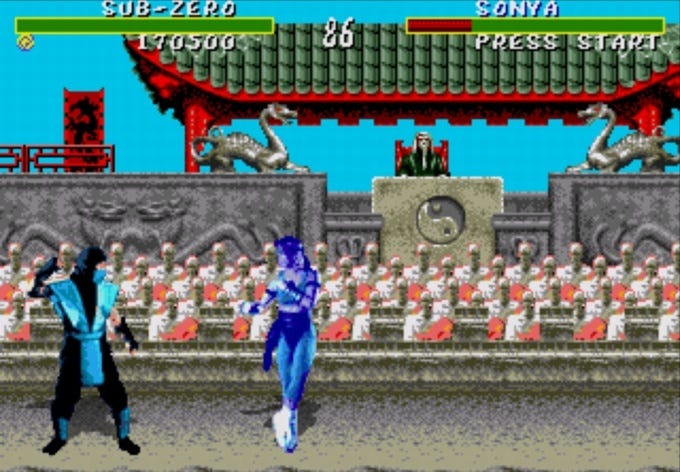
ICE to see you, ha ha h ... oh god.

His name's not Fatty, it's Piggy

A little overstated? Perhaps. But at the time of writing, putting "mortal kombat, fatality" into YouTube's search box brings up over 3,600 results. Try the same with "mortal kombat, game" and the number falls 100 short of that (back off man; I'm a scientist), and the first hit is a compilation of fatalities. Enough to suggest that, alongside people bashing out the theme on casio keyboards and comedy montages of the godawful film, fatality footage from the series dominates the cultural barometer. Admittedly, the SNES release of the original faired well despite being bereft of blood (instead featuring mysterious grey 'sweat' globules), yet it was also massively outsold by the SNES versions of Mortal Kombat II and III, which relented and restored the gore.

To assume the fatalities were so popular due to blood and guts alone, however, is to overlook what may have been Mortal Kombat's greatest fascination - that of unlocking its secrets. Even the red gloop itself had to first be switched on with a hidden code, giving the game an enigmatic, illicit feel, suggesting further concealed depths to be uncovered. The fatalities too could only be performed with an extended series of pad nudges and button presses, unlikely to be found through mere trial and error. This not only bathed them in the illusion of mystery, but also bestowed power and kudos on those who could claim to know their details. A lifetime's supply of letters to computer magazine tips pages was almost guaranteed, to the extent that certain publications started printing misinformation about the 'special way' you could 'be' Goro or just began to use it as a running gag. In an age before internet ubiquity, this was an excellent way to create a sense of shared community between Mortal Kombat's players, the game's designers and the various publications of the time. Although the mags were probably heartily sick of running double-page spreads explaining exactly how to punch Kano into a pit and discover Reptile.

Toward, Toward, Away, Away, Away, A
2

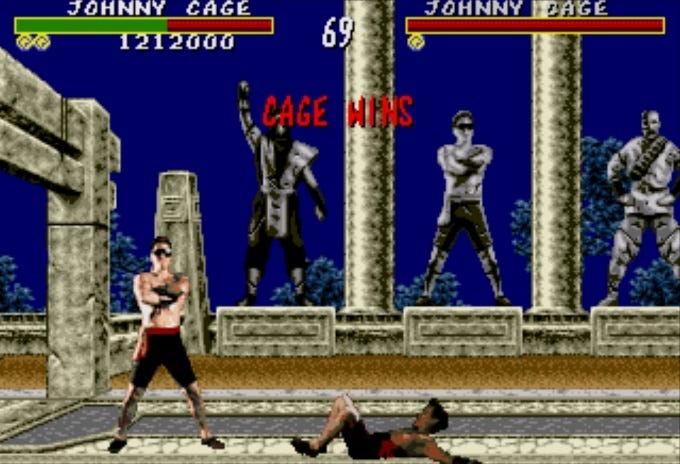
Johnny Cage, reduced to fighting himself for a pair of sunglasses.

Mortal Kombat II confirmed that the makers were aware how strong the combination of blood and secret content had been. Rather than do anything in particular to the central game mechanics (aside from the odd cosmetic change), they instead increased the number of characters - thereby increasing the volume of fatalities to be discovered. They also tripled the finishing move potential by adding odd 'friendship' and 'babality' abilities to each character, as well as increasing the number of special moves available to the fighters from the previous game. It was a marketing triumph.

But while the sales techniques were cynical, the belly of the original beast wasn't too healthy either. Once feverishly unlocked with trembling hands, the much talked about crimson splatterings were, well, a bit naff. Blood would squirt out in massive great globs whenever a powerful blow was landed, regardless of whether it was especially likely to have caused such damage. Every character was a huge walking artery, ready to start leaking at any moment. Whenever a fighter had their heart yanked out it was symbolically grotesque, but also rather silly due to the standard-issue cartoon droplets gushing from the corpse - at odds with the digitally rendered appearance. Whether this humorous streak was intentional or not is hard to say. Later games played up the lighter angle of fatalities (kisses which inflated people's heads until they burst, deadly arcade machines falling from the sky, that manner of business), but the original title was a relatively dark affair. Taken at face value, the finishing moves were all pretty grim - with little to lighten the mood except how weird they seemed when overlaid with red blobs.

Just the seven pints for me then

As mentioned, one of Mortal Kombat's more innovative aspects was the approach to fighter design. Rather than knocking together some animated warriors from pure imagination, digitised versions of real actors performing various moves were transposed onto traditional fighting backdrops (dungeons, temples and the like). This succeeded in generating additional hype, but had some accompanying problems. Most obviously, it meant that the combatants were of similar size and were all basically humanoid, resulting in something of a lack of variety. Especially with Scorpion and Sub-Zero being little more than a palette-switch with slightly different moves. It's probably no coincidence that the character who gained most attention was the imposing, four-armed Goro - based on a Ray Harryhausen style model rather than a real person. Further to this, the game fell foul of the issue suffered by many early dabblers in the realism/impressionism dichotomy: the characters looked fairly convincing (especially at a distance), but they don't always react terribly realistically during play. This is less noticeable in titles where the art direction is self-consciously fictional, but becomes far more apparent when the controllable character is 'real.'

3

Raiden recoils in horror from Sub-Zero's death-breath.

The 'weight' of the game, at least, was generally terrific. When a body slammed into the floor after a successful flying kick, the screen jiggled supportively to enhance the illusion of a mighty blow. Perhaps it was just my imagination, but the Amiga conversion felt the chunkiest of all, with every connection supported by an appropriately meaty sound effect. Although the same praise couldn't be applied to the blocking, which tended to result in the characters just sliding rather unconvincingly off one another. The paucity of 'falling over in defeat' animations was also rather glaring; anyone struggling to complete a finishing move in time would be rewarded by the defeated competitor suddenly flinging themselves to the ground after a period of groggy swaying.

Al Gore

Overall balance, too, was a bit off. Mortal Kombat moved away from the 'circle sweep and button press' school of special moves - instead branching out into all kinds of fancy sequences. Unfortunately, this just meant certain lengthier moves (such as Sub-Zero's ice-flinging trick) became rather unsafe to attempt against skilled enemies, real or artificial. Characters whose specials could be whipped out with ease, such as Raiden or Scorpion, had something of an advantage. As too did anyone who figured out that cautious, defensive play with a great deal of blocking was the way to success when in a tight spot. Not the most encouraging discovery, unless you're a fan of more strategic slogs. Despite all of this, the massive popularity of the opening games in the series resulted in a large, brand-loyal fan-base and a collection of releases which are now in double figures. Some people just can't get enough of those fatalities.

4

Shield your eyes, it's raining blood and scorpions.

Yet the discrepancy between conversions makes the original Mortal Kombat's 2D fighter credentials tricky to assess. Only the Amiga version stands up as a great transfer, and this had as much to do with the lack of other fighters available to owners of Commodore's beige machine (the only realistic alternative being Body Blows). However, the game perhaps represented a tipping point for the sophistication of the game-buying public. Today, it's difficult to imagine such an average console conversion getting as easy a ride, or racking up the sales that Mortal Kombat did, purely on the strength of blood and mystique. Tacky marketing techniques will always exist - but while the majority of gamers (though perhaps not the censors) are mature enough to accept violence and sexuality when presented in a convincing context, eyes now begin to roll if a title is hyped on the back of nothing more than controversy. Not quite a case of 'won't get fooled again', but surely a move towards 'won't be fooled so easily'.

Comments (7)

Comments for this article are now closed, but please feel free to continue chatting on the forum!

  • Loading...hold tight!