Version tested: PlayStation 3
You're a loser! We're all losers. Everything's too hard, unless it's too easy, which we pretend not to notice, and then we go online and get beaten up by kids. Checkpoints are always in the wrong place, there's never enough health, weapons are puny and AI cheats. Against this (alright, exaggerated) backdrop of declining skills in videogames of the 21st century, Midnight Club: Los Angeles is a breath of occasionally swear-splattered fresh air; a fierce, often brilliant boot camp for recovering wimps.
Your drill instructor in this case is one Mr Angeles, a rather gaudy fellow in real life and less than spectacular on the eyes here, despite an engine shared with Rockstar North's Grand Theft Auto IV. But his ruddy textures are forgotten in the flattering sweep of the day and night cycle and, most precipitously, when he starts throwing you around Santa Monica, Hollywood, Beverly Hills and Downtown in a cut of the city enclosed by the 5 and 405 Freeways to the west and east and the 10 and 101 south and north.
When Rockstar North took Liberty's inspiration from the layout of New York, it sacrificed real-world details for imagined, gameplay-minded alternatives. Midnight Club's Los Angeles pulls the same trick, but rather than enabling GTA's fiction and multi-faceted action levels, the objective is to preserve the player's speed in a car or on a bike, and to this end the only things that slow you down are NPC-controlled vehicles and walls. Pedestrians scoot out of the way, and lamp-posts, chain-link fences, rubbish bins and bus shelters disintegrate on contact, or allow you to sail through them, while your speed increases, oblivious to their plight in either case. And the walls, though dangerous when struck at too straight an approach, are smooth to rub along if not, despite their superficial details. You're playing in a square-edged maze, where much of the city's content and sharp visual details are incidental to the gameplay.
The sense of speed is terrific when you get going, even in the early hours, and there are some bewilderingly fast cars and bikes deeper into the single-player.
However, they're paramount to tension. Predominantly a checkpoint-based racer, MCLA is almost uniformly open-world in its circuits and point-to-point chases, and as you glance down at the mini-map, which highlights the next two checkpoints, then back up at the road, the weight of visual information deceives the senses. Broken down to what's relevant - corners and cars - it might achieve a WipEout-style purity, but it's not after that; it wants to be an impossible, Fast And The Furious-style blur of shattered background, as you hurtle down LA's immense boulevards, through cross-sections, beneath buildings and over ramps, flying and sometimes gambling down half-expected shortcuts, imperilled by the headlights and brake lights you're constantly trying to dissect from the city's glossy, still-living carcass on the route to the next checkpoint flare.
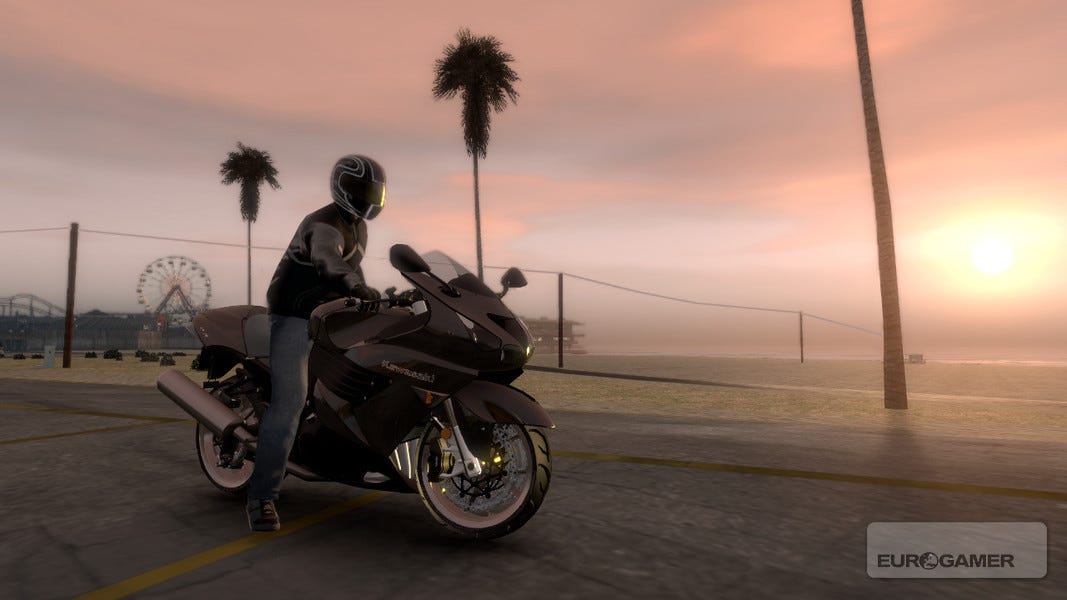
Cars - even the spry but creaky opening trio - are built to go fast in one direction: forwards. Cornering knocks the wind out of you, and acceleration is a laboured recovery, challenging you to brake less. We were ambivalent about the prospect of adding bikes to this at first, but again, the balance is just right: acceleration isn't always great, and you're inevitably held up for longer if you're thrown across someone's bonnet than you would be spinning a car, but the bikes are nimble, LA's massive streets give them the edge through corners, and, like the cars, even a complicated-looking row of shopfronts catches them smoothly and redirects them back toward the road rather than grabbing at them with the usual videogame velcro of edges and indentations.
The PS3 version (tested here) includes Trophies, which is nice to see. Good luck getting them all though, or the 360 Achievements.
But Midnight Club has always been a brutal opponent, and MCLA is no exception. Everything in the world except the other cars and walls is on your side, but by god those cars and walls hate you. You'll spin, you'll roll, you'll crunch to a halt, and you'll have to wheelspin yourself in the right direction before getting back on track. Races, time trials and the game's other variations often last nearly five minutes, if not longer, and the AI - even in the first few hours - makes little concession to players who hold it together almost to the end, barrelling past you when you come unstuck and necessitating a restart.
In an attempt to offset this, Rockstar San Diego issues reputation points - experience, basically - for failure as well as victory, and there are numerous ways to obtain them: evading the cops (it's particularly enjoyable to pull over and then accelerate away as a cop gets out to walk to the driver-side window), racing opponents you encounter while cruising to the start of the race proper, and of course coming second, third, or anywhere in the field. It's hard not to approve of this, but it contradicts your instincts. Midnight Club: Los Angeles sets a blistering tempo, and when you come unstuck, even late on, you just want to begin again and get it right.
Building up rep and winnings from races also allows you to buy up performance upgrades and abilities, and the game's parsimonious approach to money and pink-slip races means you get time to love your rides, outfitting them with nitrous, improving brakes and other elements. All of it can be automated, but it's simple enough to operate that you'll probably do it by hand, while an optional customisation suite wrings a lot of detail out of the vehicle models, with tons of options for vinyls and paint schemes. Partial repairs are possible out in the field, and nitrous can be topped up by driving through petrol station forecourts. The structure rewards sensible driving by keeping you shiny if you keep it clean and charging up special abilities, like "Zone", which gives you a short span of Bullet Time, and other offensive upgrades for frying rival electrics or smashing through traffic. You can also slipstream other racers to get a short speed boost, although you're more precarious when you sacrifice clear road ahead.
Like GTA, MCLA also blurs the line between online and off at your command, employing a sponsored PDA to switch to online cruising, where you can propose races with friends or randomers. Modes are varied and, even when they fire you out of the checkpoint and circuit race comfort zone, have a decent hit ratio, and suffer from negligible performance issues (we tested the PS3 version), partly because you sacrifice the NPC traffic.
Like GTA IV, the detail levels sometimes stress the frame rate, but it's infrequent, and we didn't notice any screen-tearing.
Ploughing relentlessly into the fierce, voluble challenges available on the single-player streets better suits our temperament, however, and with a large number of vehicles and track layouts to unlock, this is the game's core. Track layout is varied (there's a race editor if you're unimpressed), but for the most part Rockstar carves out memorable courses, using - and intensifying the detail panic - in signature areas like the train yard, flood control channels, Santa Monica's pedestrianised shopping parade and the seafront; or it creates something out of nothing, like a simple off-ramp and angled freeway crossing left-hander. With so many variations to the open-world layouts, the ability to create a favourites list is also welcome.
Where it's ultimately let down, slightly, is in the punishment it metes out. The rep system can't compensate for dramatic late-race capitulations - short of invoking a Burnout Paradise-style no-restarts rule, a self-inflicted vanity scar that everyone's still divided over anyway - and in practice our "percentage restarts" stat wavered around 100 after a few hours, and stayed there. We always wanted to get back to racing that mattered, rather than consolidating a loss. But it's not so much that that harms MCLA as the manner of your recurring downfall: a sideswipe at an intersection, a wall you couldn't quite skirt, a slight analogue twitch at the wrong moment. Often decisive, and so difficult to eliminate even after dozens of races getting used to the handling and track layouts.
There's a story behind your actions, but we didn't care all that much, although the smacktalk is occasionally so bad it's good.
From time to time, it will get the better of you, and at that point it's not about difficulty so much as accumulated failure, a burden Midnight Club: Los Angeles forces you to carry, and one that's tough to bear for all the game's other successes. Tolerate the lashing of agony that accompanies every one of these moments, though, and this is fast, brutal, ingenious racing drama, dragging you into the screen every bit as thoroughly as Burnout Paradise, and delivered in a manner that befits the publisher that financed GTA IV.
8 / 10
