Metal Gear Solid: Portable Ops
Is that a Snake in your pocket? (Sorry.)

When the PlayStation originally burst onto the games market in the mid-nineties, quite a few gamers and journalists alike became preoccupied with one rather odd question - who was to be the mascot for this new system? After a decade of Nintendo and SEGA's platforms being all but defined by Mario and Sonic respectively, it was tough to grasp the fact that Sony had no intention of allowing their console to be led out by a single character franchise - after all, the whole point of PlayStation was to reach an incredibly wide range of people by appealing to a broad swathe of gaming tastes. Undeterred by Sony's apathy on the matter, pundits tried to give PlayStation a third-party mascot - Crash Bandicoot and Lara Croft were both front-runners - but none of them ever really stuck.
None of them except, perhaps, for one - a character who couldn't be further away from the primary colours of Mario, a grizzled war veteran and stealth expert whose idea of a good time is sitting in a cold corner of a nuclear base inside the arctic circle having a radio conversation about the meaning of warfare and loyalty with a nerdy anime fan who's just pissed himself in a locker. He's a good-time kind of guy. Metal Gear Solid took the gaming world by storm when it was launched near the high point of the PlayStation's lifespan; Metal Gear Solid 2 sold countless thousands on the idea of "next-gen", back when next-gen meant the PlayStation 2. The rapturous response given to trailers for Metal Gear Solid 4 ahead of the launch of the PS3 cemented the deal; he may have dalliances with other platforms, but PlayStation does have a mascot character at last - and it's Solid Snake.
PlayStation Portable hasn't lacked for a little love from this enormous, sprawling franchise either - two turn-based games based on a trading card system, called Metal Gear Acid, have won critical acclaim and are seen by many gamers as an excellent compromise between Metal Gear's gameplay and the requirements of a handheld device. There's even a "digital graphic novel" title for the PSP, a Metal Gear story told using heavily stylised graphic novel artwork and distributed on UMD. What the platform lacks, though, is a solid instalment in the core Metal Gear story arc; a slice of genuine Tactical Espionage Action and a piece of the growing epic of the Snake operatives, the FOX units, Outer Heaven and the Patriots to call its own. Until now, that is.
Insertion
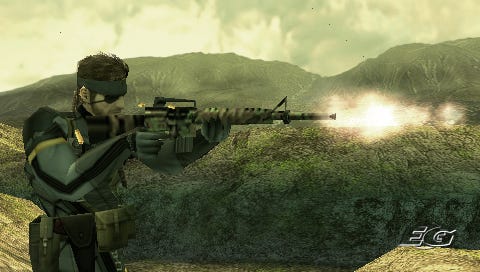
MGS Portable Ops ("MPO" is the helpful acronym-of-an-acronym which Kojima suggests) fulfils both of those considerations, and is the game which fans of Metal Gear have been clamouring for since the launch of the PSP. It is a genuine Metal Gear Solid game, focused on sneaking and combat, albeit distilled to suit the portable format and evolved to include a wider strategic overview. It's also a core part of the developing story of the series, which follows on directly from the excellent Metal Gear Solid 3 and provides a lot of background to the games set later in the series chronology (MGS, MGS2 and MGS4), as well as developing the likeable central character of Naked Snake and introducing some characters who later become pivotal in the Metal Gear universe.
In a nod both to the creative prowess of the team behind the MGS digital graphic novel and to the handheld format itself, the game opts to eschew the traditional in-game engine cut-scenes which the Metal Gear Solid games have become known for, and tells its story through the use of graphic novel based cut-scenes - fully voiced sequences built up from a succession of dramatic still images. It's a visually stunning approach, although in what may be a concession to the size of the UMD discs, the fully voiced nature of the game doesn't carry through to radio conversations, which are presented in text only. The storyline, which is set in 1970 and sees Naked Snake (the hero of MGS3 and a forerunner to Solid Snake) being taken captive by a rogue military unit in South America before escaping and mounting an operation against the leaders of the unit, is full of the usual double-crossing and peculiar motivation which those familiar with Kojima's storytelling have come to expect - although it seems more restrained here than usual, reflecting the gradual maturing of Metal Gear's narrative since the frankly ludicrous high pantomime of MGS2.
At this point, people who were turned off by MGS2 and never came back to the series are probably rolling their eyes somewhat - and there can be no denying that Kojima's plots and dialogue, not to mention his incredibly heavy focus on cut-scenes, have turned many people off the series. However, this is actually the most accessible Metal Gear Solid game yet on that front; the balance of the game is much more heavily skewed towards actually sneaking around and playing this time out, rather than sitting through cut-scenes and codec sequences. Portable Ops surpasses even Metal Gear Solid 3 - itself a huge improvement - in this department, and in finishing the central single-player game, the vast majority of the 12 to 15 hours it'll take you will be spent actively playing, rather than being a passive observer.
Which, of course, leads us conveniently past the inevitable comment on the storyline and the balance of cut-scenes to gameplay, and on to talking about how the game actually works.
On-Site Procurement
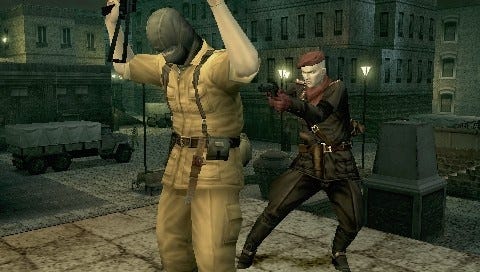
The answer to that question, as it happens, is "exactly how you remember it". Portable Ops is a clear progression from Metal Gear Solid 3, and the vast majority of Snake's moves still work in exactly the same way - everything from the classic flattening against walls to the basics of close quarters combat (CQC). The camera is lifted from MGS3: Subsistence, and is a user-controllable free camera setup - although the lack of a second analogue stick on the PSP means that you'll be spending quite a lot of time pressing the L shoulder button to realign the camera perspective, it still works relatively well and rarely actually frustrates you when playing the game, which is about as much as you can ask from the camera in a game of this sort. One gripe is that the view seems more zoomed-in than in previous MGS titles, which means that you can't see as much of the world around you as you'd like to; this is not only annoying in terms of being unable to see enemy soldiers at times, but can also make it tricky to get your bearings in some of the levels.
The major concession to the handheld format which Portable Ops makes is that each of Snake's missions are broken down into smaller chunks, which take place within an enclosed area with clearly defined goals. Mostly, that goal will simply be to reach a certain marker on the map - although the game does occasionally throw in different objectives or level structures when the plot calls for them, there's a feeling that a bit more variety in general wouldn't have gone amiss. As it is, the bite-sized nature of the sneaking missions is ideally suited to playing on the go, because it means that you can accomplish something significant in the game even on a relatively short train journey, or over a lunch break; however, it can also lead to the game feeling a bit more like one of the old MGS VR missions than a full-scale instalment in the series, and it means that the rogue military base you're infiltrating doesn't really feel like a coherent location - more like a series of sandboxed levels filled with automaton soldiers who don't have anything better to do than stand around and wait for Snake to roll into town. It's a trade-off that makes sense for the most part, admittedly, but it's a trade-off nonetheless. On the plus side, it does mean that the game has developed an overview map, which gradually grows as you explore more of the peninsula on which the base is located, and you can travel to any location on the map as you please. Those which will progress the story are highlighted, so you don't get lost, and there's no more tedious backtracking to advance through the game, which is nice.
If the new sandboxed level design is arguably a watering down of the Metal Gear Solid formula to make it fit on a handheld, though, the other headline feature of Portable Ops is a genuine evolution of the series into gameplay territory it hasn't previously explored. Early on in the game Snake - along with his newfound pal, an injured US Green Beret called Roy Campbell ("a HA!" say the hardcore MGS fans) - decide that they won't be able to take down the rogue military chaps all by themselves, and instead set about recruiting support from the disaffected Soviet soldiers who are now being commanded by the rogue element, having been abandoned in the base when the US and USSR signed a detente agreement. As such, a major part of the game is the bolstering of your own forces - which is accomplished by knocking out enemy troopers, dragging them to the back of your van, and convincing them that they're better of fighting for you than against you.
Once they agree to join your unit (they sit on your menu screen as "prisoners" for a while before becoming available as soldiers), your troops can be assigned to work as medical staff (healing other troops and producing medical items), technical staff (building gadgets) or as spies (who provide information, and also secure supplies such as ammo). The final option is to use them as soldiers, in which case you'll actually be bringing them into the field alongside Snake, and controlling them directly. Each soldier's ability in various categories is rated, so you can decide intelligently where he'll best be put to use - and soldiers also differ in that some of them have access to parts of the military base, so rather than having to sneak around, you can just walk right in amongst the enemy as long as you're careful.