Let's Tap Review

Thinking outside the box.

Version tested: Wii

When you first open Let's Tap's oversized box and pull out about seven nicely decorated pieces of cardboard, which the packaging implores you to assemble into further boxes and rest your Wiimote upon, it makes absolutely no sense. In the same way that Wii Sports Tennis has people waving tentatively the first time they play it, reluctant to believe that their actions will translate onto the screen in any meaningful way, there's a bit of a belief barrier between the average person and accepting that you can control a videogame by tapping a cardboard box.

Still, let's play along. Assemble the boxes, rest your Wiimotes face-down on top of them, stick in the disc, and a tutorial appears, which won't help out much in the sense-making department if you don't read Japanese. Thankfully that's the full extent of the language barrier here - once you make it through to the main menu and into one of Let's Tap's five mini-games, it all falls into place. The game's control system is so simple and so natural that it almost defies explanation; you'll watch others tapping away with a furrowed brow, but as soon as you sit down to play you suddenly understand what to do without a shred of clarification.

We'll give it a go anyway. There are five different games, each controlled by tapping the box. It doesn't need to be a special Let's Tap-branded box, obviously - discarded pizza boxes work just as well. It registers hard, medium and light taps, but that rarely comes into play. One tap moves between options in menus and two taps selects, or you can pick up the Wiimote and point for easy navigation. The menus are all bright orange, loud and energising and bolstered by arcade-style Japanese techno, and each of the arcadey mini-games has its own, endearingly minimalist visual design. There's a definite old-school SEGA flavour about the place.
'Let's Tap' Screenshot 1

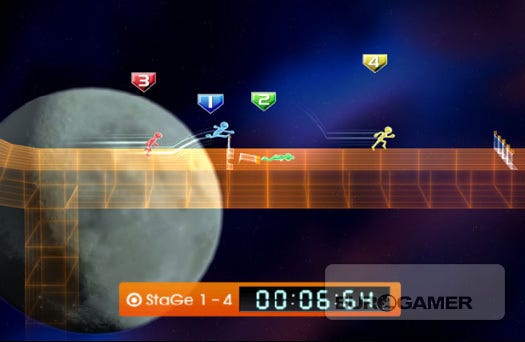
Tap Runner is genius, even if it will make you hate whomever you're playing it with.

Rhythm Tap is the simplest and most obvious of the game concepts on show here. It's an uncomplicated rhythm game where beats scroll towards you from the left, and you match them with light, medium or hard taps. Any tap at all will keep your combo going - getting the velocity right is only important for high-scoring. Twelve thumping, techno-ey, occasionally bouncy J-pop tracks provide the soundtrack, and though they never get particularly hard, they're an ample enough challenge for the after-pub Wii multiplayer crowd.

Like all of Let's Tap's games, Rhythm Tap is best in multiplayer. Like lovely, neglected old Donkey Konga used to, Rhythm Tap gives each different player a slightly different part to play. You can get a pretty good symphony of rhythmic tapping going in combination with obnoxiously loud, repetitive music if you want to be especially popular with non-participating bystanders in your flat/Japanese dormitory.
'Let's Tap' Screenshot 2

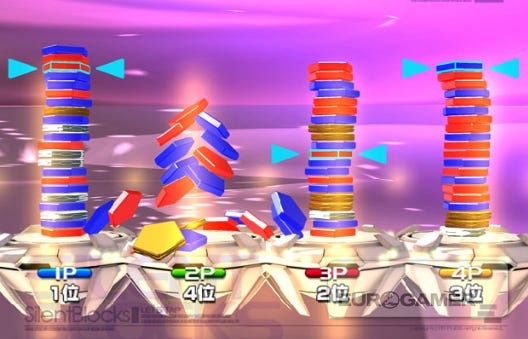
NOOOOO DON'T COLLAPSE AAARRGH.

Tap Runner, though, holding pride of place on the selection screen, is without a doubt the star of the show. Four little men line up at the start of an abstract neon racecourse, four players furiously tap through hazards and across gaps and past infuriating traps, and one emerges victorious in a flurry of insults, yelps of agony and thrown cardboard boxes. Tapping lightly in rhythm gets your man running at speed and bashing the box makes him jump, and that's the extent of the controls; the complexity comes from the courses themselves, which progress from simple running and jumping to incorporate tightrope-walking, trapeze-swinging, electric traps and warp gates.

You occasionally end up tapping the box a bit too hard and doing accidental jumps in moments of desperation or fury, but that's all part of the fun. Tap Runner is ludicrously competitive in multiplayer, drawing just enough from both skill and luck to ensure that every player has a chance at winning and races can be turned upside-down at a moment's notice by one lapse in concentration. We stress-tested Let's Tap's multiplayer in a roomful of excitable Japanese students, and of all the games on offer Tap Runner proved by far the most popular, probably because it's so worryingly competitive.

Silent Blocks, meanwhile, is by far the most complex game here. It's also the most subversive - it's the game that two or three entranced people are still playing at two in the morning long after everyone else has gotten bored and gone home. There are two variants: one is a very slightly more elaborate Jenga where the velocity of your tapping affects the stability of the tower of blocks, and the other is a slow-paced puzzle game where you remove blocks from the tower to match three like-coloured ones together. It gets steadily more and more complicated - three red or blue makes copper, three copper make silver, three silver make gold and so on up to diamond - and you're in constant peril of collapsing your entire tower and losing all your progress, at which point it's difficult to hold onto the will to live, let alone keep playing.

Bubble Voyager is a little mech shooting game, more notable for its angular, retro visual style than the simple fly-and-shoot gameplay. It has a multiplayer component that weirdly resembles Asteroids - tapping sends your constantly-spinning spacecraft off in whichever direction it's facing and tapping hard launches a missile. Shooting down other players is usually more blind coincidence than skill, but it's entertaining nonetheless.

The collection is rounded off with Visualiser, which is a more concept piece than mini-game. You cycle through various scenarios and accompanying music - a cityscape, a canvas, a pond - and tapping produces different effects, creating ripples in the pond, exploding fireworks over the city nightscape or daubing the canvasses with ink or paint. The game gives you hints as to which patterns will attract enormous fish or other special effects if you can read kanji, but Visualiser is there to show how accurately the tapping works rather than to attract hours of your attention.

'Let's Tap' Screenshot 3

Visualiser is pretty but shallow - hardly representative of the collection.

Obviously, Let's Tap's simplicity means that people who barely understand videogames can play and enjoy it perfectly well. But accessible as it is, the long-term gamer in us still finds Let's Tap compelling because of the minimalism of the design, and the purity of the concept; the games are built around simple, addictive arcade competitiveness. Tap Runner and Bubble Voyager especially have a real retro-SEGA appeal to them, but Let's Tap feels new and innovative - it's a great example of how a new control method can reinvigorate game concepts as old as videogames themselves, and hook a new audience on them. There's something wonderfully heartening about it.

Of Let's Tap's five offerings, one is essential, two more are excellent, and all are inspired examples of minimalist and creative game design. We can only hope that decision to present five perfectly-rounded little slices of action rather than a grab-bag of duds, filler and occasional flashes of brilliance will inspire other developers to do this same. This sits alongside Wii Sports as one of the few worthwhile and interesting mini-game compilations in existence, and as a multiplayer classic for the platform. Can we have it in Europe please, SEGA?

8 / 10

To which SEGA's answer is "Yes, we can!" For the moment though, Let's Tap is available exclusively for Wii in Japan, ahead of its western release this summer.

Read the Eurogamer.net scoring policy

Comments (62) Latest comment 3 years ago

Comments threads automatically close after 30 days, but please feel free to continue chatting on the forum!