IL-2 Sturmovik: Birds of Prey Review

It's good to hawk.

Version tested: Xbox 360

Ah, the console version of the classic PC simulation. What a palaver this always is. The simulation series has built up a devoted and loyal fanbase on the PC, and they'll want reassurance that the unforgiving realism of the game they know and love hasn't been simplified into mush for its console debut. On the other hand, there's an even larger audience of console owners for whom this will be their first exposure. They'll probably be a little bit daunted by the ruthless reputation of the PC original, and looking for reassurance that it isn't too complex.

Of course, balancing these seemingly conflicting audiences is what developer Gaijin Entertainment has had to do with IL-2 Sturmovik: Birds of Prey, and perhaps inevitably the studio's taken the middle path, creating a game that can be played at both ends of the spectrum, but defaults to its easiest setting, the fairly self-explanatory Arcade mode. You can't stall the plane, and you also benefit from numerous other assists. Both aiming and flight control get an invisible helping hand, while enemy and allied units are highlighted on your HUD. There's even a floating crosshair that works out the optimum deflection angle for your bullets, making it easy to place your fire where the enemy is going to be.

It's a generous game as well, with a single-player campaign that offers 20 missions across six European theatres, from the Battle of Britain through to a climactic assault on Berlin that sees you bombing the Reichstag. Success in these missions unlocks new planes and pilots, as well as additional standalone missions that can be accessed separately at any time. There are 50 of these, and they're a real mixture of objective types. From reconnaissance sorties into enemy territory to testing allied landing strips in a storm, these bonus stages are also more flexible than the story missions, allowing you to alter the amount of fuel and ammo you can carry.

There's also a meaty multiplayer component for up to 16 players, boasting four game modes and a raft of user-defined variables. Not only can you set the weather and time of day for your skirmishes, you can even restrict players to planes based on the year of their manufacture. Dogfight and Team Battle modes are much as you'd expect, but Capture Airfields adds an aerial twist to the timeworn base-capture objectives by landing on airstrips. Strike, meanwhile, is a more tactical option. Teams battle to destroy each other's ground units, a task that requires a balance between bombers and fighters, as well as offensive and defensive play. Sadly, the servers for the game weren't active at the time of writing, but unless there's some horrendous netcode calamity this suite of online play should easily extend the game's lifespan.
1

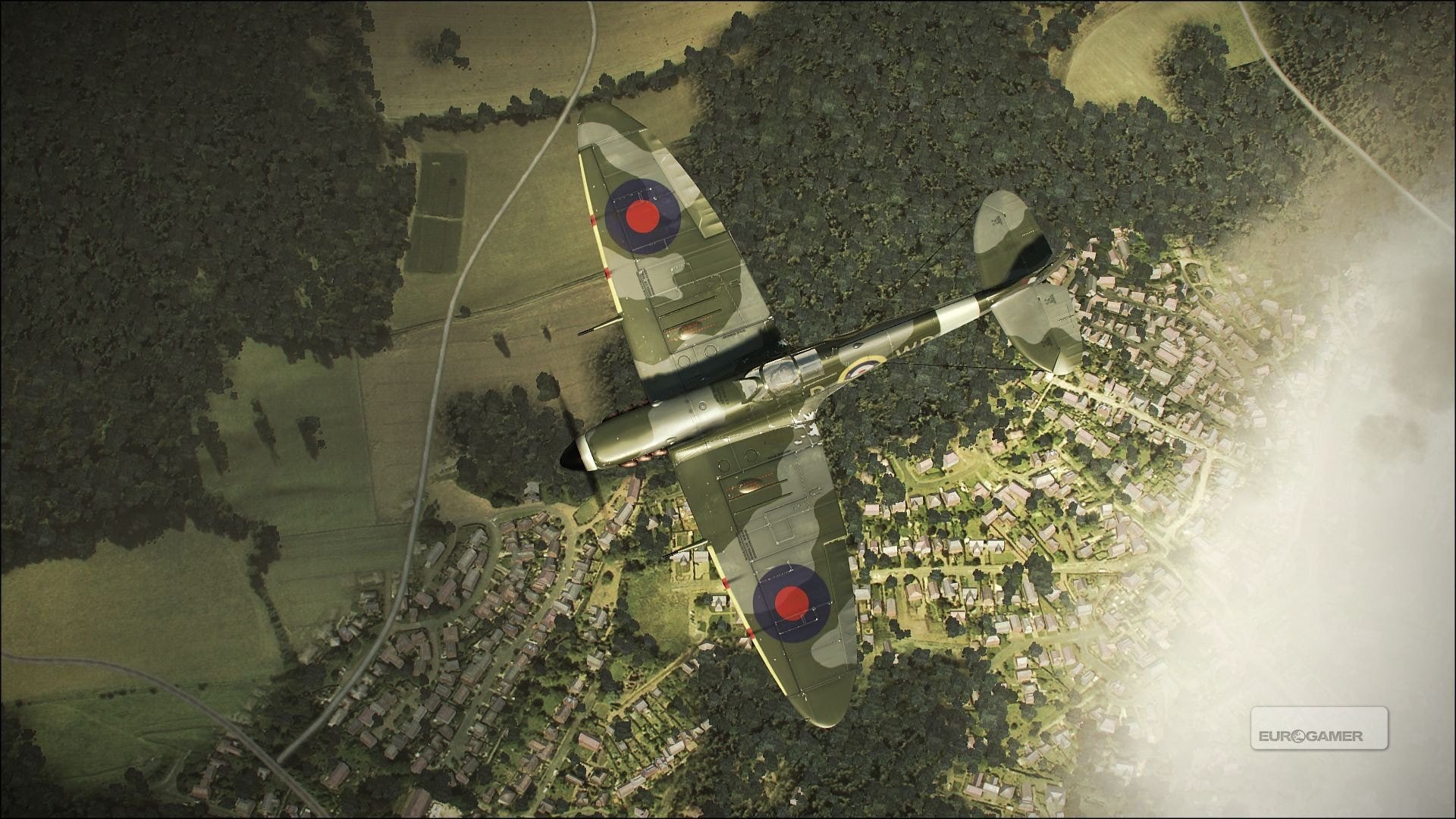
Behind the scenes at Google Maps, 1944 edition.

The timid player can enjoy all this content in Arcade mode, the easiest setting, and not once have to worry about realistic physics literally dragging them down. Played this way it's more like Ace Combat: WWII Edition, but that's no bad thing. A button press cycles through enemy targets (hold it down to select the nearest mission objective) and the left trigger can then be used to lock the camera on whatever you're chasing. Rockets and bombs are mapped to the shoulder buttons, when available.

The forgiving physics makes it easy to pull off manoeuvres that would be virtually impossible on the higher difficulties. Throwing your plane into a screaming, banking dive, skimming rooftops and then hurtling into a loop while tearing the wings off a Stuka is a genuine thrill. Flying right through the midst of a Messerschmitt squadron, guns blazing, and seeing a hail of fuselage parts roar past your canopy in balls of flame never gets tired. Faced with such cathartic moments, you'd have to be a fairly joyless simulation snob to not see the visceral benefit of more accessible gameplay.

The presentation certainly helps in this regard. Jeremy Soule supplies an orchestral soundtrack that equals his rousing score for Oblivion, while Joss Ackland narrates the between-mission snippets with appropriate gravitas. Visually, IL-2 Sturmovik won't be the best-looking game you see all year, but while its occasionally chuggy frame-rate may not sound amazing, the game itself always feels pretty fantastic. Holes can be torn in your wings, allowing you to see the scenery flying by down below and also affecting the plane's stability. Speckles of soot pepper your canopy as you hurtle through the smoke trail belching from a downed enemy. Of course, the plane models are second to none, with fully working cockpit instrumentation and distinctive handling. Being able to look out over the wing and see emergency instructions in Russian - these are the small details that help to sell the flying ace fantasy.

The environments are equally seductive. Combat arenas are vast - far larger than the missions technically require - but with size comes an unbeatable sense of scale, aided by a commendable draw distance. Most flight games pay scant attention to what's beneath you but with distinctive local architecture from Dover to Sicily and on to Berlin, and rolling, sprawling rural landscapes where you can even see tractor treads in a snowy Soviet winter, Sturmovik's world feels organic and real. Fly beyond the convincing cloud cover and it really does feel like there's a world beyond the invisible walls that usually hem you in.

It's well-populated too, with the game capable of filling the maps with more than 100 units. You rarely, if ever, get to see that sort of a crowd in action, but towards the end of the solo campaign you'll certainly experience hectic dogfighting between scores of fighters, while bomber squadrons thunder towards their targets and AA batteries pound the skies. It's just another example of how far the game is willing to go in order to immerse you in the seat-of-your-pants world of pre-jet aerial combat. Enemy pilots aren't particularly taxing on the Arcade setting though, and, while you'll be given a more robust challenge in the later campaign missions, a flexible AI slider would have helped keep control accessible without compromising the difficulty of the gameplay.

It's as you move up the rigid three-tier difficulty ladder that the game's attempt to be all things to all people starts to come unglued. You need to complete the relevant tutorial before the game will allow you to take to the air on the Realistic or Simulation settings, and the difficulty spike is pronounced. As well as removing the passive aiming and control aids, Realistic difficulty also introduces much less forgiving aerodynamics. Basically, if you attempt any kind of fancy flying, you'll stall. And, chances are, you'll then fall into a terminal spin. You need precision to keep your plane aloft and wrestling it back under control using two tiny thumbsticks is a fairly thankless task.

2

Real time shadows will obscure your instruments, making the Simulation setting even harder.

It's even more pronounced on Simulation, where all modern assists are banished. There aren't even any HUD details telling you which planes are on your side, and the only view allowed is through the tiny smudged windows of the cockpit. It's claustrophobic and terrifying, and therefore makes you appreciate just what the real pilots suffered, but without a solid flight stick to hand it also feels virtually impossible. I usually groan at PC vs. console arguments, but as an example of how the simulation suffers because of inevitable hardware restrictions, to free-look from the cockpit you need to depress the right thumbstick and then keep it pressed while rolling it around. Stick-pressing is a slippery and often unpopular design decision at the best of times, but in a game mode where you have no choice but to continually look around to manually locate enemies and objectives it's a real pain.

So the physics may be up to simulation standard, but there's no getting around the fact that unless you invest in a console-friendly stick you're going to be playing with an arcade controller. These rickety kites were hardly the most complex flying machines, but even with a proper flight stick anyone hoping for the full simulation experience will be ill-served as the core control system was, by necessity, designed around the limited inputs of a gamepad. Plane functions beyond basic control and attack amount to little more than pressing a button to lower and raise the landing gear, and even that's rarely used since most missions start in mid-air and only require you to fly out of the combat area for completion.

You're always aware that the game is torn between full simulation and accessible shoot-'em-up, so while it's admirable that Gaijin Entertainment has attempted to bring a simulator to consoles, the end result falls between the two stools. Newcomers will probably be scared by the sheer difficulty of the higher settings, but I can't help feeling that existing simulator fans won't bother accommodating the compromised joypad controls when they can just play a previous Sturmovik game on the PC with whatever depth they desire.

Going back to the dilemma from the start of the review, your enjoyment of IL-2 Sturmovik's console debut will depend greatly on what you want it to be. Taken as a rousing aerial shooter, it's easy to recommend - and sadly rather too easy to complete. There's a ton of content, at least, and it's all presented in a whiz-bang style that draws you in with heart-pounding action without belittling the history behind the explosions. It's just a shame that for such a venerable simulator series, it's the more serious game modes where Birds of Prey feels most compromised by its hardware.

7 / 10

Read the Eurogamer.net scoring policy

Comments (107)

Comments for this article are now closed, but please feel free to continue chatting on the forum!

  • Loading...hold tight!