Opening the Valve
Part 2: On Warren Spector, Alyx, and the importance of playtesting.

Despite the massive acclaim and the shower of awards thrust upon Valve in the wake of Half-Life 2's release in November 2004, the developer listened more than ever to the feedback from the community, meticulously cataloguing thousands of hours of playtesting feedback from hundreds of playtesters and setting about to continue the Half-Life 2 story episodically, but while also fixing many of the niggling issues that fans had with the game.
Pacing, in particular, is a recurring theme among the Valve team's comments - of how to permanently keep the player interested, how to challenge them in new ways and "have something new around every corner".
And in this latest interview with the developer, Gabe Newell reveals how the focus is very much on trying to make sure the gamer gets to see "as much entertainment as possible" and never get the feeling that they missed out. Read on to find out why he thinks Warren Spector's expansive design philosophy is a "mistake" and why Valve is still a relatively close-knit developer after ten years in the business...
With Episode One we started with the gameplay chunks we had from Half-Life 2, and because of the feedback we got we already had an understanding of what customers liked, what they didn't like and so on.
We think there were some pacing issues there, so, for example, some people thought the airboat sequence went on too long so we paid close attention to pacing throughout Episode One. We have a set of different tools like exploration and the combat sections and puzzle-solving and the sort of visual rewards and that sort of thing. On Episode One we spent a lot of time making sure the pacing is top notch in terms of the player not getting fatigued from too much combat and that sort of thing, so the game stays fresh and there's something new around every corner.
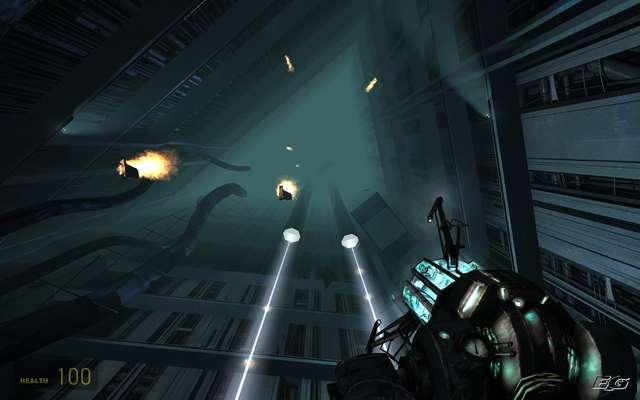
I think the things we're happiest about in Episode One is the extra focus gave us the ability to go beyond that, actually, and pack even more gameplay in the same amount of time so it's a very dense experience. You asked earlier about the physics gameplay, and we pushed on throughout the episode in two different ways. One was to increase the interactivity in the environment, and dealing with the larger scale problems of physics; stuff happening like massive objects falling on you as you go down an elevator shaft and how to keep them off the elevator.
And then we did something else that we've always wanted to do, which was to push physical interaction into our monsters and into our NPCs. For example, the Zombine monsters runs at you and pulls out a grenade that's about to go off, and in the past we haven't really allowed you to interact with the NPCs with your gravity gun, so we really wanted to you to be able to pull the grenade out of his hand or shoot it out of his hand with bullets...
If you can aim!
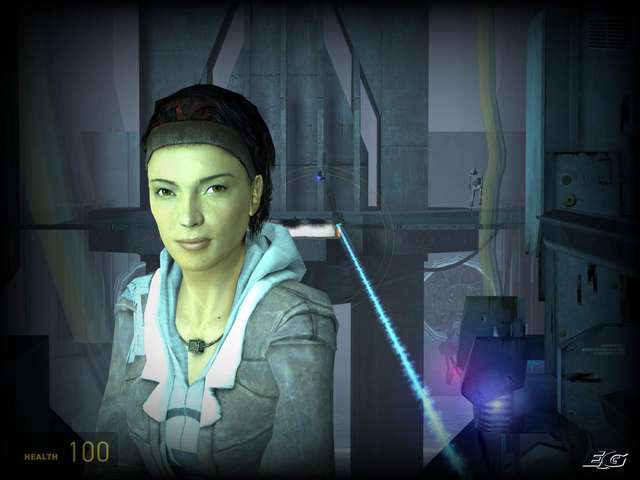
That's really exciting for the gravity gun to start to affect the NPCs in deeper ways.
We spend a lot of time on training, so we sort of craft specific experiences where you really need to do something to continue on here, so we've built those kinds of experiences into the episodes. You're put in a place where this appears to be the only thing to do right now. Gameplay elements have to be very deliberately introduced.
It's one of the critical things that playtesting shows. If there's a capability and 80 per cent of people aren't figuring it out then that's probably a defect in the design. Not to be heavy handed, but the most ridiculous example is to have a hole with a Zombine hand sticking through with a grenade. You'd catch on pretty quick! "You know, I'll do something to that thing!" I mean, you'd never do that, but that's a kind of approach you use to get people to understand that there's now a new choice available to them at that point in the game.
That's why playing catch with Dog with the gravity gun was so important to the whole game.
If you look back at Half-Life 2, many of our training things were doing multiple stuff where you might be learning a new gameplay element, but at the same time you're learning about a character that you're interacting with who might be telling you something about the world, and the relationship between you and the character you're dealing with. For example, the cop who tells you to pick up the can, which we want you to press use, but at the same time you're learning about the relationship between the Metro Cops and the players, and the way they use civilians. But at the same time you're building this animosity between you and this character that eventually you'll be able to deal with when you get a weapon, and so on. Our training is all there throughout the game, but it's fairly well disguised with you doing multiple things at the same time.
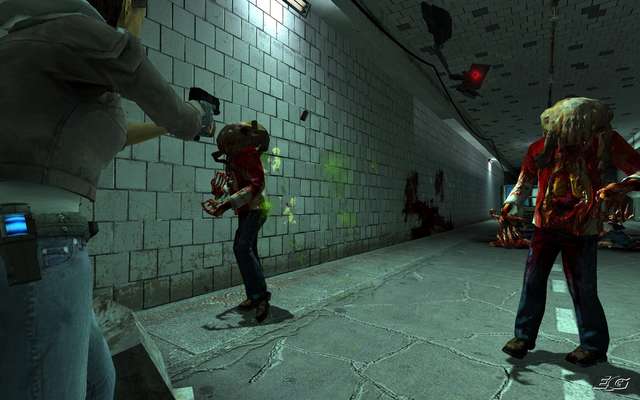
What we try to do is get people through as much entertainment as possible. This is an argument I have with Warren Spector; he builds a game that you can play through six different times. So that means that people pay for the game, but don't get to play five sixths of the game, which I feel is a mistake. You spend all of this time to build stuff that most players will never ever ever see, and I feel we try to maximise... I mean, I understand the exploration impulse and we try to make people happy doing that because it's an important part. Exposition, exploration, combat and so on are things that we need to make sure are present, but if only one per cent of your customers see this cool thing that takes five per cent of your development budget, that's not a good use of resources.
Playtesting drives a lot of this. Often, you'll watch a playtest and something incredibly cool happens, and the first question you ask afterwards is how can we make sure all of our customers see that? They'll say 'the gunship nearly crashed on me when I shot it down and I had to jump to the side to dodge it and that was incredibly cool'. How can we make sure that happens to almost everyone?
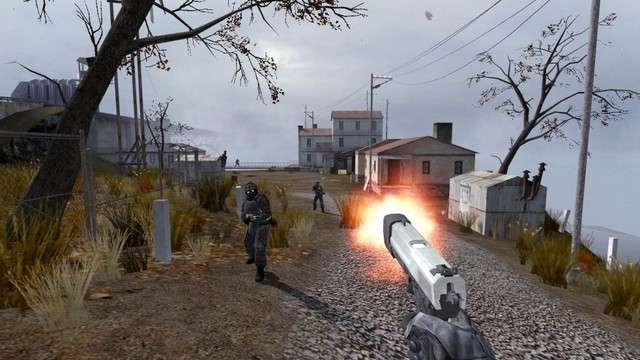
We've got plenty of entertaining scares, for sure. Lots of screaming!
I think it's different for different people. For some people it is pretty scary.
There's a portion of the game where you're in the dark for a while - and that has a creepy element to it that I don't think that Half-Life 2 and Half-Life 1 had.
People are screaming when they're playing, right? That's a reasonable goal for us! [Cue maniacal laughter from everyone.]
I think in some ways, having Alyx around you gives us this opportunity, this co-op, almost a buddy movie type experience where a lot of the fun comes from being in a predicament and seeing the reaction from your buddy - it's a little different. Ravenholm with Alyx would have been a different experience than Ravenholm without Alyx. We've tried to build experiences that when you've got through them you think 'I couldn't have had that without Alyx'.
A good example of that is with the flashlight when you're in this very dark section - in fact it's the first time we've ever put the player through an area so completely black they can't see anything without using the flashlight. And of course, Alyx can't see anything at all, so she relies on your use of the flashlight to warn her of enemies - and at the same time you're low on ammo, so you're relying on her to deal with some of the enemies.
That sort of really natural interaction with Alyx is not really about darkness, but about co-operation. The goal wasn't to say how do we make a dark area, but how can you interact with Alyx in some interesting way? How can we make you dependent on each other?
Later on in the game, the more you allow her to be helpful, the more fun you're going to be having, so we put you in these situations where you have to be dependent on her and then you get used to the idea that she's actually a pretty competent companion, and that will make the rest of the game more fun, because you've been through that sequence.
Most of our design decisions tend to be collaborative, Robin and the usual crew of people, which is satisfying because people want to ask 'Who's the lead designer?', 'Who's the lead programmer?' and we're, like, 'errr?'...
104...we're really picky. Basically everybody who built Half-Life 1 is still here, and it's hard to find people. We have to go all over the world to find people who are going to fit in. Our collaborative approach that we use is incredibly dependent on those sorts of personalities and skill sets. The good news is it lets us have the design person we have. The bad news is we can't just go out and hire 50 people and say 'go make more!' because we'd end up firing 48 of them and starting over.
I dunno... cheerleader, complainer, playtester, why the hell is it so late? [laughs] AMD-FX63 water-cooled, with dual SLI and 30-inch monitor tester!
If you missed the first part of this in-depth interview, but sure to check out what Valve had to say about Hollywood, future expansions and the making of Episode One elsewhere on the site.