Archer Maclean talks Mercury
Its esoteric charm, designing levels with hidden depths, and more.

Archer Maclean's Mercury has already captured the imagination of a lot of gamers. One of only two really new puzzle games on the PlayStation Portable, it's drawn comparisons to the likes of Super Monkey Ball and Marble Madness, but really belongs in a niche of its own. Having reviewed the game yesterday, today we chat to Archer Maclean himself about the game's influences, designing levels with so many hidden depths, the game's esoteric charm, and how the PSP is helping developers sidestep the "graphical arms war".
Eurogamer: Mercury has been compared to games like Marble Madness and Super Monkey Ball. Were they key influences? And which other games would you say helped shape your vision of Mercury?
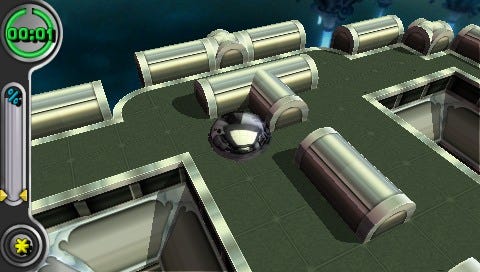
Archer Maclean: Mercury was originally inspired by those tilting puzzle games where you had to steer little metal balls around a maze. In fact, as some people will probably remember, there’s a mini-game based around them in Cueball World. Then we developed a ‘liquid metal physics’ prototype engine and we had one of those “hold on a minute” moments and one thing led to another. We’ve certainly looked at both Marble Madness and SMB but Mercury is actually a very different game, there’s a much heavier puzzle element involved and the characteristics of the blob itself give the game’s dynamics a very different feel. We all feel that The Blob is the star of the show!
Eurogamer: One of the things Mercury seems to get most right, for me, is its high end game. At a basic level it allows you to make steady progress and build your skills up to a certain level, but with patience and application it's possible to manipulate the physics and work out some extraordinary shortcuts. How do you go about creating something like that? Do you actually sit down and look at a level design and ask yourselves how you can hide those depths? I can't believe it's just a satisfying accident.
Archer Maclean: It’s a combination of different things really. Some of it is deliberate design but the rest comes from extensive internal playtesting and tweaking of the levels. Often we’d notice that you could almost shave off time to complete a level by doing certain things and it was just a question of tweaking the level to allow these shortcuts to be used. You have to remember that what may seem like quite a basic level in Mercury was revised and tweaked over and over again internally to make these shortcuts appear to be almost accidental. Having said that of course it was, occasionally, just blind luck!
Eurogamer: Some reviews have said that Mercury might be too esoteric for some people. I'm sure you have a view on that, but I'd be interested also to know where you feel the line is on that stuff. What is it that makes something like Mercury "too esoteric" whereas Tetris and Zoo Keeper have mass-market appeal? Is it core simplicity? The nature of the actual task? What are your views on that?
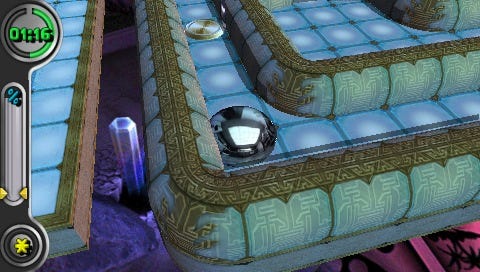
Archer Maclean: I’m not sure if it’s a bad thing for your game to be considered “too esoteric” when lined up next to today’s ceaseless avalanche of mediocre sequels and me-too games. Of course you want your game to appeal to as broad a cross-section of players as possible but, like the man said, you can’t please all of the people... I think that these days more and more games seem to be sold on the basis of the number of features in the game, more cars, more weapons, more characters etc. rather than whether or not the basic play dynamic is actually any good. That’s because it’s very easy to lose sight of that core simplicity when you’re part of a hundred man team working on a cinematic behemoth of a game! Yes, Mercury has simplicity at its heart but personally I think that’s part of its appeal. We can focus on exploiting that simplicity and surprising the player with the ways in which we can constantly build upon and expand it. Remember that Tetris didn’t become popular on the back of a global marketing campaign, it was strong core gameplay and good word of mouth and spawned a million me too sequels. Besides, imagine trying to sell a 2D game with one level to a publisher these days!
Eurogamer: You must be very pleased that there's little else in the "puzzle" genre besides you and Lumines on the PSP at the moment, as it puts you in a strong position compared to how it'd be if a game like Mercury came out on, for example, the GBA, where the genre's already very well established. Was it your goal all along to be ready for launch, and if so why? And do you think publishers position products for launch because they realise they won't know how to get the most out of them later?
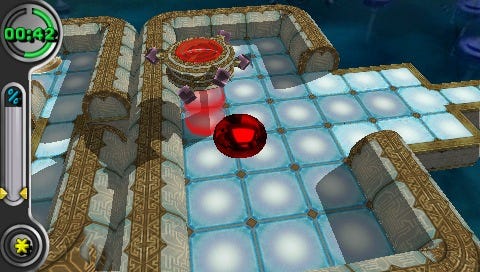
Archer Maclean: We’ve always aimed to have Mercury ready for hardware launch but the game was in development before the PSP was announced so there was an element of “right place, right time” to it as well. The PSP is an ideal format for the game though and it would be much harder to sell the game into the much more crowded market that exists for the home formats. My hope is that with Mercury being one of the only puzzle games on PSP we will get the game in front of more players and that word of mouth will do the rest.
Eurogamer: Then again, although Mercury is, to most people, "a puzzle game", we seem to be getting a bit beyond these generic classifications, with games like TrackMania putting critics at a bit of a loss. It seems to be exposing cracks in the promotional machine if nothing else, with games that don't have that Bruckheimer-style bigger/faster/louder blockbuster core finding it much harder to make an impression. How do we get past that, and who has to make the first move?
Archer Maclean: I don’t know if we will get past that, I just think that there will be an “indie” stream of game development in the future which will produce games that appeal to a more limited section of the audience. Just as with movies and music these games will still be able to break into the mainstream and achieve mass appeal but it will have to be without the colossal marketing spend of a FIFA or Halo.
It's easy to say that you could fund 10 new game types for the marketing spend on something like FIFA alone.
Unfortunately we’re in a position now where the mass-market increasingly expects the inflated production values that you find in these big games and small developers are simply unable to compete on that playing field. It’ll only get worse with the next-generation of hardware too.
Eurogamer: And, just as important, what happens if we don't?
Archer Maclean: Stagnation and eventual consumer apathy. The constant raising of the production values bar doesn’t help anybody in the long run, it’ll just mean fewer developers and therefore fewer ideas, as well as fewer publishers willing to risk ever rising development budgets on new genres when instead they can stick with lower risk known-formulas like racing and fighting games!
It’s no accident that so many developers have leapt at the chance to develop on PSP, where the emphasis will be more on the gameplay and less on the graphical arms war. I think Mercury’s a perfect example of the way in which we’ve got to think laterally about development these days. We’ve got to aim to expose players to new experiences and gameplay and not just give them more of the same with slightly prettier graphics.
Archer Maclean is head of Awesome Studios. His latest game, Mercury, is out now in the US for PlayStation Portable, and will be a launch title when the system appears in Europe.
You may also like...
-
Warp Review
-
Why Can't Games Do Sex?
-
Remedy's message to Alan Wake PC pirates: "enjoy the story!"
-
The Kickstarter Conundrum
-
Assassin's Creed 3 release date announced
-
Dear Esther Review
-
Full-length Far Cry 3 cinematic trailer
-
NCsoft confirms Guild Wars 2 on console
-
Alan Wake PC version footage
-
Huge range of PlayStation 2 Classics storm European PlayStation store
-
Japan PlayStation Vita sales at lowest ever weekly total
-
Indie game Dear Esther profitable in less than six hours
-
Assassin's Creed Revelations getting Desmond single-player DLC
-
Bethesda on Skyrim's viewable Morrowind, Cyrodiil: "maybe we'll use it one day"
-
App of the Day: Tongue Tied!
-
Valve selling a virtual Team Fortress 2 ring for $100
-
Syndicate launch trailer blasts out the dubstep
-
Solitaire Blitz Preview: Why PopCap's Approach to Facebook Gaming is Anything But Casual
-
Notch can match Schafer's $13m Psychonauts 2 budget valuation
-
Capcom registers new Darkstalkers trademark
-
UFC Undisputed 3 Review
-
Far Cry 3 release date revealed by leaked trailer
-
PS3 exclusive JRPG Ni No Kuni out in Europe Q1 2013
-
The Walking Dead screenshots shamble in
-
Ubisoft and TrackMania dev announce ShootMania Storm


Comments (10) Latest comment 7 years ago
Comments threads automatically close after 30 days, but please feel free to continue chatting on the forum!
Comment below viewing threshold Show
Having said that of course it was, occasionally, just blind luck!
So "often" they'd "notice" something. But luck was only "occasional". Sounds like a bit of a contradiction and they're not giving Lady Luck the credit she deserves. Good interview though. The guy sounds like a decent bloke not up his own arse.
Comment below viewing threshold Show
Fact : Lumines was produced by a team of only 5 members... and its probably the best PSP game to date.
Comment below viewing threshold Show
Obviously.
His point is that developing for the PSP you sidestep have to take part in "graphical arms war". I.E. create the kind of commercial next gen games that can only be funded by the EAs of this world and take years to develop and millions finance.
My point is that with the PSP even small developers can now produce something groundbreaking on a platform with potentially millions of users and still compete on a level playing field - which can only be good thing.
Am I the only one who 'RTFA' ?!
Comment below viewing threshold Show
strange comment about the PSP given it's the graphics pimp of the portable world.
assuming this games sells well and sony haven't signed them to an exclusive i don't see why they wouldn't port to other consoles.
while i'm here...
/gets up on soap box
I'm also sick of this rubbish that's continuously trotted out on this site about the supposed demise of the games industry. take the f**cking rose colored glasses off. sure there are a bunch of derivative and dull "big production" games - but they cater to an audience and keep money flowing through an industry that enables small creative devs to carve a niche for themselves and possibly crack the big time.
it's like saying the music and movie industries are in crisis because hollywood trots out the same bunch of shit every year. this hasn't stopped some great films/music being made along the way.
the message from publishers/music studios/movie studios is pretty clear: if you think you can create something that people will like, prove it to them and they'll fund it. if you want to create self indulgent art that a small minority will appreciate then don't expect a big budget.
/gets off soap box
sorry...
Comment below viewing threshold Show
Just as I thought. The next gen will be the death of gaming as we know it. I predict another industry crash like Atari experienced in 80's.