Guitar Hero: On Tour
Stays on tour. Hopefully.

Guitar Hero and the Nintendo DS make an odd-looking couple, but the decision to produce hundreds of thousands of wacky clip-on plastic peripherals is perfectly sound. Activision and RedOctane have driven rhythm-action to unprecedented success on home consoles (over a billion dollars in revenue, for instance), and Nintendo has widened the market for handheld games with unprecedented videogame controllers. Guitar Hero: On Tour can look as silly as it likes - it's a match made in money, as the game's more than 300,000 US sales demonstrated last week.
But Guitar Hero and the Nintendo DS also make an awkward couple. The guitar peripheral is a chunk of plastic a bit like a fingerless mitten, which grips the DS by plunging a cartridge-shaped protrusion into the GameBoy slot. The DS is rotated 90 degrees and held like a book, with the touch-screen on the right-hand side for people who play guitars the traditional way, while the left hand holds it by the peripheral, which has a strap to fasten it around the hand and leave the fingers free to press the fret buttons when prompted. But the peripheral frequently slips out of the GBA cartridge slot, sometimes enough to disrupt communications and force you to reboot the game, and the strap restricts finger movement - exactly what it's there to enable. The best you can do is an uncomfortable compromise that stresses the base of your thumb.
The core Guitar Hero gameplay is intact but compromised. The top-screen shows the familiar fret-board gameplay area, with notes descending towards a line at the bottom. As notes pass through this, the player holds the corresponding fret button and uses the stylus to strum along on the touch-screen. There are only four fret buttons, compared to five on the traditional controller, but the difference is absorbed by a recalibration of the difficulty levels, which curve smoothly upwards. The problem is the strumming.
You're expected to use a plectrum-shaped stylus to brush the touch-screen across a guitar graphic for every note, but a single back-and-forth motion with constant screen contact doesn't work, and more comfortable tapping gestures only work when the DS senses some movement on contact, so in practice you're slashing awkwardly but rhythmically at the screen - an action that jiggles the DS in your hand, which makes it difficult to see the gameplay area on the touch-screen. Even proper strumming seems to be measured inconsistently, breaking otherwise-perfect sequences and potentially losing you points or even getting you booed off if your performance dips below a certain threshold, forcing you to replay the entire song.
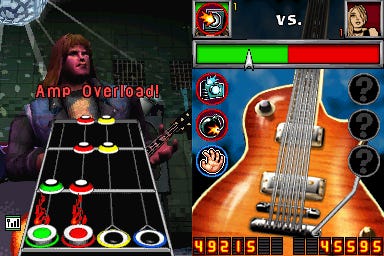
Other features from the original game also make the transition. The best-implemented is the whammy bar. When you're holding fret buttons down after strumming to elongate a chord, you can scrub the touch-screen to bend the note back and forth, which increases the amount of points you receive. Star Power - the points-multiplying special power - also returns, and is still built up by completing a highlighted sequence of notes without error. But it's activated by blowing or shouting into the microphone, which is overly sensitive - not enough to pick up the noise of the music itself or your frantic strumming slaps, but enough to take its cue from other noises like a passing bus, or the train you're on, or even a gust of wind. Star Power is often best deployed to try and grind your way through particularly complex sequences, and having it triggered by accident is a massive problem on the higher difficulty levels.