Grand Theft Auto IV's Aaron Garbut: Part 1

Rockstar's art director on how GTA is made.

Grand Theft Auto IV is finished. It's on the way to the shops right now, in a herd of lorries guarded by helicopter gunships and men who wear sunglasses indoors and keep touching their radio earpieces ostentatiously. The information they're being fed is that you can't have it. Not yet. Not for another week.

What you can do, though, is read over our interview with the Grand Theft Auto series' art director Aaron Garbut, who spoke to us last week about GTA IV's development - from the initial brainstorming and first programming and planning steps, including the all-important location research, to script refinement and how missions are integrated.

That's all in part one today. And if you check back tomorrow, you can find out how Rockstar approaches game development, what cats and diarrhoea have got to do with the game's enormous number of fake brands, and what GTA IV has in common with the game that propelled the series to superstardom in the first place, GTA III. All of it spoiler-free. Enjoy.

Eurogamer: When Rockstar makes a new Grand Theft Auto game, what is the very first thing that happens, and how significant are those early decisions in terms of the game's overall artistic direction?

Aaron Garbut: Firstly we just start collecting ideas. Locations, technology, gameplay, missions, basically everything and anything we want to include or do. We think about what we are trying to achieve in basic terms, we spend a bit of time sorting and discarding some of the initial ideas. Then we just start...

In terms of the art department, the character artists will start playing about with concepts, trying various main characters in the game, playing about with pushing the style a little, basically experimenting. The vehicle department will begin a first pass of every vehicle, the environment artists will lay out a road network and once we've all driven around on it for a bit will block in each city block roughly so we can start to see the skyline. The intention is that as soon as possible we have a very, very rough version of the game and then we begin to refine it. Like every other aspect of the game the artistic direction grows organically, we try stuff and things that work pull us in their direction and things that don't are changed.
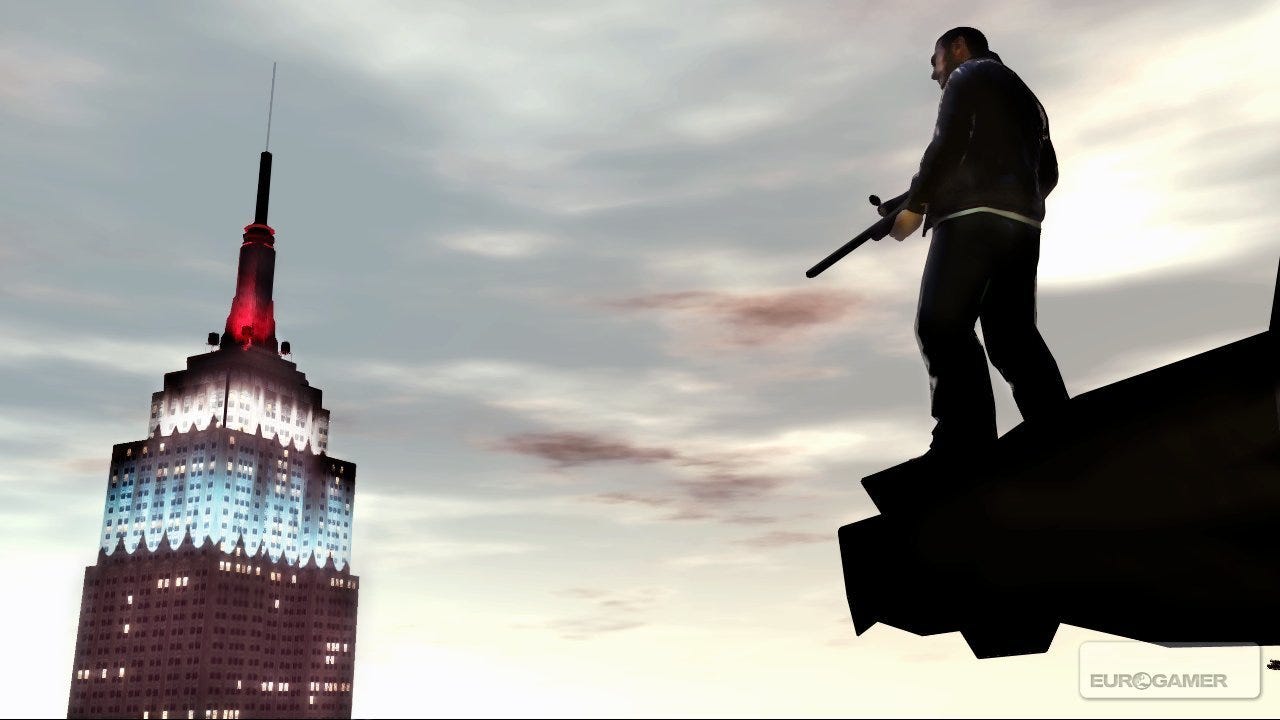
1

Eurogamer: At what stage do the characters take on form, and do they change significantly over the course of development? What impacts that?

Aaron Garbut: Right at the start the ambient characters are blocked in, there is a first pass that gives us an initial version of them and as the style tightens and the artists become more confident with the tools we go over them again and again and tighten them up, add varieties and consistency. The main characters all wait for the script. We work from some initial biographies while the script is still in its early stages and then again push these further when the script evolves.

Eurogamer: Did the exponential increase in hardware power on PS3 and 360 relative to PS2 have any influence on the kind of New York reconnaissance research you had to perform?

Aaron Garbut: Not really. We always aim to get as much reference as possible regardless of the platform. It's always going to be reusable in some way and building up a library of this stuff is really useful. The first reference trip happens fairly early in the project, not long after we have the initial block in. At this stage in the project we were still fairly unsure of what the power of each system was. When we did the second reference trip though it was much more focused. We had a fairly evolved game by this point and were able to get exactly what we needed to help us in areas we were struggling with.

Eurogamer: Character interaction, but in particular simple gestures and mannerisms - the way people move while they speak, for instance - have always seemed like the GTA cut-scenes' best weapons in the fight to define characters visually in spite of system limitations. But now that you have the ability to pose characters convincingly (like Niko leaning on Roman's kitchen table in the opening cut-scene) and do things like eye contact convincingly, did you find yourselves having to think differently about how you approached character design and animation?

2

Aaron Garbut: I think the key difference in approach this time was that we just didn't take the easy way out, not that it was ever easy before. We just shot the action we wanted and then dealt with it when it arrived. Having any sort of interaction like this always adds to your problems, and now that you can see those problems in HD we couldn't really hide anything. On this project though, there was a decision to make as few compromises in all aspects as possible. Just to try stuff we might have shied away from in the past and see if we could manage.

I think the level of detail the cut-scene guys have achieved is intense. They have the characters interacting with the world, which is hard enough, but they also have added a lot of feedback onto the world. Some of it is so subtle you sometimes don't even notice (though you would if they hadn't done it). Things like pillows and mattresses bending or bouncing a little under the weight of characters sitting on it, phone cords dangling and following the phones movements, liquid moving around in glasses. It's pretty amazing.

There's so much of this stuff, all the characters just feel part of the world, they lean on or against things, interact with each other, push things about, knock things over. I think we have more of this stuff in one scene than we had in the entirety of previous GTAs.

To get to your question though, I think it was more of a mindshift than anything else; we just decided to go for it.

Eurogamer: I've read about how you sought strong brow lines and a face that could convey the emotions you wanted for Niko. Were there any other directions you could have taken, or was Niko the exact fit for your goals?

Aaron Garbut: There were a few other versions of Niko that went down slightly different routes, but he evolved into more or less his final look pretty early in the day. I'm sure he would have worked in a number of ways, but when we got to what was essentially the version you've seen, he just seemed right. He had a good feel about him, he looked like he had a history, and he looked different.

Eurogamer: In creating Niko, what was it about his face that allowed you to achieve what you wanted? And how do you even begin to search for that kind of thing? And, moreover, what comes first - the emotional core of the character or the framework of the journey you will be laying out for them to take?

Aaron Garbut: We don't do anything as pre-planned as designing the character around his journey through the story. The story always comes a little later in the day. At the point when the characters are developed we tend to be working more from feel and a short biography. We know the kind of character the player is supposed to be and we know a little of his background but we still don't know what he is going to do and say. So in that sense we have to work with broad strokes. Niko's face looks like he's had a past, that he has done and seen things most people haven't and that this has affected him. That's a good basis to build on.

Eurogamer: Living next to the sea myself, my very first impression of GTA IV was that you had captured the character of water under sun, metal and glass - the range of colours and their interaction with dynamic surroundings. Can you tell us a little bit about that process?

Aaron Garbut: A large part of this is down to programmers with a great eye. Most of what is going on with the water is very clever and creative code. The only influence we have as artists is obviously creating the world that's being reflected and then setting the lighting up to get this looking as nice as possible.

There are some lovely things going on in the water FX. From the way it reflects the surroundings and distorts that reflection, to the real-time physics on the surface (drop a car into the water and actual waves will distort the surface, which will affect nearby boats). There's even foam wherever the water gets shallower and simulations of viscosity around the edge. It's an insane level of detail, but you can see this when the water laps up and down a wooden post or jetties. All that is done in the FX code.

On top of that, we have global control for each time of day and each weather type to alter the way it fades with depth, which can help to make it look really murky. We can tint it subtly, but mainly it's the time of days, sunlight and sky colouring that has the biggest effect. But as artists we're just tweaking what is already at its base level a bloody nice effect.

3

Eurogamer: Are there any other effects in the game of which you're particularly proud, or which threw up particular design challenges that you feel others have yet to overcome?

Aaron Garbut: I think the lighting system in general is pretty amazing. There are no hard limitations on the number of active dynamic lights around the player. The real-time shadows are working across every object and surface in the game with everything self-shadowing and casting onto everything else, there's ambient occlusion and emissive lighting on top of that. And then your standard next-gen shenanigans - light shafts, bloom, depth of field and motion blur, and of course it goes without saying everything's rendered with HDR.

The net result is a fully dynamic, real-time lighting system that is consistent across every surface in the game and has the subtlety and solidity of prebaked lighting. We've always had to make compromises in GTA's lighting because we had dynamic time of day. You make a trade-off with this essentially between variety and quality. There's a lot of stuff you simply can't do because the lighting needs to gradually fade between hours and weather types. With the system we have now though, there really aren't the same trade-offs. We get amazing almost prebaked quality combined with a constantly changing world. Where you can stand at the same spot and the combination of weather and moving time will mean you will probably never see it look the same twice.

4

Eurogamer: Given your use, in some cases, of real world locations, do you find that you have to contrive or excise details to skew the game in a fictional direction, or does the process of creating locations from visual material and memory naturally imbue them with their own distinctive aesthetic quality?

Aaron Garbut: We never reproduce real world locations. We take interesting or representative elements and create something new from them. It's about taking inspiration from real places and producing something that captures the essence of it. We're trying to take our impression of New York and keep it as that, an impression, not a laboured reproduction. I think that gives it more flavour, more intensity and in an odd way makes it feel more real. I've seen it in other games that set out to rebuild a city street by street, not only do compromises get made that favour realism over fun but a lot of the life is lost and all that's left is a hollow representation of a real place. I'd rather have the right vibe than an accurate roadmap.

Check back tomorrow for part two. Grand Theft Auto IV is due out on PS3 and 360 and will be released on 29th April. But then you knew that.

Comments (69)

Comments for this article are now closed, but please feel free to continue chatting on the forum!

  • Loading...hold tight!