GDC Indie Roundup

Monaco, Closure, Trauma, Shank and Vessel.

The Independent Games Festival, the Sundance of the gaming world, threw some classics into the mix this year. Of these Limbo, Super Meat Boy! and Joe Danger need less of an introduction - so here are Eurogamer's five other hot tips from the most worthy (and crowded) corner of San Francisco's Moscone Centre.

Monaco

  • Developer: PocketWatch Games

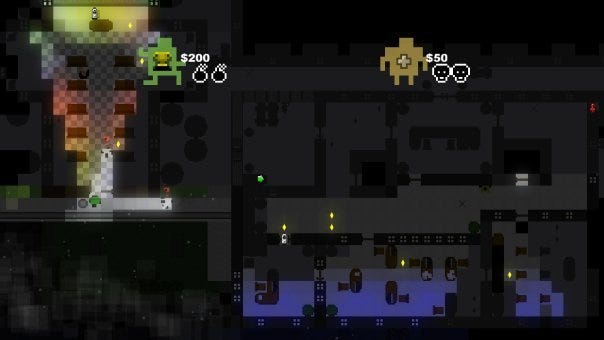
Essentially a collision between Gauntlet and Hitman, Monaco presents top-down maps of various exclusive Monte Carlo residences and hotels for up to four co-operative players to loot, pillage and get shot down by security within. In fact, the best way to describe it is to imagine playing Hitman from the map screen - having scrunched up your eyes to ensure a pleasurable degree of lo-fi scuzziness.

The aim is to break into an exclusive area, steal a valuable object that lies hidden somewhere within and then leg it back to your getaway car while armed guards give chase. It's Ocean's Eleven, yet significantly less rubbish; a great game that's more than worthy of its overall IGF victory.
1

Each player can choose a different character with different aptitudes - nuzzle the Locksmith against a door and he can open it quicker than the other players, for example, or shove a Hacker towards a security terminal and you'll push back the darkness of unseen areas and watch the guards on patrol. Should your high-speed heist go terribly wrong, as it no doubt will, there are also smoke bombs that can be dropped and there are cupboards to hide in with a worried expression.

Despite its Roguelike-meets-Pac-Man visuals, it somehow manages to conjure up atmospheric locations without breaking a sweat; our favourite being an evening soiree in a mansion that has a front room swarming with countless top-down toffs who are liable to produce a question mark out of the top of their head, and therefore a concerned dash towards the security guard, within in a moment's notice.

Best of all, however, are the frantic dashes for safety and the getaway car once alarm bells are ringing and security guards want you dead. In the same way that Left 4 Dead's closing moments are all about throwing yourself back in the fray to save a fellow player or guaranteeing your own survival, you'll watch one of your primary-coloured friends being gunned in the back by pixel-bullets and face the decision of saving him or not.

Whether or not there are post-mission sequences in which your getaway vehicle teeters over the edge of a pixellated cliff somewhere up in Alps is as-yet unconfirmed.

Closure

  • Developer: Closure Team
2

With Closure and Limbo in competition it seems that all the coolest kids in this year's IGF were monochrome. Unlike Limbo though, Closure makes this balance of light and dark a game mechanic. In the world of Closure anything that isn't lit up simply does not exist - you may well know that a platform stretches out to your helmeted hero's right, for example, but that won't stop you plunging through it into the inky blackness should you stray into the shadows.

To traverse anything, then, you either need to adjust the direction of handy light sources on the level - or you need to carry glowing light orbs around the level and leave them in the sorts of areas that you wouldn't mind having some solid ground.

As demonstrated by the fact that the game won the Excellence in Audio award at the IGF, the sound effects are pretty special too. Haunting piano chords mix in with sounds of the player's actions and whistling, swirly noises in a pleasantly discordant fashion - giving the entire affair the feel of a particularly on-edge and creepy corner of the Twilight Zone.

It takes your brain a while to engage with the contempt Closure has for standard interpretations of 2D scenery. Put an orb in a socket and allow it to be carried around the level and you're able to travel on it like you're standing on a torch beam, for example. But the process of learning and discovery is a great one. Stay out of the darkness and you'll be fine.

Trauma

  • Developer: Krystian Majewski

The game where Myst collides with severe head injuries, Trauma is the collated interactive dream-sequence of a solemnly-voiced woman who's recently been in a road accident.

It's essentially a sequence of still-images elaborately displayed and stacked on-screen, and as you investigate through them you hear her sad, monotone German-tinged voice commenting on the significance of the locations and analysing what you see. It's beautifully put together, and utterly captivating in its proud sense of psychological oddness.

Further interaction comes in the form of gestures you can learn from golden symbols hovering around the various photo-memories of the game's urban environments, which teach you how to turn from left to right or progress past certain obstacles using a drawing made on-screen with the mouse.

3

There's no real sense of difficulty, because this isn't a puzzle game - far more an exercise in storytelling, acute scene-setting and the creation of a frankly mesmerising ambience.

From the way one picture flicks to another with the sound of a photo being taken, to the way that it feels a little (a little) like Deckard constantly zooming further into his evidence screen in Blade Runner, it's four chapters of brain-based oddness you'll be advised to click through immediately upon its release.

Shank

  • Developer: Klei Entertainment

Who's the man? It's Shank! A large muscly man who's rather adept with knives, guns and a chainsaw he manages to keep unseen about his person until it's being used to carve a punk's midriff.

4

Shank is a fairly simple brawler, but it's also an utterly beautiful one - meant to come across as the game in which the Golden Age of Comics and the stylings of Tarantino (and perhaps Rodriguez, seeing as there's more than a touch of Desperado/El Mariachi about it) come together in one glorious and bloody sunset.

It's not the deepest game ever then, but the controls are slick and your attack moves merge together beautifully. Once you see Shank raising his chainsaw above his head for a plunge-attack while silhouetted against the setting sun on a rickety bridge, it's hard to avoid utterly adoring the visuals to boot.

Quite how the game holds out over an extended period is still up for question, but as far as pick-up-and-play side-on bloodletting goes the level on show at GDC was startlingly proficient. Recently signed by EA.

Vessel

  • Developer: Strange Loop Games
5

It may share the storyline of Robin Williams' mug-fest Flubber, but don't hold such spurious comparisons against it. Vessel is the story of one man's quest to rid the world of the synthetic fluid-based creatures of an inventor called Arkwright - and who henceforth should therefore be thought of as looking exactly like a late 1970s Ronnie Barker.

What makes the game interesting are the liquid physics - as you run around through levels solving puzzles with a variety of squirt-guns - from nozzles that lob splats of goo around the place, to hoses that you can merrily run around with and dribble on the scenery. Everything that's wet is physically simulated, and impressively so, from an eruption of lava all the way through to a dribbling pipe.

What's more the Fluros, the synthetic life forms that you're helping A-A-A-Arkwright to bring back into control, are similarly afflicted by liquid physics (and can be splatted-apart by the machinations of the scenery as such) and their wanderings across the 2D landscape can often be part of the puzzles you'll face. The simplest brainteasers deal with filling up containers and machines, or blasting different switches with wet stuff, but super-hot lava liquids and sticky green goo soon make their presence felt too.

Vessel is undeniably a remarkable piece of coding, and if the game entire can match the simple pleasure of hosing down a level with an array of suspicious liquids then it'll certainly be one to watch.

Comments (23)

Comments for this article are now closed, but please feel free to continue chatting on the forum!

  • Loading...hold tight!