Journalists often ask creators what influences them, and the answer is usually that we draw influence from everywhere - films, books, music, television, the walk to work, that time we tripped over the bathmat...
But game creators, just like film directors, musicians, novelists and X-Factor hopefuls, are all influenced by the things in their own medium that speak to their tastes most directly. Sometimes they alter those tastes in the process. Nor are creators always conscious of their most significant influences, which makes it all the most interesting.
It's a fascinating subject and one we've wanted to explore for a long time. With that in mind, recently we've been privileged to speak to some of the world's top game creators and we asked all of them: which one game has been most influential on you as a game developer?
Read on to find out what everyone from Peter Molyneux and Tim Willits to Jonathan Blow and Keita Takahashi had to say about the games that helped to define their careers.
Jonathan Blow is the creator of award-winning indie game Braid and is currently developing The Witness.
"Counter-Strike is influential because subtlety really matters in that game. What the texture is on a wall at the end of a long hallway matters hugely, because then that controls how well you can see whether a guy steps in front of it with a sniper rifle, and that determines your reaction time.
"Or, if you're playing Dust, or one of those levels that gets played to death, and you're pinned down in that centre area where everybody always gets pinned down, because the sound effects are different you're like, 'Okay, there's a guy with an AK off to the left and I know he's probably behind the left side because I've got all this experience of playing this level, and I heard a sniper shot, so he's probably behind those crates looking down under the hallway, and the guy with the bomb just died, so they're probably covering the bomb, so I probably need to...'
"You make all these plans based this holographic imaging of the level that happens in your head, which is based on very subtle things and player experience, and I find that very valuable. The Witness values subtlety in that same way, in a very different kind of game design."
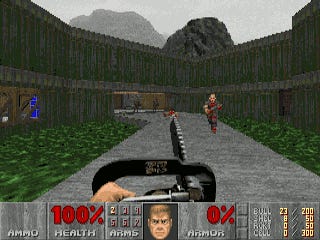
Tim Willits is creative director at id Software on RAGE, having previously worked on everything from Quake to Doom III.
"Doom 1. That is an easy question.
"When I downloaded the shareware episode of Doom, I actually thought that the whole demo was that first room in Doom 1. Which was pretty cool - I could walk around, pick stuff up, shoot my gun and so on. But I didn't figure out there was a door because it kind of looked like a wall.
"I moved up to it, somehow I hit spacebar and it opened, and I was like, 'Woah.' And that was the defining moment of my life."
Mike Simpson is studio director of The Creative Assembly, and is best known as the driving force behind the Total War strategy series.
"It's probably the original board game version of Dungeons & Dragons. That was before computer games existed, or around the same time as Pong and stuff. That's what caused me to end up making computer games: it was very natural to go from playing them a lot to making games."
Tameem Antoniades is one of the co-founders of British studio Ninja Theory, which recently finished work on Enslaved: Odyssey to the West and is producing a new Devil May Cry game for Capcom.
"I would probably have to go with Half-Life, the original. It achieved something that was way ahead of its time, and whether you're making a first-person or a third-person action game, the level design in that game and the way it melded with the story was second to none.
"In meetings and design meetings we still refer back to that game."
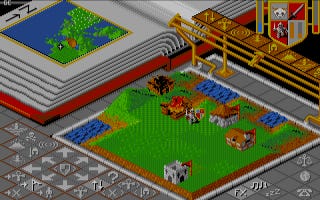
Dave Perry is CEO of Gaikai and in a previous life co-founded MDK developer Shiny Entertainment.
"I played Populous and by god I learnt a lot from that and Peter Molyneux. I've watched his whole career and played all of his games.
"I can talk about individual moments in lots of titles, and I apply that when I'm talking to students and I review their game designs. If you say ZT Online to most western game designers, they'll be like, 'What's that?' They make $100,000 from a single player, and the game looks like it was made in 1995. It's isometric 3D. Why haven't you played that one? Did you know the company that made it's called Giant Interactive, and they listed on the New York Stock Exchange based on that game for $3 billion? What?"
Keita Takahashi is the creator of Katamari Damacy and Noby Noby Boy. These days he designs playgrounds, among other things.
"It's a game by Sony that wasn't released. It's called Densen in Japanese, which means power line. It's where a girl hangs a clothes hanger on a power line, and then she slides on it.
"That's what the game's about. I was really shocked by the implementation of the normal things we see in our daily lives - just by changing the way we view things. It was amazing how they made it into a game.
"It was on PlayStation 2. Maybe they found it difficult to complete it as a videogame. I haven't played the game. I just saw a demo video."
Jonathan Jacques-Belletete is art director on Deus Ex: Human Revolution at Eidos Montreal.
"If I had to pick one, just for sheer feeling and narrative, it would have to be Out of This World. In Europe it was called Another World.
"It was so elegant. There were very few things you could do, yet it allowed you to do so much. The narrative was so tightly intertwined with how you played and how you evolved. For the time it was beautiful.
"Also, the fact it's one guy all by himself. Your companion, the alien, he just runs, but you end up liking him and developing affection for him. It was emotional, like very few games are. It was almost perfectly put together."
Matt Southern is the creative lead on the MotorStorm series at UK-based Evolution Studios.
"In the genre I work in the biggest influence of all time is unquestionably OutRun.
"I can still remember seeing it in the flesh for the first time in an arcade in Spain when I was 14. Its perception of depth and speed and the fact it was so damn cool – racing a Ferrari with a hot girl next to you in the sun...
"I'll never forget the first time I played it. The music was incredible. The graphics at the time were incredible. One of those little voices in my head said, 'This is going to be something very special and important.'"
Dr. Ray Muzyka is one of the co-founders of BioWare.
"I'd go way back to 1979, 1980. It was on an Apple II – not an Apple II E or a II Plus, a II, with the lowest memory you could get, 16k or something, and it had a cassette tape drive, it didn't have even a disc drive or a hard drive. That was in grade six or something. My science teacher said, 'Hey, I think you'll like this, you should check this out,' because he knew I was into technology and board games.
"It was Pirate Cove by Scott Adams. It was a text adventure game. It took three tries, each about three minutes, to load this cassette tape – the old squealing sound. The first two failed. I was ready to give up, and he said, 'No, trust me, you'll like it once it loads.' I played it, and in the first couple of minutes I was completely in love with videogames. I'd played some arcade games before that, but this was the first PC-based experience. It was just awesome, and it captured my imagination.
"You had to visualise everything in your head. You were on an island. You could type in two word sentences. Those games spawned the RPGs and adventure games that followed. Everything else evolved from there.
"That was the starting point for everything I did from that point on. That's why videogames are my main hobby."
Dr. Greg Zeschuk is also a co-founder of BioWare.
"There's this game called Dogfight on the Apple II Plus. You had a single screen, it had helicopters and planes, and you had left, right and shoot. We literally would have eight or 10 people play this game, and you'd just put your arm on this computer, seeing the screen through this forest of heads.
"We spent the whole summer playing, changing seats and hot swapping. It was our very first multiplayer experience. I look at that and go, 'Wow, that was remarkable,' because literally the amount of pain we would go through to play this every day, all summer. When you played this you realised how incredibly compelling that play experience was in a group of people.
"That was very powerful. It maybe didn't have as much of an impact, because we hit a point at BioWare where we didn't do as much multiplayer, but then we came back to it with co-op experiences. But obviously Star Wars is a big multiplayer game. That's always been one of our passions, funnily enough. We're known for RPGs, but Baldur's Gate was multiplayer and Neverwinter Nights was basically an offline MMO."
Martin Hollis is the founder of Zoonami and was the designer of the original GoldenEye 007.
"To a degree this is a stock answer, but it certainly has had a big impression on me and it's still true: PaRappa the Rapper, which I saw in 1999.
"I completely fell in love with it. I will always love music games because of PaRappa the Rapper. The naivety of the visuals opened my eyes to the fact that you don't need to chase reality all the time. It isn't necessarily the right answer. Because of that, it's had a huge influence on me."
Chris Hecker is a former technology fellow at Sims developer Maxis and creator of SpyParty.
"It would have to be Go. Go is the most beautiful game ever made. The saying about Go is, when the space aliens come down and they land on earth and we're trying to communicate with them and then we show them Go, they're like, 'Oh yeah, we have that.' For me it's inspirational because it shows the fractal complexity that can come from really simple rules, which is just amazing depth and beauty.
"It has an incredible handicapping system, with the ability to have players at different skill levels both have compelling games in the same world and space. It's aesthetically beautiful, with the stones. The graphics are good!"
Ru Weerasuriya is co-founder and creative director at Ready at Dawn, whose most recent release was God of War: Ghost of Sparta on PSP.
"Uncharted 2: Among Thieves. It finally bridged the gap between traditional gaming and what we need to expect in the future from everybody in this industry.
"Every developer needs to take a hard look at what we need to do for the future. Naughty Dog were the first guys to really provide a full entertainment experience, like the kind of things you normally only expect out of movies. This was a complete interactive entertainment. That's a huge jump from where we were."
Maxx Kaufman is game director at inXile on Hunted: The Demon's Forge, published by Bethesda Softworks.
"I'm going to say System Shock.
"I played a lot of games before that, but I really love that cross between RPG elements, shooters and just losing yourself in that world; immersing yourself in that world.
"That's really what we're trying to do with Hunted - we're trying to immerse you in this world and give you depth and variety, but give you faster-paced action, and get you a little closer to make it gritty as well."
Yuji Naka is boss of Japanese developer Prope and one of the creators of Sonic the Hedgehog.
"It is hard to think of anything particular which influenced me the most. As a developer, I get influenced by many things on daily basis; games of course, films, people I meet when I travel, etc. It is important for us creators to be stimulated, and learn from many things in everyday life."
Adrian Chmielarz founded People Can Fly, now owned by Epic Games and developing Bulletstorm.
"Modern Warfare offered me an experience I did not have before. Was I immersed in games before? Of course. But this sort of experience, when you let go of the controller and you go, 'F***.' When that atom bomb went off... That doesn't happen. That's not how it is. They were supposed to survive. It's a simple thing that was done in movies many times, but this first-person immersion – such a deep immersion that you actually stop playing and just enjoy soaking in the moment, and you're overwhelmed by emotion at this point – that is something that happened to me for the very first time.
"I always tell our guys that after that nuclear bomb went off, nothing was the same in the game business. You have to step up your game. You have to offer the same kind of experiences.
"It works out very well for me, because what I am interested in is taking players to other worlds. I'm never going to be a space pirate. I'm not going to be a Navy Seal. But if you give me a game that sells it, that I can really feel like I'm there, it's probably 20 per cent of the real feeling, but it's still some percentage of the real feeling. So we try to offer the same thing, in a much lighter way, of course.
"If there is a bible of 10 games you have to play and understand and dissect if you want to be a good designer, Modern Warfare is on that list."
Sean Murray is co-founder and managing director of Joe Danger developer Hello Games.
"I'd like to choose something really different that no one else is going to say, but I can't - the honest truth would be Mario 64. It's too obvious. Minecraft! Only now!
"But that's got to be for most people - Mario 64 is one of the greatest games ever made. The thing I always say about it is that it was the first proper 3D platformer I played and had seen, and the team that made it had never done a 3D game before. Imagine that they got everything right! That's amazing to me. And the rules they set down are set in stone now. For about 10 years afterwards everyone tried to do poorer versions of that.
"It was that exact thought that made me get into games - somebody's just sat down and thought, 'I will make a 3D platformer,' and nailed it, and thinking about all the design decisions in their heads and all the iterations, and thinking that would be so much fun to do.
"And for a lot of people, you can't say this with books or films, but if you make a game it might be the first game somebody has ever played. Mario 64, for loads of people, is probably the first game they've ever played.
"Imagine that. You could only do that with a book if it was a kids' book, but with games you can just make a game and it can be their first game."
Peter Molyneux is creative director of Microsoft Game Studios in Europe and co-founder of Fable developer Lionhead.
"I think it's probably ICO.
"You go back to that title and have a look at it - there were no icons on screen to speak of, the story was told in such an amazing way, it was told without language, it was incredibly iconic, the environment still is one of the most mystical, enchanting environments ever made, its gameplay with the hand-holding mechanic was brilliant.
"It broke every rule of gaming when you think it didn't have tangible foes, it only introduced the baddie very late on, mystery was part of its mechanic, it didn't have real power-ups or anything. It was genius and it still remains a work of genius.
"If I made something like ICO, I'd be very happy to die."
Compiled and edited by Tom Bramwell and Wesley Yin-Poole. Enormous thanks to everyone who contributed.
