Games of 2009: Canabalt
The magnificent monochrome marathon.

No one sets out to make a bad game. Conversely, not enough people set out to make a really brilliant game. Sometimes, though, it happens anyway. That's Canabalt - a one-button, one-man, one-idea Flash game originally created as a fun but throwaway entry in an Experimental Gameplay Project competition. It's been my go-to game in any idle moment over the last few months, and the strange grey world that I most often see when I close my eyes and let my imagination idle.
As great things do, it went huge. Increasingly for indie webgames, there's an inevitable consequence to that - an iPhone app arriving in short-order. In a time of entrenched piracy and dramatically declining funding for PC gaming, the iPhone is fast becoming a vital way for independent developers to make money. Canabalt is excellent on the PC, most especially the gorgeous, screen-hugging high-definition version, but it's on the iPhone and iPod Touch that it really shines. It's a game that feels as though Apple designed its frighteningly prevalent gizmo specifically for it - control system and game mechanic in perfect harmony, in a way that very little else on the iPhone achieves.
It's not so much that the controls are simple - all you have to do is tap to jump - but that everything you need to do is absolutely apparent within seconds. You're in a city. The city is crumbling. You have to run. Showing it to games-snob friends in the pub, they all knew exactly what to do as soon as I passed the phone to them. Tap to jump. Run as far as you can before dying. Try again. Again. Again! Moments later, their own iPhones are out. Pause. Three more copies of Canabalt are bought and downloaded there and then. Fingers tap. Larynxes expand and contract, shaping laughter and swearing alternately. High scores are exchanged, beaten, gloated over.
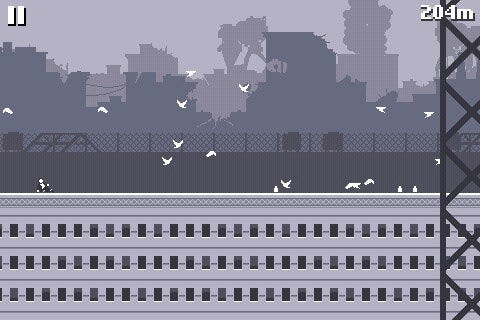
It's a scene simultaneously as modern as gaming gets, and a throwback to the sharing and boasting of eighties arcade and Spectrum culture. It's a game for gamers and non-gamers alike, achieving immediate intuition and reward in a way that we're supposed to believe Guitar Hero does, providing we forget about that first half hour of panicky "What do I have to do? I can't do it! I can't press buttons and strum at the same time! Can I give up?"
That said, I can't do the bloody windows for the life of me. Boxes, leaps of faith from collapsing rooftops, giant missiles, the lip of billboards: these I am master of. A timely tap and I'm over and away the obstacle, my pace increasing, my coat tails fluttering faster, the sense and noise of escape pounding in my ears, my eyes, my heart. But then there'll be a window, and I'll panic. I need to jump through it - not over or beneath it. To smash through its implacable glass surface requires entirely different timing to the rest of the game. Now? No. Now! Oh. Thud. Splat.