Final Fantasy XIV
A confusing first meeting with Square Enix's new MMO.


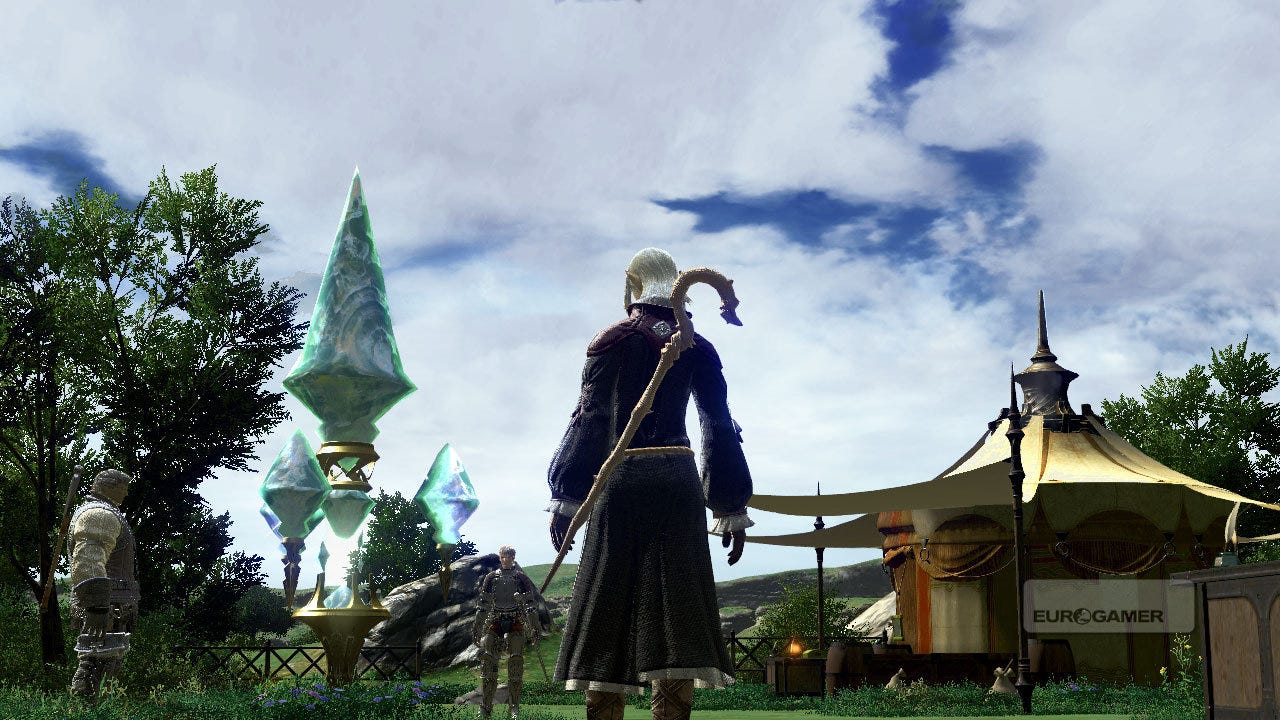
It's a general rule that Japanese developers are nowhere near as effusively forthcoming about their games at preview stage as their European or (especially) American counterparts. But for the world's first showing of Final Fantasy XIV, we might have expected slightly more than producer Hiromichi Tanaka and online director Nobuaki Komoto sitting in a room and waiting for questions whilst the game ran in the background, showing an immobile Elvaan mage standing in front of a building.
Square Enix seems to want FFXIV to speak for itself. The alpha build is playable on the show floor, giving attendees 15 minutes with the game without explaining how any of the combat or skills actually work. The result is party after party of confused adventurers wandering around in FFXIV's world clicking on random things to see what happens, and altogether failing to kill the five somethings that the demo quest demands of them.
From such a brief glimpse it's difficult to discern too much about the game except a distinct visual similarity to FFXI. Partly to tempt XI subscribers into XIV's world, the game's five races bear a huge resemblance to XI's - you can't carry over your old character into the new game, but the developer wants it to be possible to create a very similar visual approximation.
But Nobuaki Komoto doesn't necessarily see a mass exodus of FFXI players abandoning hundreds of hours of painstaking effort in order to jump right into XIV. "If the player wants to stay with FFXI, that's fine with us," he says. "And if they want to go to XIV, or play both, that's also fine with us. What we want to do is provide [FFXI players] with a new experience, and we would like to reach a wider audience at the same time."
In the interests of reaching that new audience, FFXIV abandons two of the cornerstones of the MMO - experience points and levelling. Characters also aren't tied to a particular class or profession, but are free to put time into anything they like. As with Monster Hunter Frontier, the popular online version of Capcom's world-beating social PSP game series, your skills are defined by your equipment. You can have as many equipment sets as you like and change between them at will, even mid-battle.
The same goes for skills. If you want to craft, you equip crafting tools. If you want to go fishing, you equip a fishing rod. You don't have to level up those individual skills - instead the equipment levels up naturally as you use it. It's rather like an equipment-based version of, say, Oblivion's learn-through-doing philosophy; you can play exclusively to your strengths, or spend time creating a more multifarious character. Square Enix calls it the Armoury system. Weapons and equipment level up the more you use them, rather than your character. Within this system there are four basic disciplines (crafter, mage, gatherer and warrior, broadly categorised), but there's no need to commit to any of them.
It opens the game up to solo players more, as you can build characters that both fight and heal themselves, or a magic user that can also whip out a battleaxe when necessary. "FFXI was really party-focused game design, so you'd always be working in a party to defeat a monster and you had to have your own role within the party," explains Hiromichi Tanaka, "but for FFXIV, because we have this armoury system, you will be able to fight on your own. Only when you encounter a higher-level boss and need to team up with other player will you need to define your role within the party. You can play it both ways."