Final Fantasy XIII Review

Experience.

Version tested: PlayStation 3

It's tempting to portray Final Fantasy at a crossroads: stumbling, after three unusually long years, into an unfamiliar landscape of multi-platform releases and a weak Japanese gaming industry, and onto a generation of console hardware that was already middle-aged by the time the great series showed up. Role-playing games have been scattered to the four winds of American sci-fi, pocket monster hunting, genre crossover and MMOs, and you might assume that Final Fantasy needed to do something to redefine itself.

But the truth is, it was ever thus. The first Final Fantasy, made as the young Square faced bankruptcy, was born and named in a desperation that was only ironic after the fact. Since then, despite its gargantuan success, the series has treated every moment like it was its last. Every Final Fantasy - especially since its arrival on disc and in 3D with the seventh game in 1997 - has been a reinvention, telling the same old story with new characters, new worlds, new tools, new systems, and ever-greater helpings of spectacle and sentimentality. They've always been a contradiction.

In that sense, Final Fantasy XIII is no different. On one hand, it sticks closer to the strict formal rhythms and linear underpinnings of the Japanese RPG than not just the divisive Final Fantasy XII, but even many of its predecessors. But the thirteenth game is also far more innovative and forward-thinking than it's been given credit for. It's as bold and intractable, as rebellious and respectful as one of the series' angsty teen heroes.

But that's not quite the whole story. Final Fantasy XIII is different in one respect; it does have a manifesto for the strange new world it finds itself in. And it's one a lot of fans of the series might not like.
1

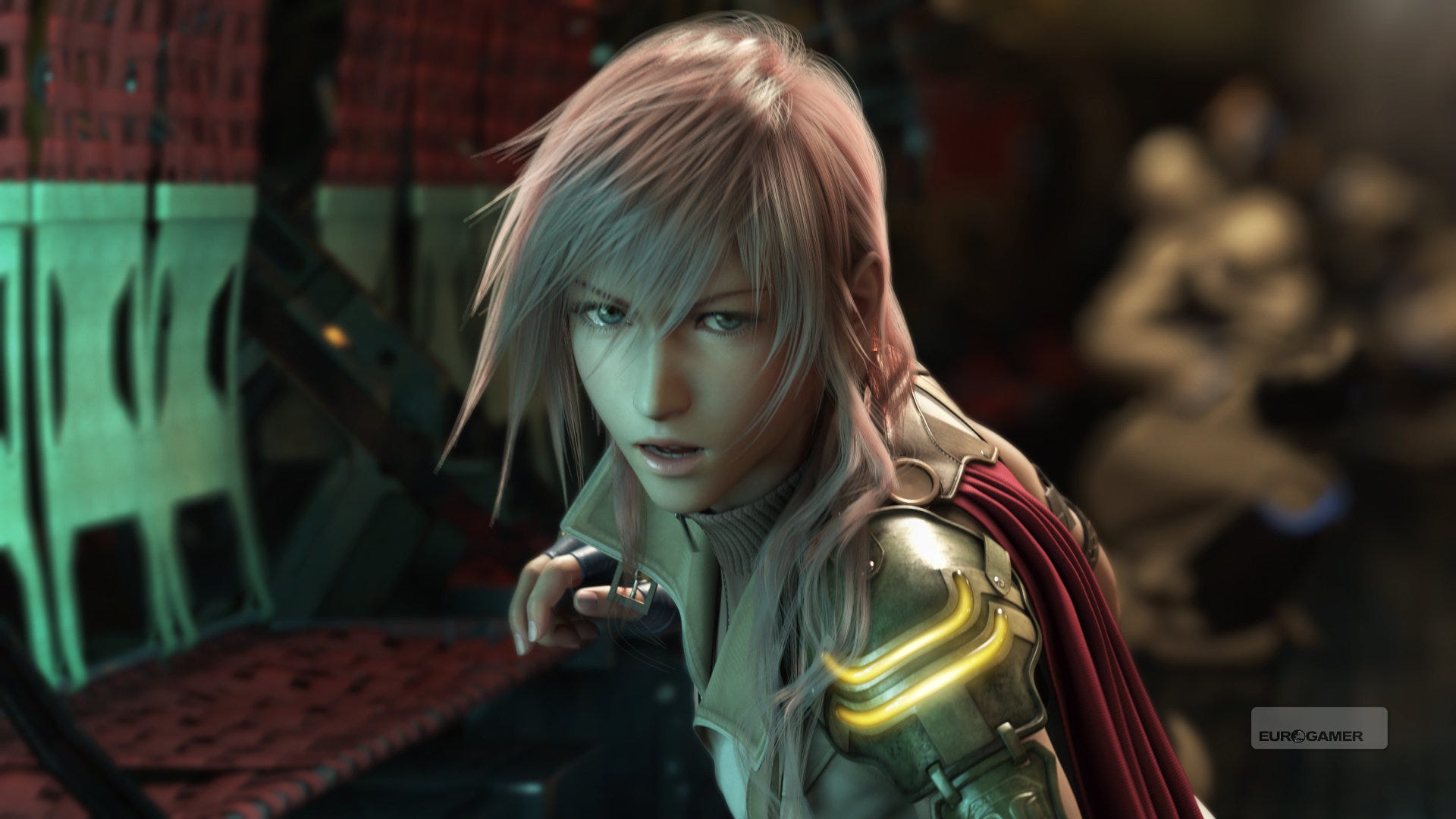
In-game cut-scenes mesh surprisingly well with Square's blockbuster CG. This is a stunning-looking game, especially the character models.

It is absolutely, ruthlessly, single-mindedly populist. It's stripped down, streamlined and simplified to the extreme. Its features are spoon-fed so slowly it's excruciating, even as the pace of the battles is amped up to be as fast and flashy as possible. It is a My First Final Fantasy, promoted with power ballads, and all that implies.

This agenda results in both awkward weaknesses and stunning strengths, but you have to respect the intention: to toss out all the decades-old clutter of the JRPG form, distil the Final Fantasy experience to its very core, and then make that as relevant, approachable and slickly modern as possible.

So, you don't get an overall character level and you don't have to wait for new skills; you just buy advancement from the menu when you see fit. Health is instantly replenished after every battle and there's no mana or other resource to worry about. Equipment slots are few, options limited, depth sparing and mostly optional.

You don't get direct control of more than one character at a time and input, if you want to, can be automated to the extent that it's more like tapping out morse code on the action button than selecting from menus. There's no downtime in towns for trading and tinkering, with functional services - shopping and a rather undernourished system of equipment upgrades - available from the very frequent save points.
2

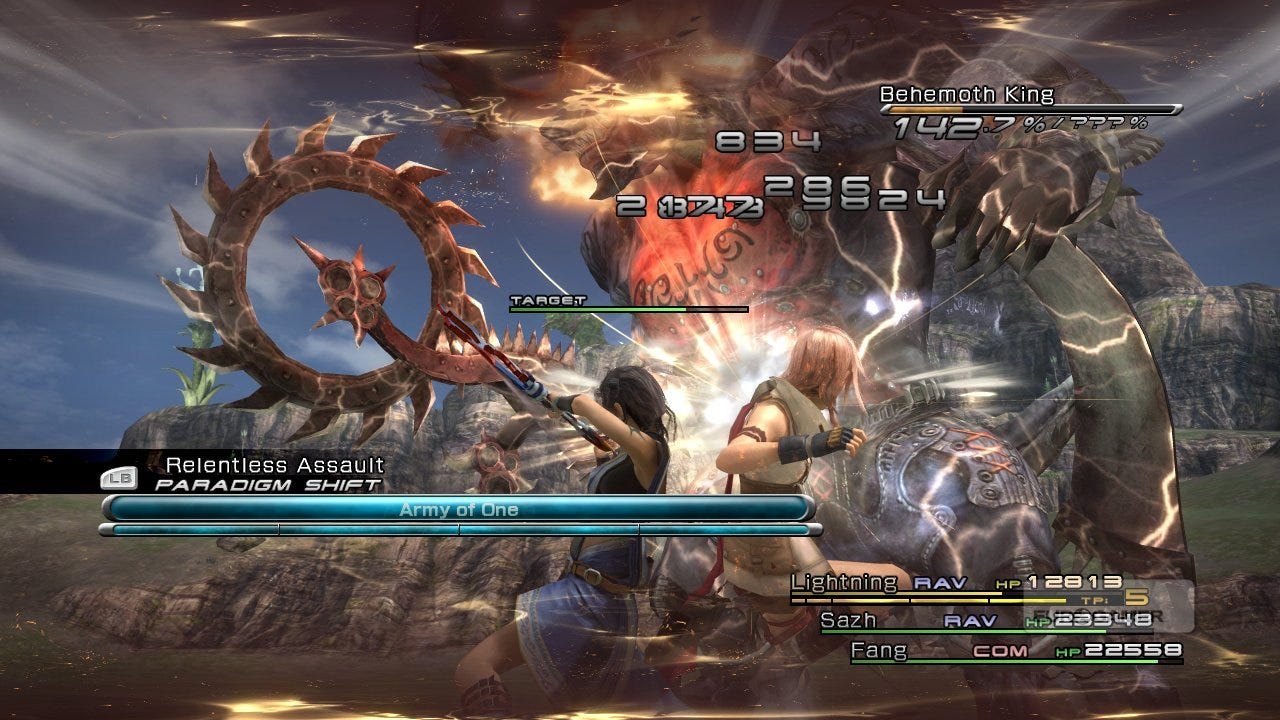
Every single Paradigm permutation has a pithy, memorable title. This is a great localisation job.

Until halfway through the story - and that's some 20 or 25 hours in, treble the length of many of the action blockbusters Final Fantasy XIII has modelled itself on - you don't even get to choose the composition of your party, or where you go and what you do next. There's no world map, and for the first half there's no element of choice or exploration at all. There is absolutely nothing to distract you from whatever the game wants to throw at you next - the next lush, twinkling vista, melodramatic cut-scene or punchy scrap. It's the RPG equivalent of a corridor shooter.

Does that sound like a nightmare to you? It's worth pointing out that this one-way crawl punctuated with battles has always been the meat of Final Fantasy, with the world map acting as an elaborate but limited graphical menu in most games - Final Fantasy XII was the closest to being open-world, and even then just barely. It's the illusion of choice and exploration that's been removed - although that is an important illusion, and XIII has lost a measure of excitement and romance as a result.

Square Enix's developers would also argue that if it's good enough for Modern Warfare or God of War, it's good enough for Final Fantasy, and to some extent they'd have a point. When Final Fantasy XIII is at its best - when the simple tactical brilliance and snappy, intoxicating pace of the battle system asserts itself; when the storyboard is shovelling breathtaking, colour-soaked vistas, inconceivable monsters and sumptuous video at you faster than you take it in - the last thing you have on your mind is wandering off a path that's not been beaten so much as carpeted in gold leaf.

But it isn't always at that best. There are one or two drab environs crammed with too many samey encounters, and what's worse, these come early in the game when you're existing on a gameplay diet that is thin indeed, with only the most basic features available. Bizarrely, there are also impractically lavish locations in which there is nothing to do but wander around and listen to the insane number of audio soundbites provided for a milling cast of thousands. All it takes is for the pacing to be a little off for that gilded path to become a gilded cage, and the few avenues of interaction open to you to feel claustrophobically narrow.

Pacing, in fact, is everything that's right and wrong with Final Fantasy XIII. In terms of the locations, the story, the character advancement and the unfolding of the game's systems, it's best described as a lumpy crescendo, with painful longeurs at the start gradually, oh so gradually, giving way to satisfying pay-offs.

3

Beefcake Snow (centre) and chirpy Vanille (right) could grate parmesan. Lightning, left, has the least convincing inspirational speech though.

The first half is spent in the appropriately named sky-world Cocoon, a rich but oppressive society and the most aggressively futuristic, science-fiction milieu yet for Final Fantasy. The barbaric otherworld of Pulse is spoken of with fear, and anyone who comes into contact with it - which includes all our heroes - is "purged". At the game's midpoint, you reach Pulse - a world of natural wilderness, dinosaurs and creaking steampunk tech - and the contrast isn't just stylistic. It coincides with the game finally offering up an open play-field and the option of taking time off from the main story to do some questing, exploration or even grinding.

The effect is so dramatic, so deliberate and so carefully metaphorical that it goes a long way towards justifying the long, long wait. In fact, it even overstates the charms of Pulse somewhat - it's a beguiling place and a glorious change of pace, but it won't be that long before you're back on the hamster-wheel of story, and secretly not minding that much at all.

That story concerns a bunch of Cocoon misfits who, for various and mysterious personal reasons, end up in contact with a fal'Cie - one of this world's demigods - from Pulse. This makes them l'Cie - magic-wielding agents of the gods - and enemies of their own world, Cocoon (or so it seems). It's typically soapy nonsense, and it has to be said that the basic, gauche lines of dialogue don't come across nearly so well in fully-voiced cinematic presentation as they used to in little blue text boxes with some dots and exclamation marks at the end.

4

This summon actually turns into a racing car. They went there.

That said, the way the characters' intersecting stories are revealed in flashback is artful, the thumping twists and revelations arrive with appropriate force, and the CG action scenes are dependably jawdropping. The cast isn't the most charming in Final Fantasy history - Tetsuya Nomura's character designs seem calculating and stereotyped, if unimpeachably good-looking - so it's all the more surprising to feel genuine affection developing for most of them over the course of the game, from stiff military poster-girl Lightning to blaxploitation refugee Sazh - even the standard-issue simpering JRPG moppet Hope turns likeable. The English (well, American and Australian) voice cast mostly do a great job with what they have to deliver.

The storyline has an obsession with pairing them off with each other during the early stages, which might help define the characters but has an unfortunate ramification for gameplay. Although each character can ultimately learn any of the game's six classes, they're initially limited in what they can do, and some pairings work better than others (Sazh and sweet-girl-with-a-secret Vanille give good odd couple in the cut-scenes but have no chemistry on the battlefield). The excellent battle system is designed for a trio and needs three to really sing, but opportunities to experience that before the magic halfway mark are scarce. It's one of several examples of Final Fantasy XIII being so careful not to overwhelm the player that it underwhelms instead.

The character advancement is another. This is done by spending Combat Points earned from each battle in an absurdly over-produced and nonsensical 3D talent tree called the Crystarium. This unwieldy beast allows you to buy skills and stat boosts whenever you like and on a set path for each character with some very limited branching.

A less flashy presentation allowing you to see more of the tree would have been much more useful, as it's actually rather limited and the stat distribution is rather odd. It's also strange to have to remember to go into the menu and level up. But the freedom and more organic character progression make a nice change, and the options you do have - creating a jack of all trades or master of some - tie in beautifully with the battle system's structure.

Which brings me to Final Fantasy XIII's star attraction, and the one area where its pacing is thrilling and perfect. Its all-new version of the series' Active Time Battle (ATB) system has been controversial, and initially seems worryingly basic. It takes a few hours to reveal its true colours; in the end it turns out to be radical, ingenious, elegant and exciting to use. That's thanks to a great suite of character classes, the system of chaining attacks and 'staggering' enemies, and something called Paradigm Shift.

On the face of it, you only have control of one character, the party leader; you can select role-specific abilities for the leader to use each turn according to how many slots they use in that character's ATB bar, which grows as you progress through the game. In actuality, you'll rarely be doing even that. Much of the time, you'll pick a role for your leader and use the "auto-battle" command, letting the game do the rest. This effectively relegates them to the same level as the AI party members (which is very smart, provided you use Libra to study your enemies' strengths and weaknesses first).

5

Efficient battle performance earns you star ratings and TP to spend on summons and other Techniques.

Why would you do that? Because the fun is all in setting up Paradigms - permutations of two or three of the six roles - and swapping between these instantly and frequently to suit the situation. It actually represents similar thinking to Final Fantasy XII's wonderful Gambit system - in that it allows you to automate the behaviour of your party and wield several characters as one, in real time, without turns - only instead of being based on back-end tinkering, it's about direct input and quick responses on the fly.

The roles are Medic, Ravager (magic damage), Commando (physical damage), Sentinel (protection or "tanking"), Synergist (buffs) and Saboteur (debuffs). They all interact with each other and the enemy designs, and combinations of enemies, in interesting ways. Also, every enemy has a Chain gauge which can be filled by balancing magic and physical damage, increasing in effectiveness all the time and when filled, 'staggering' the enemy for huge damage multipliers. It's essential (not to mention immensely gratifying) to use Stagger to get through fights efficiently, but it's always an edge-of-seat challenge to balance it with switching your party between different utilities.

To be fair, Paradigm Shift and Stagger are actually more interesting in combination with groups of moderately tough enemies than in the thoughtful but rather gruelling boss fights. Nor do they sit that well with XIII's other battlefield innovation, Gestalt Mode, a sort of QTE affair that allows you to pull off showboating attacks in tandem with the visually astonishing Eidolon summons (which look like Transformers designed by Gaudi). Gestalt is amusing but doesn't quite offer the massive-damage pay-off to match a well-executed Paradigm strategy.

6

Part Covenant Elite, part butterfly, part fifties hot rod, all monster. FFXIII's enemy design is as fabulously bonkers as ever.

Still, Final Fantasy XIII's is a superb system overall, easily making up what depth it has lost in speed, tactical cunning and moment-to-moment engagement. Some have bemoaned the apparent retreat from XII's daring reinvention - I did myself, at first - but in its way XIII is just as big a step for the party RPG, albeit a simpler and perhaps more palatable one.

Palatable is very much the word for Final Fantasy XIII. The Final Fantasy series, with its lengthy cinematics, stubborn style and carefully prescribed limitations, can never hope to please everyone. So it's strange to see it try, and no surprise that the result is not a total success. It's cautious, narrow, far too slow to get going, and is stripped down to such a bare naked form that even some FF traditionalists might find it off-putting.

What's left, though, is faultlessly accomplished, gorgeous to behold and, in the long run, thoroughly enjoyable. For better or worse, it's another new beginning, and that's one Final Fantasy tradition that should never be changed.

8 / 10

Read the Eurogamer.net scoring policy

Comments (222)

Comments for this article are now closed, but please feel free to continue chatting on the forum!

  • Loading...hold tight!