Final Fantasy Tactics: The War of the Lions Review

When two prides go to war - uh!

Version tested: PSP

Wearing my JRPG Nerd Hat (yes, I own a JRPG Nerd Hat - I wove it myself from the hair of the denizens of Eurogamers' JRPG Otaku group, in fact), I'd probably pick out three games as being the Holy Trinity of titles which have been, thus far, denied to us miserable Europeans.

I'd choose Chrono Cross, stunning follow-up to the SNES classic Chrono Trigger. I'd choose the oddly paced but nonetheless magnificant Xenogears. Last, and certainly not least of the three, I would choose Final Fantasy Tactics - arguably the finest spin-off game to a major franchise the industry has ever produced.

Yes, sorry - I don't really feel like I can keep you in suspense over this one, posing the "ah ha, but is Final Fantasy Tactics really any good?" question and dragging it out for the next thousand words. Final Fantasy Tactics was superb ten years ago on the PlayStation, and it's still superb today in its long-awaited PSP remake. No illusions, from the outset; this is a review of a superb game.

The Noise Before Defeat
1

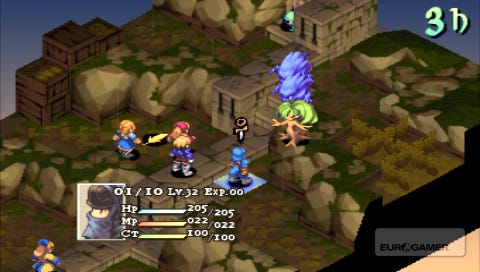
We should probably warn you that you'll be seeing scenes like this in your sleep for months.

This superb game is, at its most basic level, a turn based strategy game. You control a band of soldiers, at the beginning of each battle you choose your force from within this band (normally a fairly small group - four to six is typical). You then move your fighters around a rectangular playing area laid out on a grid, complete with hills, valleys, buildings, rivers and so on. Each character - yours and the enemy's - takes a turn which can include both moving and an action, be it attacking, casting a spell or using an item.

That's the 30 second guide to Final Fantasy Tactics. The full version would probably fill a manuscript so thick it would make Tolkien's eyes water. Certainly, FFT's battles take place on the small scale - they are mere skirmishes between a dozen characters, really. However, the sheer level of depth which the game affords to players who engage with its prodigious charms is sufficient that you have to wonder if there are entire new lifeforms living in the trenches at the bottom.

The character progression system is at the heart of this. At the start of the game, you command a party largely made up of Squires, the basic class who can do a bit of fighting and use some somewhat useful abilities, but who aren't really masters of anything. As each of your soldiers progresses, however, you'll find that you can move them around to new jobs which open up. So a Squire can become a Knight after a few levels, say, or perhaps an Archer, while a Chemist (a basic item-using class who can chuck around potions) could decide to focus on magic and become a White Mage, replacing his potions with healing spells.
2

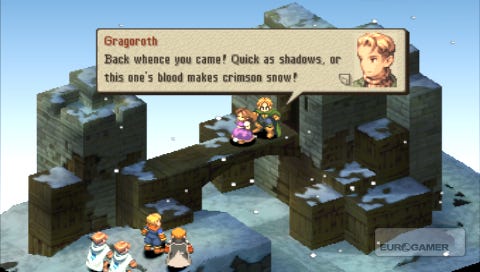
Battles take place across a wide variety of locations - and the scripted events manage a surprising range of drama, given that they're acted by small sprites.

Progression between classes isn't the same as levelling up. Instead, the game gives each character an innate level, and a "job level" for each of the jobs available to them. You could, for example, have a character who was level 7, but a Level 3 White Mage, Level 5 Squire and Level 2 Knight. This aspect isn't particularly complex, although it's worth bearing in mind that sometimes the next job along the tree isn't actually better than the one you're doing at the moment - just different.

As you advance in each job class, you'll earn JP - job points - alongside the standard experience points that raise your character level. These points are allocated every time the character performs an action, and are assigned to the job class that action belongs to - and they can be spent on "buying" new abilities within that class, like new spells for the Black Mage or the ability to use more advanced items for the Chemist. To mix things up a little, each character is also capable of expressing job traits from multiple classes.

You may not be interested in strategy...
3

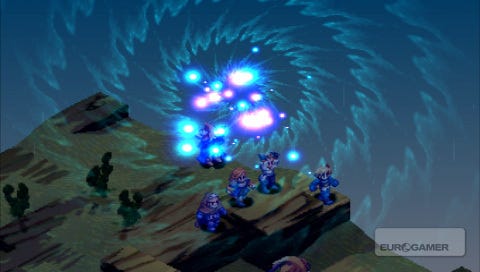
Some spell effects are appropriately huge and impressive. There are even summons to be discovered, as you'd expect from Final Fantasy.

This is where things start getting complicated (yes, start!) - and although it's initially somewhat daunting (and the game is pretty awful at holding your hand through early experiments with job classes and abilities), it's also where much of the depth of the game comes through.

So, to pick up another example, you might have a character who has levelled up to some degree both as a Chemist and a White Mage, but is presently set as a Chemist. His first action slot will always be the actions open to him as a Chemist (using items, mostly) and his innate talents will be that of a Chemist. In a second action slot, you could add White Mage abilities, giving him the power to cast healing or protective spells. Even more complexity comes from the ability to add other abilities from the full range of job classes you've picked up - the same character could have the Counter-Tackle ability from the Squire, for example, which counter-attacks automatically in response to physical damage.

If your eyes have glazed over at this point as though you're at a really, really dull lecture, then this may not be the game for you. On the other hand, if you're turning over in your mind the prospects afforded by a game in which each character can be customised with abilities from a wide range of job classes... Well, come on in and let me buy you a beer. We have much to discuss.

Final Fantasy Tactics' flexibility is exactly what you'd hope from such a promising system, and that's a large part of why it has remained such an enduring fan favourite for ten years - at one point, commanding genuinely ludicrous sums on eBay for original copies. The potential of the system is almost limitless; imagine our joy upon discovering that combining the Knight's ability to break pieces of enemy equipment with his attack, when applied to an Archer, allowed us to break people's stuff at long range. Beautiful.

A somewhat bittersweet aspect of all this customisation, however, is that it makes you get very attached to the otherwise faceless members of your miniature army. Once any character is knocked out, a count-down appears over their heads, giving you a certain number of turns in which to resurrect them before they're gone for good. While the key storyline characters in the game can't be allowed to die in this manner during battles, your normal grunts certainly can... But once gone, they're really gone.

More than once we've gone back to an earlier save point to try and complete a battle without allowing a favourite soldier to die. There's a real sense of attachment to them, even though they have no dialogue or storyline involvement - and of course, there's a more pragmatic realisation that you've probably customised them to a degree which will take ages to replicate in a fresh recruit from the Guild. No game encourages such obsessive compulsive behaviour to quite the degree that FFT does.

But strategy is interested in you.

4

The full range of job classes on offer is bewildering at first glance, but they're introduced gradually enough to give you a feel for what's going on.

One element that has occasionally been criticised about FFT is that its difficulty curve is somewhat peculiar - to put it charitably. This is at once both a fair and an unfair comment to make, because the way you customise your characters means that the curve will never be quite the same for any two players. We certainly encountered some battles that were ludicrously easy, and a couple (especially early on) so hard that we had to re-equip and fight a few random battles before trying again. Everyone seems to share that experience; but everyone seems to find different battles hard or easy.

We would, however, draw attention again to the fact that the game does a minimum of hand-holding in the early stages. Once it's taught you to move around and hit things, you're on your own - aided only by a tutorial that can be accessed at any point, but doesn't really teach you everything you need to know by any means. Keeping an FAQ close at hand isn't really possible with a portable game, so you'll probably find a lot of trial and error goes into your selections early in the game. Perseverance is the key here; within a couple of hours, you'll be flicking through menus like a grizzled veteran of Ivalice.

Despite being a ten year old game from a console most people have consigned to the attic by now, FFT looks fantastic on the PSP. The team's decision to run with hand-drawn sprites for characters and 3D tiles for the background looking more inspired than ever, since the game is one of the few 90s titles that comes bounding across the years looking as gorgeous as it ever has. A wide variety of animations and combat effects deliver a surprisingly impressive looking game that's perfectly suited to the handheld format.

5

The unique art style of the game carries through to its shiny new cutscenes - which display a gorgeous pencil-shaded effect.

Several tweaks have been made to the PSP edition - two new classes have been added, for a start, bringing the total to 22, along with a new hidden character in the form of Balthier from FFXII (which was set in the same world as FFT, and developed by much of the same team). The most notable change is the addition of brand new rendered videos for key plot points. These are utterly beautiful, presented in a flat pencil drawing style which perfectly complements the in-game sprites and artwork. The translation, too, seems to have been fixed significantly from the somewhat dodgy work on the original PlayStation release, which fans will be relieved to hear.

The presentation of the game is secondary to the game itself, to a large extent - but that doesn't do justice to the fantastic narrative and design on display here. The influences that shaped FFXII are clearly at work, with a story which concerns itself with political machinations and the destiny of the nations of Ivalice as much as it does with the individual characters on the stage. Musically, too, it is magnificent; Nobuo Uematsu may be the composer most closely linked with Final Fantasy, but little of his work on the series touches the elegance and beauty of Hitoshi Sakimoto and Masaharu Iwata's soundtrack for FFT.

6

And if you didn't recognise the sky pirate, perhaps this Square Enix celebrity cameo will ring a few more bells?

Final Fantasy Tactics is the kind of game that hoary old RPG types wax lyrical about to one another for hours, and it justifies every minute. The game may initially be daunting - lacking, perhaps, the sort of finesse that we've come to expect from more modern, user-friendly experiences - but once you're engrossed, it's quite simply one of the most addictive, intriguing experiences you'll ever have.

Gorgeous, complex, well-written and beautifully presented, Final Fantasy Tactics: The War of the Lions has been polished and refined to make it into the best version of one of the best games of the 1990s. For old fans, it's a welcome return for a beautiful game that's been gone ten years; and for those who didn't import, all those years ago, we can only say we're jealous that you get to experience it all afresh.

9 / 10

Read the Eurogamer.net scoring policy

Comments (108)

Comments for this article are now closed, but please feel free to continue chatting on the forum!

  • Loading...hold tight!