Version tested: Xbox 360
In 1986, my beloved Liverpool were rampant: already 16-times First Division champions, FA Cup holders, four-time European Cup winners, with Ian Rush leading the line and Kenny Dalglish in a manager's seat embossed by our first ever double the previous season. The subsequent decline throughout the nineties was largely self-inflicted, but it didn't help that a sweary Scotsman had arrived at Old Trafford, and started making good on his promise to "knock Liverpool off their f***ing perch".
Pro Evolution Soccer finds itself in the Liverpool role these days. Demoted to second-best in 2008 after a few years of increasing stagnation, Konami will not enjoy FIFA 10. Conflicting embargoes mean that we can't put the two latest instalments head to head until our PES 2010 review on 15th October, but unless something dramatic has happened since last month, the gap is ever more significant. If last year saw FIFA knocking PES off its perch, this year it's chasing it around the birdcage with a plank of wood and a sledgehammer.
FIFA 10's 360-degree control is the key revelation. FIFA 09 still worked on diagonals - although not in such a pronounced way as PES 2009, to the latter's cost - but you don't realise how restrictive that was until you've played FIFA 10 for a few hours and try to go back. You can angle runs, shots and passes to your exact specifications, and it makes the world of difference to a game that was already a splendid simulation of the real thing. It's tempting to say that if FIFA 10 was simply FIFA 09 with 360 degrees of control, it would be worth that elusive ninth mark out of 10 anyway.
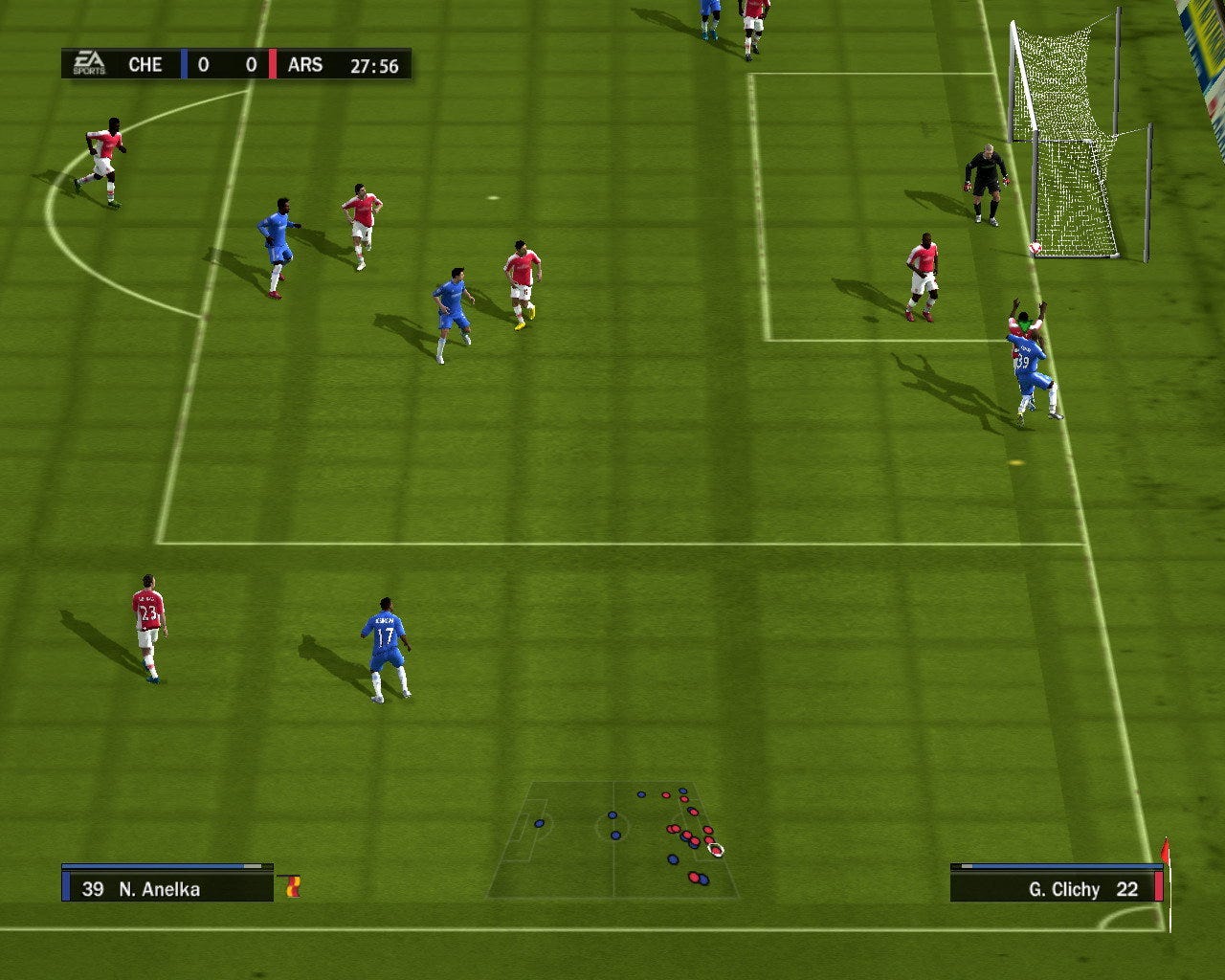
Snowy pitches are an early office favourite.
But that's not quite true - EA Canada did have some work to do, and while the range of refinements isn't all that sexy, it is meaningful. Ball physics remain excellent, with passes and shots accelerating and slowing with believable zip and inertia, but the ball is no longer so prone to ballooning over the crossbar, and cross-field passes are flatter and faster.
Balancing changes also have widespread repercussions. Pace is no longer as potent as it was in FIFA 09, for example, and this not only affects top-level strategy - you need to move the ball around to tempt players out of position instead, or use a bit of imagination and flair - but it closes off loopholes, so you can't simply rely on lofted through-balls, and winning a corner no longer leaves you so vulnerable to breakaways. At the same time, these changes are deftly managed, so fast-moving players remain influential, just not ludicrously so.
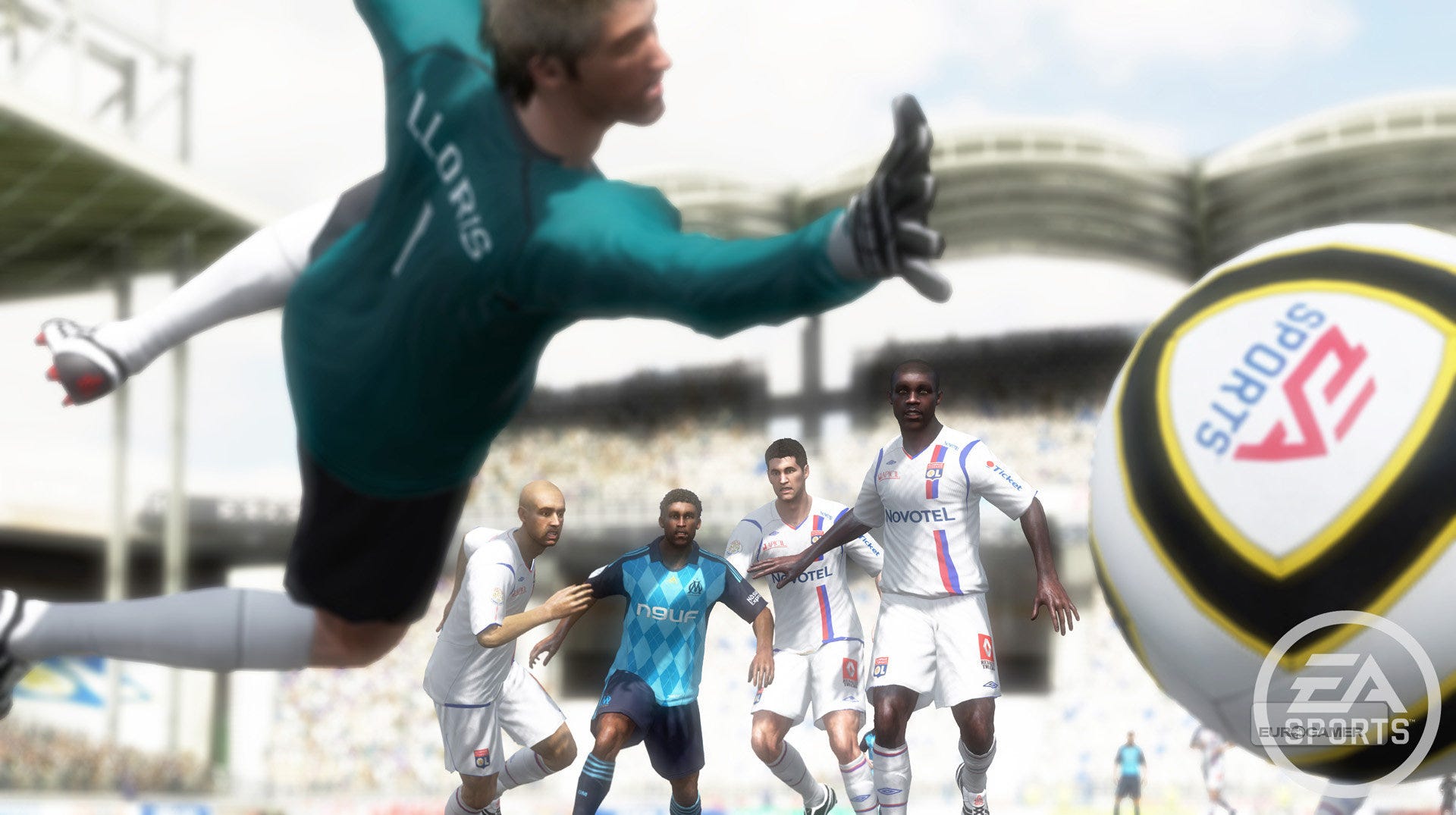
The refs now dodge the ball when it's fired at them, although not all the time.
Another key factor in settling last year's nearly excellent game down a bit has been programming in suitable margins of error. For example, in FIFA 09 a tall player who won a header in the box generally scored. FIFA 10 understands that he may be under pressure that puts him off scoring, or he may be poorly positioned to score, or he may actually be rubbish at heading despite his height (I'm looking at you, Former People's Hero Peter Crouch).
It's true of shots in general, but the flipside of the issue is that outlandish goals and delightful, long-range, last-minute screamers are also possible very occasionally, if the circumstances are right. Just as Neil Mellor will never score a more perfect goal than his Liverpool winner against Arsenal, which finally broke the back of The Invincibles, you may put down your friends in similar fashion. Knowing it can happen, even if it probably won't, is more than football games have previously been able to give us.
Elsewhere, the physicality that had grown to prominence since FIFA's 07 rebirth has been ratcheted up yet again, and it can be jarring to observe players like Lionel Messi, with his low centre of gravity, shrugged so easily off the ball by a lumbering centre-half. With that said, while a strong player can knock a smaller one almost completely out of contention, going in too hard is penalised by the referee, and the 'drag' on a fast player caused by someone at his side can now be mitigated by angling the analogue stick a few degrees further away - something that would have surrendered any advantage and perhaps even angled the ball into touch 12 months ago.
Despite its love of simulation, FIFA 10 is also sensible about where to draw the line, continuing to ignore handballs, inadvertent back-passes and other things for which the player can't be held responsible. It's even more lenient in some areas, like free-kicks given away by players sliding in after the ball has been played, which happened all the time in FIFA 09. In FIFA 10, the referee may play advantage, but play is rarely stopped completely unless the late tackle has a dramatic impact on the side in possession. There are some nice tweaks to the interface too, like the option to change kicker on dead balls using a drop-down menu. There are also quick free-kicks, although quick throw-ins would be a nice addition for FIFA 11.
Visually, FIFA 10's probably less of an upgrade than we're used to, but with the console lifecycle going deeper than ever, and the game already handsome, it's not too surprising to discover that spare processing cycles have been fed back into things like off-the-ball movement AI. As it stands, the likenesses are generally strong for anybody in the prestige leagues - Spanish, Italian and English - with Rooney particularly convincing, and weaker the further afield you go, albeit with some impressive howlers in the icing (Luka Modric, for example, looks like a Scream mask).
'Tutorial videos' might sound like a crap addition, but you might be surprised at some of the basic stuff you don't know.
Otherwise, production values are typically high. There are more licences in place than ever (including the elusive Dutch national team one), and the menuing's very slick and a bit more responsive. Commentary seems less repetitive than ever (put that on the back of the box), although allowing Martin Tyler and Andy Gray to improvise their rambling banter has mixed results.
Off the pitch, the one big new idea is Virtual Pro, not to be confused with Be A Pro. You design a player (who can even have your "Game Face", if you've uploaded one to EA's servers), as you would in Be A Pro, but rather than limiting him to one area of the game he's available in any offline mode, and Pro Club and ranked matches online. So, if you fancy blooding him a bit in random Exhibition matches, you can do that, and you can even gain experience in the Arena - the third-person perspective kickabout area that masks FIFA's loading screens. It's a long, hard road from a 65-rated nobody to top of your profession, but if Be A Pro: Seasons proved anything it was that these modes can work, and Virtual Pro is a thoughtful progression.
Should you choose to venture online - whether using a Virtual Pro or not - it's as robust as it was last year, although there's room for improvement. You still can't select your team's line-up and formation before being paired with another player, for example, which usually adds a couple of minutes' set-up to any encounter. With few people playing online before release, it's not possible to gauge how well new features like Virtual Pro integrate into Pro Club mode, sadly, and it's also important to note that EA doesn't have a spotless record fixing exploits, despite FIFA's vast popularity, although with any luck the improved core gameplay will prove less vulnerable to things like last year's Custom Tactics mischief. One good bit of news is that Be A Pro matches can now be set to have five human players rather than 10, so you can use an AI defence.
The third pillar of FIFA, if you like, behind Exhibition and online ranked matches, is Manager Mode, and FIFA 10 had promised to finally show it some love, although EA's ambition to achieve a base level of authenticity will have to wait at least another year. With my first 2009/10 season as Liverpool barely six games old, Manchester United were rooted to the bottom of the Premiership and I'd re-signed Xabi Alonso from Real Madrid in the same window Rafa Benitez sold him (I was perfectly happy with both scenarios, naturally, but it's not very realistic). Exotic, completely ridiculous signings (Fabregas to Fulham!) are less prevalent, and there's better menuing, but there's still a long road ahead for EA's designers.
The Set-Piece Creator, accessible through the back-button menu in Arena, is also a bit of a work-in-progress. You select a section of the pitch near the opposing goal and can record elaborate routines involving multiple runners, but your plans are often upset by the fact you seldom earn a free-kick in the exact position you planned for. Moving even a few feet away can upset timings and positions, and while defensive players adapt, your colleagues generally don't.
Arena now comes with options for practice matches. Yay bibs!
What's more, AI-controlled teams are still a bit too risk-averse for my liking - you'll never get Rio Ferdinand trying to scoop the ball over a Manchester City striker in the last minute, even though recent form suggests he might try it once in a blue moon. And as with every football game ever, there are a few patterns starting to emerge (the ball hits the post less often, thank goodness, but chip shots which the keeper tips round the post are a prominent fixture), and legacy issues familiar to football game fans still linger, like buffered button-presses punting the ball away just when you really need to keep it.
There's more for EA Canada to do, in other words. There can always be a greater variety of outcomes to any given situation, control can always be tighter and more agile, with greater degrees of flexibility, and the holy grail of a believable football season using real clubs and players, with just the right level of unpredictability, is still a ways off. But, having convincingly overtaken its main rival last year, FIFA 10 nevertheless consolidates its lead with great authority. Last year, I said FIFA feels like football, rewards football, and punishes football for football reasons. The difference between FIFA 09 and FIFA 10 is that the latter knows exactly where the former fell short of that, and makes up the distance in almost every case.
9 / 10
