FIFA 10

Kicking our way through EA Canada.

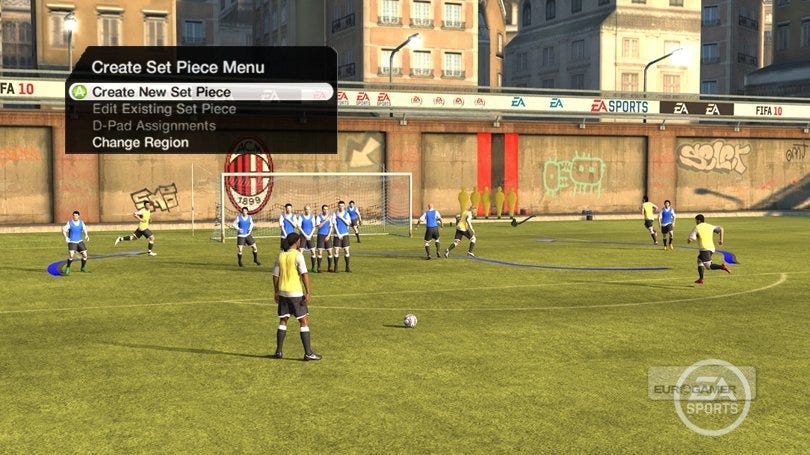
Five years ago, it would have shocked no one. Turning up at a FIFA event in London and being introduced to a set-piece creator would have made perfect sense. It's another line for the back of the box. Five years later though, perhaps it should be shocking. Nowadays you almost get the sense that FIFA developers David Rutter and Gary Paterson delight in making the box designers squirm. "I'm militant," creative director Paterson tells me as we sit down in one of EA Canada's many conference rooms a month later. "I'm not doing anything just for the back of the box. It has to be somehow linked to a fundamental of the game." And by the game, he means football.

FIFA's transformation from glossy licensed dirge into the footballers' football game of choice has been led by men like Paterson and Rutter, and of course, despite appearances, the set-piece creator is another example of why their approach has worked: its marketability is incidental. "That's something that arguably real footballers do," lead producer Rutter says of the set-piece creator. "Sunday league teams do if they're having a practice... I've been making football videogames for something like 13 years now, Gary's probably not far off it, and there's a bunch of us who've probably only worked on footy games, and that's where we've come from."

The vast majority of the things I've come to Canada to see and discuss are far less marketable, however. They're the guts of the game: changes to pace and stamina, the way goalkeepers behave, new ways for wingers to beat their man, how the game applies error to shots, headers and long-range passes, curbing acceleration... Stuff like that. Stuff that matters.
1

The referee's interventions no longer involve cut-scenes - he runs up to you and cards you, or sometimes just issues a warning, the uncertainty heightening the tension.

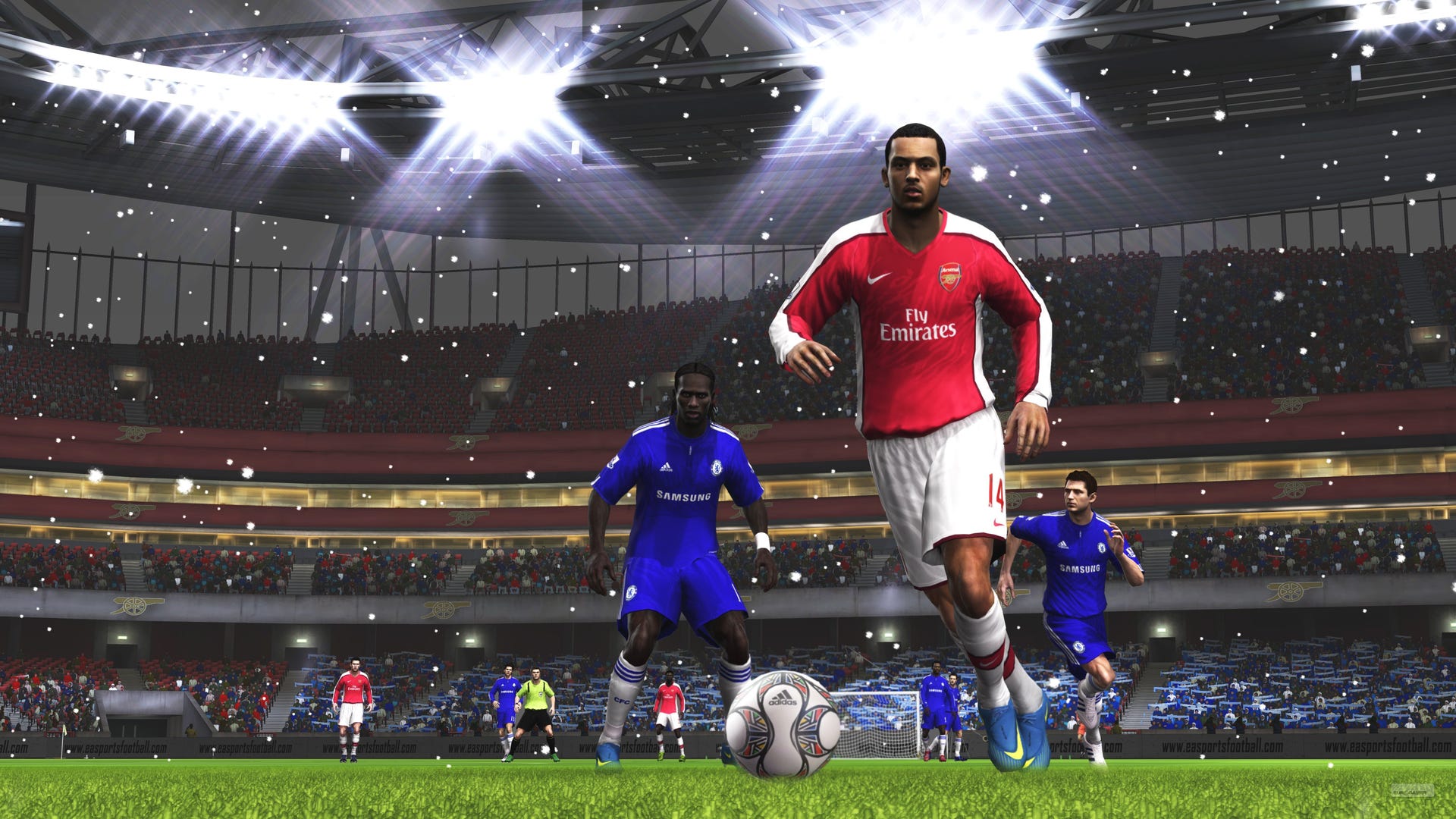
The biggest footballing revelation in FIFA 10 is the introduction of 360-degree dribbling, and the difference it makes is considerable. It means that you can turn in the exact direction you want and put the ball exactly where you intend, providing you can point the analogue stick in the right direction (no mean feat, as Geometry Wars players will appreciate). It also means that you can use the full width of the pitch: rather than having to change sprint direction in 45-degree increments, you can angle yourself to move away from a chasing defender into the remaining margin, increasing your chances of pulling away or drawing a foul. Changes elsewhere wring further value from it. Last year's contextual knock-ons allowed you to tap the ball past a defender and then run onto it, but in FIFA 10 your player is programmed to run around the defender if his path is blocked (some even run around the wrong way, Bergkamp-style).
2

You can now hold the right trigger on set-pieces to open a drop-down menu and pick another kick-taker.

That, it turns out, is one of the easier changes to appreciate, because a great many others happen away from the ball. Attackers will saunter on the halfway line when their team is not in possession, while players near to the ball will hustle along and orientate themselves to face it, which helps when they suddenly become involved by one of the now-faster cross-field passes. A player facing the ball is naturally better-placed to trap it and move off quickly than someone who has to turn first. Last year they didn't always do that, but this year they do, and along with reworked run cycles and urgency, it contributes to a greater sense of fluidity. FIFA 10 also behaves more credibly when you get into advanced positions. Last year's floaty shots are gone after EA adjusted a couple of key physics effects on the ball, and this means that players like Steven Gerrard can hit it harder and more accurately on their favoured foot.

"I think that the big problem," says Paterson, "is that if you want to make one feature better, it means that another feature has to react to that, and it has to react to that in a sensible fashion. If we make the shooting system realistic, the CPU has to learn how to shoot. And so you can see how these things have knock-on effects." More importantly, it looks like EA can see where they do, because for every concession to attacking verve there's a logical counterpoint. In Gerrard's case, for example, he will need the ball in a particular position to hit a screamer. Everything else introduces error - the pace of his shot, his angle of approach, the physical proximity of defenders, even the weather conditions. The increased role of error is particularly evident in heading. Up front, tall players like Peter Crouch and Luca Toni continue to win a lot of headers, but they won't guide them all into the net as they so often did in FIFA 09.

As Paterson says, the implications quickly snowball, but often in positive ways. Defending corners is no longer a question of hitting the pass button to head it precisely to a friendly player, because you may be under pressure, and the ball may end up flying to an attacker on the edge of the area instead rather than triggering a counter-attack. EA wants you to use the clearance button, which pushes the ball further out but with a reduced chance of retaining possession. The net result is that you work harder to avoid conceding a corner.

3

Having rushed the goalie out with the manual button, you can now double-tap it to halt his advance, making it harder for attackers to beat him with a chip.

A lot of these changes also reduce the potency of some of last year's exploits, assisted by a few welcome amendments to the underlying player logic. Goalkeepers last year had conflicting logic that drove them off their line just as they should have been catching a lofted ball which, combined with the lack of error on distant long-range shots, led to some embarrassing goals from the kick-off. Now they know better, and take fewer risks with balls heading towards the crossbar too, tipping them over if they're in any doubt. And besides, with error going up the harder the shot, they won't be troubled so often by cheeky punts, although the corner flags may be.

Similarly, while Custom Tactics haven't been changed dramatically, EA has tweaked the aggression and pressure sliders. "We discovered last year that people were sticking like seven players in defence," Rutter notes, referring to a particularly annoying exploit, "and having a Cristiano Ronaldo-type person up front, and what they were doing was, we had top-left bumper and through-ball is a chipped, lobbed pass, and you could ping a massive... just rocket it over the team, and it would land almost perfectly for a fast player who could then bear down on goal and score in a one-on-one situation." Good luck with that this year.

4

Fatigue has been adjusted so that players burn it up faster when they're in possession or moving at top speed.

"Then there's balancing out the fact that those situations tended to happen if you were pushed right up," Rutter continues, "so say you'd gone up for a corner, and your team's pushed way up the pitch, there wasn't enough defensive cover, so you'd have the kind of John Terries and everyone going up for a corner if you were Chelsea, and the play would break down and as John Terry was running back Michael Essien, who had been hanging back, would be running forward to meet it, so the ball would just fly over his head." This didn't work out well. Fixed.

Perhaps most significantly, EA has adjusted sprinting. "Last year pace was king," Paterson admits. "We were in a tricky situation, because we were trying to turn the corner and convince people FIFA was legitimate, but we weren't there yet, so it was important to show that attributes made a difference. Maybe we went a little too far with sprint speed, but what we've done this year is, when the players touch the ball, their acceleration slows, and it can slow to such an extent that he slows down, so you can imagine if you draw an acceleration curve for Ronaldo, he'll accelerate [gestures a smooth curve], and he'll touch the ball [introduces a stutter in the curve], and so on."

While it might sound like EA's sucking some of the fun and spectacle out of the game, playing it reveals that matches feel faster due to the increased fluidity, and are less predictable, not more. Take shooting, with help from gameplay producer Aaron McHardy. "The way that the shooting system worked algorithmically, it could give us some results that didn't have a whole lot of variety," he points out as I manfully lose to a journalist from the Telegraph. "You'd get variety, but you'd get it in chunks, so there were areas where you could get a similar result over and over and over. We've refined the system so that each context is more independent of each other, and the variety you get in the shot error is therefore a lot more."

Besides gamers who knew the game well enough to exploit it, EA has also had to contend with players who barely knew how to operate it - or, to be more charitable, who weren't aware of how certain things could be done, or who did peculiar, non-footballing things. "The biggest challenge we have with Custom Tactics," says Paterson, picking up the thread, "is educating people to understand what they do, and that they're on by default. Sometimes people complain that there's no one in the box for crosses and stuff like that, and that's because the crossing's really low for that team." Defending's another problem, and Paterson notes that this is why players you're not controlling with the cursor or the secondary defensive-press button act independently of your actions. To combat some of this, FIFA 10 has a number of tutorial videos, partly to introduce the free-kick system to newcomers, for instance, but also to offer tips on things like defending. "I think we need to go further next year," he adds.

5

Players now arch their bodies or duck to avoid shots or passes not intended for them.

It almost seems a shame to leave the pitch and consider Manager Mode, but it's become an imperative for EA, and Rutter and Paterson both talk about a multi-year plan similar to the original decision, following FIFA 06, to redesign the core football over a longer period than usual. In other words, don't expect miracles from Manager Mode in FIFA 10, but do expect a few steps in the right direction. This year is about "base authenticity", according to Paterson. "Authenticity of the league table, results and stuff like that, authenticity of the transfer market, player growth authenticity, because obviously in the Manager Mode before there was a problem with some player growth being too easy..." And next year? "Well, I don't want to touch on it too much, but obviously there's a lot of things like multiplayer, or online - these are things we're thinking about building a platform for. It may not happen next year, but these are the kind of things we're thinking we can push." As for other modes, like Be A Pro: Seasons, we'll be told more about them at gamescom this week.

6

Handball is still not in the game. Paterson notes that if you have no control over a player's arm movements, they have no right to penalise you for them. Just so.

Frankly, though, they could take them out completely, and strip away most of the licences, and ditch the improved animations and player likenesses, and FIFA 10 would still impress. It's the ultimate testament to its transformation, in a sense, because what would be left is a similar vision to Pro Evolution Soccer during its heyday of a few years ago. It's hard to imagine that the finished game, which of course does include all of the above, will be any less revered: over dozens of matches between half a dozen cynical football fans across two days at EA Canada, there isn't a single dull game, and it's hard to recall a single pattern emerging - either as a result of the game, or of a player's lack of tactical imagination.

But then, as with the set-piece creator, appearances here are deceptive, and this is arguably the key to EA Canada's growing success over the last few versions of FIFA: the realisation that the guts of the game may not belong on the back of the game box, but that, once combined, they justify the front of it. They make the difference between a facsimile of football, and football itself, and selling football to football fans works. Five years after we expected little from the series, it's not shocking to discover that FIFA 10 is the best embodiment yet of that ideal.

FIFA 10 is due out for every system under the sun on 2nd October.

Comments (43)

Comments for this article are now closed, but please feel free to continue chatting on the forum!

  • Loading...hold tight!