Valve is approaching a "pretty big milestone". Chet Faliszek calls it "lockdown". It sounds like a big deal. Remembering back to the summer of 2003, when "September 30th" was starting to rust, I feel suddenly uncomfortable about effectively downsizing Valve by eight people for three crucial hours of team-based online zombie duckshoot. Oh well, it's their funeral. "We're pretty fickle gamers here, especially since we don't have much time to play games, and it's not hard to get people to play Left 4 Dead," says Erik Johnson.
Nor is it hard to play, as we explained when we last did that. The scenario's simple: virtually everyone in the world except your four-man term of survivors is infected with a zombie virus, and you need to escape to safety together. It's the "together" bit that presents challenges. What's the key to making people respect it? "We've found that positively reinforcing good co-op play was more valuable than negative reinforcement of bad co-op play," says Johnson. "Making sure you don't have one person trying to ruin the experience, that's the easy problem. But making sure new players know when they've done something well is a lot more difficult from a design standpoint."
Key to achieving that is the line-up of Infected "bosses". They're not bosses in the traditional end-of-the-level sense, but turn up at unpredictable intervals and present more of a challenge than the rank and file zombies, who just charge at you screaming in great numbers ("We put more enemies on-screen in this game than we have in any of our other games," says Faliszek). The bosses, Valve says, have been designed with attacks that demand a concerted response. "When someone's being choked by a Smoker they're going to die unless you deal with it," says Johnson. "Being the person who kills the Smoker that's going to end a person's game is very rewarding." So each boss drives the survivors together.
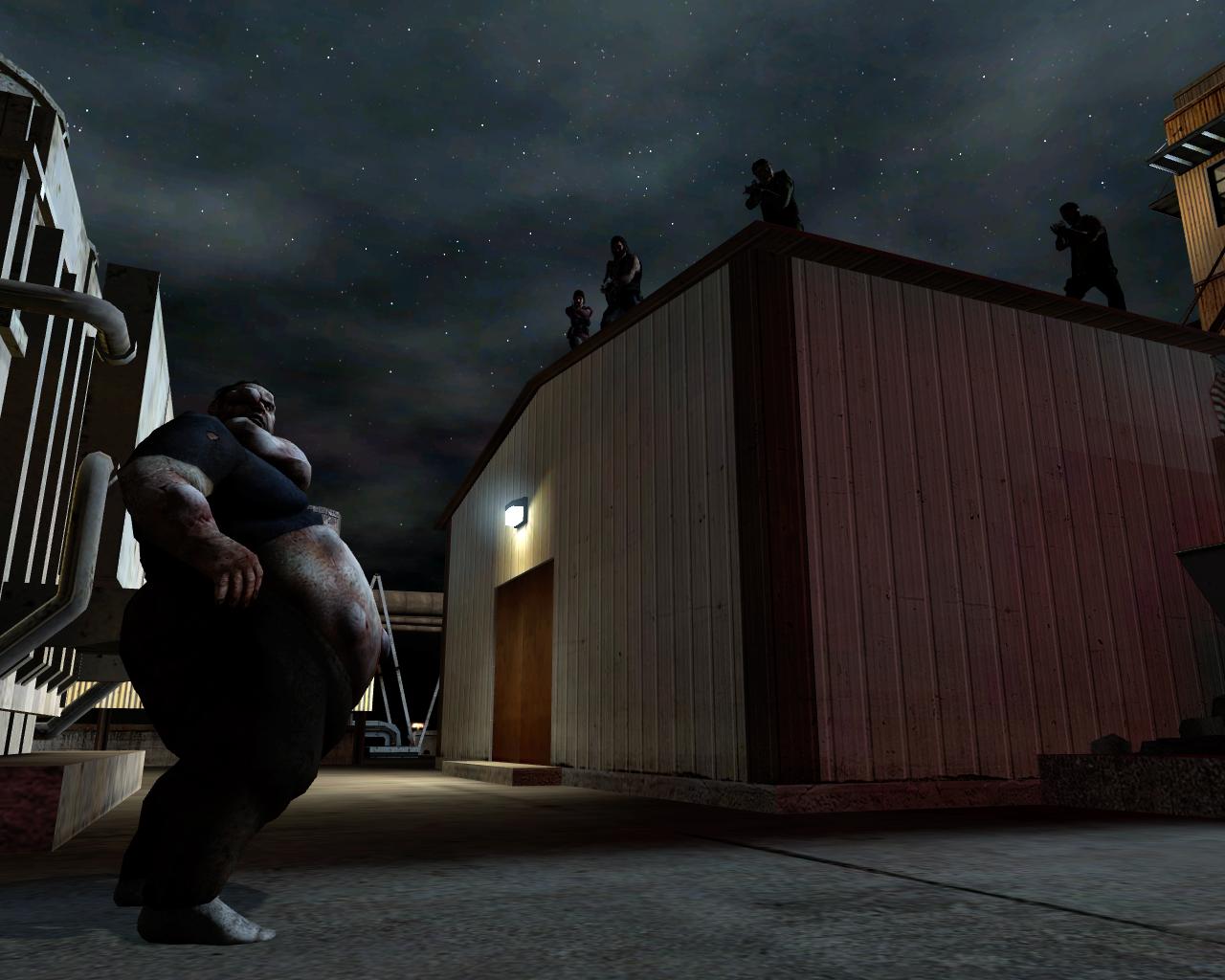
It helps that you don't entirely die when you run out of health - you just fall to the ground, still able to fire off your pistols, and lie there while 300 healthpoints tick down to nought. If someone gets there they can revive you, providing they're not interrupted. But if a Hunter, who can scale walls and pounce from great distance, straddles you, he needs to be blasted off urgently. Elsewhere the Tank (think zombie Ben Grimm) can pick up bits of the ground and throw them at you, and toss cars around, so he needs a lot of guns trained on him. And the Boomer is probably the most ingenious - a pus-filled waddling bomb of obesity, he explodes if you shoot him, scattering the group, but if he vomits on you it obscures your vision and the low-rank Infected target you, drawing the group in to protect you again, and increasing the risk of the inevitable Boom finding more victims.
Merits and demerits are handed out at each checkpoint and accumulated when you complete a scenario. Meritorious acts include healing a friend (fail to do so as a team and they spawn in a locked room later in the level and have to be let out), staying on your feet for a whole section, shielding someone from a back attack, gathering headshots - that sort of thing. But the demerits are the more interesting. "Forgetful" is if you take a chunk out of an enemy and they come back to haunt you or your team. The game also penalises for friendly fire, but Faliszek indicates that it understands the truth of things. "You might notice in the bottom-left of the screen it says 'Pressplayer attacked his own team-mate', but if there's people between you, or you clearly did it by accident, it doesn't penalise you." You won't be pulled up if someone runs across your firing line either; in fact, they'll be cited for recklessness.
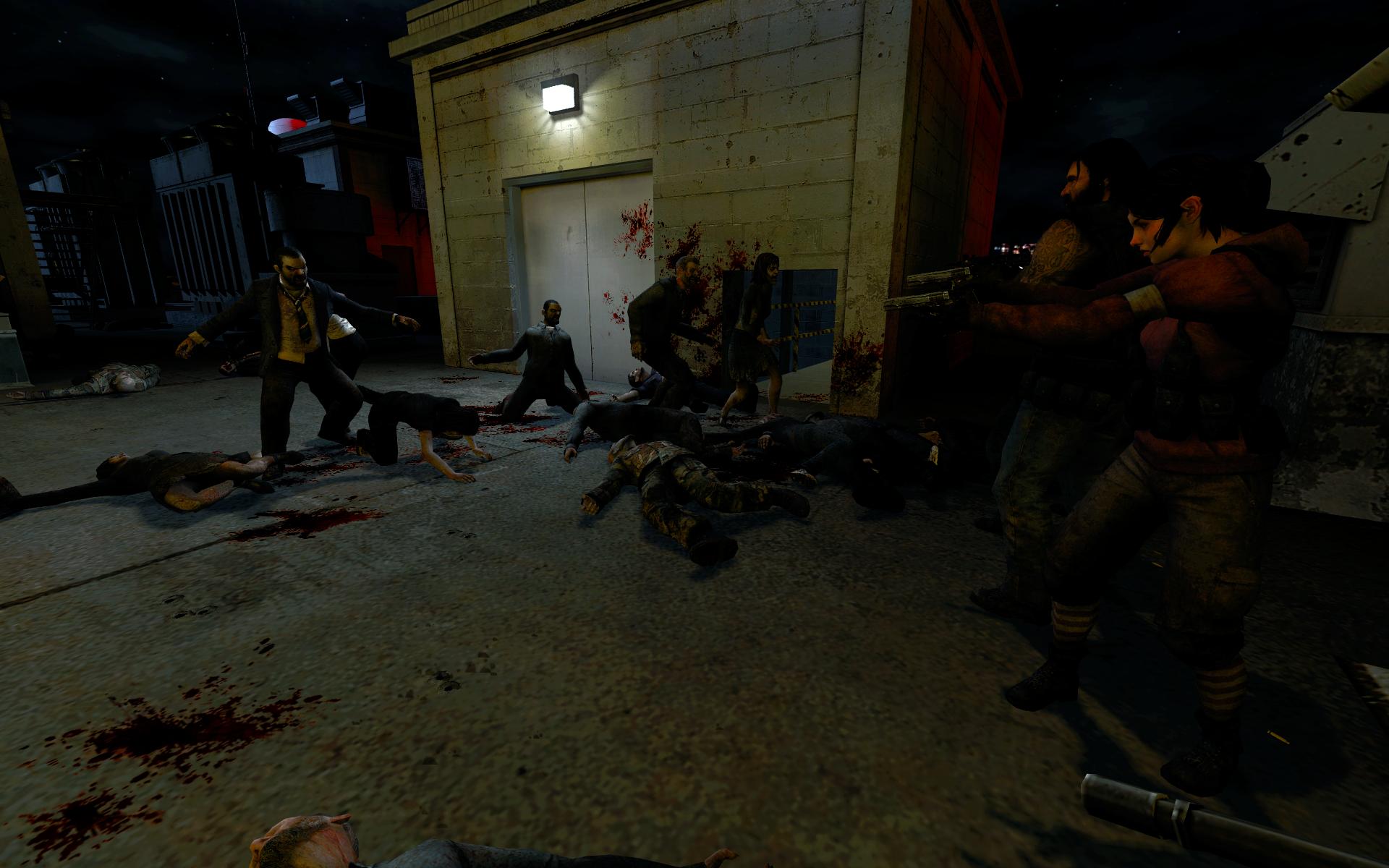
It shouldn't be surprising that Left 4 Dead exhibits intelligence. Primarily developed by Mike Booth's Turtle Rock, with whom Valve's collaborating, the game hinges on the idea of an "AI director". It's not so much about telling the Infected classes that force players together where to go (in many cases the Infected are controlled by opposing players, anyway), but about dictating the game's rhythm and pace; determining how many Infected are going to swarm over that rooftop, or erupt from that doorway, or whether you're due for a break. "One of the first demos Mike showed us had these bars that measured player stress, and that's the thing he's trying to control," says Johnson. "If you do the same thing over and over again, no matter how well you execute on that, players aren't switching gears enough and it gets boring, or too stressful, and the game feels cheap. 'Combat fatigue' is a term we use a lot when we playtest our single-player games. So Mike can watch stress levels and make sure players aren't having high-amplitude events again and again."
Unpredictability is a welcome natural byproduct. Normally in press game demonstrations there are cheesy stage-managed reveals. But Faliszek and Doug Lombardi, Valve's marketing director, who's playing next to me, are constantly surprised by what's going on. In one case I've been playing as a Hunter on the Infected side for several minutes, and I've clambered onto a rooftop that overlooks a petrol station the survivors have to pass through. They have no idea where I am. One of them, the female character, is bringing up the rear, and I'm stalking her. I measure my pounce, and then propel myself off the rooftop with the goal of pinning her and causing chaos. Except I never make it, because almost at the point of impact both her and I are blown sideways by the explosive force of the petrol tanks in the forecourt next to us, which have been set off by shrapnel in another firefight with the horde. It's comic, disorientating, and completely unexpected.
Playing as Infected is typically this way. It's part Alien vs. Predator, part Spy vs. Spy. You can usually see the survivors as red ghostly figures through the walls, helping you to stalk them, and the game also paints red arrows on the floor to show you their likely route, and highlights pipes you can climb and bits of destructible scenery. Your job is to cause as many hitpoints of damage as possible - that's your score. As the Smoker, you can lie in wait, and then use that prehensile tongue to actually hang someone from above. "It's terrifying as a player to have that happen," says Johnson. "There's nothing more fun in the game - I know Chet and I would say so anyway - than choking somebody to death as a Smoker." "And then choking the person that comes to help them," Faliszek points out. With up to four players on both sides, the AI director makes sure the survivors aren't too severely overwhelmed, managing your Infected spawns. Inevitably it's a bit street-smart about this, too, recognising that if you're a Boomer, for instance, and you die within two seconds of spawning, you probably deserve another go immediately.
There's tremendous potential to be sneaky and foster panic in the survivor ranks. A favourite tactic as a Hunter is to lay low as they approach the final section of the scenario, where the game gives them a breather. Wait for them to let their guard down, and then pounce. As a counterpoint though, cunning players like Valve's John Morello can hang back, go quiet and ambush predatory Infected. The hunted becoming the hunter. Staying off the Infected radar requires patience, as you need to slow to walking pace and switch off your flashlight to avoid showing up as a red man through the wall, but the pay-off for the industrious survivor is quite something. And of course this is a team-based first-person shooter, so you can see who you kill, and then yell something across the office.
Turning off the flashlight wasn't for me though, which is a clue to how much vision plays a role. All four scenarios are set at night, and even interior sections and the sunrise on a cornfield endgame don't lessen the need to keep yourself lit up. Fortunately the batteries in this light are a bit better than whatever Gordon's using in Episode One. It's still for nothing when a Smoker uses his ability to fog up a room, though, sewing panic. And while the flashlight can identify Hunters as they lurk, it also lights you up through the walls, and it certainly gets up the nose of the one Infected boss you can't play as, the Witch, who arrives on Normal difficulty and above. She's a bit like the Berserker from Gears of War's evil twin. Combating her is "not about being a super marksman," says Johnson; "it's about everyone agreeing what the plan is; if you're going to attack her or try to sneak by her, and hopefully everybody's sticking to it. It's one of those things where the price of failure's incredibly high."
The Witch is an enemy that demonstrates how Left 4 Dead's not about level-dominance in the way Counter-Strike was, but escape. Bolting to checkpoints, getting everyone inside and closing the door - probably using the right-click melee to barge Infected back from the narrowing gap. The checkpoint rooms are a welcome respite, providing ammo and sometimes health, and you can't rely on seclusion anywhere else: when the banging starts to ring out on a slim metal door I've sought refuge behind to reload, I notice it's starting to pepper with dents, and then a hole's ripped through. As I fire through it in alarm and then start jamming shells back into my auto-shotgun, the whole door gives way and the surge overwhelms me.
When I respawn, it's on the roof of Mercy hospital, where a helicopter is supposed to come and extract us. Before it does that though, there's the final fight. You're given time to prepare, scattering petrol canisters into key areas so that if things get hairy, you can loose a round into one and hopefully stem the flow of Infected. When you activate the radio signalling for help, the AI director cracks his knuckles behind the curtain and unleashes hell. Each scenario's endgame is slightly different. "They play out similarly but the terrain itself is such that they play out pretty differently," says Johnson. "The one where you're on a rooftop's tough because you can get yanked off by a Smoker, so instead of looking up you need to look down." He says the one set in the cornfields is probably the spookiest in terms of feel, as you arrive in the dawn-lit lanes of corn and quiet sweeps over the group.
The endgame is your last stand, after which the scenario ends, and it's brilliantly frantic, like the iconic scenes of a zombie film. But the Z-film genre's influence appears to be subtler at Valve than it has been in other survival-horrors like Resident Evil and Dead Rising. They don't rip off Bruce Campbell's one-liners (although characters do chime in, and some of it is pretty comic - especially the orgasmic healing sounds, which I hope they keep), but don't imagine it all had no influence. "The cornfield's a pretty good example. You use imagery in-game to evoke emotion in players one way or another, because it's a language that people who consume that kind of media understand," says Johnson. "We do it in Half-Life all the time to give people a feeling of oppression."
Oppressed is the right word for how you feel after a few minutes trying to survive, and the natural bond that always develops between survivors in Z-films is carefully assembled here. Into this, tactics flood naturally. It's not like Counter-Strike, where you're going to get shouted at for not grasping inobvious things like the need to run with the knife to maintain speed. Bottle-necking enemies, crouching if you're in front, keeping eyes outward, and cover-and-move all slip into your play, helped by some of the better elements of its cousin-game, like having sniper rounds go through thin wood, and a range of easy keyboard-comms accessed through Z, X and C. You can also vote for things, which is handy if you want to ban Doug Lombardi from using grenades - something that proves popular in Bellevue.
But, as we said last time, this isn't Counter-Strike, and it's not Half-Life either. It's something else. It's hard to pigeonhole. What it definitely is, is fun, whether it's the thrill of blowing a leg off an Infected and watching him hobble towards you for a couple of steps, the thrill of the hunt, or the realisation that experience is nothing: hop in an elevator and you might make it the whole way up the shaft without incident, only for a sodding Boomer to land on top of you the next time you board. It hits a lot of buttons, and game's composure is clearly far from accidental. Perhaps that's why they're allowing everyone to play with me in spite of looming deadlines: positively reinforcing good co-op development. Or perhaps, like me, they're just a bit in love with Left 4 Dead, and make time for it even when they shouldn't. If Valve can match the game to a system that makes it work well over the Internet, it could be very big.