Fallout 3 Review

Oblivious.

Version tested: Xbox 360

Fallout 3 is such an embarrassment of riches, it's hard to know where to begin. The news is definitely good though, because whichever way you stack it up it qualifies as a landmark game. Like BioShock and Oblivion, unpicking its merits is something of a Gordian knot. But that is, of course, precisely its charm.

The bedrock, as you would hope, is the game's immensely well-realised and beautiful openworld. Arty, varied and epic, it's crafted with attention to detail, housing secrets, lies, hopeless ambition and revenge. The Capital Wasteland has a palpable sense of place, where even the more obscure backwaters hide pleasing diversions, intriguing characters and curious sub-plots.

It doesn't seem to matter which angle you take with Fallout 3 though, because there's usually something pleasing to report. It makes the fiddly micromanagement of weapons, apparel and health a relative joy with a slick, intuitive interface. It rewards and encourages progress with a transparent and logical levelling system. It delights with countless improvements to the Oblivion engine, physics and animation. Even the script and voice acting are pretty decent, and there are reams of detailed text logs to discover. At one point, you even stumble across a playable beta version of a fully-fledged text adventure.

Question marks will always linger over how much it can live up to the expectations of diehards, and people will argue about how Bethesda's storytelling stands up to Black Isle's, but this is a new game, from a different developer in a different era, and the most important thing for now is that Fallout 3 manages to improve on almost everything Oblivion did well, as well as what it didn't do so well - and how it streamlines a lot of the questing without resorting to dumbing-down. For a fair chunk of you, that's pretty much all you need to know.
1

Is that a bollard in your pocket or are you just pleased to see me?

Undoubtedly one of the most appealing aspects of Fallout 3 is the fact that the post-apocalyptic premise feels fresh - assuming the harrowing aftermath of thermonuclear war can be described as such. The fact that games haven't milked this theme to death is puzzling: rooting the game in the realms of potential reality gives the world credibility, with dozens of real-life weapons (from pistols to assault rifles) and near-future equivalents (think laser and plasma), recognisable locations, and relatively normal characters populating the world. There's even a series of local radio stations, belting out dubious propaganda or the rantings of the ever-exuberant Three Dog.

That said, the basic setting for Fallout 3 isn't exactly the down-to-earth playground I've portrayed once you dive into the fiction. It imagines a parallel version of America that remained locked in the cultural norms of the '50s, complete with the naivety, unflinching optimism and penchant for pre-rock 'n' roll. In this version of 2077, technology progressed to the extent that robot slaves populated every home, everyone drove fusion-powered cars down bold art-deco streets, fearing communism, wearing beehive hairdos and bopping along to happy jazz. Strangely, though, computer technology remained resolutely stuck in the late 1970s green-screen era.

Then it all went to hell at the climax of a long-running war with Communist China over Alaska, and the world went nuclear. 180 years later, literally at your birth, you join the game in the depths of a shelter known as Vault 101. The opening hour plays out as a wonderfully engaging run through the first 19 years of your life, through baby steps and petty infighting with the other children. With the sudden, unexpected departure of your father, you decide to fight your way out of the sterility of the Vault and emerge blinking into the shattered wilderness of Wasteland for the first time.
2

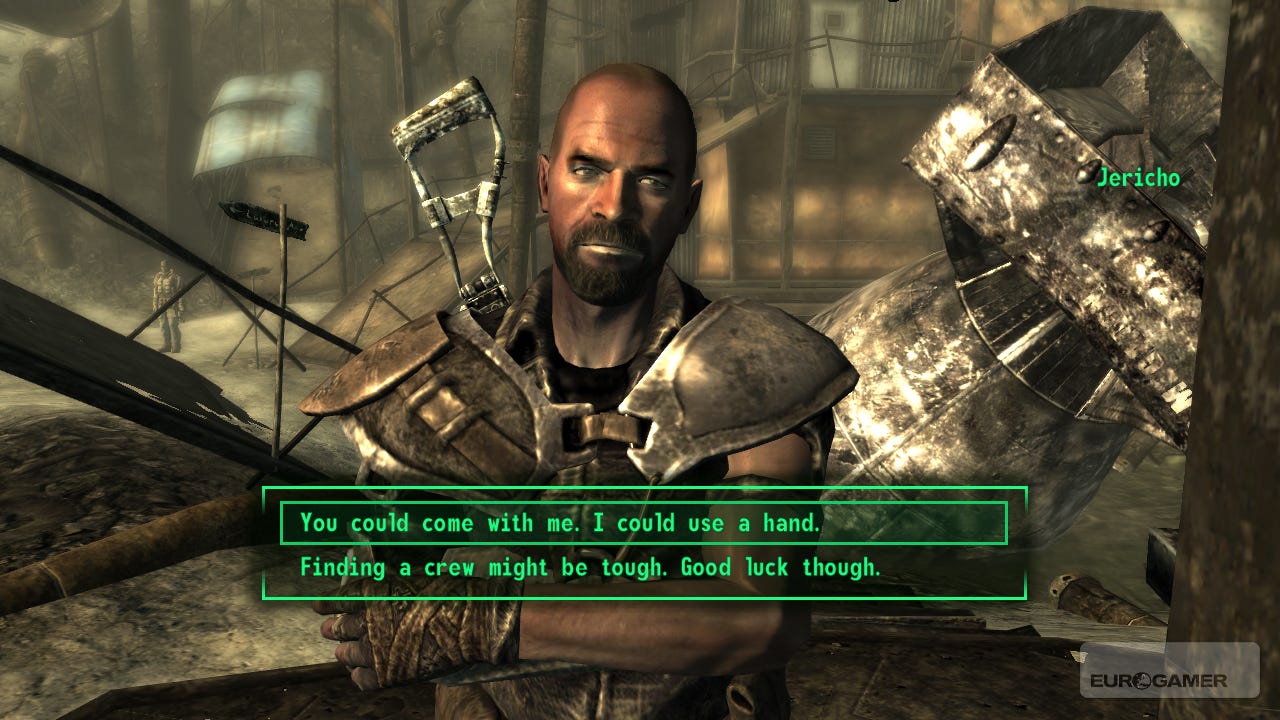
The dialogue system is simple and elegant, usually offering positive, neutral or negative responses.

Stark freedom awaits you, in much the same way it did after emerging from Picard's dungeon in Oblivion - only this time under much less welcoming circumstances. The landscape is almost the polar opposite of Oblivion's lush green pastures, with a sea of grey and brown shattered rocks and ruined buildings stretching off into the distance. You can trudge to the nearest settlement, Megaton, or wander off wherever takes your fancy. There's no specific path to follow, and never is. You can either let the curiosity of your father's disappearance guide you through the game, or just explore.

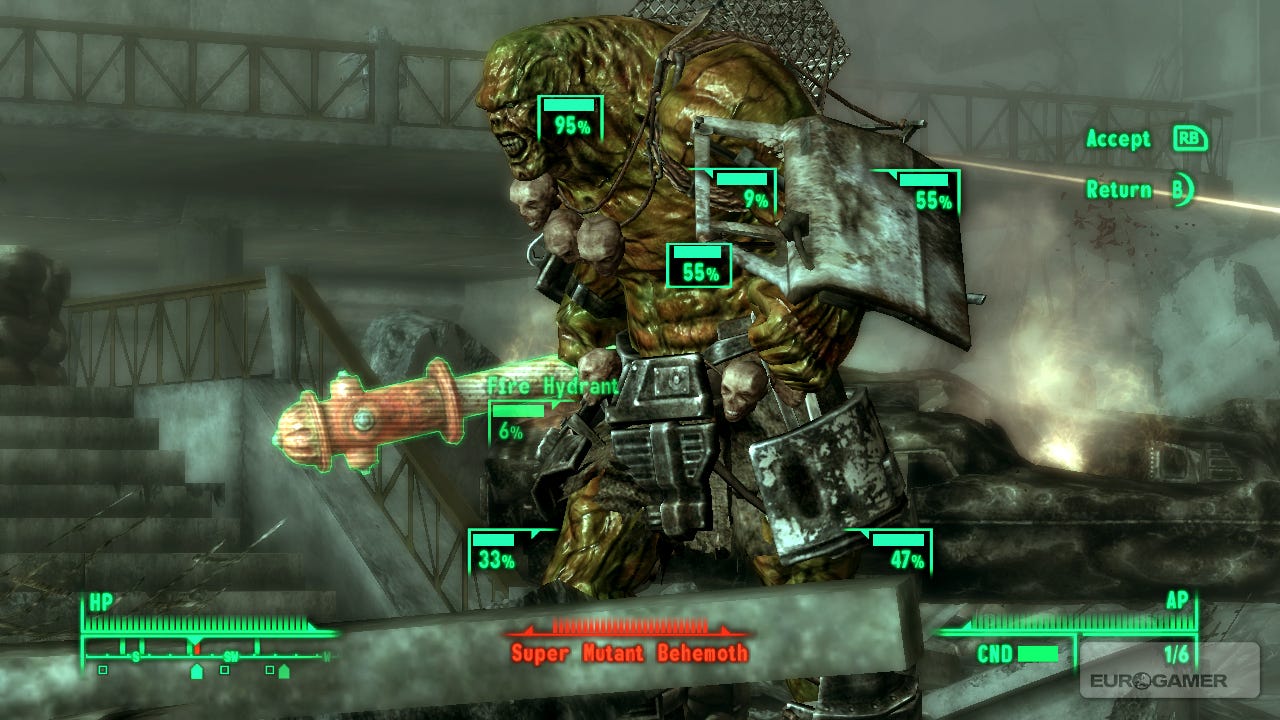
The controls follow the standard first/third-person template, although, like Oblivion, first-person is preferable. As you might expect, enemy threats are never far away, and you won't get very far without facing some sort of mutant bug or ghoul. This, it turns out, is a good thing, as it shows of the first truly impressive aspect of Fallout 3: the V.A.T.S. The Vault-Tec Assisted Targeting System.

On one level it's a cinematic way of framing the combat in what is already a glorious-looking game, but this hybrid of real-time and turn-based combat also forces players into a new approach. Effectively you pause the action and decide on specific areas to target, whether it's head, torso, arms, legs or weapons. To help decide, each area is marked with the percentage chance you have of landing a hit, determined by the distance and angle of attack. At the start of each 'round', you have a limited number of action points to commit, which generally equates to three or more hits before the slow-motion combat reverts to real-time. Then your action points slowly regenerate, leaving you vulnerable.

Because combat is so fast and deadly in real-time, you find yourself forced to rely on V.A.T.S. in a measured, strategic fashion. You'll dive out of cover, slam it on, try and cripple a specific body part and get the hell away before the enemy can strike back. And if you're cunning, you'll find time to recharge your action points and repeat the process without wasting too much ammo or getting busted up.

Some might find it irritating, initially, that the real-time combat is so fast and loose compared to the average FPS, but then that's the point. It's rarely if ever desirable to fight this way. This bias towards V.A.T.S. also helps Fallout 3 evade comparison with FPS titles it has very little else in common with, and this aligns it more closely with its RPG roots than, say, Mass Effect, which had a comparatively troubled time integrating action into gameplay. That Fallout 3's combat is distinct from everything out there is a massive achievement; that it's enjoyable merely adds to how much credit is due.

With an eye on progression, the chances are that your first port of call will be the ramshackle community of Megaton, home to two bars, a supply store, a grumpy doctor's surgery, a religious cult, and numerous battered homes for the strange and wonderful individuals who found sanctuary there. If you manage to resist the temptation to break into everyone's home and loot their belongings, it's possible to mine the town for leads and side-quests that may or may not prove useful to finding out the whereabouts of your father. Or, you could just work out how to blow the stupid place up. As a graphic illustration of choice, Megaton is an excellent distillation of the freedom afforded to you and the knowledge that nothing is ever that straightforward. What might seem like a good deed ends up screwing someone else, and the path you take ultimately shapes your destiny.

In those first few hours in Vault 101, and Megaton, and the surrounding locations, it's possible to sink hours into doing almost nothing. You might struggle to come to terms with the freedom, and end up, as I did, clinging to Megaton like a life raft. When you finally do start following up leads and exploring, the sheer scope comes as a shock. You'll come across a seemingly abandoned underground station and see what's inside, only to discover that it's part of a coherent network that spans the length and breadth of Wasteland. Far from a pointless dungeon, this subterranean world has a purpose, connecting discrete areas and providing access to quests you'd otherwise never encounter.

3

A cripped head and leg? Nothing a stimpack can't sort out.

You can also scavenge for loot in these areas, which facilitates levelling. And unlike Oblivion's derided system, which saw enemies level up with you, Bethesda has returned to the more familiar progression of awarding players XP for every kill and successful mission, allowing you to level up as you go. Gone is the ridiculous convention of having to sleep to level, replaced by a straightforward, transparent process that allows players to designate skill points where they see fit, along with a single 'Perk', which grants an extra layer of precise customisation. Do you want to be a smoothie who can talk your way out of things, or a master thief, or throw everything towards brute force?

Whatever your decision, the game's ability to reward you is one of its greatest feats. Far from making you feel you've missed out, the dazzling array of choices heightens the incentive to go back and play again. You'll come across missions with four or more ways of succeeding. Sometimes you'll want to go for the least risky option, especially if you're keen to maintain good karma, so bribery might work best. At other times, you might decide to hack computers, or repair a specific item. Or, of course, just kill everyone. Whatever you choose, it's generally always entertaining. It's a no-lose kind of decision.

It isn't, however, all that difficult, and there's no option to crank up the challenge, other than making things difficult by heading off to areas that are too dangerous. If you even vaguely follow the main storyline, there's rarely anything that feels beyond you. This worked for me - it's more than big enough without the game bashing me over the head every five minutes - but it'll be understandable if others hanker for more brutality.

4

Such scenes of breathtaking destruction soon become the norm, but the sheer craft never fails to impress.

And when you get all the way up to level 20, you simply become a bit too good for the game. With your abilities capped, you're generally such a badass that the tension is reduced as you explode every head you aim for. With no more levelling possible (at least until the DLC, perhaps), there's no longer the same sense of reward, and it turns into a bit of a victory march. This is a problem specific only to truly committed players, but in a series that attracts an unusually large proportion of hardcore gamers, the endgame is relevant.

Another thing that threatens to undermine Fallout 3 is the massive amount of repetition while scavenging and exploring. As entertaining as it undoubtedly is to check out every last empty office, factory or subway station, you do get into a cycle of checking every locker and desk, entwined with a succession of OCD battles against Super Mutants and Ghouls.

Then again, one of Fallout 3's strengths is that it doesn't seem to matter how long you trawl the Wasteland, or how many times you snap into V.A.T.S. It's always entertaining to duke it out, seeing how many different stylish ways it can cut together the uber-violence as entrails flap around. And even when you feel like you've seen everything the game has to offer, you find yourself greeted by entirely new creatures, characters and architecturally unique areas more than 60 hours into the game. The sheer scope and ambition shames most other blockbuster games.

In any case, I'm scraping the barrel for things to pick holes in. Fallout 3 has been by some margin the most enjoyable game I've played since BioShock - a game with which it shares a similar artistic vision and ambience. Despite so many worries, Fallout 3 almost effortlessly succeeds in its central aim of reviving a much-loved brand to appeal to the vast majority of players. It's a thrilling, all-consuming experience that will absorb you for weeks, whether you're attracted by the action, the adventure, or the role-playing, as you fall in love with the relentless excitement, incredible atmosphere, sense of place and sheer choice.

Bethesda has once again delivered a game of life-affirming brilliance that will be heralded as a classic, and talked about for years to come.

10 / 10

Read the Eurogamer.net scoring policy

Comments (486)

Comments for this article are now closed, but please feel free to continue chatting on the forum!

  • Loading...hold tight!