Eurogamer Editors' Games of the Decade • Page 6

Six of our Top Men (and a lady) pick a game they love and explain.

Who wants one present on their birthday when they can have loads? Not us, certainly, which is why in addition to Eurogamer's Lifetime Top Ten, we're also publishing this series of blogs from Eurogamer editors past and present, each of whom got to pick a game of the last 10 years that meant a lot to them and explain why.

  • John Bye (Editor, 1999-2002/3) - Unreal Tournament
  • Rob Fahey (Long-time contributor / founder of GamesIndustry.biz) - Deus Ex
  • Ellie Gibson (News Editor, 2005-2006 / Content Editor, 2007-2008 / Deputy Editor, 2008-present) - Fruit Mystery
  • Kristan Reed (Editor, 2002-2008) - Half-Life 2
  • Johnny Minkley (Eurogamer TV Editor, 2006-present) - Guitar Hero
  • Oli Welsh (Long-time contributor / MMO Editor, 2008-present) - World of Warcraft
  • Tom Bramwell (Editor, 2008-present) - ICO

John Bye (Launch Editor) - Unreal Tournament

When Eurogamer launched in 1999 I was a dyed-in-the-wool id kid.

As a teenager I discovered the joys of multiplayer gaming by fragging my friends in Doom deathmatch sessions over the school network. At university I joined the online gaming community, downloading literally hundreds of homebrew Doom maps from the legendary Walnut Creek file depot at ftp.cdrom.com, along with a level-editing tool that gave me my first real taste of game development.

As time went by I spent more and more time creating and reviewing Doom maps, and less time going to lectures. Eventually I dropped out of university entirely and founded my own online games company, The Coven, recruiting some of my favourite designers from the mod community to make expansion packs for the Quake games. I even spent a year running the world's biggest Quake fan site, PlanetQuake. And it was while covering a Quake II tournament for PlanetQuake that I first met the Loman brothers. A few months later they invited me to join their new company as Editor-in-Chief of Eurogamer.

1

John Bye (centre) launched Eurogamer in 1999, back when we capitalised the 'g' and everything. He is responsible for Tom spending 90 per cent of his early paycheques on Region 1 DVD recommendations.

So why am I writing about Unreal Tournament as one of my favourite games of the last decade?

10 years ago, nobody in their right mind would have bet on Unreal Tournament. Announced just a couple of months after Quake III Arena was first revealed to the world, it was written off by a lot of people as a cheap, bandwagon-jumping knock-off. One of Epic's own designers described Unreal Tournament to me as "a bad joke". It's not hard to see why.

id Software was a pioneer of online gaming, from the fast-paced modem-to-modem action of Doom through to the internet deathmatch perfection of QuakeWorld and the addictive grapple-happy teamplay of Quake II CTF.

By comparison, Epic's first foray into deathmatch was a disaster. Unreal was a fantastic single-player game for its day, but its multiplayer was a lag-ridden mess that was barely playable out of the box. Facing a chorus of complaints from fans, Epic had to release a steady stream of patches to finally bring the game's network code up to par with the Quake series.

And yet, against all the odds, Epic stole id's thunder.

My own first taste of Unreal Tournament came just a couple of days after Eurogamer's launch at ECTS 1999. Having failed to blag my way into SEGA's hot-ticket Dreamcast party, I instead found myself in a cellar bar in north London with Epic boss Mark Rein, programmer Brandon "Greenmarine" Reinhart and a host of outcasts... I mean, PC gaming journalists.

Things got off to a good start when the rest of the press decamped to another server mid-game, leaving me playing with a group of AI bots for a quarter of an hour until one of our hosts politely pointed out to me that I was the only human left in the game. While their limited range of taunts might not get them through a Turing test, the bots' deathmatch behaviour had been almost flawlessly believable.

A short stint storming the beaches in Assault mode and a quick dip in the steady shower of blood that is DM Morpheus with the instagib mutator enabled showed the game's versatility, but it was the epic CTF battles on Facing Worlds that proved the biggest draw of the night.

Perched precariously on a ledge high up on the side of a tower, watching the other players scurrying around ant-like on the rocky asteroid far below as space tumbled around us, it was hard not to be blown away. Not least because I had my trusty sniper rifle to hand, my headphones echoing with the words "headshot" and "killing spree", only drowned out by Greenmarine screaming "where's that sniping bitch Gestalt" from the other end of the bar as I turned his head into a fine red mist for the umpteenth time and shifted to another shadowy balcony.

2

In honour of an old standard: Facing Worlds, yesterday.

So it was perhaps no great surprise when, a few weeks later, Unreal Tournament scored Eurogamer's first ever perfect 10/10 score.

As a games journalist working on what was then a small independent website whose editorial department was essentially run out of my spare bedroom, I didn't have a lot of time to play games just for fun. It was a 24 hour, 7 day a week job. Most days I was playing games we had been sent for review or preview, typing up or editing the latest news reports and articles, or taking the train in and out of London for press events.

Unreal Tournament is one of the few games in the early days of Eurogamer that I kept going back to months after I'd finished reviewing it, a game that I played to unwind after a long day playing other games. Whether it was trying to break the one-minute barrier in the speed running mayhem of Assault mode, battling back and forth amongst the alleyways of Domination, or dropping shrapnel shells at people's feet with the wonderfully chunky flak cannon in a fast and furious free-for-all deathmatch, Unreal Tournament was an endless source of entertainment.

Rob Fahey (GamesIndustry.biz founder) - Deus Ex

You never forget your first 10.

In later years, I became more and more annoyed with the idea of 10/10 being "special". The phrase "perfect 10" makes me grind my teeth. 10 isn't perfection, it's just the best score we reviewers can award - the top of a scale that's frankly pretty arbitrary in the first place.

But Deus Ex was my first, for Eurogamer at least, and also one of the first the site had ever awarded - so it's probably unsurprising that there was debate, and argument, and soul-searching, and more debate, before I decided, in concert with the other writers and editors, to gently dab a number 10 on the end of the review. Still, from the moment it went live, with a sense of misplaced self-importance that my later self would find hilarious, I wondered if I'd made a terrible mistake.

With the benefit of almost a decade of hindsight, it turns out that Deus Ex was a bloody good place to start awarding 10s.

3

He's behind you!

It's not, as such, that Deus Ex was a stunningly original game. On several occasions over the years, Eurogamer has stood accused of rewarding originality over quality. It's not a bad thing to be accused of and there's probably even some truth to it, but it's an urge I've always resisted. Sometimes, when the planets align, the best games are made up of old ideas simply executed better than ever before.

So yes, Deus Ex was a child of System Shock, and had its father's eyes and plenty more from that lineage besides. Yes, it tipped its cap to the likes of Metal Gear Solid, rifled through the wardrobe of The Matrix and held an illicit party in William Gibson's back yard. You can't point to a single element of Deus Ex and say, oh, that's new - but taken as a whole, this was a rare beast, a game whose familiar component parts came together perfectly, seamlessly, creating something far greater than their sum.

Countless words have been written about how Deus Ex worked - about the freedom and customisation granted by the augmentation system, the remarkably open level design which rewarded exploration and experimentation, the storyline which wove cyberpunk, conspiracy and urban mythology into a tale which would do Hollywood proud. A decade down the line, I don't have anything fresh to add to that analysis.

But what I can remember most clearly of all - what comes flooding back thanks to the handful of small change I paid for a new copy of the game last week - is how Deus Ex made me feel.

I didn't express it at the time, because with the foolishness of most young games writers, I thought that the technicalities and details of the game's systems were more important - but looking back, I didn't fight to give Deus Ex a 10 because it had an interesting upgrade and character progression system. I wanted to award this game the highest score I could because of something much more nebulous - because, fundamentally, it made me feel like I was dangerous.

4

Rob "Silent Hunter" Fahey currently freelances for Eurogamer and places like The Times and his old haunt, GamesIndustry.biz.

Dropping down behind an enemy from a rooftop and killing them without a sound, stalking foes silently, killing swiftly and disappearing again into the shadows. Turning my enemies' own security systems against them, destroying them before they even saw me. Deus Ex turned the frantic videogame feeling of being pursued or attacked on its head. Instead I was the hunter, emerging from the shadows to take my prey. It was empowering, intoxicating.

That's what still stands out about Deus Ex today. It still empowers you, placing you at the controls of a character who instills terror in his foes - rather than asking you to be the lone gunman beset from all sides.

The wonderful level design, the beautifully balanced augmentations and upgrades - these are means to an end, not an end in themselves. 10 years later, I can see that it's not those individual systems that made Deus Ex great, but the moments when they worked together, cogs in a perfectly oiled machine, and the feelings they created for players in those moments.

For me, JC Denton eternally stands on the edge of a rooftop in Hell's Kitchen, watching his oblivious target, ready to pounce. 10 years later, that mental image still sends shivers down my spine - and I know that I should never have worried about awarding that score.

Ellie Gibson (Deputy Editor) - Fruit Mystery

"You will Enjoy the game."

There are three questions female games journalists get asked on a regular basis, as the other three female games journalists in the world know. The first one is, "Do you just sit around playing games all day?" (To be fair, I'm sure male games journalists get asked this too.) There is no right answer to this. If you tell the truth - "No, I also do some typing" - people tend to look a bit confused, or disappointed, and never know what to say next.

You can try throwing in a bit of self-deprecation: "Yes, sometimes. But sometimes the games are so rubbish that playing them is an utter chore, and on those days I'd much rather do your job than sit through another two hours of Wacky Family Sporty Party Wii or Generic Shooting Man Game 9." (NB: this doesn't usually impress nurses, teachers or abattoir cleaners.)

The second question is, "Hi, have you got any assets discs?" This is asked at press events by male games journalists who assume you are a PR woman. You can forgive them for this as the vast majority of women at press events are PR women. Besides, it's a compliment to be mistaken for a sophisticated, professional PR lady rather than recognised as a shambolic mess who was up till 4am playing Pokemon Puzzle League and couldn't find any tights without holes in this morning.

5

Ellie reviewing a Wii game, 2009.

The third question is, "So... Do you actually like games?" This is the most difficult one to answer. And not just because your instinctive response is to go, "Not as much as lipstick or shopping or shoes obviously, but it was this or stripping." It's hard to answer because, for me anyway, the honest reply is, "No. The majority of them are mediocre, while almost all the other ones are rubbish. They're clichéd and derivative and predictable. If I see one more muscly shaven-headed man hiding behind a crate while throwing a grenade at a space monster and stabbing a Nazi in the face, I'm going into stripping."

But the key word there is "almost". Because every so often, even after all these years, I come across a game I love. A game that grabs my attention and refuses to let go. A game I just can't stop playing, or thinking about when I'm forced to stop playing and do tedious things like eat or maintain personal relationships. A game that, unlike so many of the other ones out there, is brilliant.

I wish I could subvert gender stereotypes here and say that those games include things like Gears of War, Call of Duty and Pro Evolution Soccer. But I couldn't give a toss about any of them. I am a girl and I like platformers and puzzle games. Yes, that's right - I'd rather play Ratchet & Clank than Resident Evil. I am not ashamed.

Other games I have loved in the last ten years include Diner Dash, Jak & Daxter, Bejeweled, Zuma and Pac-Man Championship Edition. I enjoyed not only Cake Mania but Cake Mania 2. I spent so much time playing Farm Frenzy over the bank holiday weekend that I rowed about it with someone I am supposed to maintain a close personal relationship with. Yes, I know many of those games are about as clichéd, derivative and predictable as you can get, but I love them anyway.

I also adore the Tomb Raider series, probably because it's the closest I'll ever get to living out my fantasy of having amazing adventures in exotic locations while performing spectacular acrobatics, blowing up dinosaurs with shotguns and having huge knockers. And I love the Burnout games, for reasons I don't understand myself (in real life I don't even have a driving licence, though I recently started having lessons. I was disappointed to learn that Traffic Checking is illegal).

6

Fruit Mystery. I'm not even going to dignify this by allowing it to load properly.

So those are the games I have loved, but the game I love most? Fruit Mystery. No one can tell you what Fruit Mystery is, you must play it for yourself. And to understand its true genius, you must follow the two golden rules: put the sound on, and play it to the end. Ready? Go on then.

Fruit Mystery is all the things I love about games. It is brash and loud and clumsy and silly and pointless. The music makes me feel happy, even though it is terrible. The visuals cheer me up, even though they hurt my eyes. The gameplay is instantly accessible and suitable for all ages. And yet there is a dark, menacing undertone to it all which finally comes into its own for the shocking denouement. But most of all, Fruit Mystery is my favourite game because it's the funniest game I've ever played.

I've recommended Fruit Mystery to other people more than any other game. I've spent more time playing it than Gears of War, Call of Duty and Pro Evo put together, despite the fact it's 38 seconds long. Yes, it's completely stupid, but that's why I like it. Most videogames are stupid - at least Fruit Mystery is honest about it.

So to conclude, here are my three honest answers to those three questions:

1. No, I also do some typing.

2. No, **** off.

3. Yes, I do like games. Not all of them. I feel no more emotions towards most of them than I do towards, say, coat-hangers. I find many of them about as interesting. But I love some of them. What's great about games, and this is true more today than it was 10 years ago, is that there's something for everyone. I can have my Cake Mania and eat it, and you can have your Gears of Medals of Brothers of War in Space, and we can both be happy. Let's just try not to judge each other too much.

Kristan Reed (Editor, 2002-2008) - Half-Life 2

Dates aren't usually something I particularly remember when it comes to videogames but when it comes to Half-Life 2, two of them are always lodged in my mind. The first is September 30th 2003 - the date that Valve's Gabe Newell promised the game would be out the first time around. I don't think I've ever been as excited about an impending release, before or since.

Even though the game had been in development for nearly five years at that point, it seemed somehow destined to never make that date. Sure enough, just weeks after the announcement, a German hacker called Axel Gembe decided to leak the game's source code and threw the project into crisis.

At the time, it was hard to fathom how a game apparently so close to completion could slip by more than a few months. But this was Valve, a studio famed for taking its sweet time over everything. We probably shouldn't have been too surprised to be kept waiting until the back-end of the following year - 16th November 2004, to be precise - before the game was finally released.

As wee little Eurogamer, we had to wait to play the game like everyone else in the world. Back then the site was still very much in the process of establishing itself and the dominant print mags got all the spoils - the early preview, interview and review exclusives - while we worked from our homes, two people writing an entire website.

In fact, in terms of editorial, Eurogamer was basically still myself and Tom Bramwell at the time Half-Life 2 came out. And he'd recently moved in with me. A two-bed flat in London's NW2, churning out as many words on videogames per week as most entire magazines managed in several months.

Typically around this time, we'd keep ridiculous hours in order to make sure everything got done. Tom would pound out the news quicker than I could speak, and I'd generally spend all the hours when I wasn't sleeping, eating or watching Norwich City lose playing games. At 5.30am on the day of Half-Life 2's release I was sat in front of a 50-inch plasma hooked up to my newly re-specced PC, hammering F5, and following the Eurogamer forum thread.

Kristan

Kristan Reed, long-serving Eurogamer Editor. Do not gauge this man's taste and judgement from this photo.

We'd all pre-loaded the files from Steam in the preceding weeks like good little boys and girls, but when it got to 8am GMT, or midnight in Seattle, it seemed to be something of a lottery as to where in the authentication queue you were. Those 19 minutes before the validation process completed were probably the longest I'd ever experienced in more than two decades of playing. Even then, it felt like something would probably fall over at the last minute.

As the first big name game to be made available for download on the day of release, this was something genuinely new and exciting. Being officially From History, when games were communicated to computers via the medium of sound, the idea that the game maker itself was capable of delivering their game on launch day straight to the computer in my house blew my tiny little mind.

Better still, it actually worked. While the internet spoke of all manner of glitches and problems with Steam, I got on straight away and had a seamless experience as I basked in 18 hours of entertainment I will never forget.

The only problem with Half-Life 2, for me, was the weight of expectation. Most of us played the 1998 original in no great hurry. The hype was comparatively minimal and I played it with a rare freedom, blissfully unaware of just how seminal an experience it was going to be. Back then I was only taking my first tentative steps into games journalism, doing piecemeal freelance for PC Zone, and not really looking at games with the critical eye that can spoil some of the magic.

The majority of people playing Half-Life 2 were willing it to be amazing or outright expecting to be blown away. This felt like it could and should be what next-generation gaming was about: new experiences, dazzling technology, compelling, crafted narrative, engrossing atmosphere, intelligent AI, forward-looking design, the works.

Few developers seemed to have the verve to pull off something as intelligently designed as this game, so when it finally arrived it was always going to struggle to meet the completely ludicrous expectations people had. For some, the chief complaint was that This Was Not The Game I Had In My Head, which is obviously never going to happen.

What we got instead was an extremely accomplished, beautifully polished shooter with one memorable set-piece after another. I've always admired how Valve crafts experiences that don't dwell on any particular trick for too long. It gives you a new problem, a contrasting environment, some new toys and perhaps some entirely different enemies and then lets you get on with it.

While the likes of Bungie believed firmly in the 30 seconds of fun over and over ethos for an entire trilogy, Valve preferred to shake things up repeatedly. This deliberate attempt to keep things fresh throughout was risky, for the simple reason that not only have you got to maintain a consistent quality threshold, but somehow keep the audience entertained.

The things that stick in my mind about Half-Life 2 are the things it did first and the things no one has bothered doing since. I loved the idea that you would often face a seemingly impossible situation, only to end up slipping out of it by getting one-time enemies to fight on your side. That glorious moment when the Antlions... Well, let's not spoil it just in case, but it's one of the smuggest realisations ever.

hl2

Alyx through the looking glass.

The best fun I had with the game was when I played it in my patented moron mode, trying to confound it with stupidity. One such moment of rampant idiocy was when I was gamely trying to outrun the attack chopper on foot during Route Kanal for a good 45 minutes, diving into concrete pipes, quicksaving like crazy and hotfooting it around in the dogged belief that I could make it with a bit of luck. Of course, I was hilariously wrong, as I often am when it comes to videogame decision making.

If there's one black mark against Half-Life 2, it's that the magic came from experiencing it the first time, at the time. Once you've drawn back that curtain repeat play isn't quite so kind, and sections which you pored over with palpitated zeal can be ripped through in a quarter of the time. You start to notice where the pacing was off, and where sections dragged, and wish there was more attachment to the NPCs fighting periodically by your side.

Now that The Orange Box has long been out, I feel compelled to return once again to give the Combine what for, and listen again to those incredible developer commentaries that shed so much light and shade on how this wonderful videogame ended up the way it did. If you have yet to experience it, or maybe haven't played it since it came out nearly five years ago, join me in some long overdue nostalgia for one of the decade's finest achievements... Then let's start hammering Valve again for news on Episode 3.

Johnny Minkley (Eurogamer TV Editor) - Guitar Hero

Bernard Butler was mine. The floppy-haired, hip-swinging, riff-slinging Suede guitarist conjured sounds unlike anything my ignorant teenage ears had ever heard. I can pinpoint the exact moment I realised I wanted - needed to play electric guitar. I'd borrowed a cassette of the first Suede album from my first proper girlfriend, largely just to humour her.

When I finally got around to pressing play, the music picked up during the outro solo to the opening track, So Young. I was mesmerised, inspired, rewired. And I played the song - plus its angry neighbour, Animal Nitrate - over and over and over. My dad's Les Paul was swiftly taken hostage and I've never looked back. (And he never got his guitar back. Sorry, dad.)

The genius of Guitar Hero is in its instinctive understanding of the powerful bond between man and axe, and the primal need not just to make music, but to make it while grunting, jutting and thrusting as ridiculously as possible, ideally in public.

In 15 years of obsessive, devoted, glorious guitar playing I've managed to 'live the dream' of live performance in a handful of unremarkable bands, often watched by literally tens of people (and, on one memorable occasion after a power cut, by a barman upturning chairs, while a cleaner mopped the floor).

On 14 June this year, on the main stage of the Isle Of Wight Festival, I swaggered on after a set from the Pigeon Detectives, to play guitar in front of tens of thousands of people. When I say guitar, I mean, of course, Guitar Hero. My "band" played Eye of the Tiger. People sang and cheered. No-one threw bottles of piss. And then I walked to the front of the stage and took a photo.

As appallingly naff as it may be to caper around on stage clutching a child's toy, filling the void between genuine acts, the sweeping rush of adrenaline, the intoxicating fizz of excitement is all too real. It's the experience everyone who picks up an electric guitar craves: to perform in front of thousands. One which, even for those of us who've spent half a lifetime in bands, will never otherwise know. Dignified? Not remotely. Fun? Immensely. And that's the essence of Guitar Hero.

realband

Eurogamer TV Editor Johnny Minkley with his actual band. Probably playing to the barman and the cleaner.

The experience has, of course, evolved via Rock Band and World Tour into the classic four-piece structure. But for the discerning fret-wanker - and the association between playing the electric guitar and masturbation is hardly coincidental - drums, bass and an irritating, show-stealing ponce on vocals are just a means to an end. To the axe-wielder, one man and his guitar remains the purest expression of self-indulgent twattery: an epiphany of onanism.

And that's exactly what made the original Guitar Hero so brilliant and revolutionary: it was the short cut to the kind of extreme cock-rockery and absurd posturing that otherwise required years of dedication and terrible haircuts to replicate (I discount air guitar out of hand as a form of mental illness).

The success of Guitar Hero is usually, and understandably, attributed to its accessibility - anyone can pick up and play along to classic songs in seconds. But that's only half the story. At the other end of the, er, scale, it appealed to a specific type of knuckle-scraping male, for whom the same rings true with the real thing: the faster the finger-work, the bigger the dick. Willy-waving with a whammy bar. Do you think Harmonix included a tilt sensor by accident?

And, therefore, critical to Guitar Hero's early growth was the hardcore, elitist appeal of the most ferociously unapproachable Expert tracks on the setlist. Bark At The Moon was the original executioner; and this trend reached its brutal apotheosis in Guitar Hero III's Through The Fire And Flames: the lick that launched a thousand flicks on YouTube. Above all, the game excelled whatever the player's aptitude.

Looking back at the track listing for the original Guitar Hero, the tracks that stand out are not necessarily those that were my favourites songs, but those that produced the most memorable gaming moments. Who would have guessed Boston's preposterous More Than A Feeling, with its cabaret arpeggios, chugging powerchords and twinkling solo that demanded the player drop to their knees, groin forward, head back in a trance of self-satisfaction (surely this wasn't just me?), would prove the game's highlight?

low

Preparing to go on stage at the Isle of Wight festival with Guitar Hero 'band'. Just a few people there .

And that's another important legacy of the original Hero: introducing bands to new audiences in a uniquely engaging way that has effectively revitalised cobwebbed careers and motivated gamers to explore unfamiliar genres (admittedly mainly of the hard rock variety, but still).

The Gallagher brothers' latest domestic got me thinking about Guitar Hero on this point. If Bernard Butler was my guitar hero, Oasis were the band that defined my youth and - like a million other bedroom Britpoppers - made me want to write songs and, yes, become a rock'n'roll star.

Yet despite vast success on home soil, Oasis famously never truly cracked America; the demands of touring the US, and the basic levels of professionalism required proving too much for the Mancunian Chuckle Brothers, who also split mid-tour in 1996. I am utterly convinced that had games like Guitar Hero been around in the mid-nineties and enjoyed similar popularity, Oasis would have cracked the US without even sticking a hush puppy on a plane. Note, also, that breaking point this time was reached because Liam apparently smashed up Noel's guitar. The Unforgivable.

There will always be the joyless jerks who sneer at those of us enjoying Guitar Hero and Rock Band for playing with toys instead of manning up and trying the real thing. Which is, of course, to miss the point entirely. Those who already wanted to play the guitar already do. But I'd wager a big number of those who didn't may well end up making the switch. And, frankly, who gives it toss if it's this much fun?

Guitar Hero will never teach you how to play the guitar. But whether you're thrashing plastic on your own, or in full view of 40,000 eyeballs, the feeling in that moment of escapist bliss is every bit as electric. And if that's not the whole bloody point, then I'm Bernard Butler.

Oli Welsh (MMO Editor) - World of Warcraft

I just hit level 60!

Not for the first time, of course. But with the first character I made in World of Warcraft. A troll warrior, a ramshackle, cack-handed character in bad gear who was always more interested in tinkering with his engineer's toys than leading from the front. He has a pet mechanical squirrel that he made himself, and two lines from Althea & Donna's 'Uptown Top Ranking' bound to a one-click macro. He's not a very good warrior. But I love him.

He was abandoned a few months after WOW launched in Europe, somewhere in the 40s, as my original guild fell apart and I finally decided I'd had enough of a character class that I'd only picked because I'd been asked to. I started again, another troll (I just love the Jamaican accent, the nonchalant slouch of the animation), a hunter this time, a solo survivalist chosen with hard-won pragmatism for the lean times when the friends aren't there to play with - but when the call of this incredible playground, the greatest virtual world ever made, draws me back regardless.

Oli

Eurogamer's Oli Welsh, during a break between punching rats at last year's E3.

The hunter's made it all the way to the current level cap of 80, and has enjoyed a purple patch since second expansion Wrath of the Lich King came out, revelling in the richness of the spectacle and adventure and egalitarian reward as Blizzard's craft has reached its summit. The option to raid in teams of 10 meant I saw and bested some of Azeroth's most notorious villains for the first time, and fully appreciated the intricate genius of boss fights at the game's sharp end - especially in Naxxramas, the multiplayer dungeon to end them all. I also settled into the vanishing-point depth of the endgame, tweaking and balancing and optimising, compelled despite the admittedly diminishing returns. This is the WOW you hear talked about the most, the lingua franca among the hit-capped, rep-grinding, loot-lusting louts of the game's unwieldy, unruly audience.

But it's not the only way to play.

By nature, I'm a wanderer. An explorer. Partly in purely geographic terms: the richness, diversity, detail, and potent atmosphere of WOW's locations was always the strongest lure for me. As someone who five years earlier had been spellbound stepping out onto Hyrule Field for the first time in The Legend of Zelda: Ocarina of Time, WOW offered the same sensation again and again, month in, month out, on a scale I hadn't previously dared hope for. My hunter's spending his current sabbatical going for the World Explorer achievement, and it's astonishing that after years, after hundreds of hours of play, there are still so many places in this world that he's not been.

Then there's my exploration of the riotous, kitchen-sink fantasy sociology of the place. I only ever paid so much attention to lore, and some of it still strikes me as overcooked, clichéd or trashy. But against the big satirical picture of the squabbling, arrogant races of Azeroth I look for - and constantly find - lovely little gems of quests, tales that seem spun just for me, for the moment that I play them. Like the time, levelling Horde and Alliance characters in Hillsbrad Foothills on subsequent days, I found myself playing both sides of one story. Something WOW doesn't often get credited with is soul, but it's got buckets of it.

I've explored the classes too, as a serial starter (if not finisher) of "alts". I've levelled all of them a little way, half of them halfway, and here my appreciation of some of the best RPG design (MMO or otherwise) yet seen has only deepened. Each class, each specialised build of a class, almost every skill is so crisply defined, so individual, and all the permutations and combinations work so well. The combat seemed basic at first, but over time a wealth of optional breadth as well as depth opened up, of pleasingly different ways to do the same endlessly satisfying thing, and I was swallowed whole.

So, inevitably, I had to wonder whether I was right to hate being a warrior four years ago. I decided to bring the old codger out of retirement. My travels in WOW had brought me back to where I'd started - or rather, to where I'd stopped.

It was painful at first. He resisted my efforts to master him, keeled over humiliatingly time and again at the hands of a coven of sorcerers in a smelly wood. It clicked in the end, but there was another kind of pain that lingered and lingers still as I play him: nostalgia.
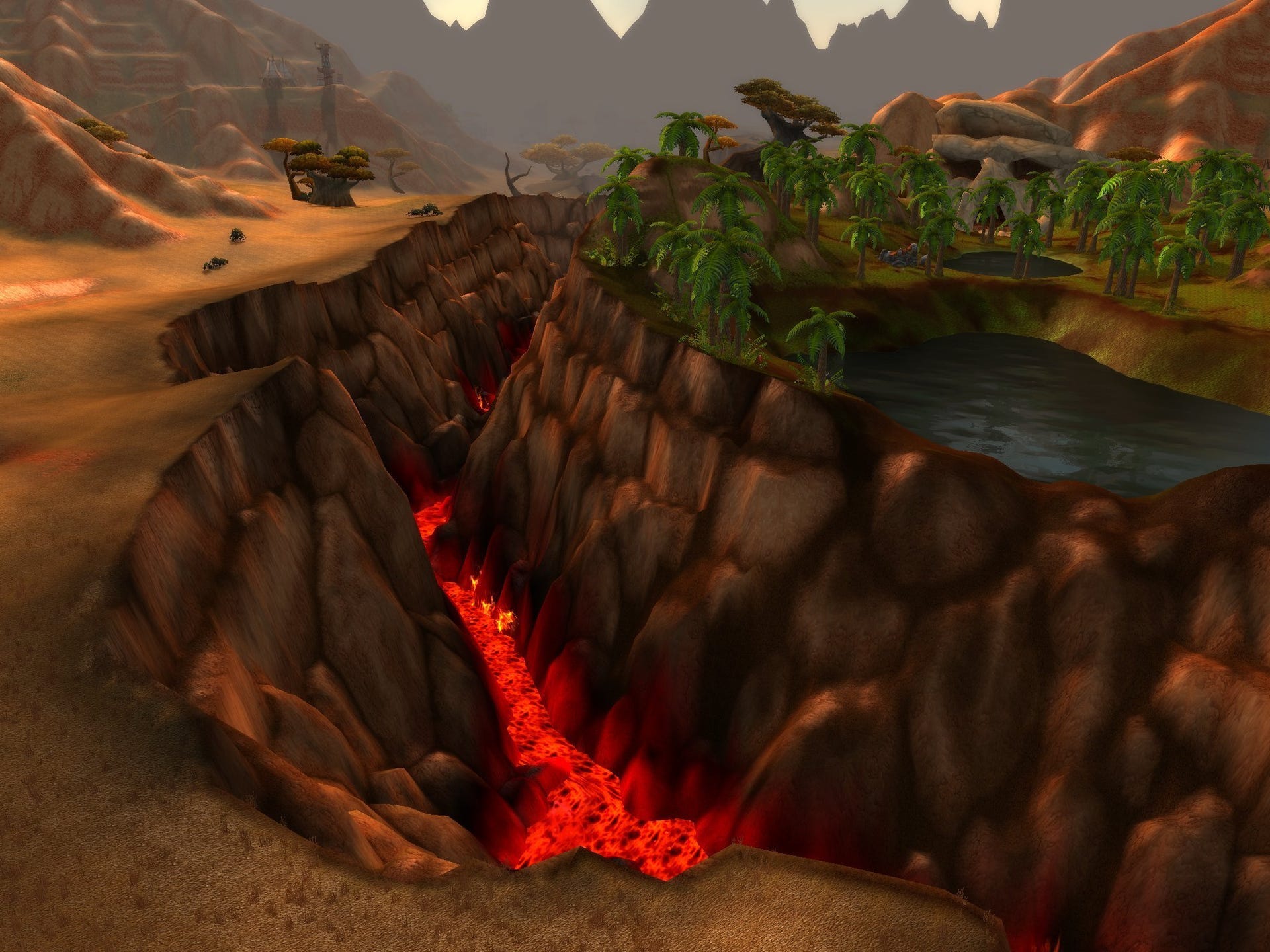
12

Been there, punched rat.

The warrior has history. In his way, he has more history than all my other characters put together, because he was there at the beginning, when it was all so new, so pregnant with the unknown. When you made up for the occasional gaps in the fun (it was slow back then, oh so slow, and rough going in places) by making your own. I remember sending everyone in my guild a gift-wrapped mechanical squirrel; base-jumping off cliffs in Thousand Needles using a parachute cloak; having a wordless conversation of gestures across the linguistic and factional divide with a gnome, while we both waited for a boat. I remember being teleported into a dungeon to lead a stranded bunch of guildmates out and save the day, and feeling more like a hero at that moment than in any game I've played before or since. I remember the guild chat, fizzing with sleepless excitement, obsession, wonder and thrilled disbelief that one game could contain so much to discover - that someone had made all this for us.

It will never be that way again. Not even when the next expansion Cataclysm rewrites the whole thing from scratch, however much that might stoke the old fires. We know it all too well now, and even when there's new content, some margin of magic is lost forever. That makes me wistful and sad, because those unforgettable months were the best time I've had playing games in the last 10 years.

But they're still not what make WOW my favourite game of those years, and they're certainly not why I'm still playing it with such pleasure. In the end, what we lost in mystery, we gained in quality. It really is a much better game now, a lavish spread, all the more luxurious for being so comfortingly familiar. And what's more, no matter how long you've played for, you can't ever know it all. There will always be another undiscovered corner. That's nothing short of a miracle.

The old warrior's got 20 levels to go, and there's exploring to be done.

Tom Bramwell (Editor, 2008-present day) - ICO

When we first decided to do these blogs - around a thousand words each on one of our favourite games released during Eurogamer's 10 years of life, in case you haven't caught the drift - I told everyone that I didn't think we should write retrospectives. We do those already on Sundays, I like them where they are, and I don't want to rule out any of our anniversary faves for Retro treatment in the future.

Instead, I suggested we talk about why each game was special for us as individuals, then and now, hoping that in the process we would each reflect and delve into the spirit of the website in earlier days, not only saluting the games but exploring ourselves a little in the process. The practical upshot of this, I realise now, is that we'll probably find out Unreal Tournament was actually rubbish and Deus Ex was a poor man's Fruit Mystery, but hey, making catastrophic errors and then owning them is a bit Eurogamery anyway! On with the show.

Or, sort of not. Unfortunately, it turns out that I've already been down this road for my chosen game, ICO. Three years ago I re-reviewed it for its re-release alongside Shadow of the Colossus, screaming childishly, ludicrously, self-indulgently about its qualities, imploring people to buy it. Even now, what I wrote there captures a lot of what meant so much to me at the time.

Tom

Funny story: Tom's mother accidentally threw out his original postcard edition of ICO, as signed by Fumito Ueda. Her card is marked.

Meant so much to me, though. I can't relate to my younger self. Appointing the velvet-lined white coat of an existential alchemist to my shoulders for a second, I suspect it's because I'm older, colder, and - judging by my recent tendency to write as though I'm pitching for a tweed jacket - more or less incapable of escapism, merely of basking in other people's design skills. With Portal, for example, I enjoyed playing it with the developer commentary and discovering how Valve moves your eyes around a room or teaches you to solve puzzles more than I enjoyed the game itself. This was a triumph? This was beyond the veil.

Of course, there are things I like about ICO as much now as I did then. Top of the list is the soundtrack, which is so tender, so personal, and so irritatingly catchy that I still whistle the save-game music once every few weeks. But interestingly, second on the list is probably the visuals.

ICO is a PS2 game, so by definition it's like bathing your eyeballs in hot sauce and then scraping them across a cattle grid, but really, whenever I catch a glimpse of one of the long sight-lines to the coast, or look out over the sea, it's enough to give me pause, even in the same week I bought a new PC that can run Crysis at full whack and regards Unreal Engine 3 as a Flash app. Unlike so many games since, ICO is beautiful in spite of its technology, not because of it.

But I digress. What's lovely to discover about ICO is that like the very best music, film and - dare I use the word - art, I find myself admiring it for new reasons now that a few more years have passed. It works differently on me. Once it was the tender relationship between Ico the boy and Yorda, the economy of animation and voice work that overcame the deliberate decision to make it impossible for the two to communicate, and the vast, isolating magnitude of the characters' imprisonment. I lost myself there. Coupled to that I had a marvellous puzzle game. Not everything worked intuitively, but I could forgive the confusion at the windmill and accidentally leaving Yorda behind at the lagoon beneath the artificial waterfall in context of the rest.

14

Doo-doodleoo, doooo-doodleoo. (Bombombom.) Doo-doodleoo, doooo-doodleoo. Do-DOOO-doodleoo, doo-doodleoo.

And it's other things now that mean so much to me. It's the geometric precision of the castle, in particular, that holds me to its hazy, wistful bosom and whispers calming sentiments; the absolute clarity of routing and puzzle navigation across those four hours, almost never confusing the player or breaking its own rules, even though its rules, and even Ico's objectives, are never spoken.

For all that it's presumably meant as a kind of paean to hope in the face of abandonment and uncertainty, it's the crushing, geophysical certainty of the game's construction - from the broadest strokes of the East Arena to the simplest block-and-switch puzzle - that keep me going and, more importantly, that keep me company. Never mind innocent little Yorda - where once I had turned off pad vibration because I felt like I was yanking her arm too hard, this time I wouldn't even wait for her to walk five feet without wrenching her onward toward the next brainteaser. How about a handcuff patch so I can drag her up ladders too? It's probably a bit late for that now, but you know, one for The Last Guardian perhaps? That's basically ICO with a flying cat-Yorda, isn't it?

You know, I'm forever blathering nonsense on this website (thanks for your support, by the way) about whether a developer was seeking to upset the essential gravitational morality of a particular genre with the jaunty angle of the third goblin from the left's hat, and all sorts of other gibberish, but ICO reminds me that games are sometimes incredibly complex despite being amazingly simple. Playing it in 2009 is like taking my socks off and splashing cold water on my face after a long day in the sun.

I can't wait to play it again in a few years and see what else I like about it. Assuming I last that long, I'll let you know.

Comments (48)

Comments for this article are now closed, but please feel free to continue chatting on the forum!

  • Loading...hold tight!