Version tested: Xbox 360
Has a console conversion of a PC game ever ended up better than the source material? With so many compromises made in the graphics department, and various control, interface and gameplay tweaks for developers to take into account, you're onto a loser from the start, and sofa-bound gamers are often left with little more than an approximation of the original vision. Sadly that's more or less what we're dealing with here. Knowing full well the limitations it faced on the technical side, Nerve Software - developer of our Xbox 360 review copy - at least invested a fair amount of effort to make Enemy Territory: Quake Wars more approachable. The main failing is that Quake Wars simply doesn't have enough spark in the gameplay department to compete with the riches that have befallen the shooter genre in recent times.
The game's premise is a familiar one: it's a team-based, eight-on-eight, objective-orientated first-person shooter. Set over 12 medium-sized maps, you can choose to play either as the human GDI forces, or plump for those bio-mechanical, chain-smoking Barry White fans, the Strogg. Set against the clock (usually 20 minutes), one team is on the offensive, while the other seeks to thwart the three or four of their opponents' objectives. This usually involves trying to blow something up, hacking a piece of equipment, and maybe taking a data disk somewhere else to upload it to a lucky fellow elsewhere in the Quake universe. You win if you can achieve your objectives within the time limit, or, conversely, prevent your opponents doing their ugly deeds.
To add to the fun, each side has five classes of unit, and you can choose to respawn at any time as a soldier, medic, covert ops, engineer or field ops (the specific units on each side are given slightly different names, but essentially they fulfill the same roles). A slick interface makes it a simple process to see which unit can complete the current objective - by hitting 'back' on the pad, you can cycle through the five unit types, and a green tick indicates whether that particular unit is capable of doing the job, as well as letting you know how many of that specific unit are currently on the battlefield. With a couple of button presses, you're able to parachute back into the action at the spawn-point of your choice and get going.
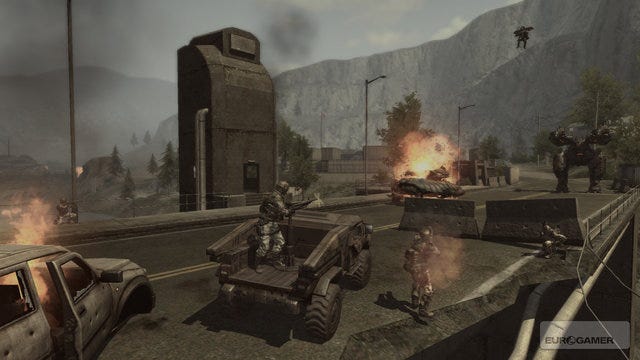
That guy with the machine gun's about 0.5 seconds away from death, trust me.
In one of the more useful tweaks to the console versions, tasks such as bomb-planting, hacking and repairing are now context-sensitive actions, meaning that you can simply walk up to the item and press X rather than having to cycle through your inventory to find a specific tool as you had to on the PC. Elsewhere, the sub-missions that featured in the PC original (such as repairing emplacements and vehicles) have been dropped, allowing you to focus on the main objectives. These minor tweaks go a long way to making the game a lot slicker in the heat of battle, and, yes, more fun. The previous learning curve confusion has been further aided by the inclusion of a tutorial, too - although for some curious reason it only features on the 360 version.
Undoubtedly the most jarring aspect of Quake Wars is that the run-and-gun side of the combat never manages to feel like Quake in any way. Simple machinegun fire (or even pistol fire) is often enough to see off your opponents, even from a distance, and the process of transferring the combat to a battlefield has pushed it in a direction far removed from the brand's rocket-duelling origins.
On the plus side, the game benefits from an array of excellent ground and air vehicles and static units that keep things interesting and enhance the overall strategic depth. GDI forces rely on more conventional tanks, APCs, and hover-copters, but the Strogg tech is altogether more exciting, with jetpack-style Icarus units soaring high into the air to bomb targets from a distance, and gigantic, clanking mech-walkers and insectoid Tormentor aerial attack craft raining death. Careful use of the various anti-air, anti-personnel and anti-vehicle units can often neutralise even the most determined assault with a bit of forethought.
Arguably, the most fun you have with Quake Wars is this process of experimentation as you work though each class and approach each map a slightly different way. With the game's inability to properly tutor you in its hidden depths an undoubted annoyance at first, the payback for sticking with the game is finding out all sorts of evil you can wreak upon your opponent once you explore what's available. It's not a game many people will appreciate in the first few days, but persistence reveals it to be a real slow-burner.
Inevitably, with so many shooters crowding out the console market, it will be the underwhelming first impressions that put many people off. Despite looking pretty solid, the muddy war of attrition isn't as eye-catching as it could be - and certainly compares unfavourably to a steroid-pumped PC game - but you could have guessed that without so much as glancing at a screenshot. The target was to get the 360 version to stand shoulder to shoulder with the 'recommended' PC spec, but fashioning the "Megatexture" tech to the 360's innards without major compromise appears to have been just out of Nerve's reach.
Initially, Quake Wars feels like a solid, regulation port. The controls, despite what you might have heard, feel great, and everything's been thoughtfully mapped for joypad play. But the more you play, the more the little glitches start to add up. Apart from the fact it's vying for the Brownest Game Ever award, you'll also notice a subtle abundance of scenery pop-in, with near-ground grass and bushes routinely appearing mere feet away from you, while often gigantic plumes of smoke suddenly appear from nowhere.
Quake Wars could really benefit from allowing your soldiers to make intelligent use of cover.
As nit-picky as this might sound, we'd probably forgive it if the action was silky smooth and the frame-rate consistent - but it's plainly not. When mass explosions are kicking off, smoke effects can drag the action down to single digits for several seconds. Offline against the bots this won't feel like a major issue, but if you're unlucky enough to fall foul of this online, then the action dips into slideshow territory and it becomes a lottery as to whether you'll stay alive or not.
There's no doubting that all 12 maps are well-designed, reasonably intricate and work perfectly within the relative confines of eight-on-eight multiplayer, but they're intensely boring to look at. Any tech that boasts Megatexture really needs to back such lofty claims with some hard evidence - such as wonderfully lit, stunningly detailed, and interestingly crafted environments that rival the very best out there. Instead, Quake Wars looks very much like everything else. Almost criminally (if you're a Quake fanboy, at least), it's not even sporting the same style as Quake, preferring an overly familiar ragged, gritty military look that a dozen other shooters have managed in the last year alone. That's not to say the game's especially deficient, either, but it's a tired look and feel that doesn't wow in any way.
Where the game fares better is the destructibility of all the vehicle units and deployable artillery, which have been lovingly rendered in a way that's at odds with their vanilla surroundings. These are not only varied in terms of utility, but blessed with a satisfying degree of destructibility, which goes a long way to adding to the game's chaotic ambience.
The biggest question mark we have though is whether there's enough variety to justify positioning this at full price. With just 12 medium-sized maps to flit through and precious little variety in them, the biggest fly in the ointment is a massive amount of repetition and a questionable lack of different modes and customisation options. Unlike so many multiplayer shooters, Quake Wars appears content to merely offer a single, objective-based gameplay mode, where you're either defending or attacking. The main problem is that you tend to find yourself performing the same old tasks, involving generators, bridges, mining lasers, and getting (or preventing) key vehicles reaching to their destination. Sure, the option to switch between the Strogg and GDI and explore the nuances of the unique abilities of the five different classes can put a different spin on the gameplay, but in no time the repetition of the tasks within the maps can't help but chip away at your enthusiasm.
It's always a risk for publishers to try and sell a game based entirely on its multiplayer mode when so many great single-player games ship with a fully fledged online component. If Quake Wars' online offering boasted a richly varied and well-realised experience, you wouldn't even comment on the absence of a convincing single-player mode - but that's plainly not the case. Calling a sequence of bot-matches over all the game's 12 levels a "Campaign" is optimistic, and smacks of "will this do?" To replicate the whole thing with limited customisation options and then call it "Instant Action" is worse. The third mode, Stopwatch, is, again, identical to the main objective-based Campaign mode, only you have to play as GDI in one round, and then play the same map from the Strogg perspective. That all three almost identical gameplay modes exist isn't so much the issue, as the baffling lack of imagination to do anything else with these maps.
Anyone fancy a Strogg fancy dress party? I want a suit like that.
It definitely helps that the game's bots are excellent, but that's no substitute for a compelling online experience. With frame-rate issues already dragging down the offline game at times, the moment the same thing happens online, it's lag central. Once in a while you can probably tolerate it, but when missions involve getting tanks from A to B, and you're being shelled to kingdom come, the whole thing nearly grinds to a halt. Not good. In simple terms, some of the objectives within each map just aren't optimised for online play, and for a game which relies almost entirely on its online prowess, that's a big no-no.
That said, Enemy Territory: Quake Wars is by no means a shoddy product. Despite struggling to make a good first impression, it's one of those games that you find yourself getting more out of the more you invest into it, and hides a surprising amount of depth. The biggest question mark is whether a big enough online community will spring up around it to allow it to fulfill its potential. Sadly, with a fair amount of optimisation issues rearing their heads early on, Quake Wars looks destined to line-up with the also-rans in the online shooter stakes.
6 / 10